
What Does PPI Mean? PPI Meaning: Payment Protection Insurance, Proton Pump Inhibitor, Producer Price Index, and Pixels Per Inch (2026)
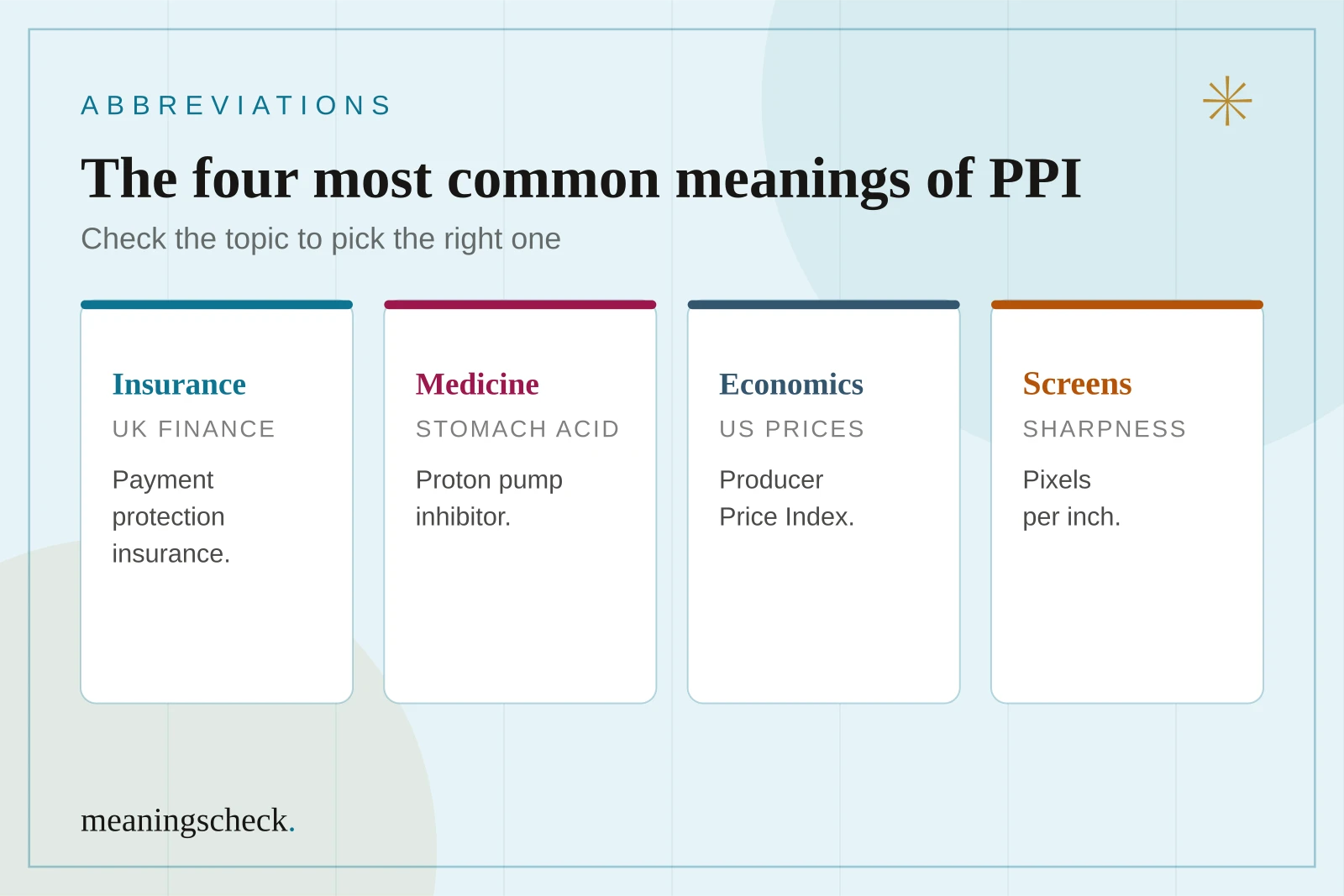
PPI has several meanings that depend on context: payment protection insurance (UK loan cover), proton pump inhibitor (a stomach-acid medicine), producer price index (a US inflation measure), and pixels per inch (screen sharpness).
In this guide24 sections
PPI is an abbreviation with several very different meanings. Which one you need depends on where you saw it. In UK finance, PPI means payment protection insurance. On a medicine label, it means proton pump inhibitor. In economics news, it's the Producer Price Index. On a monitor or phone spec sheet, it's pixels per inch.
That's four fields, four meanings, and one three-letter abbreviation. The good news is that context almost always makes the meaning clear.
If you're asking what does PPI mean, this guide explains each major meaning in plain English. You'll learn the PPI meaning in insurance, medicine, economics, and technology, how to tell them apart, how PPI compares with CPI and DPI, and a few of the less common meanings you might run into.
Key takeaway: PPI = payment protection insurance (UK), proton pump inhibitor (medicine), Producer Price Index (economics), or pixels per inch (displays). Check the context to pick the right one.
This guide is general information. It isn't financial, legal, or medical advice. For decisions about money, health, or medicines, talk to a qualified professional.
Executive Summary: PPI at a Glance
Here's the quick version:
- Payment protection insurance: A UK insurance product sold with loans and credit cards. Famous for a mis-selling scandal.
- Proton pump inhibitor: A medicine that reduces stomach acid. Omeprazole is one example.
- Producer Price Index: A US inflation measure from the Bureau of Labor Statistics (BLS).
- Pixels per inch: A measure of screen sharpness (pixel density).
- Other meanings: Protein–protein interaction, Progressive Policy Institute, picks per inch (textiles), and more.
- Spelled out: People say "P-P-I," one letter at a time.
- Texting: PPI isn't a widely used texting abbreviation. If you see it in a chat, it's probably one of the meanings above.
| PPI Stands For | Field | One-Line Meaning |
|---|---|---|
| Payment protection insurance | UK finance | Insurance sold with loans |
| Proton pump inhibitor | Medicine | Stomach-acid medicine |
| Producer Price Index | Economics | Prices producers receive |
| Pixels per inch | Technology | Screen or image sharpness |
What Does PPI Mean? The Core Definition
The Short Answer: PPI is a three-letter abbreviation with many meanings. The most common are payment protection insurance, proton pump inhibitor, Producer Price Index, and pixels per inch. The field you're reading in tells you which one applies.
Why So Many Meanings?
Short abbreviations get reused. Different industries each invented "PPI" for their own term. Wikipedia's disambiguation page for PPI lists dozens of meanings across science, business, and other uses, including protein–protein interaction, patient and public involvement, picks per inch, and plan position indicator (a type of radar display).
How People Say It
PPI is read as letters: "P-P-I" ("pee-pee-eye"). Some people say "pixels per inch" out loud in tech talk and "producer prices" in economics talk.
How to Tell Which PPI Someone Means
The Short Answer: Look at the topic and the words around it. Loans, banks, or refunds point to payment protection insurance. Stomach, acid, or prescriptions point to proton pump inhibitors. Inflation or prices point to the Producer Price Index. Screens, photos, or phones point to pixels per inch.
| Clue Words | Likely Meaning of PPI |
|---|---|
| loan, credit card, bank, refund, claim, mis-sold | Payment protection insurance |
| heartburn, acid reflux, stomach, omeprazole, GP | Proton pump inhibitor |
| inflation, producers, prices, BLS, economy | Producer Price Index |
| screen, display, phone, resolution, monitor, image | Pixels per inch |
| radar, textile, protein, policy | Other meanings (see below) |
A Quick Test
If you're unsure, ask: "Is this about money, health, the economy, or a screen?" That narrows it to one of the four.
PPI in Finance: Payment Protection Insurance (UK)
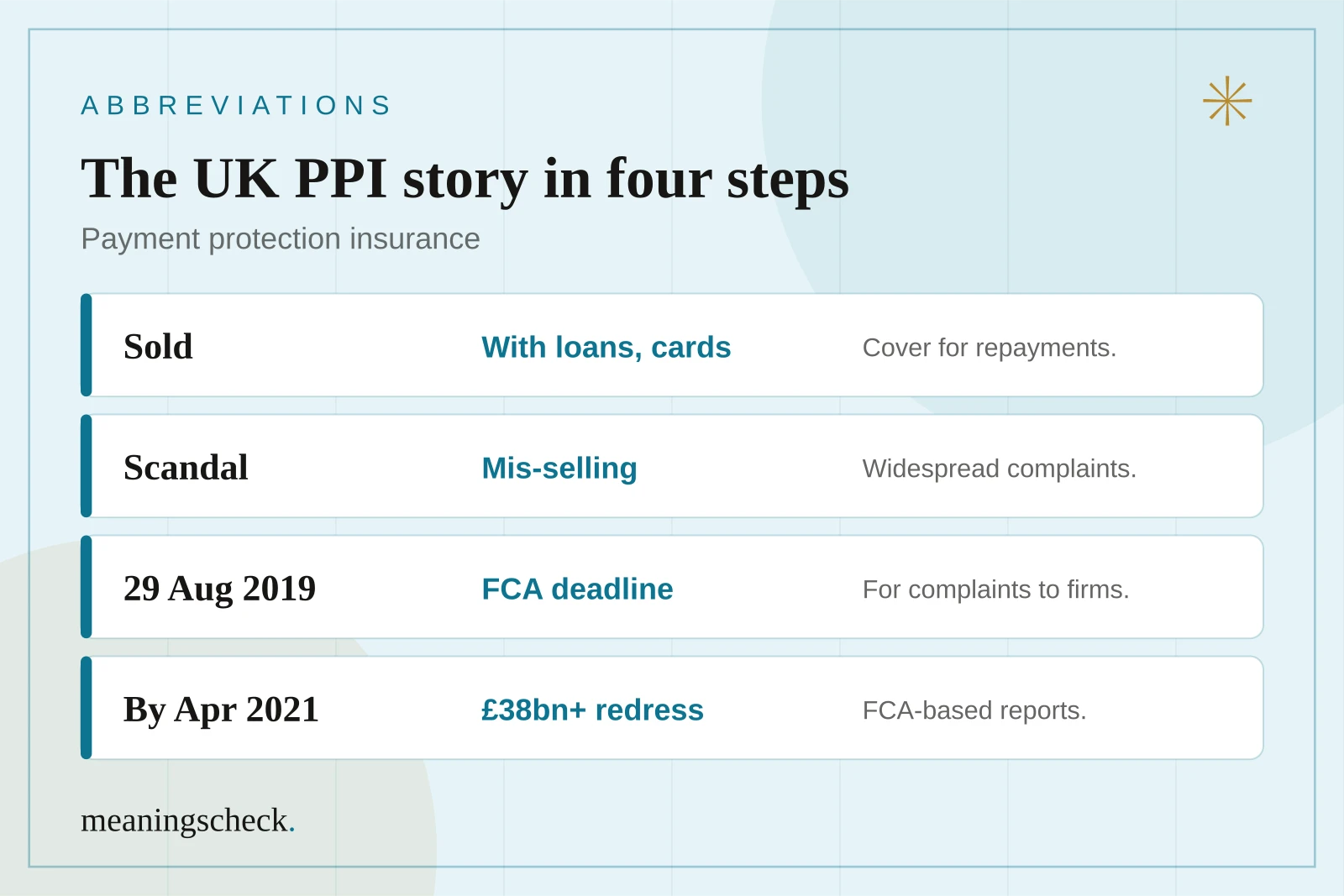
The Short Answer: In the UK, PPI means payment protection insurance, a policy often sold alongside loans and credit cards to cover repayments if the borrower couldn't pay, for example after illness or job loss. PPI became known for a huge mis-selling scandal, and the main complaints deadline passed on 29 August 2019.
General information only — not financial or legal advice.
What It Was Meant to Do
Payment protection insurance was designed to cover your loan or credit card repayments if something went wrong, such as an accident, illness, or redundancy. It was typically sold with personal loans, credit cards, and mortgages.
Why It Became Famous
Many people were sold PPI they didn't need, couldn't claim on, or didn't know they had. This became known as the PPI mis-selling scandal in the UK. Banks and lenders paid out huge sums in refunds. According to figures reported from the Financial Conduct Authority (FCA), redress passed £38 billion by April 2021. The FCA is the UK's financial regulator.
The Deadline
The FCA set a deadline of 29 August 2019 for making PPI complaints to the firm that sold the policy. Reports note that this deadline applies to complaints to firms, not to court action, which has its own rules. If you think you have an unresolved PPI issue, get advice from the Financial Ombudsman Service, Citizens Advice, or the FCA.
Beware of PPI Claim Scams
For years, unsolicited calls, texts, and emails offered to "get your PPI refund." Because the main deadline has passed, treat these with strong suspicion:
- Never pay upfront fees to a stranger who contacts you.
- Don't share bank details with someone who called you.
- Hang up and contact your lender directly using a number you trust.
- Report scams to the proper UK authorities.
| Fact | Detail |
|---|---|
| What it is | Insurance sold with loans and cards |
| Where | The UK |
| Scandal | Mis-selling to millions |
| Regulator | Financial Conduct Authority (FCA) |
| Complaints deadline | 29 August 2019 |
| Redress | Over £38 billion (by April 2021, per FCA-based reports) |
Key takeaway: UK PPI was a loan-repayment insurance product. The main complaints deadline passed on 29 August 2019. Unsolicited "PPI refund" offers today deserve suspicion.
Money terms differ by country. For another UK-specific term, see our Direct Earnings Attachment meaning guide, which explains a government wage-deduction rule.
PPI vs. Other Insurance
| Insurance | What It Covers |
|---|---|
| Payment protection insurance (PPI) | Loan or card repayments |
| Income protection | A share of your income if you can't work |
| Life insurance | A payout to your family after death |
| Car insurance | Vehicle damage, liability, and more |
Car insurance is a different product, though drivers face their own insurance questions, as our OWI meaning guide explains.
PPI in Medicine: Proton Pump Inhibitor
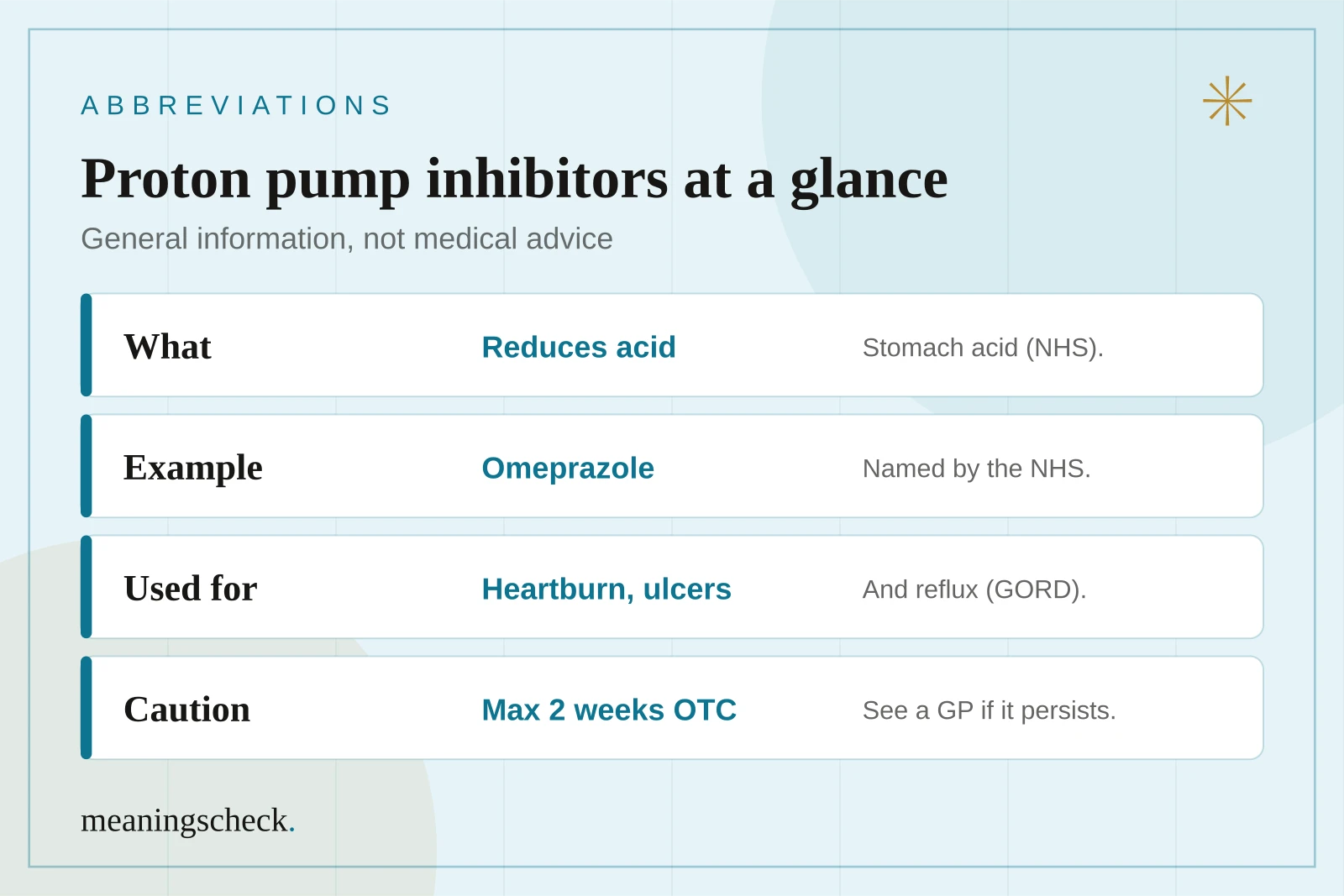
The Short Answer: In medicine, PPI means proton pump inhibitor, a type of medicine that reduces the amount of acid in the stomach. The NHS describes omeprazole as "a medicine called a proton pump inhibitor (PPI)." PPIs are used for heartburn, acid reflux, and stomach ulcers.
General information only — not medical advice. Talk to a doctor or pharmacist about any medicine.
What PPIs Do
Proton pump inhibitors lower stomach acid. According to the NHS, omeprazole is "a medicine called a proton pump inhibitor (PPI). It reduces the amount of acid in your stomach."
What They Treat
The NHS lists these uses for omeprazole:
- Stomach ulcers
- Heartburn
- Gastro-oesophageal reflux disease (GORD) — the UK spelling of GERD
- Helicobacter pylori infection, together with antibiotics
Safety Notes From the NHS
The NHS page on omeprazole says:
- "Do not take omeprazole for longer than 2 weeks if you bought it without a prescription."
- "See a GP if your symptoms get worse or do not get better."
- Serious side effects are more likely with long-term use, described as a year or more.
Key takeaway: A medical PPI is a class of acid-reducing medicine. Follow the label and your doctor's advice, especially on how long to take it.
When You See "PPI" at the Pharmacy
PPI is a drug class, not a single drug. Omeprazole is one example. Other medicines in this group have different names, and a pharmacist can tell you which ones apply to you.
| Fact | Detail |
|---|---|
| What it is | A class of acid-reducing medicine |
| Example | Omeprazole (per the NHS) |
| Used for | Ulcers, heartburn, reflux (GORD) |
| Key caution | Don't use over-the-counter versions for more than 2 weeks without medical advice |
| Who to ask | A doctor or pharmacist |
Don't Self-Diagnose Long-Term Heartburn
Persistent heartburn can have different causes. If symptoms keep returning or get worse, see a healthcare professional instead of treating them yourself for a long time.
PPI in Economics: Producer Price Index
The Short Answer: In economics, PPI means the Producer Price Index. The US Bureau of Labor Statistics describes it as "a family of indexes that measures the average change over time in selling prices received by domestic producers of goods and services." It looks at prices from the seller's side.
What the BLS Says
The Bureau of Labor Statistics (BLS), part of the US Department of Labor, publishes the PPI. Its official description: the PPI "is a family of indexes that measures the average change over time in selling prices received by domestic producers of goods and services."
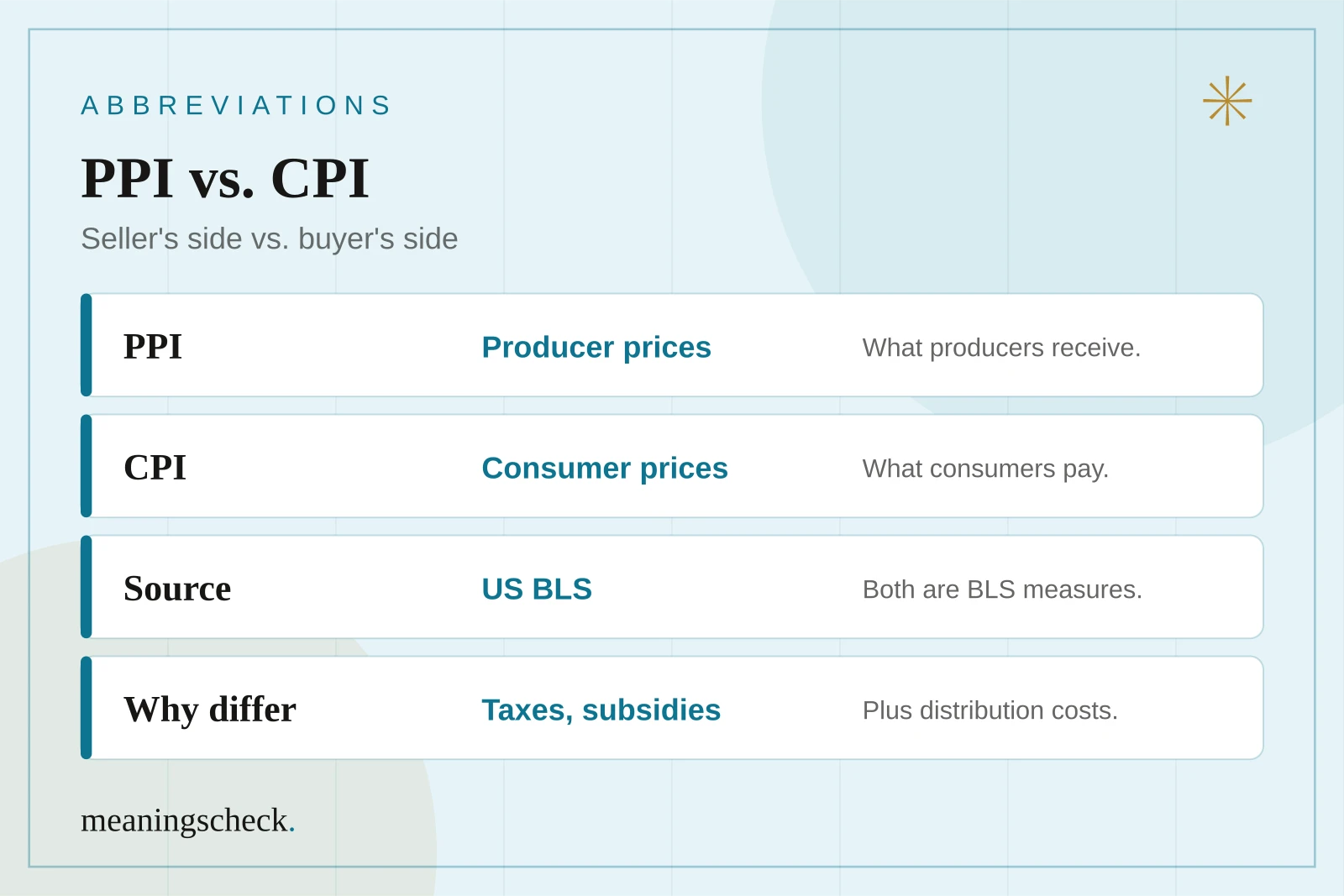
PPI vs. CPI
The Consumer Price Index (CPI) measures what consumers pay. The PPI measures what producers receive. The BLS notes that these can differ because of "government subsidies, sales and excise taxes, and distribution costs."
| Index | Measures Prices From the... | Question It Answers |
|---|---|---|
| PPI (Producer Price Index) | Seller's side | What are producers getting paid? |
| CPI (Consumer Price Index) | Buyer's side | What are consumers paying? |
How It's Collected and Published
According to the BLS:
- For most items, businesses report selling prices for the Tuesday of the week containing the 13th of each month.
- The PPI is usually published during the second full week of the month following that reference date.
- About 10,000 PPIs are released each month.
- The sample covers over 16,000 establishments.
Why People Care
Economists, businesses, and journalists watch PPI to see price pressures building before they reach shoppers. Rising producer prices can signal that consumer prices may follow, though the link isn't always direct.
| Fact | Detail |
|---|---|
| Published by | US Bureau of Labor Statistics |
| Measures | Selling prices received by domestic producers |
| Frequency | Monthly |
| Reference date | Tuesday of the week containing the 13th |
| Release timing | Usually the second full week of the following month |
| Compare with | CPI (what consumers pay) |
Key takeaway: The Producer Price Index tracks the prices producers receive. The Consumer Price Index tracks the prices consumers pay.
PPI in Technology: Pixels Per Inch
The Short Answer: In technology, PPI means pixels per inch, a measure of how many pixels fit in one inch of a screen or image. Higher PPI means a sharper image. Wikipedia defines it as "a measurement of the pixel density of an electronic image device."
What It Measures
Pixels per inch (PPI) tells you how densely packed the pixels on a screen are. More pixels in the same space means sharper text and images.
The Formula
For a monitor, PPI is the diagonal length in pixels divided by the diagonal length in inches. The diagonal in pixels comes from the Pythagorean theorem: the square root of (width in pixels squared plus height in pixels squared).
Examples (From Wikipedia)
| Example | PPI |
|---|---|
| 1920 pixels across a 20-inch-wide monitor | 96 ppi |
| A 21.5-inch 1920 × 1080 screen | About 102 ppi |
| A 100 × 100 pixel image printed in a 2-inch square | 50 ppi |
How Sharp Is Sharp Enough?
Wikipedia notes that the unaided human eye generally can't see detail beyond about 300 PPI. This depends on viewing distance. A phone held close needs a higher PPI to look sharp than a billboard seen from far away.
PPI vs. DPI
People often mix these up:
| Term | Stands For | Where It Applies |
|---|---|---|
| PPI | Pixels per inch | Screens and digital images |
| DPI | Dots per inch | Printers and printing |
A pixel is a single sample of any color. A printer's dot is a specific color of ink. That's why the two terms aren't identical, though people often use them interchangeably.
Why It Matters
- Phones and tablets: Higher PPI makes text crisper.
- Monitors: Higher PPI helps with detailed work, such as photo editing.
- Printing photos: Higher-resolution images look sharper in print.
Common Mistake: Resolution Isn't PPI
Resolution (like 1920 × 1080) is the total pixel count. PPI is how those pixels spread across a physical size. The same resolution on a bigger screen means lower PPI.
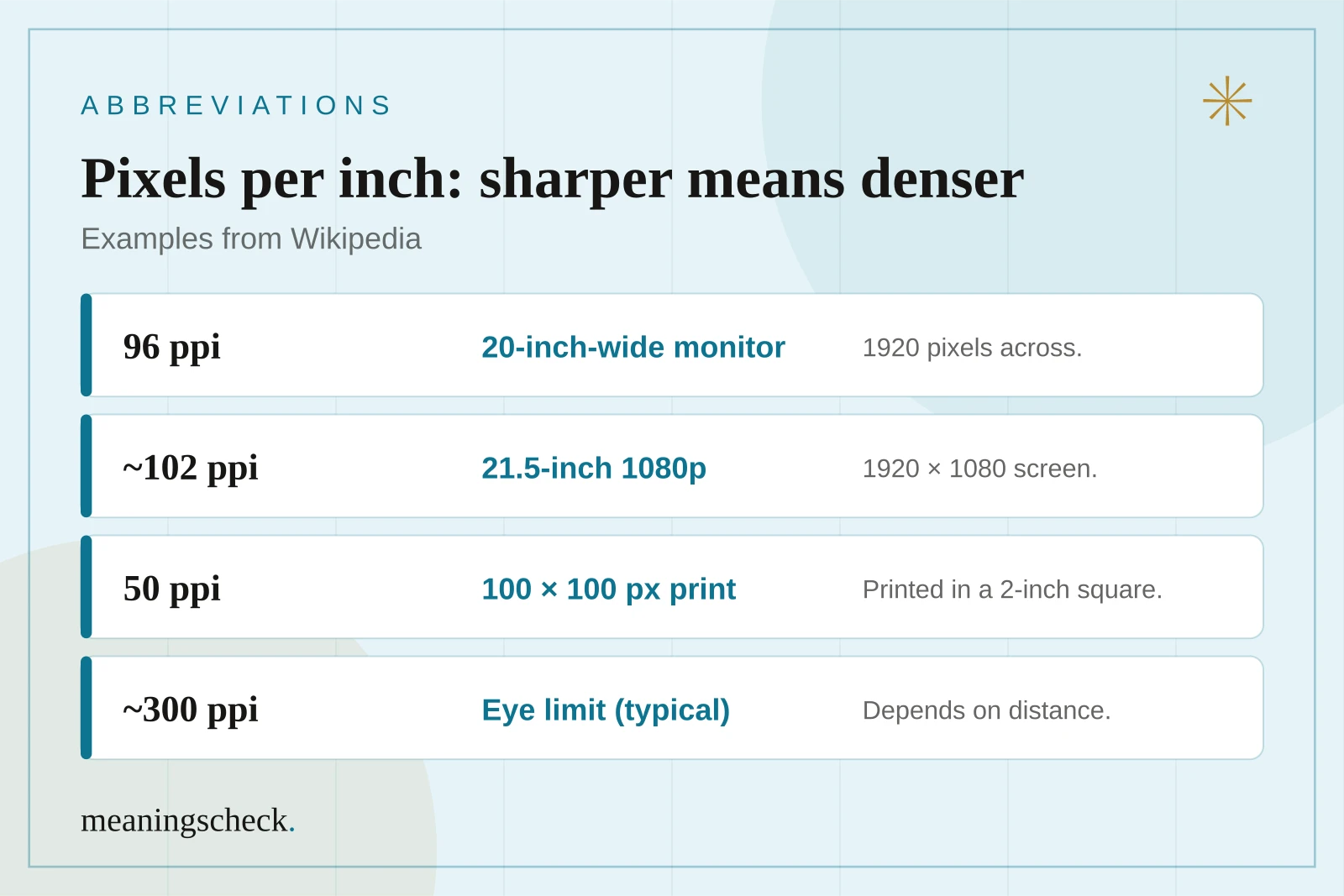
Photo Printing Math: How Many Pixels Do You Need?
The Short Answer: Multiply the print size in inches by the PPI you want. Wikipedia's formula is "Number of pixels = Size in inches × PPI." For a 6 × 4 inch print at 300 PPI, you need 1,800 × 1,200 pixels.
The Formula
Number of pixels = size in inches × PPI. Wikipedia gives this simple rule, and you can use it for any image.
Worked Examples
| Print Size | PPI Target | Pixels Needed |
|---|---|---|
| 6 × 4 inches | 300 | 1,800 × 1,200 |
| 5 × 7 inches | 300 | 1,500 × 2,100 |
| 8 × 10 inches | 300 | 2,400 × 3,000 |
| 8 × 10 inches | 150 | 1,200 × 1,500 |
What the Table Shows
Higher PPI needs more pixels for the same print size. A lower PPI works for pictures viewed from farther away, because the eye can't see as much fine detail at a distance.
Quick Tips
- Check your photo's pixel size before printing.
- Don't stretch small images. They look blurry.
- Use the print shop's guidance. Services have their own recommended settings.
How to Choose a Screen: What PPI Do You Need?
The Short Answer: Higher PPI gives sharper text, especially on screens you hold close, like phones. Wikipedia notes that the unaided human eye generally can't see detail beyond about 300 PPI, and that depends on viewing distance. For most people, screen size and viewing distance matter as much as the PPI number.
Distance Changes Everything
A phone is usually held close. Extra pixel density helps there. A TV is viewed from across the room. A lower PPI can still look sharp.
Using the Formula
You can work out PPI for any screen:
- Diagonal in pixels = the square root of (width² + height²).
- Divide by the diagonal in inches.
For a 21.5-inch 1920 × 1080 monitor, Wikipedia gives about 102 PPI.
| Device Type | Typical Viewing Distance | PPI Matters |
|---|---|---|
| Phone | Close | More |
| Tablet | Close to medium | More |
| Laptop | Medium | Medium |
| Desktop monitor | Medium | Medium |
| TV | Far | Less |
Don't Compare PPI Alone
Panel quality, brightness, color accuracy, and refresh rate also shape what a screen looks like. PPI is one useful number among several.
How to Read a Producer Price Index Report
The Short Answer: A PPI report shows how selling prices changed. A positive monthly change means producers' prices rose on average. A negative change means they fell. Read the percent change and the time period, and remember that one month can be noisy.
The Basics
When a news story says "PPI rose 0.2 percent," it means the average selling price producers received increased by 0.2 percent from the previous month. These numbers are illustrations, not real data.
What to Look For
- Direction: Up or down?
- Size: A small or large change?
- Period: Month over month or year over year?
- Context: One month can mislead. Trends tell more.
Illustrative Example
| Scenario | What It Might Suggest |
|---|---|
| PPI rises for several months | Producers face higher costs or stronger demand |
| PPI falls for several months | Producers face weaker demand or lower costs |
| PPI is flat | Producer prices are stable |
These are general interpretations. Economists look at many other measures to understand inflation.
Where to Find It
The BLS publishes the PPI on its website. The BLS home page lists the next release date. You can plan around it.
Questions to Ask a Pharmacist About a PPI
The Short Answer: Ask why you're taking it, how long to take it, when to stop, what side effects to watch for, and whether it affects other medicines you take. Don't buy over-the-counter versions for longer than the label allows without checking with a professional.
General information only — not medical advice.
If you've been prescribed or are considering a proton pump inhibitor, these questions can help:
- What am I taking this for?
- How long should I take it? The NHS warns against taking omeprazole bought without a prescription for longer than 2 weeks.
- What side effects should I watch for?
- Could it interact with my other medicines?
- What should I do if symptoms return?
- When should I see a doctor? The NHS says to see a GP if symptoms get worse or don't improve.
Bring a List
Write down every medicine and supplement you take. A pharmacist can check for problems you might not think about.
A Quick Checklist for PPI Refund Scams
The Short Answer: Be suspicious of any unsolicited call, text, or email offering to recover a PPI refund. Don't pay upfront, don't share bank details, and verify through your lender or the FCA. The main complaints deadline passed in 2019.
Warning Signs
| Warning Sign | Why It's Suspicious |
|---|---|
| Unexpected call or text | Legitimate firms rarely cold-call about old PPI |
| Demand for an upfront fee | Real complaints to lenders don't require paying a stranger |
| Pressure to act fast | Scammers create urgency |
| Request for bank or card details | Never share these with an unsolicited caller |
| Vague about who they are | Real firms identify themselves clearly |
What to Do
- Stop the conversation. Hang up or delete the message.
- Contact your lender directly using a number from a trusted source.
- Check the FCA (the UK financial regulator) for guidance and firm checks.
- Report the scam to UK authorities.
- Tell family and friends, especially older relatives.
Other Meanings of PPI
The Short Answer: PPI also stands for protein–protein interaction, patient and public involvement, prepulse inhibition, picks per inch (textiles), plan position indicator (radar), and organizations like the Progressive Policy Institute. These come from specialized fields.
According to Wikipedia's disambiguation page for PPI, other meanings include:
Science and Technology
| Meaning | Field |
|---|---|
| Protein–protein interaction | Biology |
| Patient and public involvement | Health research |
| Prepulse inhibition | Neuroscience |
| Picks per inch | Textiles (weaving) |
| Plan position indicator | Radar displays |
| Programmable Peripheral Interface | Computer hardware |
| Psychopathic Personality Inventory | Psychology |
Organizations and Other Uses
| Meaning | Notes |
|---|---|
| Progressive Policy Institute | A US think tank |
| Italian People's Party (Partito Popolare Italiano) | Political party |
| Pakistan Press International | News agency |
| Pirate Parties International | Political organization |
| Port Pirie Airport (IATA code) | Airport |
| Pulse Polio | Indian immunization campaign |
Where You Might Meet These
Most people never see these meanings outside their specialty. If you work in biology, textiles, or policy, your own PPI is probably one of these.
PPI vs. CPI, DPI, and Similar Abbreviations
The Short Answer: PPI is often confused with CPI (consumer prices), DPI (dots per inch), and PPE (protective equipment). Each has its own meaning. CPI and PPI are both price indexes. DPI and PPI both relate to image sharpness.
| Abbreviation | Stands For | Field |
|---|---|---|
| PPI | Pixels per inch / Producer Price Index / more | Varies |
| CPI | Consumer Price Index | Economics |
| DPI | Dots per inch | Printing |
| ppi (lowercase) | Pixels per inch | Tech specs |
| PPE | Personal protective equipment | Safety |
| PPO | Preferred provider organization | Health insurance |
Lowercase vs. Uppercase
In tech, people often write ppi in lowercase for pixels per inch. In economics and finance, PPI in capitals is standard.
Abbreviations With Many Meanings
PPI isn't unusual. Many short abbreviations have several meanings. For instance, "DW" means "don't worry" in texts but "dishwasher" in rental listings, as our DW meaning guide explains. And "MO" can mean "modus operandi" or "Missouri," as our MO meaning guide shows.
PPI Examples in Sentences
The Short Answer: Each PPI meaning has its own typical sentence. Insurance: "She reclaimed her mis-sold PPI." Medicine: "He takes a PPI for heartburn." Economics: "The PPI rose 0.2 percent." Tech: "The phone has a high PPI."
Payment Protection Insurance
- "She was sold PPI with her loan and never needed it."
- "The PPI complaints deadline passed in August 2019."
Proton Pump Inhibitor
- "The doctor prescribed a PPI for reflux."
- "Omeprazole is a PPI."
Producer Price Index
- "Economists are watching the next PPI report."
- "Rising PPI can hint at future price increases."
Pixels Per Inch
- "This display has a PPI of about 100."
- "Print the image at 300 PPI for sharp results."
Expert Insights: Why One Abbreviation Means So Many Things
The Short Answer: Three-letter abbreviations are efficient. Every field reuses them. That creates "collisions." Writers can avoid confusion by spelling out the full term on first use, and readers can avoid mistakes by checking the context.
Abbreviations Collide
There are only so many three-letter combinations. Doctors, economists, banks, and engineers all create abbreviations for their own terms. Eventually, they overlap.
Context Is the Disambiguator
Experts rarely mistake the PPI in a financial article for a PPI in a medical journal. Surrounding words give it away.
Best Practice for Writers
Spell out the full term the first time, then use the abbreviation: "Producer Price Index (PPI)." This helps readers who work in other fields.
Best Practice for Readers
When an abbreviation looks unfamiliar, search it with a topic word: "PPI insurance," "PPI medicine," "PPI economics," or "PPI screens."
Real-World Patterns of PPI
- Consumers (UK): "Did I have PPI?"
- Patients: "My doctor put me on a PPI."
- Economists: "PPI came in hotter than expected."
- Designers: "What's the PPI of this display?"
PPI Across Fields: Who Uses Which Meaning?
The Short Answer: UK consumers and journalists use PPI for payment protection insurance. Doctors and pharmacists use it for proton pump inhibitors. Economists and financial media use it for the Producer Price Index. Designers and gadget reviewers use it for pixels per inch.
| Group | Typical PPI |
|---|---|
| UK consumers | Payment protection insurance |
| Doctors and pharmacists | Proton pump inhibitor |
| Economists and traders | Producer Price Index |
| Designers and photographers | Pixels per inch |
| Textile workers | Picks per inch |
| Radar engineers | Plan position indicator |
Real-World Examples: PPI in Everyday Conversations
The Short Answer: You'll hear PPI at the bank, the pharmacy, in business news, and in tech shops. These typical scenarios show what each speaker means.
These are typical patterns, not quotes from real people.
At Home (UK)
Relative: "Did Dad ever get his PPI sorted?"
What it means: Payment protection insurance, probably a past complaint or refund.
At the Doctor's Office
Patient: "Should I stay on the PPI?"
What it means: Proton pump inhibitor. The doctor or pharmacist can answer.
On the Business News
Anchor: "Producer prices, or PPI, will be released Thursday."
What it means: The Producer Price Index report.
In an Electronics Store
Shopper: "What's the PPI on this tablet?"
What it means: Pixels per inch, or how sharp the screen is.
| Setting | PPI Signals |
|---|---|
| Family chat (UK) | Payment protection insurance |
| Clinic | Proton pump inhibitor |
| Business news | Producer Price Index |
| Tech shop | Pixels per inch |
A Useful Habit
When someone says "PPI" and you're unsure, ask: "Which PPI?" Nobody minds the question, and it saves confusion.
All Four PPI Meanings Side by Side
The Short Answer: One table can hold the whole picture: what each PPI is, who uses it, and the main fact to remember.
| Meaning | Who Uses It | Main Fact |
|---|---|---|
| Payment protection insurance | UK consumers, regulators | FCA complaints deadline: 29 August 2019 |
| Proton pump inhibitor | Doctors, pharmacists, patients | Reduces stomach acid; example omeprazole |
| Producer Price Index | Economists, journalists | BLS measure of prices producers receive |
| Pixels per inch | Designers, gadget reviewers | Pixel density; higher looks sharper |
How to Explain PPI to Someone Who Doesn't Know
The Short Answer: Say: "PPI is a short form that means different things in different areas: an insurance product in the UK, a type of stomach medicine, an economic price measure, or how sharp a screen is."
- "PPI has more than one meaning."
- "In UK money talk, it's payment protection insurance."
- "At the doctor, it's a stomach-acid medicine."
- "In the news, it's the Producer Price Index."
- "On a phone, it's pixels per inch."
If you ever want the short version of a long explanation, a quick summary line helps, a habit our TLDR meaning guide explains.
Quick Quiz: Which PPI Is It?
The Short Answer: Match each sentence to its PPI meaning. Look for clue words like "loan," "heartburn," "inflation," or "screen."
| Sentence | PPI Meaning |
|---|---|
| "The bank refunded her mis-sold PPI." | Payment protection insurance |
| "My GP prescribed a PPI for acid reflux." | Proton pump inhibitor |
| "The PPI report showed producer prices rising." | Producer Price Index |
| "A higher PPI makes text look sharper." | Pixels per inch |
| "The radar's PPI display showed the storm." | Plan position indicator |
| "Researchers studied a protein–protein PPI." | Protein–protein interaction |
If you got all six, you can read PPI in any context.
Common Mistakes People Make With PPI
The Short Answer: The biggest mistakes are assuming PPI has only one meaning, confusing PPI with DPI or CPI, treating PPI medicines as risk-free, and responding to unsolicited PPI refund calls.
- Assuming there's one meaning. Check the context.
- Mixing up PPI and DPI. Pixels vs. printer dots.
- Mixing up PPI and CPI. Producers vs. consumers.
- Taking over-the-counter PPI medicine for too long. Follow label and NHS-style guidance, and ask a professional.
- Trusting unsolicited PPI refund offers. The main UK deadline passed in 2019.
Frequently Asked Questions (FAQs)
What does PPI mean?
PPI can mean payment protection insurance, proton pump inhibitor, Producer Price Index, or pixels per inch. The topic tells you which one.
What does PPI mean in the UK?
In UK finance, PPI means payment protection insurance, a policy sold with loans and cards that became the subject of a mis-selling scandal.
What is the PPI deadline?
The FCA set 29 August 2019 as the deadline for making PPI complaints to the firm that sold the policy. Court claims have separate rules. Get advice if you have an unresolved case.
What does PPI mean in medicine?
It means proton pump inhibitor, a medicine that reduces stomach acid. Omeprazole is an example, according to the NHS.
What does PPI mean in economics?
It means the Producer Price Index, which measures the average change in selling prices received by domestic producers, according to the US Bureau of Labor Statistics.
What does PPI mean for screens?
It means pixels per inch, the pixel density of a display or image. Higher PPI looks sharper.
What's the difference between PPI and CPI?
PPI measures prices from the seller's side. CPI measures prices consumers pay.
What's the difference between PPI and DPI?
PPI applies to screens and digital images. DPI refers to dots on a printed page.
Is PPI a texting abbreviation?
Not commonly. If you see it in a message, it likely refers to one of the meanings above.
Final Thoughts
PPI is a perfect example of how one abbreviation can lead several lives. To a UK borrower, it's an insurance policy and a scandal. To a patient, it's a stomach-acid medicine. To an economist, it's a monthly price report. To a designer, it's a measure of screen sharpness.
Whenever you see "PPI," pause and check the topic. That one habit makes almost every abbreviation easier to read.
For more abbreviations explained clearly, explore our abbreviation guides.
Related terms
Share: · Post on X
Written by MeaningsCheck Team · Published
The MeaningsCheck team researches and writes plain-language explanations of slang, abbreviations, and everyday words — checked for accuracy, updated as language changes.