
What Does Ubiquitous Mean? Ubiquitous Definition, Pronunciation, Examples, and Synonyms (2026)
Ubiquitous means existing or seeming to be everywhere at the same time — constantly encountered or widespread, as in "Smartphones are ubiquitous." It comes from the Latin ubique, meaning "everywhere." The noun form is ubiquity.
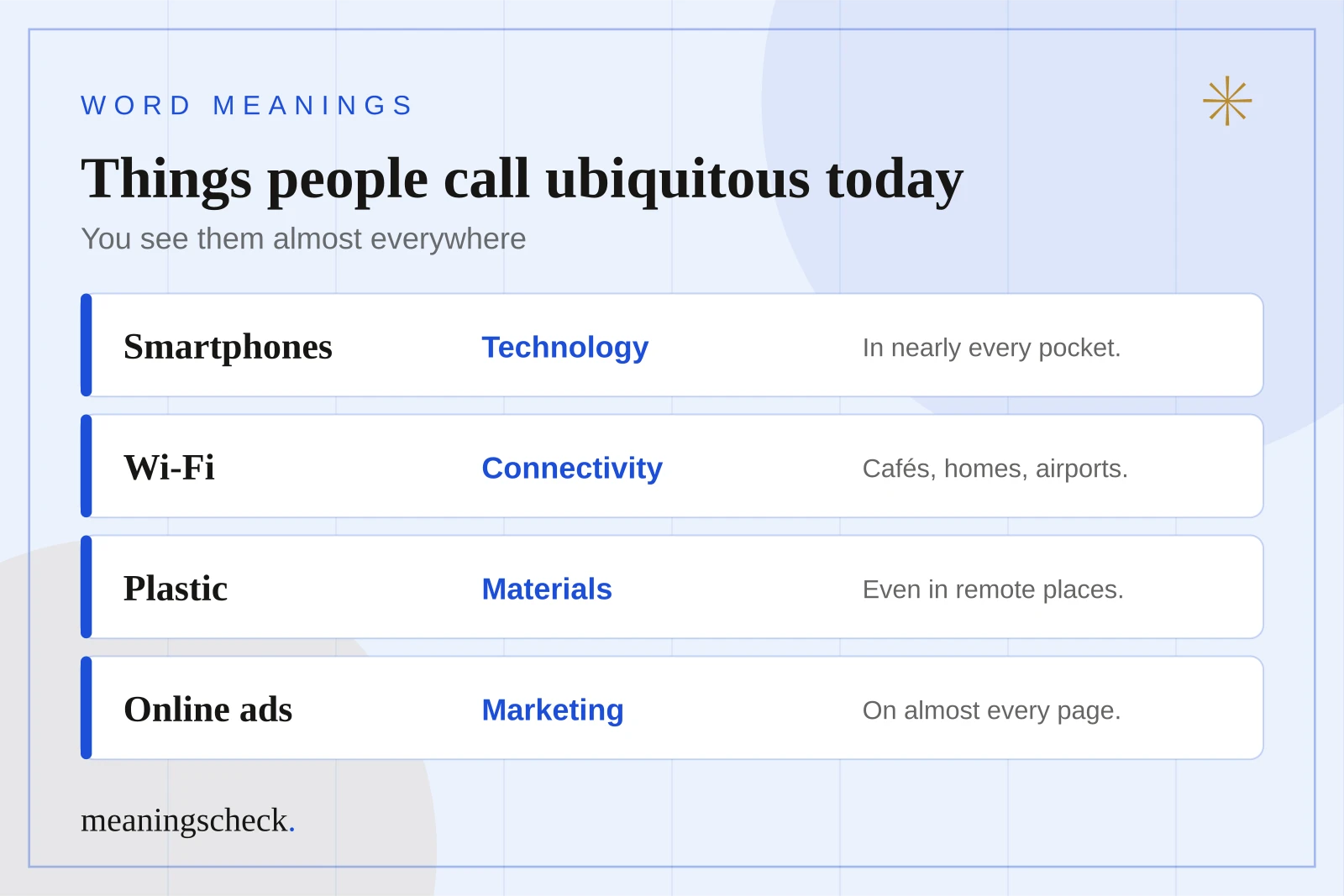
Ubiquitous means seeming to be everywhere at once. If something is ubiquitous, you run into it constantly. Smartphones, Wi-Fi, and coffee shops are classic examples. You can hardly walk down a street without seeing one.
It's a fancy word for a simple idea: everywhere. And like the things it describes, it shows up all over — in news articles, business reports, and essays.
If you're wondering what does ubiquitous mean, this guide covers it all. You'll get the ubiquitous definition, how to pronounce ubiquitous, where it comes from, real ubiquitous examples, synonyms and antonyms, and how it compares to omnipresent, pervasive, and prevalent.
Key takeaway: Ubiquitous = found everywhere, constantly encountered. "Smartphones are ubiquitous" means you see them everywhere you go.
Executive Summary: Ubiquitous at a Glance
Here's the quick version:
- Meaning: Existing or seeming to be everywhere at the same time; constantly encountered; widespread.
- Pronunciation: yoo-BIK-wih-tus.
- Part of speech: Adjective.
- Noun form: Ubiquity. Adverb: ubiquitously.
- Origin: Latin ubique, "everywhere." Merriam-Webster dates ubiquitous to 1772.
- Synonyms: Omnipresent, pervasive, widespread, common, universal.
- Antonyms: Rare, scarce, uncommon, sparse.
- Famous phrase: Ubiquitous computing — technology woven into everyday surroundings.
What Does Ubiquitous Mean? The Core Definition
The Short Answer: Ubiquitous means "existing or being everywhere at the same time," according to Merriam-Webster. In everyday use, it means "constantly encountered" or "widespread." When people call something ubiquitous, they mean you see it so often it feels like it's everywhere.
The Dictionary Definition
Merriam-Webster defines ubiquitous as "existing or being everywhere at the same time" and also "constantly encountered" or "widespread."
Literal vs. Everyday Use
Strictly speaking, almost nothing is truly everywhere at once. In real life, people use ubiquitous more loosely. It describes things you keep running into:
- "Smartphones are ubiquitous."
- "Those ads were ubiquitous on TV this year."
- "Coffee shops are ubiquitous downtown."
Merriam-Webster notes this looser use is common: writers often apply it to things that just seem to pop up constantly.
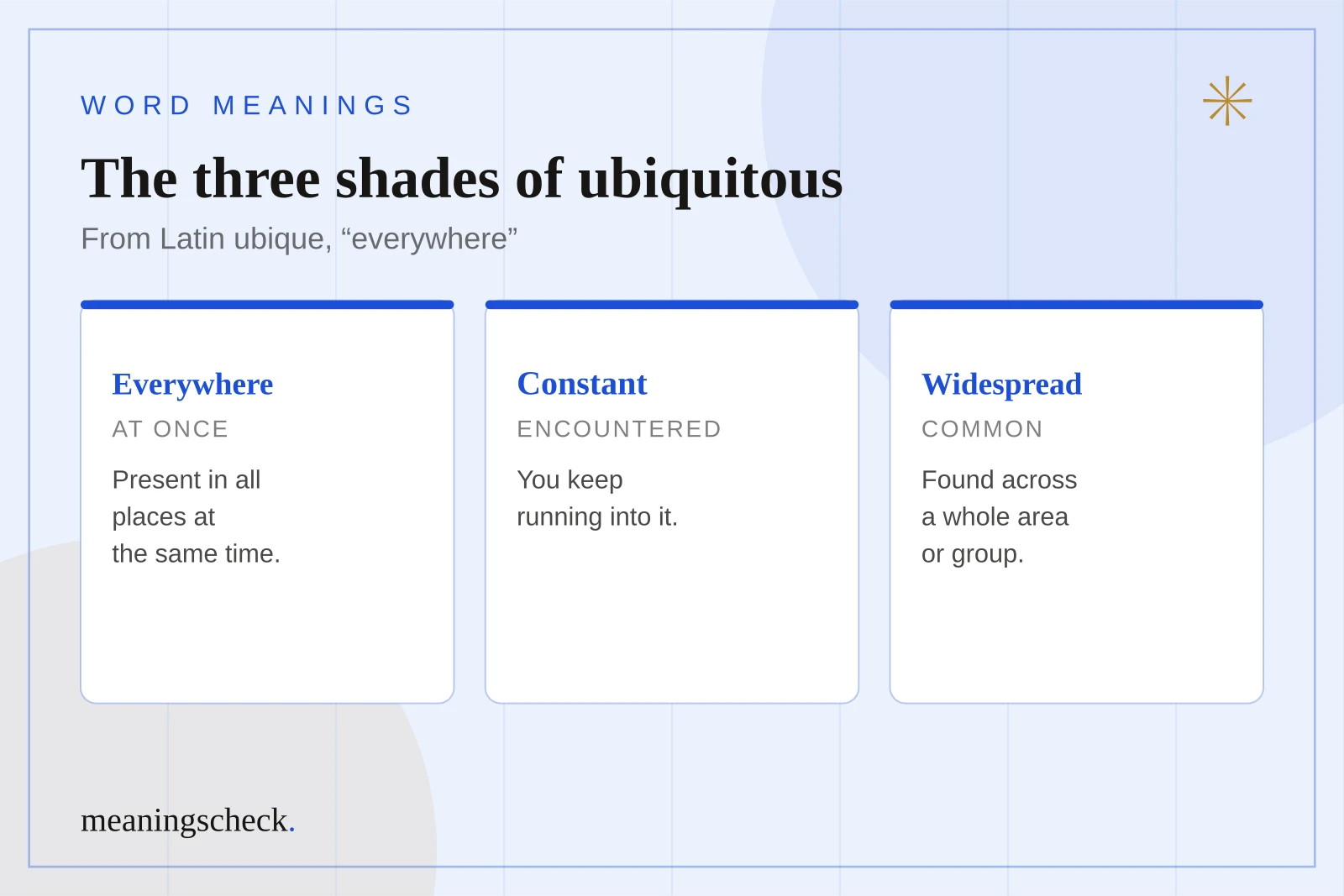
Three Shades of Meaning
| Shade | Meaning | Example |
|---|---|---|
| Everywhere at once | Literally present in all places | "the ubiquitous air around us" |
| Constantly encountered | You keep seeing it | "a ubiquitous pop song" |
| Widespread | Very common across an area or group | "ubiquitous Wi-Fi in the city" |
How Do You Pronounce Ubiquitous?
The Short Answer: Ubiquitous is pronounced "yoo-BIK-wih-tus," with the stress on the second syllable. The "qu" sounds like "kw," as in "quick." The noun ubiquity is pronounced "yoo-BIK-wih-tee."
The word has four syllables: u-biq-ui-tous.
| Syllable | Sounds Like |
|---|---|
| u | "yoo" |
| biq | "BIK" (stressed) |
| ui | "wih" |
| tous | "tus" |
Common Pronunciation Mistakes
- "oo-BIK-wih-tus" — it starts with a "y" sound: "yoo."
- "yoo-bih-KWEE-tus" — the stress belongs on "BIK."
- "yoo-BIK-wis" — don't skip the "tus" ending.
A memory trick: think "you" + "big" + "quit" + "us" — said quickly, it's close.
Where Does the Word Ubiquitous Come From?
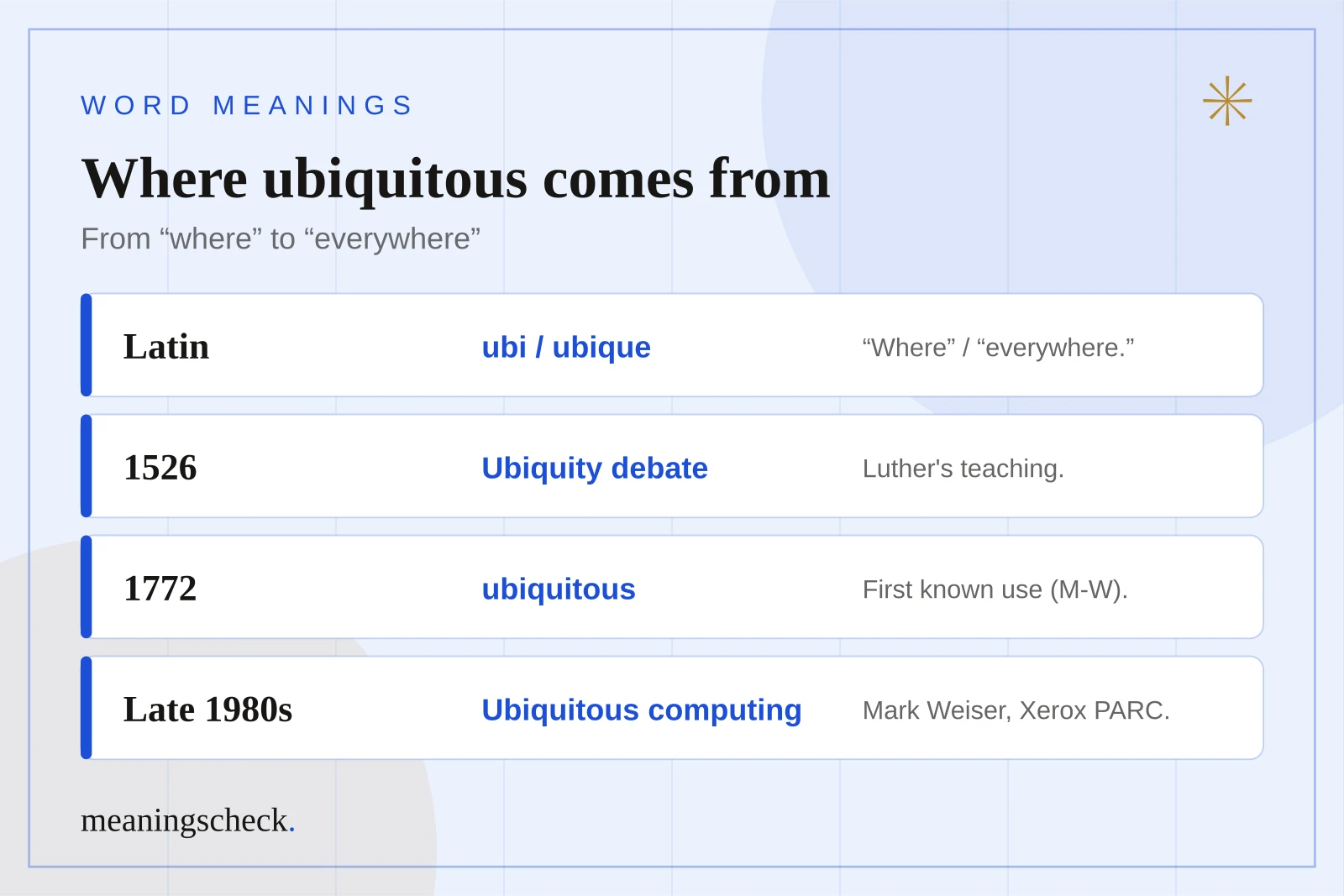
The Short Answer: Ubiquitous comes from the Latin ubique, meaning "everywhere," built from ubi ("where"). The noun ubiquity grew out of 16th-century religious debates about whether Christ's body could be present everywhere. Merriam-Webster dates the adjective ubiquitous to 1772.
The Latin Root
The core is Latin ubique, "everywhere." It's built from ubi, meaning "where." You might know ubi from the old literary phrase "ubi sunt" ("where are they?").
A Theological Start
The noun ubiquity first gained attention in religious debates. During the Reformation, Martin Luther argued that Christ's body could be present wherever the Eucharist was celebrated. He set out this teaching in a 1526 sermon. The idea became known as the doctrine of ubiquity, and it was written into a Lutheran creed at the Synod of Stuttgart in 1559, according to the Schaff-Herzog religious encyclopedia.
From Church to Everyday Life
Over time, "ubiquity" and "ubiquitous" moved beyond theology. Today they describe anything that's everywhere — from plastic to pop songs.
Timeline
| Period | Milestone |
|---|---|
| Ancient Rome | Latin ubi ("where") and ubique ("everywhere") in use |
| 1526 | Martin Luther sets out his teaching on Christ's presence (later called the doctrine of ubiquity) |
| 1559 | The ubiquity doctrine enters a Lutheran creed at the Synod of Stuttgart |
| 1772 | First known use of "ubiquitous," per Merriam-Webster |
| Late 1980s | Mark Weiser at Xerox PARC coins "ubiquitous computing" |
| Today | Everyday word for anything you see everywhere |
Key takeaway: Ubiquitous comes from Latin for "everywhere." It started in theology and now describes everything from phones to fast food.
Ubiquitous Examples in Sentences
The Short Answer: Ubiquitous usually describes something common enough to feel like it's everywhere: "Smartphones are ubiquitous," "Plastic has become ubiquitous in the oceans," or "Her face was ubiquitous on billboards that summer."
Technology
- "Smartphones are now ubiquitous in schools."
- "Free Wi-Fi is almost ubiquitous in cafés."
- "QR codes became ubiquitous on restaurant tables."
Everyday Life
- "Coffee shops are ubiquitous in the city center."
- "That song was ubiquitous all summer."
- "Sneakers have become ubiquitous at work."
News and Science
- "Microplastics are now ubiquitous in the environment."
- "The virus became ubiquitous within months."
- "Security cameras are increasingly ubiquitous in public spaces."
Business
- "The brand's logo is ubiquitous around the world."
- "Online reviews are a ubiquitous part of shopping."
- "Remote meetings became ubiquitous after 2020."
| Pattern | Example |
|---|---|
| X is ubiquitous | "Wi-Fi is ubiquitous." |
| a ubiquitous X | "a ubiquitous chain store" |
| ubiquitous in X | "ubiquitous in schools" |
| become ubiquitous | "Smartphones became ubiquitous." |
| almost/nearly ubiquitous | "nearly ubiquitous in homes" |
| the ubiquity of X | "the ubiquity of social media" |
Ubiquitous vs. Omnipresent, Pervasive, Prevalent, and Universal
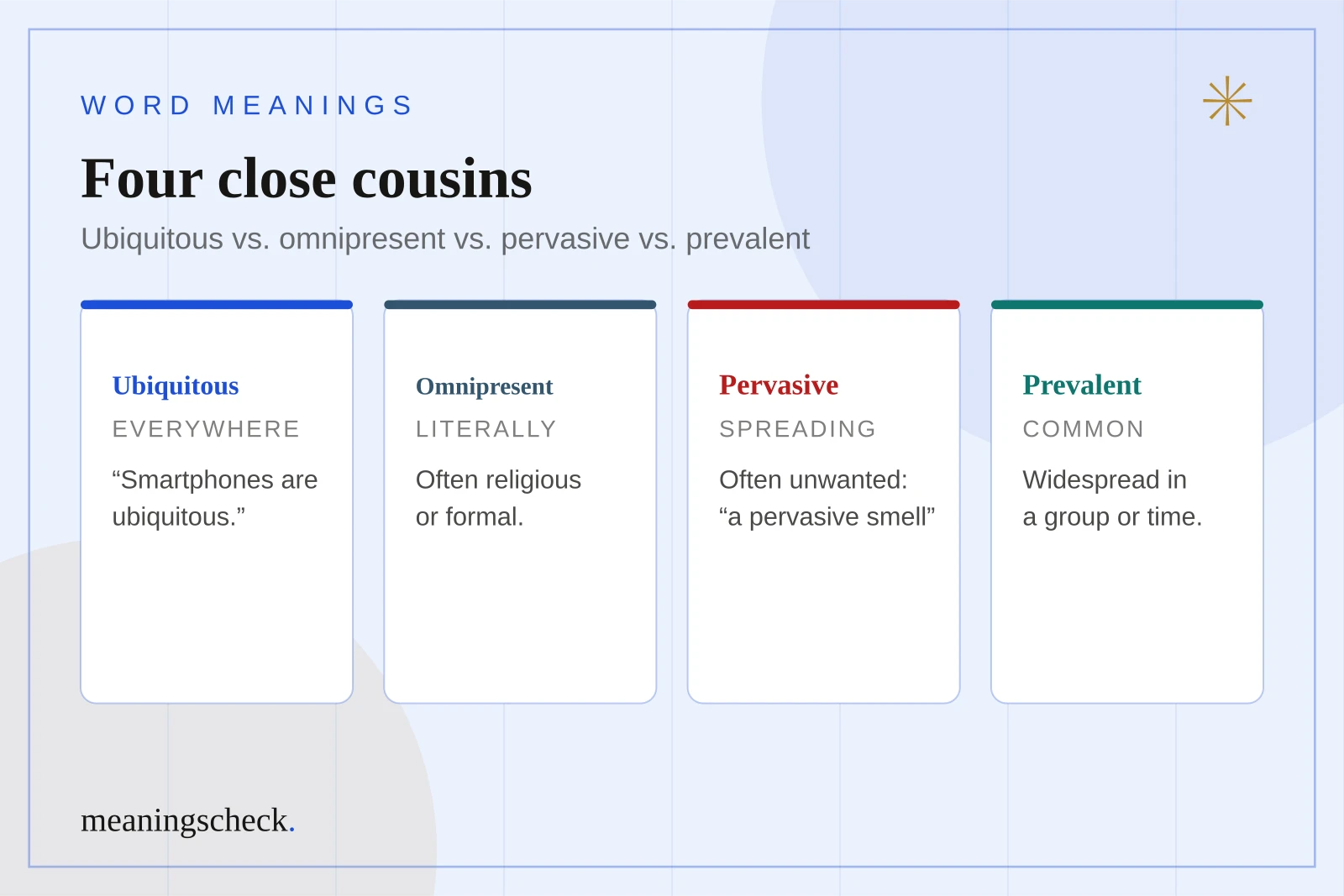
The Short Answer: Ubiquitous and omnipresent both mean "everywhere," but omnipresent often has a religious or literal sense. Pervasive suggests spreading through something, often unwelcome. Prevalent means common or dominant. Universal means applying to all.
These words overlap. Still, each has its own flavor:
| Word | Meaning | Tone | Example |
|---|---|---|---|
| Ubiquitous | Seemingly everywhere, constantly seen | Neutral, slightly formal | "Smartphones are ubiquitous." |
| Omnipresent | Present everywhere at once | Formal; often religious | "an omnipresent God" |
| Pervasive | Spreading through every part | Often negative | "a pervasive smell of smoke" |
| Prevalent | Widespread, dominant | Neutral | "Flu is prevalent in winter." |
| Universal | Applying to everyone or everything | Neutral | "a universal truth" |
| Widespread | Spread over a large area or group | Neutral, plain | "widespread support" |
| Rife | Full of (usually something bad) | Negative | "rife with errors" |
Ubiquitous vs. Omnipresent
Omnipresent often describes something literally present everywhere, especially God in religious writing. Ubiquitous usually describes everyday things that just seem to be everywhere.
Ubiquitous vs. Pervasive
Pervasive suggests something spreading through a place or system, often unwanted: "pervasive corruption," "a pervasive odor." Ubiquitous is more neutral.
Ubiquitous vs. Prevalent
Prevalent stresses how common something is in a group or time: "Anxiety is prevalent among students." Ubiquitous stresses how visible it is.
Ubiquitous Synonyms and Antonyms
The Short Answer: Synonyms include omnipresent, pervasive, widespread, common, everywhere, universal, and commonplace. Antonyms include rare, scarce, uncommon, sparse, and limited.
Synonyms
| Synonym | Best Used When |
|---|---|
| Everywhere (adverb) | Casual speech |
| Widespread | Plain, neutral writing |
| Common / commonplace | Something ordinary |
| Omnipresent | Formal or literal "everywhere" |
| Pervasive | Something spreading, often unwanted |
| Universal | Applies to all |
| Familiar | Something people know well |
| Household (as in "household name") | Something everyone recognizes |
Merriam-Webster lists synonyms including commonplace, familiar, common, frequent, ordinary, and household.
Antonyms
| Antonym | Meaning |
|---|---|
| Rare | Not often found |
| Scarce | In short supply |
| Uncommon | Not usual |
| Sparse | Thinly scattered |
| Limited | Restricted in amount or area |
| Exclusive | Available to few |
The Ubiquitous Word Family
The Short Answer: Related forms include ubiquity (noun), ubiquitously (adverb), and ubiquitousness (noun). "Ubiquity" is the most common noun: "the ubiquity of smartphones."
| Word | Part of Speech | Example |
|---|---|---|
| Ubiquitous | Adjective | "Wi-Fi is ubiquitous." |
| Ubiquity | Noun | "the ubiquity of smartphones" |
| Ubiquitously | Adverb | "a ubiquitously available service" |
| Ubiquitousness | Noun (rarer) | "the ubiquitousness of ads" |
Ubiquity in Use
"Ubiquity" works well when you want to talk about the fact of being everywhere:
- "The ubiquity of cameras has changed how we act in public."
- "Plastic's ubiquity makes it hard to avoid."
What Is Ubiquitous Computing?
The Short Answer: Ubiquitous computing is the idea that computers blend into everyday objects and surroundings. The technology works quietly in the background. Mark Weiser of Xerox PARC coined the term in the late 1980s and described it in a 1991 Scientific American article.
The Big Idea
Instead of sitting at one desktop computer, people would interact with many small computers built into everyday things. The technology would fade into the background.
Mark Weiser's Vision
Mark Weiser, a computer scientist at Xerox PARC, coined "ubiquitous computing" in the late 1980s. In his 1991 Scientific American article "The Computer for the 21st Century," he wrote about technologies that "disappear" into everyday life.
Today's Examples
Much of Weiser's vision now feels familiar:
- Smartphones and smartwatches
- Smart speakers and thermostats
- Contactless payments
- Fitness trackers
- Connected cars
| Related Term | Meaning |
|---|---|
| Ubiquitous computing | Computers built into everyday surroundings |
| Pervasive computing | A closely related term for the same idea |
| Internet of Things (IoT) | Everyday devices connected to the internet |
| Ambient computing | Technology that works quietly in the background |
Ubiquitous in Science and the Environment
The Short Answer: Scientists use ubiquitous for things found almost everywhere they look, such as microplastics in the environment or certain bacteria in soil. In biology, "ubiquitous" can also describe a protein or gene found in nearly all cells.
Environmental Science
Researchers often describe microplastics as ubiquitous because they've been found in oceans, soil, air, and even remote places like mountain snow.
Biology
In biology, "ubiquitous" can describe something found in nearly all cells or organisms. A famous example is the small protein named ubiquitin — named for its presence in almost all cells of complex organisms.
Everyday Science Writing
| Phrase | Meaning |
|---|---|
| "ubiquitous in nature" | Found almost everywhere in the natural world |
| "ubiquitous pollutant" | A contaminant found nearly everywhere |
| "ubiquitously expressed gene" | A gene active in most cells |
| "ubiquitin" | A protein found in almost all cells of complex organisms |
Ubiquitous in Business and Marketing
The Short Answer: In business, ubiquitous describes brands, products, or services that are available or visible almost everywhere. Marketers often aim for a "ubiquitous presence," meaning customers see the brand constantly across many channels.
Common business phrases:
- "ubiquitous brand" — a name you see everywhere.
- "ubiquitous presence" — showing up across many channels and locations.
- "ubiquitous access" — available anytime, anywhere.
| Business Phrase | Meaning |
|---|---|
| Ubiquitous brand | Highly visible everywhere |
| Ubiquitous presence | Seen across many channels |
| Ubiquitous coverage | Available in nearly all areas |
| Ubiquitous adoption | Used by almost everyone |
There's a downside too. When a brand becomes ubiquitous, it can start to feel ordinary. Companies then have to work harder to stand out.
Ubiquitous in Pop Culture and Online Life
The Short Answer: Online, things become ubiquitous fast: a meme, a song, a slang word, or an emoji can feel like it's everywhere within days. People use "ubiquitous" to describe trends that seem impossible to escape.
Internet trends can go from niche to ubiquitous almost overnight:
- A meme spreads across every platform.
- A song plays on every short video.
- A slang word shows up in every comment section.
For example, the viral kid meme "6 7" felt ubiquitous in schools for a while, as our 6 7 meaning guide explains. Texting shortcuts like LMAO are so ubiquitous that most people know them instantly — see our LMAO meaning guide.
| Trend Type | When It's "Ubiquitous" |
|---|---|
| Meme | It's on every platform |
| Song | It plays everywhere you go online |
| Slang word | Everyone seems to say it |
| Emoji | It appears in almost every message |
Things That Used to Be Ubiquitous
The Short Answer: Ubiquity doesn't last forever. Payphones, fax machines, VHS tapes, pagers, and CDs were once found almost everywhere. Today they're rare. The word reminds us how quickly "everywhere" can change.
Some things felt permanent until they vanished:
| Once Ubiquitous | What Replaced It |
|---|---|
| Payphones | Mobile phones |
| Pagers | Text messages |
| VHS tapes | DVDs, then streaming |
| Fax machines | Email and e-signatures |
| Paper maps | GPS apps |
| CDs | Music streaming |
| Phone books | Search engines |
What This Shows
Ubiquity is temporary. A product can be everywhere for decades, then disappear in a few years when something better arrives. That's worth remembering when people say a technology will "always" be around.
Pros and Cons of Something Becoming Ubiquitous
The Short Answer: When something becomes ubiquitous, it usually brings convenience and shared standards. It can also bring fatigue, sameness, privacy concerns, and environmental costs. Smartphones and plastic show both sides.
Benefits
- Convenience: You can find it anywhere.
- Shared standards: Everyone knows how it works.
- Lower prices: Mass production often cuts costs.
Drawbacks
- Fatigue: A song or ad everywhere gets old fast.
- Sameness: Local variety can fade.
- Privacy: Ubiquitous cameras and sensors raise concerns.
- Environment: Ubiquitous plastic creates waste.
| Example | Upside | Downside |
|---|---|---|
| Smartphones | Instant information | Distraction, privacy |
| Plastic | Cheap, light packaging | Pollution |
| Wi-Fi | Easy connection | Security risks |
| Chain stores | Familiar, reliable | Less local variety |
Ubiquitous in Other Languages
The Short Answer: Many languages have a version of ubiquitous from the same Latin root: Spanish ubicuo, Italian ubiquo, and Portuguese ubíquo. German usually says allgegenwärtig ("present everywhere").
| Language | Word | Literal Sense |
|---|---|---|
| Spanish | ubicuo / ubicua | Everywhere |
| Italian | ubiquo | Everywhere |
| Portuguese | ubíquo | Everywhere |
| French | omniprésent | Present everywhere |
| German | allgegenwärtig | Present everywhere |
The shared Latin root explains why Spanish, Italian, and Portuguese versions look so similar to the English word.
Ubiquitous on Vocabulary Tests
The Short Answer: Ubiquitous often appears on SAT, GRE, and other vocabulary lists. Test questions usually ask you to match it with "widespread" or "omnipresent," or to pick it for a sentence about something found everywhere.
Here's how it tends to show up:
Synonym Questions
"Ubiquitous most nearly means: (A) rare (B) widespread (C) unique (D) ancient." The answer is (B) widespread.
Fill-in-the-Blank
"By 2020, video calls had become so ______ that few people could remember life without them."
Answer: ubiquitous.
Practice Sentences
| Sentence | Best Word |
|---|---|
| "Plastic is ______ in the oceans." | ubiquitous |
| "This handmade vase is ______." | unique |
| "Clean water is ______ in the desert." | scarce |
| "Cell towers are ______ along the highway." | ubiquitous |
How to Remember What Ubiquitous Means
The Short Answer: Link "ubi" to "where" (its Latin root) and remember "ubi-quitous = where-ever." Or picture the word "ubiquitous" printed on everything around you — every wall, phone, and bus.
Try one of these memory tricks:
- Root trick: "ubi" = "where." Ubiquitous = wherever you look.
- Sound trick: "You BIK with us" — something that tags along everywhere you go.
- Picture trick: Imagine the same logo on every billboard in a city.
- Opposite trick: Ubiquitous is the opposite of rare.
How to Use Ubiquitous Correctly
The Short Answer: Use ubiquitous as an adjective for things that seem to be everywhere: "Smartphones are ubiquitous." Avoid using it for things that are merely popular in one place, and don't confuse it with "unique," which means one of a kind.
Do
- "Smartphones are ubiquitous among teenagers."
- "The ubiquity of plastic is a global problem."
Don't
- "My grandmother's recipe is ubiquitous." (Unless everyone everywhere uses it.)
- "This painting is ubiquitous." (You probably mean unique.)
- "It's ubiquitously." (Use the adjective: "It's ubiquitous.")
Can Something Be "Very Ubiquitous"?
Purists argue that "ubiquitous" is already extreme. To them, "very ubiquitous" is redundant. In casual writing, people say "almost" or "nearly ubiquitous" instead. That sounds more precise.
| Phrase | Verdict |
|---|---|
| "nearly ubiquitous" | Great — precise |
| "increasingly ubiquitous" | Great — shows a trend |
| "very ubiquitous" | Avoid — redundant |
| "completely ubiquitous" | Okay for emphasis; often unnecessary |
Spelling Tip
It's ubiquitous, not "ubiquitious" or "ubiquotous." Break it down: ubi + qui + tous.
Words That Often Pair With Ubiquitous
The Short Answer: Ubiquitous often appears before words like presence, technology, sight, feature, symbol, and figure. It's also common after "nearly," "almost," "increasingly," and "become."
Writers tend to reach for the same combinations. Knowing them helps your sentences sound natural:
| Common Pairing | Example |
|---|---|
| ubiquitous presence | "The brand has a ubiquitous presence online." |
| ubiquitous technology | "Touchscreens are now ubiquitous technology." |
| a ubiquitous sight | "Scooters are a ubiquitous sight downtown." |
| a ubiquitous feature | "Cup holders are a ubiquitous feature in cars." |
| a ubiquitous symbol | "The heart emoji is a ubiquitous symbol of love." |
| a ubiquitous figure | "She became a ubiquitous figure on talk shows." |
| nearly ubiquitous | "Seat belts are nearly ubiquitous." |
| increasingly ubiquitous | "AI tools are increasingly ubiquitous." |
| become ubiquitous | "Online banking has become ubiquitous." |
Ubiquitous vs. Popular vs. Trendy
The Short Answer: Popular means many people like it. Trendy means it's fashionable right now. Ubiquitous means it's everywhere you look. Something can be ubiquitous without being popular — like traffic cones.
These words describe different things:
| Word | Focus | Example |
|---|---|---|
| Popular | How much people like it | "a popular movie" |
| Trendy | Whether it's in fashion now | "a trendy café" |
| Ubiquitous | How often you see it | "ubiquitous traffic cones" |
Ubiquitous Doesn't Mean Liked
Traffic cones, parking meters, and pop-up ads are ubiquitous. Few people love them. Ubiquity is about presence, not popularity.
Trendy Things Can Become Ubiquitous
A trendy product can become ubiquitous if it spreads widely. Once it's everywhere, it may stop feeling trendy at all.
Ubiquitous in Everyday Places
The Short Answer: Look around and you'll find ubiquitous things in every setting: chargers at home, laptops at school, coffee mugs at work, and ads online. Spotting them is a good way to remember the word.
| Place | Ubiquitous Things |
|---|---|
| Home | Phone chargers, remote controls, Wi-Fi routers |
| School | Laptops, backpacks, whiteboards |
| Work | Email, coffee mugs, video calls |
| City streets | Security cameras, delivery bikes, coffee shops |
| Online | Ads, cookie pop-ups, memes |
Try this quick exercise: name three ubiquitous things in the room you're sitting in right now. That's the word in action. In some cities, even certain foods feel ubiquitous, like New York's halal carts. Our Halal meaning guide explains what that label means.
Ubiquitous vs. Unique: A Common Mix-Up
The Short Answer: Ubiquitous means "everywhere." Unique means "one of a kind." They're nearly opposites. Both start with "u," which is why people sometimes confuse them.
| Word | Meaning | Example |
|---|---|---|
| Ubiquitous | Found everywhere | "Coffee shops are ubiquitous." |
| Unique | One of a kind | "Her style is unique." |
A quick memory trick: ubiquitous has "ubi" — Latin for "where" — and things that are ubiquitous are everywhere. Unique has "uni" — meaning "one."
Ubiquitous in Different Kinds of Writing
The Short Answer: Ubiquitous fits well in essays, journalism, business reports, and science writing. In casual conversation, simpler words like "everywhere" or "really common" often sound more natural.
| Writing Type | Is "Ubiquitous" a Good Fit? | Simpler Alternative |
|---|---|---|
| Academic essay | Yes | — |
| News article | Yes | "widespread" |
| Business report | Yes | "everywhere" |
| Science paper | Yes | "found nearly everywhere" |
| Text message | Rarely | "everywhere" |
| Kids' writing | Rarely | "all over the place" |
Using it once in a piece of writing can sound sharp. Using it in every paragraph can sound like you're showing off. Vocabulary words like this work best when they're precise — the same advice applies to words like "dichotomy," covered in our Dichotomy meaning guide.
Writing Tip: Show It, Then Name It
The Short Answer: "Ubiquitous" lands best after you give the reader a picture. Describe how often something appears, then name it ubiquitous. The detail makes the word feel earned instead of showy.
Compare these two openings:
Weak: "Smartphones are ubiquitous in modern society."
Stronger: "On the morning train, nearly every passenger is looking down at a glowing screen. Smartphones have become ubiquitous."
The second version shows the scene first. By the time the reader hits "ubiquitous," they already believe it.
A Model Paragraph
"Walk through any airport and count the charging stations, the people on calls, the screens showing flight times. Technology isn't just present — it's ubiquitous. That ubiquity has made travel easier in many ways. It has also made it harder to disconnect."
| Writing Move | Why It Works |
|---|---|
| Start with a concrete scene | Readers picture it |
| Use "ubiquitous" once | Keeps it strong |
| Follow with "ubiquity" for the idea | Adds variety |
| End with a consequence | Gives the word a purpose |
Real-World Examples: Ubiquitous in Conversation
The Short Answer: You'll hear ubiquitous in classrooms, meetings, news broadcasts, and casual commentary about trends. These examples show how people use it and what they mean.
These are typical patterns, not quotes from real people.
In a Classroom
Teacher: "Smartphones have become ubiquitous. How has that changed the way we learn?"
What it means: Phones are everywhere. The class will discuss their effect.
In a Meeting
Manager: "Our competitor's ads are ubiquitous right now."
What it means: The competitor's marketing is showing up everywhere.
On the News
Reporter: "Microplastics are now ubiquitous in the environment."
What it means: They're found almost everywhere scientists look.
With Friends
Friend: "That song is so ubiquitous I'm sick of it."
What it means: It plays everywhere.
| Setting | Ubiquitous Signals |
|---|---|
| Classroom | A widespread technology or trend |
| Meeting | Strong market visibility |
| News | Wide presence in society or nature |
| Friends | Something annoyingly everywhere |
Expert Insights: Why "Ubiquitous" Became So Popular
The Short Answer: Modern life is full of things that are everywhere — devices, brands, media, and memes. "Ubiquitous" gives writers one precise, slightly formal word for that experience. It also signals a polished vocabulary, which is why it's popular in essays and business writing.
A Word for Modern Life
Mass production, global brands, and the internet made it possible for products and ideas to spread everywhere quickly. "Ubiquitous" fits that world perfectly.
Precision Over Wordiness
Instead of "found in almost every place you look," you can write "ubiquitous." One word does the work of a whole phrase.
The Risk of Overuse
Because it sounds smart, "ubiquitous" can become a buzzword. When everything is "ubiquitous," the word loses its punch. Good writers save it for things that really are everywhere.
From Theology to Tech
The word's journey — from debates about Christ's presence to discussions of smartphones — shows how vocabulary adapts. A word built for a spiritual idea now describes Wi-Fi.
Real-World Patterns of Ubiquitous
- Tech: "ubiquitous computing."
- Environment: "ubiquitous microplastics."
- Business: "a ubiquitous brand."
- Culture: "that ubiquitous song."
Ubiquitous Across Generations
The Short Answer: Older writers might call something "everywhere" or "all the rage." Millennials and Gen Z might say "it's everywhere" or "I keep seeing it." "Ubiquitous" stays the formal choice across all ages.
| Group | Casual Way to Say It | Formal Way |
|---|---|---|
| Baby boomers | "It's all the rage." | "It's ubiquitous." |
| Gen X | "It's everywhere." | "It's ubiquitous." |
| Millennials | "I can't escape it." | "It's ubiquitous." |
| Gen Z | "It's literally all over my feed." | "It's ubiquitous." |
These are tendencies, not rules.
How to Explain Ubiquitous to a Kid
The Short Answer: Say: "Ubiquitous means something you see everywhere. Like how there are phones everywhere you go — phones are ubiquitous."
Try this simple script:
- "Ubiquitous means everywhere."
- "If you see something all the time, it's ubiquitous."
- "Phones, cars, and trees are ubiquitous in most towns."
- "The opposite is rare — something you hardly ever see."
Quick Quiz: Ubiquitous or Not?
The Short Answer: Decide whether each item fits "ubiquitous" (found nearly everywhere) or not. Common, widespread things fit. Rare or one-of-a-kind things don't.
| Item | Ubiquitous? | Why |
|---|---|---|
| Smartphones in a city | Yes | Seen almost everywhere |
| A one-of-a-kind painting | No | It's unique, not everywhere |
| Wi-Fi in cafés | Yes | Nearly every café has it |
| A rare orchid | No | Hard to find |
| Plastic packaging | Yes | Found nearly everywhere |
| Your neighbor's secret recipe | No | Only one place has it |
If you got all six, you know exactly when to use ubiquitous.
Common Mistakes With Ubiquitous
The Short Answer: The biggest mistakes are misspelling it, mispronouncing the start, confusing it with unique, saying "very ubiquitous," and using it for things that are only popular in one small place.
- Spelling it "ubiquitious." It's "ubiquitous."
- Saying "oo-BIK-wih-tus." It starts with "yoo."
- Confusing it with unique. They're nearly opposites.
- Saying "very ubiquitous." Try "nearly ubiquitous."
- Overusing it. Save it for things that are truly everywhere.
- Using the adverb wrong. "It's ubiquitous," not "It's ubiquitously."
Frequently Asked Questions (FAQs)
What does ubiquitous mean in simple words?
Ubiquitous means "found everywhere." If you see something all the time, it's ubiquitous.
How do you pronounce ubiquitous?
It's pronounced "yoo-BIK-wih-tus," with the stress on the second syllable.
What is an example of ubiquitous?
"Smartphones are ubiquitous" is a common example. Wi-Fi, coffee shops, and plastic are others.
What is the noun form of ubiquitous?
The noun is "ubiquity," as in "the ubiquity of social media."
What is the difference between ubiquitous and omnipresent?
Both mean "everywhere." Omnipresent often has a literal or religious sense, while ubiquitous usually describes everyday things that seem to be everywhere.
Where does the word ubiquitous come from?
It comes from the Latin ubique, meaning "everywhere." Merriam-Webster dates "ubiquitous" to 1772.
What is the opposite of ubiquitous?
Rare, scarce, and uncommon are common antonyms.
What is ubiquitous computing?
It's the idea of computers built into everyday objects and surroundings. Mark Weiser coined the term in the late 1980s.
Is it "ubiquitous" or "ubiquitious"?
The correct spelling is "ubiquitous." "Ubiquitious" is a common misspelling.
Final Thoughts
Ubiquitous is a big word for something we live with every day: things that are simply everywhere. Phones, Wi-Fi, logos, songs, and memes fill our world so completely that we barely notice them.
That's the irony of the word. The more ubiquitous something becomes, the more invisible it feels. Use the word when you want to point it out.
For more words explained in plain language, explore our word meanings guides. And for a word that gained new meanings as technology changed, see our Legacy meaning guide.
Related terms
Share: · Post on X
Written by MeaningsCheck Team · Published · Updated
The MeaningsCheck team researches and writes plain-language explanations of slang, abbreviations, and everyday words — checked for accuracy, updated as language changes.