
What Does Halal Mean? Halal Meaning, Halal Food Rules, Halal vs. Haram and Kosher (2026)
Halal is an Arabic word meaning "permissible" or "lawful." In Islam, it describes anything allowed by Islamic law, especially food prepared according to Islamic dietary rules. Its opposite is haram, meaning "forbidden."
Halal is an Arabic word that means "permissible" or "lawful." In Islam, it describes anything allowed under Islamic law. Most often, you'll see it on food: a "halal" label means the food was prepared in a way that follows Islamic dietary rules.
The opposite of halal is haram, meaning "forbidden." Between the two sit a few gray areas that Islamic scholars discuss in detail.
If you're asking what does halal mean, this guide explains it clearly. You'll learn the halal meaning in Arabic and in Islam, the main halal food rules, how halal meat is prepared, halal vs. haram, halal vs. kosher, how halal certification works, and how "halal" is used beyond food.
Key takeaway: Halal = "permissible" in Islam. On food, it means the food meets Islamic dietary rules. Its opposite is haram ("forbidden").
This guide is general information, not a religious ruling. Islamic schools of thought differ on some details. For personal guidance, consult a qualified scholar or a trusted halal certifier.
Executive Summary: Halal at a Glance
Here's the quick version:
- Meaning: Arabic ḥalāl, "permissible" or "lawful."
- Pronunciation: huh-LAHL (Merriam-Webster: hə-ˈläl).
- In English since: Merriam-Webster dates its first known English use to 1797.
- Opposite: Haram ("forbidden").
- Gray areas: Makruh ("disliked" or discouraged) and mashbooh ("doubtful").
- Halal food basics: No pork, no alcohol or intoxicants, no blood, and meat from animals slaughtered in the prescribed way, called dhabihah (or zabiha).
- Beyond food: Halal also applies to finance (avoiding interest), cosmetics, medicines, and everyday conduct.
- Certification: Organizations inspect products and issue halal labels. Standards vary by country.
What Does Halal Mean? The Core Definition
The Short Answer: Halal means "permissible." Merriam-Webster defines it as "sanctioned by Islamic law," especially "ritually fit for use," as in "halal foods." It also describes a business "selling or serving food ritually fit according to Islamic law," as in "a halal restaurant."
The Arabic Meaning
Halal comes from the Arabic ḥalāl, meaning "permissible." In Islamic teaching, it covers anything God allows — food, drink, money, behavior, and more.
The Dictionary Meaning
Merriam-Webster gives two senses:
- "Sanctioned by Islamic law," especially "ritually fit for use" — as in halal foods.
- "Selling or serving food ritually fit according to Islamic law" — as in a halal restaurant.
Everyday Use
In daily life, most people use "halal" for food and drink:
- "Is this chicken halal?"
- "We found a great halal restaurant downtown."
- "The cafeteria now offers halal options."
| Use | Meaning | Example |
|---|---|---|
| Food | Prepared according to Islamic rules | "halal chicken" |
| Restaurant | Serves halal food | "a halal burger place" |
| Product | Certified free of forbidden ingredients | "halal gummies" |
| Finance | Follows Islamic rules on money | "a halal mortgage" |
| General | Allowed in Islam | "Is this activity halal?" |
How Do You Pronounce Halal?
The Short Answer: Say "huh-LAHL," with the stress on the second syllable. Merriam-Webster lists hə-ˈläl. In Arabic, the first "h" is a breathy sound made deeper in the throat than the English "h."
| Pronunciation | Notes |
|---|---|
| huh-LAHL | Common English pronunciation |
| hah-LAAL | Closer to Arabic, with a long second "a" |
| HAL-al | Common mistake (wrong stress) |
The Arabic letter at the start, ḥā', is a stronger, breathier "h" than in English. Most English speakers use a regular "h," and that's widely understood.
Halal vs. Haram: What's the Difference?
The Short Answer: Halal means permissible. Haram means forbidden. Islamic law also recognizes in-between categories, such as makruh (disliked or discouraged) and mashbooh (doubtful). It isn't always a simple two-way split.
The Basic Pair
- Halal: allowed.
- Haram: forbidden.
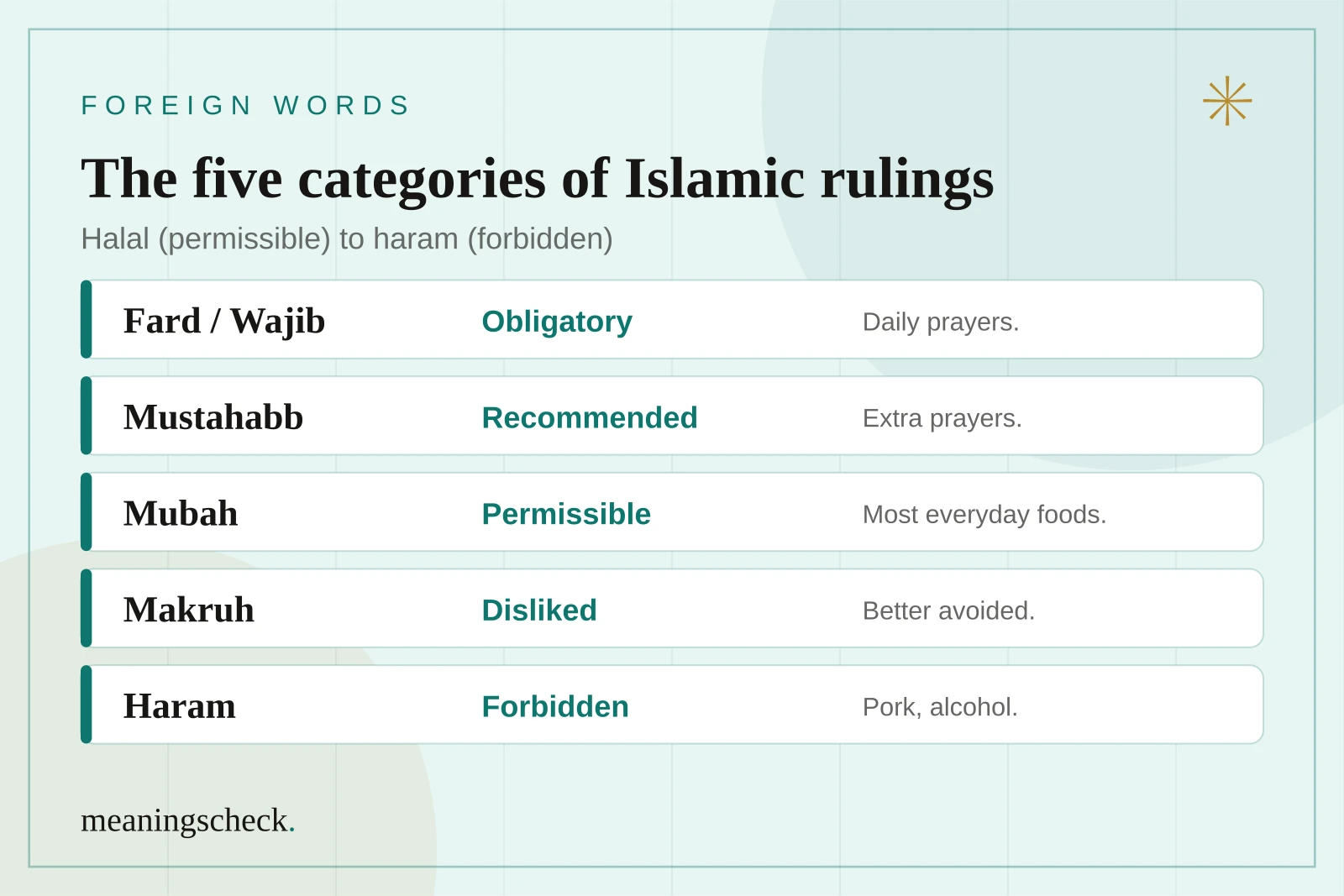
The Five Categories of Islamic Rulings
Islamic jurisprudence (fiqh) traditionally sorts actions into five categories, often called al-ahkam al-khamsa:
| Category | Meaning | Example |
|---|---|---|
| Fard / Wajib | Obligatory | The five daily prayers |
| Mustahabb / Mandub | Recommended | Extra voluntary prayers |
| Mubah | Neutral, permissible | Most everyday foods |
| Makruh | Disliked, discouraged | Some actions scholars advise avoiding |
| Haram | Forbidden | Eating pork, drinking alcohol |
In everyday speech, people often use "halal" to mean anything that isn't haram — covering the first four categories.
Mashbooh: "Doubtful"
Mashbooh (also spelled mushbooh) means "doubtful" or "suspect." It describes foods or ingredients whose status is unclear — for example, gelatin or enzymes from an unknown animal source. Many Muslims avoid mashbooh items until they can confirm the source.
Key takeaway: Halal and haram are the two ends. Makruh and mashbooh fill the gray areas. It's more nuanced than a simple either-or — a point our Dichotomy meaning guide makes about two-way splits in general.
Halal in the Qur'an
The Short Answer: Muslims point to several Qur'an verses for halal and haram food rules. Verse 2:168 encourages eating what is "lawful and good." Verses 2:173 and 5:3 list forbidden foods such as carrion, blood, and pork. Verse 5:90 addresses intoxicants. Translations vary in wording.
The Qur'an is the main source of Islamic dietary law, alongside the Sunnah (the teachings and practice of the Prophet Muhammad) and scholarly interpretation.
| Verse | Theme (summary) |
|---|---|
| 2:168 | Eat what is lawful (halal) and good (tayyib) on earth |
| 2:172–173 | Eat good things; carrion, blood, pork, and animals dedicated to others than God are forbidden |
| 5:3 | Repeats the core prohibitions and adds details on how an animal died |
| 5:5 | The food of the People of the Book (Jews and Christians) is described as lawful |
| 5:90 | Intoxicants and gambling are condemned |
A Note on Necessity
Islamic teaching also includes the principle of necessity: in genuine emergencies, such as starvation, eating otherwise forbidden food is permitted to survive. Scholars discuss this carefully. It isn't a loophole for everyday choices.
Key takeaway: Halal food rules come from the Qur'an, the Prophet's teachings, and centuries of scholarship. Exact wording and interpretations differ by translation and school.
What Makes Food Halal?
The Short Answer: Halal food avoids pork, alcohol and other intoxicants, blood, and animals that died on their own or weren't slaughtered properly. Meat must come from permitted animals slaughtered by the prescribed method, called dhabihah. Most plant foods are halal unless they contain forbidden ingredients.
Foods That Are Haram
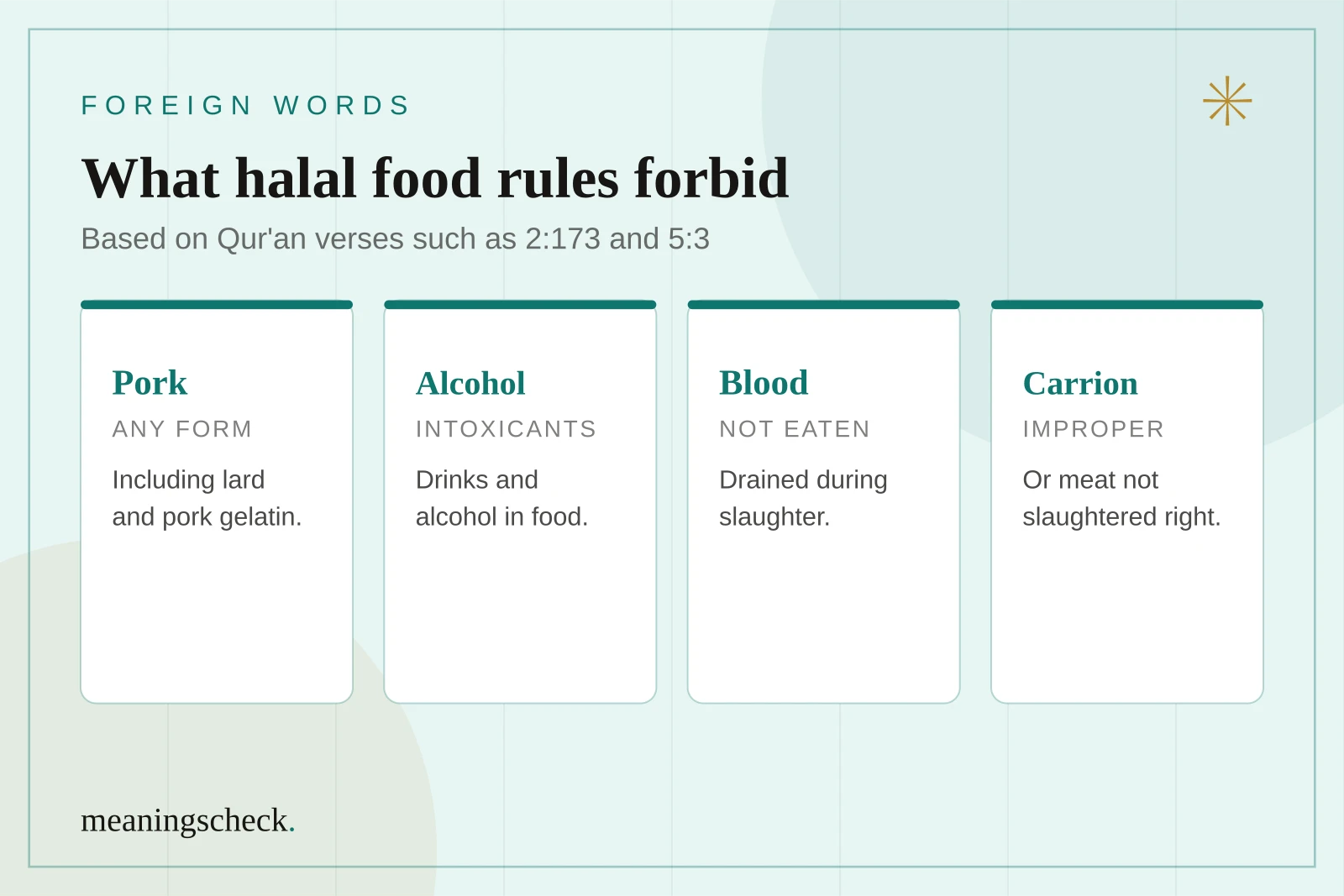
Islamic dietary rules, based on Qur'an verses such as 2:173 and 5:3, forbid:
- Pork and pork products (including lard and pork gelatin).
- Blood.
- Carrion — animals that died on their own, from disease, or by accident.
- Animals dedicated to anyone other than God.
- Alcohol and other intoxicants (see Qur'an 5:90).
Foods That Are Generally Halal
- Fruits, vegetables, grains, and legumes — unless processed with haram ingredients.
- Dairy and eggs from permitted animals.
- Fish — considered halal by most scholars. Schools differ on some other seafood.
- Meat and poultry from permitted animals slaughtered by the prescribed method.
Hidden Ingredients
Processed foods can include ingredients from unclear sources:
| Ingredient | Why It Can Be a Concern |
|---|---|
| Gelatin | Often made from pork or non-halal animals |
| Lard / animal shortening | May come from pigs |
| Alcohol-based flavorings | May contain alcohol |
| Certain enzymes and emulsifiers | Source may be animal-based |
| Carmine (red dye) | Made from insects; views differ |
That's why many shoppers look for halal certification on packaged foods.
How Is Halal Meat Prepared? (Dhabihah)
The Short Answer: Halal meat comes from a permitted animal slaughtered by the method called dhabihah (or zabiha): a swift cut to the throat with a sharp knife, invoking God's name, and draining the blood. Scholars differ on details such as stunning.
The Main Requirements
Common requirements for dhabihah include:
- A permitted animal, such as cattle, sheep, goats, or chickens.
- A sharp knife for a quick cut.
- Cutting the throat, including major blood vessels, to cause rapid death.
- Invoking God's name — commonly "Bismillah, Allahu Akbar" ("In the name of God, God is greatest"). Most scholars consider this required.
- Draining the blood from the carcass.
The Debate About Stunning
Some modern slaughterhouses stun animals before slaughter. Scholars and certifiers disagree:
- Some accept reversible stunning that doesn't kill the animal before the cut.
- Others reject stunning entirely.
Certification bodies set their own standards. A "halal" label can reflect different rules in different countries.
Fish and Seafood
Fish don't require dhabihah. Most scholars consider fish halal. Views on other seafood, like shrimp or crab, differ between schools of thought.
| Step | Purpose |
|---|---|
| Permitted animal | Only animals allowed in Islam |
| Sharp knife, swift cut | A quick, humane death |
| Invoking God's name | Religious requirement for most scholars |
| Draining blood | Blood is forbidden to consume |
Halal vs. Kosher: How Do They Compare?
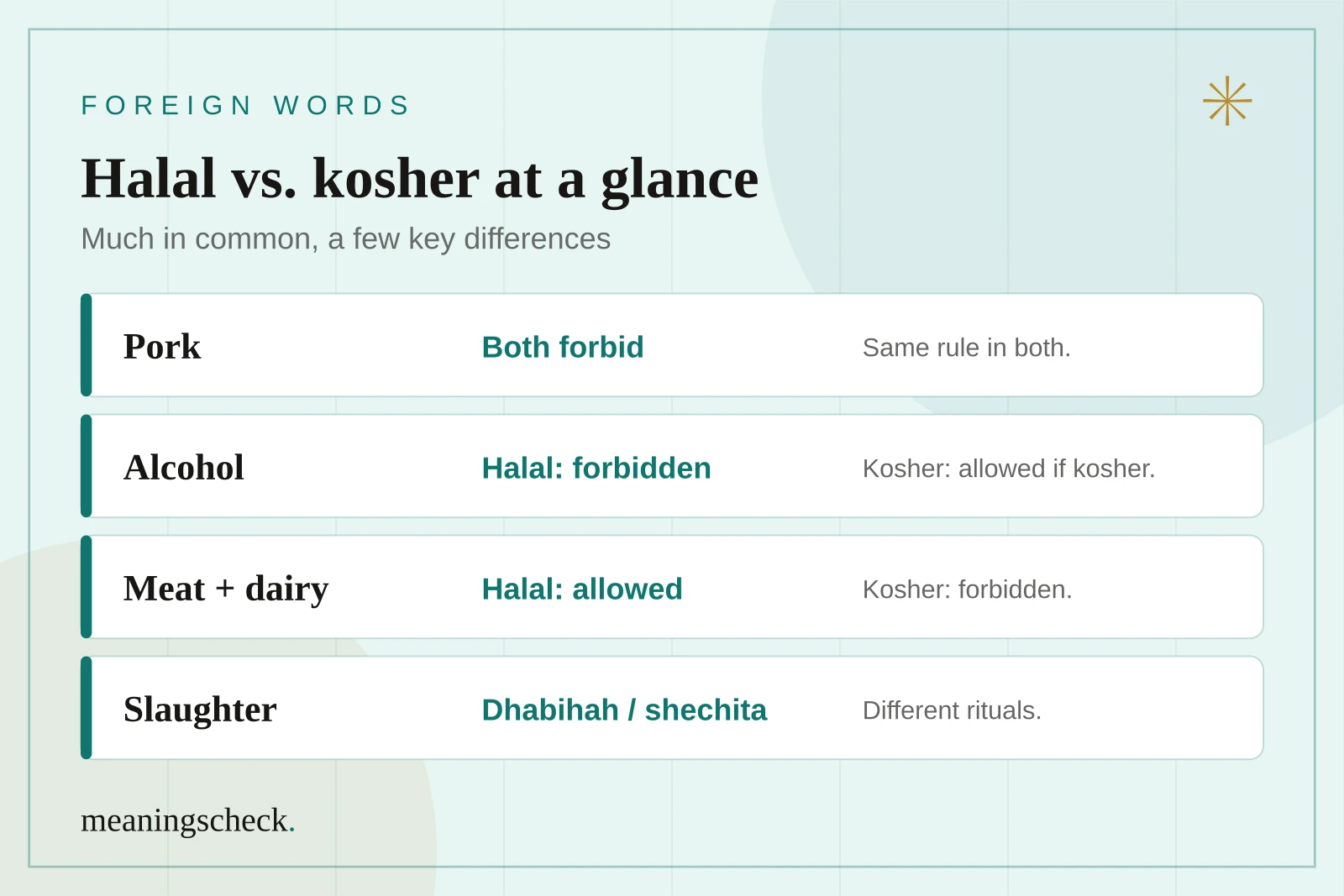
The Short Answer: Halal (Islamic) and kosher (Jewish) dietary laws share a lot: both forbid pork and blood and require specific slaughter methods. Differences include alcohol (forbidden in halal, permitted in kosher if wine is kosher), mixing meat and dairy (forbidden in kosher, allowed in halal), and shellfish.
| Rule | Halal (Islam) | Kosher (Judaism) |
|---|---|---|
| Pork | Forbidden | Forbidden |
| Blood | Forbidden | Forbidden |
| Slaughter | Dhabihah, invoking God's name | Shechita, by a trained shochet |
| Alcohol | Forbidden | Allowed (wine must be kosher) |
| Meat + dairy together | Allowed | Forbidden |
| Shellfish | Views differ | Forbidden |
| Fish | Generally halal | Must have fins and scales |
| Certification | Halal certifiers | Kosher agencies (hechsher symbols) |
Can Muslims Eat Kosher Food?
Some Muslims consider kosher meat acceptable, especially where halal meat isn't available, because both traditions forbid pork and require a religious slaughter. Others don't, mainly because of differences in slaughter requirements. This is a matter of personal practice and scholarly opinion.
Is Halal Food Kosher?
Not automatically. Kosher rules include requirements that halal doesn't, such as separating meat and dairy.
The Animal Welfare Debate
The Short Answer: Supporters say dhabihah is humane because a swift, deep cut causes rapid loss of consciousness. Some animal welfare groups argue that stunning first reduces pain. A few European countries and regions require stunning before slaughter, which has sparked debate about religious freedom.
This is one of the most discussed topics around halal (and kosher) slaughter.
Arguments for Traditional Slaughter
- A sharp knife and swift cut are meant to minimize suffering.
- Rules require care for the animal — for example, not sharpening the knife in front of it.
- Many Muslims see the practice as respectful and religiously required.
Arguments for Stunning
- Some veterinary and animal welfare groups argue pre-slaughter stunning reduces pain and stress.
- Some halal certifiers accept reversible stunning that doesn't kill the animal.
Laws in Some Countries
Denmark banned slaughter without stunning in 2014. In Belgium, the Flanders and Wallonia regions introduced similar requirements in 2019. The Court of Justice of the European Union upheld the Flemish rules in 2020. These laws affect both halal and kosher slaughter and remain controversial.
| Position | Main Argument |
|---|---|
| Traditional dhabihah | Swift cut is humane and religiously required |
| Reversible stunning accepted | Reduces stress while keeping the animal alive until slaughter |
| Mandatory stunning laws | Animal welfare should come first |
| Religious freedom advocates | Laws shouldn't restrict religious practice |
What Is Halal Certification?
The Short Answer: Halal certification is an independent check that a product, restaurant, or factory meets halal standards. Certifiers inspect ingredients, processes, and slaughter methods, then allow a halal logo. Different countries and organizations use different standards.
What Certifiers Check
- Ingredients, including hidden animal-derived ones.
- Slaughter methods for meat and poultry.
- Equipment and storage, to prevent contact with haram products.
- Supply chains, from farm to package.
Who Certifies?
Many organizations certify halal products worldwide. Well-known examples include IFANCA (Islamic Food and Nutrition Council of America) in the US and JAKIM (Malaysia's Department of Islamic Development). Some countries have government-backed halal standards.
Reading Halal Labels
| Label | What It Usually Means |
|---|---|
| Certified halal logo | Inspected by a certifying body |
| "Halal" (no logo) | Seller's claim; trust varies |
| "Zabiha" or "dhabihah" | Meat slaughtered by the Islamic method |
| "Muslim-friendly" | May avoid pork/alcohol but not fully certified |
Key takeaway: A recognized certification logo gives shoppers more confidence than an unverified "halal" sign.
Halal Beyond Food
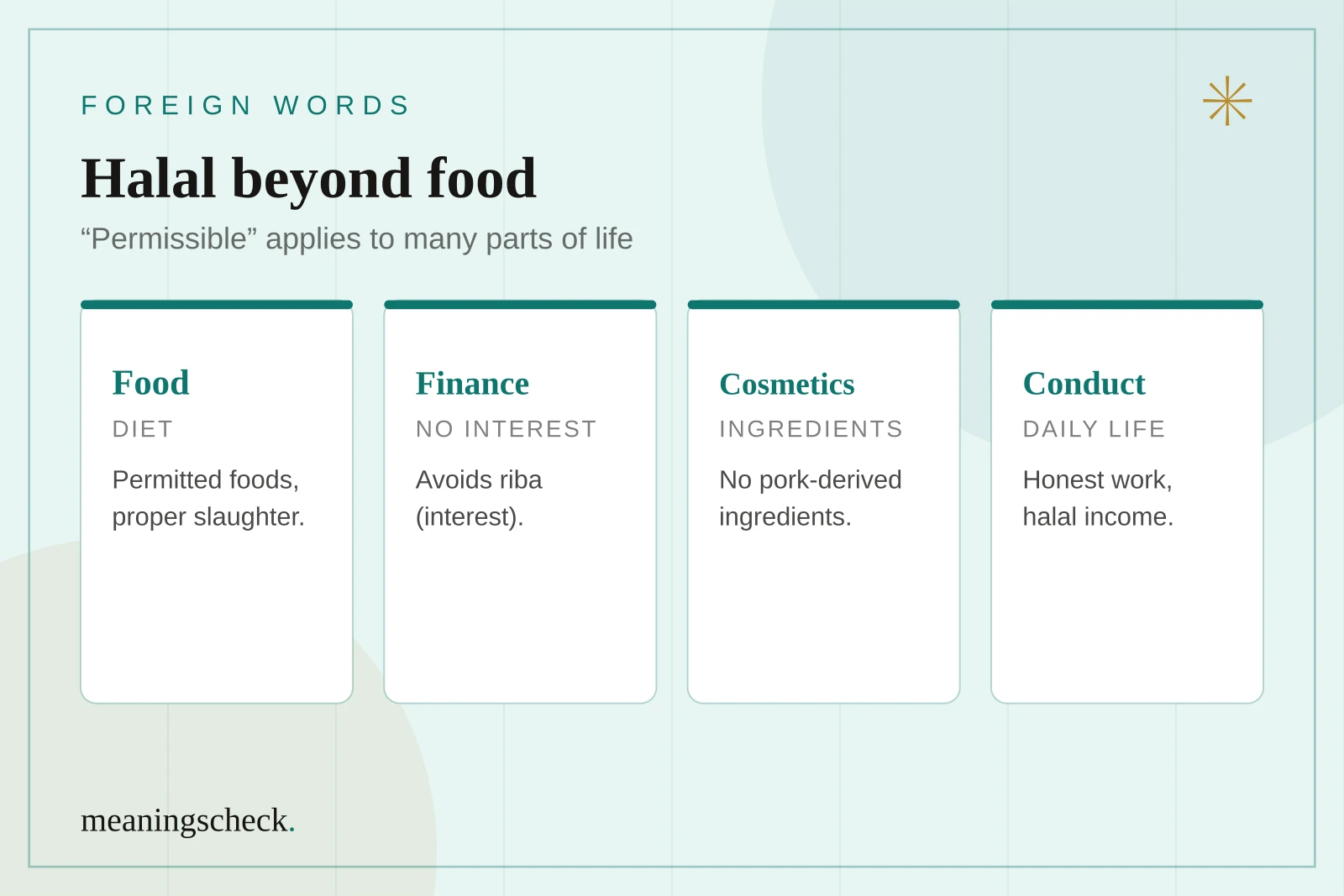
The Short Answer: Halal applies to more than food. Islamic finance avoids interest (riba) and certain investments. Halal cosmetics and medicines avoid forbidden ingredients like pork gelatin and alcohol. In everyday speech, Muslims may ask whether an action or job is halal.
Halal Finance
Islamic finance follows rules that prohibit riba (interest) and investment in businesses considered haram, such as alcohol or gambling. (Other finance terms can be just as unfamiliar. Our Direct Earnings Attachment meaning guide explains a UK wage-deduction rule, for example.) Products include:
- Halal mortgages structured as co-ownership or lease arrangements.
- Islamic banking accounts that share profits instead of paying interest.
- Sukuk — Islamic bonds based on asset ownership.
Halal Cosmetics and Personal Care
Halal beauty products avoid pork-derived ingredients and, for many brands, alcohol. Some certifiers also check animal-testing practices and manufacturing.
Halal Medicines
Some medicines use gelatin capsules made from pork. Many Muslims look for plant-based capsules or halal-certified alternatives. Islamic scholars generally allow necessary medicine when no alternative exists.
Halal Behavior and Work
"Halal" also describes conduct and income: honest work is halal, while earning money through fraud or gambling is haram.
| Area | Halal Means | Example |
|---|---|---|
| Food | Permitted ingredients and slaughter | Halal chicken |
| Finance | No interest; ethical investments | Halal mortgage |
| Cosmetics | No forbidden ingredients | Halal lipstick |
| Medicine | Halal-sourced ingredients where possible | Plant-based capsules |
| Work | Earned honestly | A halal income |
Halal in Everyday Speech and Slang
The Short Answer: Muslims often use "halal" casually to mean "allowed" or "okay," and "haram" to mean "not allowed" — sometimes jokingly. "Is that halal?" can be a sincere question or a playful tease about something mildly naughty.
In conversation, especially among young Muslims, you might hear:
- "Is this gummy bear halal?" — a genuine food question.
- "Skipping the gym is haram 😂" — a joke.
- "That deal is so good, it should be haram." — playful exaggeration.
These casual uses are lighthearted. In serious religious discussion, the words carry their full meaning.
| Phrase | Casual Meaning |
|---|---|
| "Is it halal?" | "Is it allowed / okay?" |
| "That's haram 😂" | "That's not okay" (joking) |
| "Halal mode" | Being on your best behavior |
| "Halal food spot" | A place serving halal food |
Halal Food Around the World
The Short Answer: Halal food is eaten across the world, from Middle Eastern shawarma and South Asian biryani to Indonesian satay and American halal carts. In many cities, halal restaurants and street carts are so common they've become part of local food culture.
Halal food reflects the cuisines of Muslim communities everywhere:
| Region | Popular Halal Dishes |
|---|---|
| Middle East | Shawarma, kebabs, mansaf |
| South Asia | Biryani, nihari, karahi |
| Southeast Asia | Satay, rendang, nasi lemak |
| North Africa | Tagine, couscous |
| Turkey | Döner, köfte |
| United States | Halal cart chicken and rice |
In New York City, halal food carts serving chicken over rice are so common on street corners that they feel almost ubiquitous — the word our Ubiquitous meaning guide explains. And if you've ever found yourself craving one late at night, you know what "feening" for food means, a word covered in our Feening meaning guide.
How to Find and Choose Halal Food
The Short Answer: Look for a recognized halal certification logo, ask restaurants about their meat supplier, check ingredient lists for gelatin and alcohol, and use halal-finder apps or local mosque recommendations.
A practical checklist:
- Look for certification logos on packaged foods.
- Ask restaurants whether their meat is certified halal and who supplies it.
- Read ingredient lists for gelatin, lard, alcohol, and unclear enzymes.
- Check for cross-contamination — shared grills or fryers with pork.
- Use halal-finder apps or ask local Muslim communities for recommendations.
| Question to Ask | Why |
|---|---|
| "Is your meat certified halal?" | Confirms slaughter standards |
| "Who certifies it?" | Lets you judge the certifier |
| "Do you cook pork on the same grill?" | Checks cross-contamination |
| "Is there alcohol in the sauce?" | Avoids hidden alcohol |
Halal During Ramadan and Eid
The Short Answer: During Ramadan, Muslims fast from dawn to sunset and break the fast with a halal meal called iftar. During Eid al-Adha, many families sacrifice a halal animal (qurbani) and share the meat with family, friends, and people in need.
Ramadan
During Ramadan, the ninth month of the Islamic calendar, many Muslims fast from dawn to sunset. Meals happen before dawn (suhoor) and after sunset (iftar). Both are halal meals, often shared with family and community.
Eid al-Fitr
Eid al-Fitr marks the end of Ramadan with prayers, gifts, and festive halal meals.
Eid al-Adha
During Eid al-Adha, many families perform qurbani (sacrifice) — a halal animal such as a sheep, goat, or cow. A common tradition divides the meat into three parts: one for the family, one for friends and relatives, and one for people in need.
| Occasion | Halal Food Tradition |
|---|---|
| Ramadan (suhoor) | Pre-dawn meal before fasting |
| Ramadan (iftar) | Breaking the fast at sunset, often with dates |
| Eid al-Fitr | Festive meals celebrating the end of Ramadan |
| Eid al-Adha | Qurbani sacrifice, meat shared with others |
Halal at School, Work, and in Hospitals
The Short Answer: Many schools, universities, hospitals, and workplaces now offer halal options. Clear labeling, separate preparation, and asking people about their needs help everyone eat comfortably.
Schools and Universities
Many cafeterias label halal options and avoid cross-contamination with pork. Some universities have certified halal stations.
Workplaces
At work events, offering halal or vegetarian dishes and avoiding alcohol in shared food helps Muslim colleagues join in.
Hospitals
Hospitals may provide halal meals for patients. Some medications have halal alternatives, and patients can ask their care team.
| Setting | Helpful Practice |
|---|---|
| School cafeteria | Clear halal labels |
| Office party | Halal or vegetarian options |
| Hospital | Halal meal requests |
| Conference catering | Separate serving utensils |
Halal Travel and "Muslim-Friendly" Tourism
The Short Answer: "Halal travel" or "Muslim-friendly travel" means trips designed around Muslim needs: halal food, prayer spaces, alcohol-free options, and sometimes modest swimwear areas. Hotels, airlines, and tour companies increasingly advertise these services.
Common features of Muslim-friendly travel:
- Halal meals on flights and in hotels.
- Prayer rooms and qibla direction markers.
- Alcohol-free minibars or dining areas.
- Family-friendly and modest leisure options.
Travelers often check halal-finder apps and local mosque websites for food recommendations.
Hosting Muslim Guests: Halal Tips
The Short Answer: Ask your guests about their preferences, buy certified halal meat or offer vegetarian or seafood dishes, avoid pork and alcohol in cooking, and keep utensils and grills separate from pork.
Simple ways to be a thoughtful host:
- Ask first. Practices vary — some guests are stricter than others.
- Buy certified halal meat, or serve vegetarian or fish dishes.
- Skip pork and alcohol in recipes, including wine in sauces.
- Use clean pans and grills that haven't touched pork.
- Label dishes at buffets or potlucks.
A little planning shows respect and helps everyone enjoy the meal.
Expert Insights: Why Halal Matters to So Many People
The Short Answer: For observant Muslims, halal is an act of faith and obedience to God, not just a diet. It also connects to ideas of purity, ethics, and community. At the same time, global trade has turned halal certification into a major industry with varying standards.
Faith, Not Just Food
For many Muslims, eating halal is part of worship. The Qur'an encourages believers to eat what is "lawful and good" (halalan tayyiban), linking food to spiritual and physical well-being.
"Halal" and "Tayyib"
Many scholars pair halal (lawful) with tayyib (good, wholesome). The idea is that food should be both permitted and pure — clean, safe, and ethically produced.
Diversity Within the Tradition
Islam has several schools of thought. Practices also vary by culture and family. Questions like stunning, seafood, and kosher meat get different answers. Respecting that diversity is key.
A Global Industry
As Muslim communities grow worldwide, demand for halal products has expanded into restaurants, supermarkets, cosmetics, and finance. Different certifiers and countries apply different standards, which is why trusted certification matters.
Real-World Patterns
- Shoppers: "Is this certified halal?"
- Restaurants: "Halal options available."
- Finance: "Halal mortgage."
- Friends: "Is that halal? 😂"
Halal, Vegetarian, and Vegan: How They Overlap
The Short Answer: Vegetarian and vegan foods avoid meat, which removes most halal slaughter questions. But they aren't automatically halal: alcohol in sauces, wine vinegar debates, and alcohol-based flavorings can still matter. Many Muslims choose vegetarian dishes when halal meat isn't available.
Where They Overlap
- No pork, no meat from improper slaughter — vegetarian dishes skip those issues entirely.
- Vegan foods also avoid gelatin and other animal-derived additives.
Where They Don't
- Alcohol can appear in vegetarian sauces, desserts, and flavorings.
- Cross-contamination with pork can still happen in shared kitchens.
| Food Type | Halal Concerns Left |
|---|---|
| Vegetarian | Alcohol, cross-contamination, some additives |
| Vegan | Alcohol, cross-contamination |
| Certified halal | Checked by a certifier |
For many Muslims eating out, a vegetarian or seafood dish is a practical choice when certified halal meat isn't on the menu.
Is Halal Food Healthier?
The Short Answer: Halal is a religious standard, not a nutrition label. A halal burger and fries is still fast food. How healthy a meal is depends on its ingredients and cooking, not on whether it's halal. The Islamic ideal of "tayyib" does encourage wholesome, clean food.
People sometimes assume halal means "healthier." That's not what the label promises:
- Halal confirms the food meets Islamic rules.
- Nutrition depends on ingredients, portions, and cooking methods.
That said, the Qur'anic pairing of halal (lawful) and tayyib (good, wholesome) leads many Muslims to value fresh, clean, and ethically produced food.
| Claim | Reality |
|---|---|
| "Halal is always healthier." | Not necessarily — it depends on the food. |
| "Halal means organic." | No. Organic is a separate certification. |
| "Halal means ethically raised." | Not always. Some certifiers add welfare standards; others don't. |
| "Halal emphasizes purity." | Yes, in religious terms, through the halal and tayyib ideals. |
Halal in Other Languages and Spellings
The Short Answer: The word halal appears in many languages with Muslim communities: Arabic حلال, Urdu and Hindi "halal," Malay and Indonesian "halal," and Turkish "helal." In South Africa, it's often spelled "halaal."
| Language | Word |
|---|---|
| Arabic | حلال (ḥalāl) |
| Urdu / Hindi | halal |
| Persian | halal |
| Malay / Indonesian | halal |
| Turkish | helal |
| South African English | halaal (common spelling) |
Common Misspellings
- "Hallal" — an extra L.
- "Halel" — wrong vowel.
- "Hilal" — a different Arabic word meaning crescent moon.
Halal Myths vs. Facts
The Short Answer: Common myths include that halal only means "no pork," that halal food tastes different, or that halal applies only to meat. In fact, halal covers many ingredients, products, and areas of life.
| Myth | Fact |
|---|---|
| "Halal just means no pork." | It also excludes alcohol, blood, and improperly slaughtered meat. |
| "Only meat can be halal or haram." | Processed foods, cosmetics, and money can be too. |
| "All vegetarian food is halal." | Not if it contains alcohol or other haram ingredients. |
| "Halal and kosher are the same." | They overlap but have key differences. |
| "Every 'halal' sign is certified." | Some are just claims. Look for a recognized certifier. |
Halal Vocabulary: Related Arabic Terms
The Short Answer: Related terms include haram (forbidden), makruh (disliked), mashbooh (doubtful), dhabihah or zabiha (Islamic slaughter), tayyib (good and pure), and riba (interest).
| Term | Meaning |
|---|---|
| Halal | Permissible |
| Haram | Forbidden |
| Makruh | Disliked, discouraged |
| Mashbooh / Mushbooh | Doubtful, unclear status |
| Dhabihah / Zabiha | Islamic method of slaughter |
| Tayyib | Good, wholesome, pure |
| Riba | Interest (forbidden in Islamic finance) |
| Fiqh | Islamic jurisprudence |
| Bismillah | "In the name of God" |
These words often travel together, like a family of terms passed down through generations of scholarship — a kind of shared legacy, the word our Legacy meaning guide explores.
How to Explain Halal to a Kid
The Short Answer: Say: "Halal is an Arabic word that means 'allowed.' Muslims eat halal food, which means no pork or alcohol, and meat is prepared in a special way. Haram means 'not allowed.'"
A simple script:
- "Halal means 'allowed' in Arabic."
- "Muslims follow halal rules about food."
- "Halal food has no pork or alcohol."
- "Haram means 'not allowed.'"
Quick Quiz: Halal or Not?
The Short Answer: Decide whether each item is generally halal, haram, or depends on the details. Remember: pork and alcohol are haram, and many processed foods depend on their ingredients.
| Item | Generally Halal? |
|---|---|
| Fresh apples | Halal |
| Pork sausage | Haram |
| Beer | Haram |
| Chicken slaughtered by dhabihah | Halal |
| Gummy candy with gelatin | Depends on the gelatin source |
| Grilled fish | Halal (by most scholars) |
| Pasta sauce with wine | Haram (contains alcohol) |
If you sorted them correctly, you understand the basics of halal food.
Common Mistakes People Make About Halal
The Short Answer: The biggest mistakes are mispronouncing it, thinking it only means "no pork," assuming all vegetarian food is halal, treating halal and kosher as identical, and trusting any halal sign without checking certification.
- Saying "HAL-al." It's "huh-LAHL."
- Thinking it only means "no pork." Alcohol, blood, and slaughter rules matter too.
- Assuming vegetarian equals halal. Watch for alcohol and additives.
- Treating halal and kosher as identical. They differ on alcohol and meat-dairy mixing.
- Ignoring cross-contamination. Shared grills can matter.
- Assuming every Muslim practices the same way. Practices vary. Ask.
Frequently Asked Questions (FAQs)
What does halal mean?
Halal is an Arabic word meaning "permissible." In Islam, it describes what is allowed, especially food that meets Islamic dietary rules.
What is the opposite of halal?
The opposite is haram, meaning "forbidden."
What makes meat halal?
It must come from a permitted animal slaughtered by the dhabihah method, with a swift cut, invoking God's name, and draining the blood.
Is halal the same as kosher?
No. They overlap (both forbid pork and blood) but differ on alcohol, mixing meat and dairy, and slaughter details.
Can non-Muslims eat halal food?
Yes. Anyone can eat halal food. It's simply food prepared according to Islamic rules.
Is all vegetarian food halal?
Not always. Vegetarian food can contain alcohol or other haram ingredients.
What is halal certification?
It's an independent check that a product or restaurant meets halal standards, shown by a certifier's logo.
What does makruh mean?
Makruh means "disliked" or "discouraged." It isn't forbidden. Many Muslims still choose to avoid it.
How do you pronounce halal?
Say "huh-LAHL," with the stress on the second syllable.
Final Thoughts
Halal is a short word with deep meaning: "permissible." For millions of Muslims, choosing halal food is an everyday act of faith — a way of living according to what God allows. For everyone else, understanding the word helps when sharing meals, reading labels, or hosting friends.
Next time you see a halal sign, you'll know it's more than a food label. It's a promise that the food follows rules rooted in faith, care, and tradition.
For more words from other languages explained in plain English, explore our foreign words guides.
Related terms
Share: · Post on X
Written by MeaningsCheck Team · Published
The MeaningsCheck team researches and writes plain-language explanations of slang, abbreviations, and everyday words — checked for accuracy, updated as language changes.