
Direct Earnings Attachment (DEA) Meaning: How It Works, Rates, and Your Rights (2026)
A Direct Earnings Attachment (DEA) is a way for the UK's Department for Work and Pensions (DWP) to recover money you owe — usually benefit overpayments — by telling your employer to deduct it from your wages. No court order is needed. Councils can also use DEAs for Housing Benefit overpayments.
A Direct Earnings Attachment (DEA) lets the UK government take money you owe straight from your wages. It's used by the Department for Work and Pensions (DWP), mainly to recover benefit overpayments. Your employer gets a notice, works out a percentage of your pay, and sends it to the DWP.
The big difference from other wage deductions? No court order is needed.
If you've received a letter about a DEA — or your employer has — you probably want to know what a direct earnings attachment means, how much can be taken, and what you can do about it. This guide explains the DEA meaning, who can issue one, the official DEA deduction rates, the rules that protect your pay, employer duties, and your options.
Key takeaway: A DEA is a DWP order to your employer to deduct benefit debt from your wages — without going to court. At least 60% of your net pay must be left to you.
This guide is general information based on the DWP's published employer guidance. It isn't legal or financial advice. DEA rules apply in England, Scotland, and Wales. For your situation, contact the DWP or a free debt advice service.
Executive Summary: DEA at a Glance
Here's the quick version:
- What it is: A wage deduction to repay money owed to the DWP.
- Who uses it: DWP Debt Management and local councils (for Housing Benefit overpayments).
- Typical debt: Benefit overpayments, when you're no longer on benefits and haven't agreed to repay voluntarily.
- Court order needed? No. That's what makes it different from an Attachment of Earnings Order.
- Legal basis: The Welfare Reform Act 2012 and the Social Security (Overpayment and Recovery) Regulations 2013, in force since 8 April 2013.
- How much: A percentage of net pay, from nil to 20% at the standard rate and 5% to 40% at the higher rate.
- Protection: You must keep at least 60% of your net pay.
- Start date: The next payday on or after 22 days from the date on the notice.
- Employer fee: Employers may take up to £1 per pay period to cover admin.
- Where it applies: England, Scotland, and Wales — not Northern Ireland.
What Is a Direct Earnings Attachment? The Core Definition
The Short Answer: A Direct Earnings Attachment is a legal instruction from the DWP (or a council) to an employer to deduct money from an employee's wages and pay it toward a debt. DWP guidance says it's used when the person isn't on benefits and hasn't agreed to repay voluntarily.
In Plain English
A DEA is a way for the government to collect money it's owed directly from your pay packet. Your employer becomes the go-between: it deducts the amount and sends it on.
What the DWP Says
According to the DWP's employer guide, DWP Debt Management can ask an employer to make deductions by operating a DEA when it "has been unable to recover monies owed to the DWP from customers not in receipt of a benefit, and who have not voluntarily agreed to repay."
The Key Words
| Term | Meaning |
|---|---|
| Direct | No court involved |
| Earnings | Your wages from employment |
| Attachment | A legal claim on part of those wages |
| DWP | Department for Work and Pensions |
| Net earnings | Pay after income tax, National Insurance, and pension contributions |
Who Can Issue a DEA?
The Short Answer: DWP Debt Management issues most DEAs. Local councils can also issue DEAs to recover Housing Benefit overpayments. Council DEAs are separate from DWP ones. You contact the council — not the DWP — about them.
The DWP
DWP Debt Management, part of the Department for Work and Pensions, uses DEAs to recover money owed to the DWP.
Local Councils
The DWP guide notes that local authorities, which recover Housing Benefit (HB) overpayments, "also have the power to issue a Direct Earnings Attachment under this legislation." Council DEAs are paid to the council, not the DWP.
| Issuer | Usually Recovers | Who to Contact |
|---|---|---|
| DWP Debt Management | Money owed to the DWP, such as benefit overpayments | DWP (number on the DEA letter) |
| Local council | Housing Benefit overpayments | The council |
Key takeaway: Check who sent the notice. That tells you who to contact.
What Debts Can a DEA Recover?
The Short Answer: DEAs are mainly used for benefit overpayments owed to the DWP — money paid to someone who wasn't entitled to it. The DWP says DEAs can be used for more than one type of DWP debt. Councils use them for Housing Benefit overpayments.
Benefit Overpayments
An overpayment happens when someone receives more benefit than they were entitled to. This can happen because of a change in circumstances, an error, or late reporting.
Other DWP Debts
The DWP's guidance says DEAs "can be used to recover more than one type of DWP debt."
Who It Applies To
DEAs are aimed at people who:
- Owe money to the DWP or a council.
- Are no longer receiving benefits (people on benefits usually repay through benefit deductions instead).
- Haven't agreed a voluntary repayment plan.
According to GOV.UK, "DEA only applies to a small proportion of people owing money to DWP."
| Situation | Likely Repayment Method |
|---|---|
| Still on benefits | Deductions from benefit payments |
| Working, agreed to repay | Voluntary repayment plan |
| Working, not repaying | Possible DEA |
| Housing Benefit overpayment | Council recovery, possibly a council DEA |
What Law Allows DEAs?
The Short Answer: DEAs come from the Welfare Reform Act 2012 and the Social Security (Overpayment and Recovery) Regulations 2013, which came into force on 8 April 2013. They apply in England, Scotland, and Wales.
According to the DWP's employer guide:
- The Welfare Reform Act 2012 "became law in March 2012."
- The Social Security (Overpayment and Recovery) Regulations 2013 "came into force on 8th April 2013."
- The regulations apply in England, Scotland, and Wales — not Northern Ireland, the Channel Islands, or the Isle of Man.
Timeline
| Date | Milestone |
|---|---|
| March 2012 | Welfare Reform Act 2012 becomes law |
| 4 April 2013 | DWP publishes its DEA employer guide |
| 8 April 2013 | Social Security (Overpayment and Recovery) Regulations 2013 come into force |
| May 2026 | DWP employer guide last updated (per GOV.UK) |
How Much Can a DEA Take? The DEA Rates
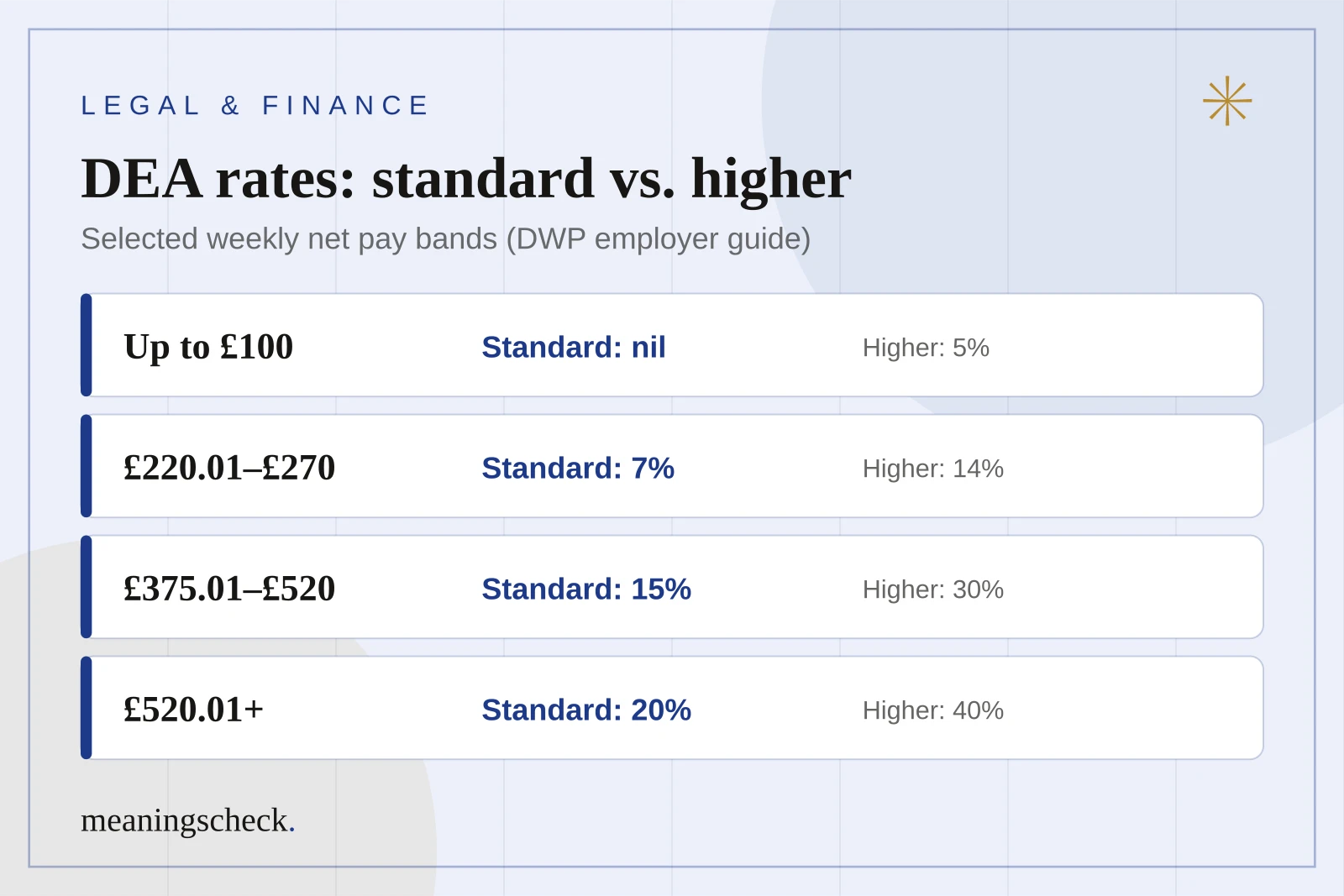
The Short Answer: DEAs take a percentage of your net earnings based on how much you earn. At the standard rate, weekly net pay up to £100 has nothing deducted, rising to 20% above £520. At the higher rate, it ranges from 5% to 40%. The DWP decides which rate applies.
Deductions use net earnings — pay after income tax, Class 1 National Insurance, and pension (superannuation) contributions.
Standard Rates (Table A) — Weekly Net Pay
| Weekly Net Earnings | Deduction |
|---|---|
| Up to £100 | Nil |
| £100.01 – £160 | 3% |
| £160.01 – £220 | 5% |
| £220.01 – £270 | 7% |
| £270.01 – £375 | 11% |
| £375.01 – £520 | 15% |
| £520.01 or more | 20% |
Higher Rates (Table B) — Weekly Net Pay
| Weekly Net Earnings | Deduction |
|---|---|
| Up to £100 | 5% |
| £100.01 – £160 | 6% |
| £160.01 – £220 | 10% |
| £220.01 – £270 | 14% |
| £270.01 – £375 | 22% |
| £375.01 – £520 | 30% |
| £520.01 or more | 40% |
Monthly Net Pay
| Monthly Net Earnings | Standard Rate | Higher Rate |
|---|---|---|
| Up to £430 | Nil | 5% |
| £430.01 – £690 | 3% | 6% |
| £690.01 – £950 | 5% | 10% |
| £950.01 – £1,160 | 7% | 14% |
| £1,160.01 – £1,615 | 11% | 22% |
| £1,615.01 – £2,240 | 15% | 30% |
| £2,240.01 or more | 20% | 40% |
Rates from the DWP's "Direct Earnings Attachment: a guide for employers." The guide also includes daily rates. Check GOV.UK for the latest figures.
Who Decides the Rate?
The DWP chooses whether the standard or higher rate applies and can change it by letter. In exceptional cases, it can set a fixed amount instead.
The 60% Rule: How Your Pay Is Protected
The Short Answer: Your employer must leave you with at least 60% of your net pay. Total deductions can't exceed 40% of net earnings, and the DEA is reduced if needed to stay within that limit. This applies even to fixed-rate DEAs.
According to the DWP's guide, the employer must leave the employee "with at least 60% of their net wage." If several deductions together would take more than 40%, the DEA is reduced to fit.
What That Means in Practice
| Weekly Net Pay | Maximum Total Deductions (40%) | You Keep At Least (60%) |
|---|---|---|
| £300 | £120 | £180 |
| £500 | £200 | £300 |
| £700 | £280 | £420 |
Key takeaway: Even at the highest rate, a DEA can't leave you with less than 60% of your net pay.
DEA Example Calculations
The Short Answer: If your weekly net pay is £300, a standard-rate DEA takes 11% (£33). At the higher rate, it's 22% (£66). For £1,500 a month net, the standard rate is 11% (£165) and the higher rate is 22% (£330).
These are simple illustrations using the published rate tables. Real calculations can involve other deductions and the 60% rule.
Weekly Example
- Net pay: £300 per week (band £270.01–£375).
- Standard rate: 11% → £33 deducted.
- Higher rate: 22% → £66 deducted.
Monthly Example
- Net pay: £1,500 per month (band £1,160.01–£1,615).
- Standard rate: 11% → £165 deducted.
- Higher rate: 22% → £330 deducted.
With an Admin Fee
If the employer also takes the optional £1 admin fee, the total taken that pay period rises by £1.
| Net Pay | Band | Standard Deduction | Higher Deduction |
|---|---|---|---|
| £150 / week | £100.01–£160 | 3% = £4.50 | 6% = £9.00 |
| £300 / week | £270.01–£375 | 11% = £33.00 | 22% = £66.00 |
| £600 / week | £520.01+ | 20% = £120.00 | 40% = £240.00 |
| £1,500 / month | £1,160.01–£1,615 | 11% = £165.00 | 22% = £330.00 |
When Does a DEA Start?
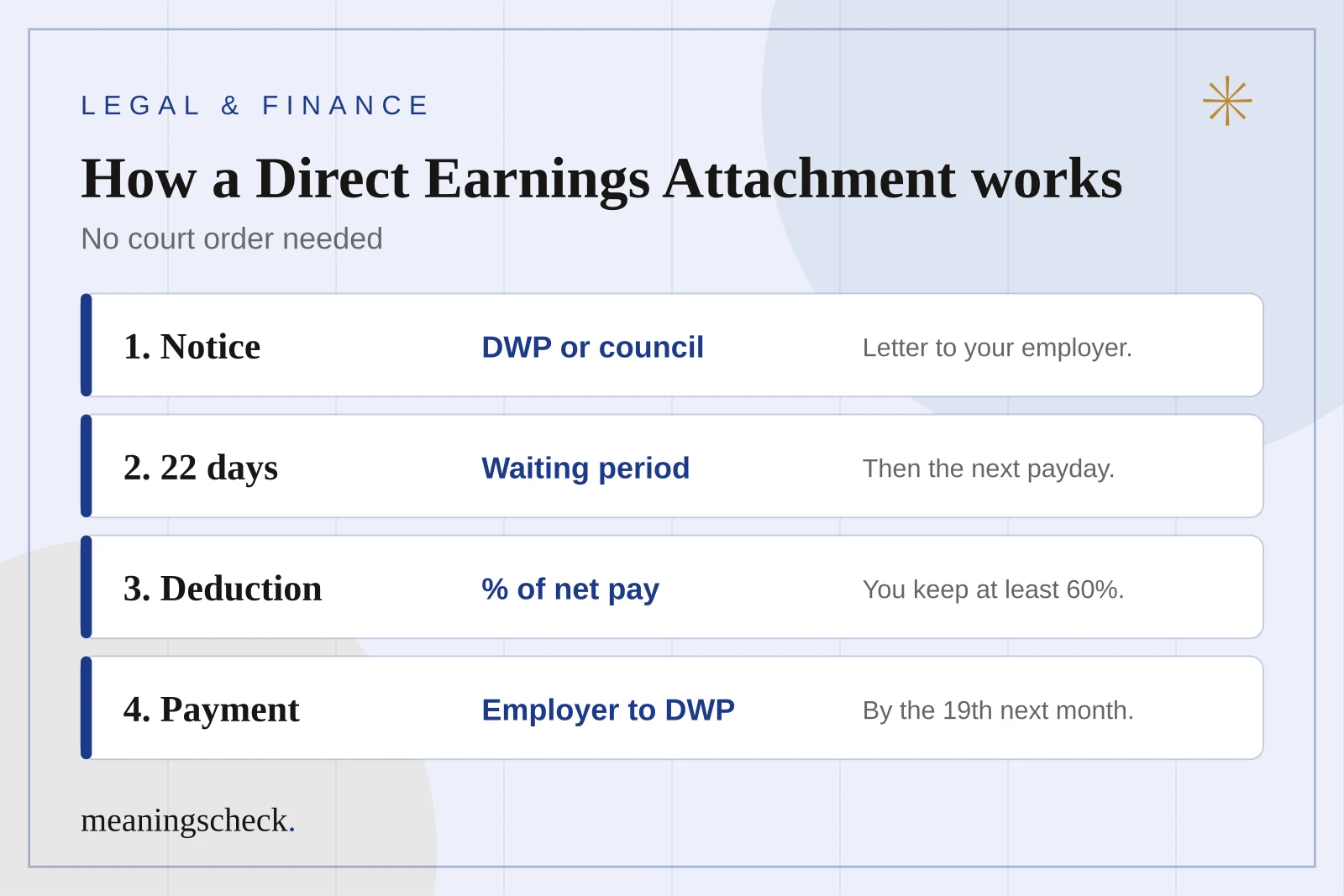
The Short Answer: A DEA takes effect from the next payday that falls on or after 22 days after the date on the notice letter. That gives employers time to set it up and employees time to plan.
The DWP guide says the DEA "has effect from the next pay day which falls on or after 22 days after the date on the notice letter."
Example
- Notice dated: 1 March.
- 22 days later: 23 March.
- First deduction: The first payday on or after 23 March.
What Employers Must Do
The Short Answer: Employers must make the deductions, pay the DWP by the 19th of the following month, tell the employee in writing how much was taken, and notify the DWP within 10 days if the person doesn't work there or leaves. Failing to comply can lead to a fine of up to £1,000 per notice on conviction.
Employer Duties
- Deduct the correct percentage from net pay each payday.
- Pay the DWP "no later than the 19th day of the month following the month in which you have taken it."
- Tell the employee in writing how much was deducted, including any admin charge (this can be on the payslip).
- Notify the DWP "in writing or by phone within 10 days" if the person doesn't work for you or leaves.
- Stop deductions when the DWP says so, the debt is cleared, or the employee leaves.
The £1 Admin Fee
Employers "may take up to £1.00" per pay period in which a DEA deduction is made. This fee stays with the employer. The DWP guide warns that it shouldn't bring pay below the National Minimum Wage.
Penalties
According to the guide, an employer that fails to comply "may be subject, upon conviction, to a fine of up to £1,000 per notice."
| Duty | Deadline or Rule |
|---|---|
| Start deductions | Next payday on/after 22 days from notice |
| Pay the DWP | By the 19th of the following month |
| Tell the employee | Each time, in writing (payslip is fine) |
| Report a leaver | Within 10 days |
| Admin fee | Up to £1 per pay period (optional) |
| Non-compliance | Fine up to £1,000 per notice, on conviction |
What You Can Do If You Get a DEA
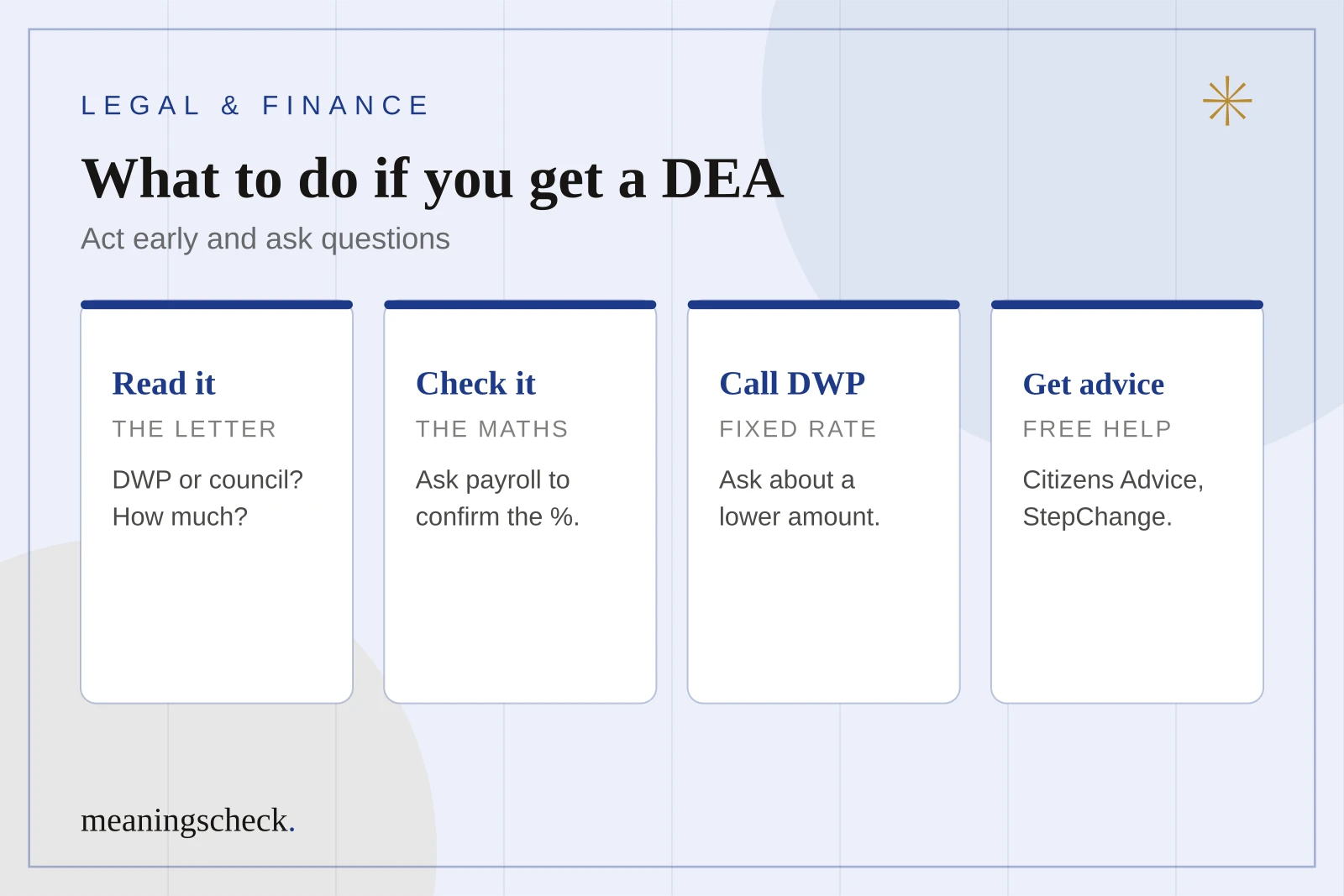
The Short Answer: Check the letter and who sent it, check your employer's calculation, contact the DWP using the number on the DEA letter, ask about a lower fixed rate, and challenge the original overpayment decision if you think it's wrong. Free debt advice services can help.
1. Read the Letter Carefully
Note who issued it (DWP or council), the amount owed, and the reference number.
2. Check the Calculation
If the amount looks wrong, ask your employer to check it against the rate tables first.
3. Contact the DWP
If the calculation is right but you're struggling, call the number on your DEA letter. The DWP guide says employees "can contact us to negotiate a fixed DEA deduction rate, which is usually a lower amount."
4. Question the Debt Itself
If you believe the overpayment was wrong, you may be able to ask for the decision to be looked at again. GOV.UK's overpayment guidance mentions mandatory reconsideration, usually within one month of the overpayment decision letter.
5. Get Free Advice
Free, independent help is available from organizations such as Citizens Advice, StepChange, and National Debtline.
| Step | Why It Helps |
|---|---|
| Check who sent it | Know whether to contact DWP or the council |
| Check the maths | Catch payroll errors |
| Call the DWP | Ask about a lower fixed amount |
| Challenge the decision | If the overpayment itself is wrong |
| Get debt advice | Free, confidential support |
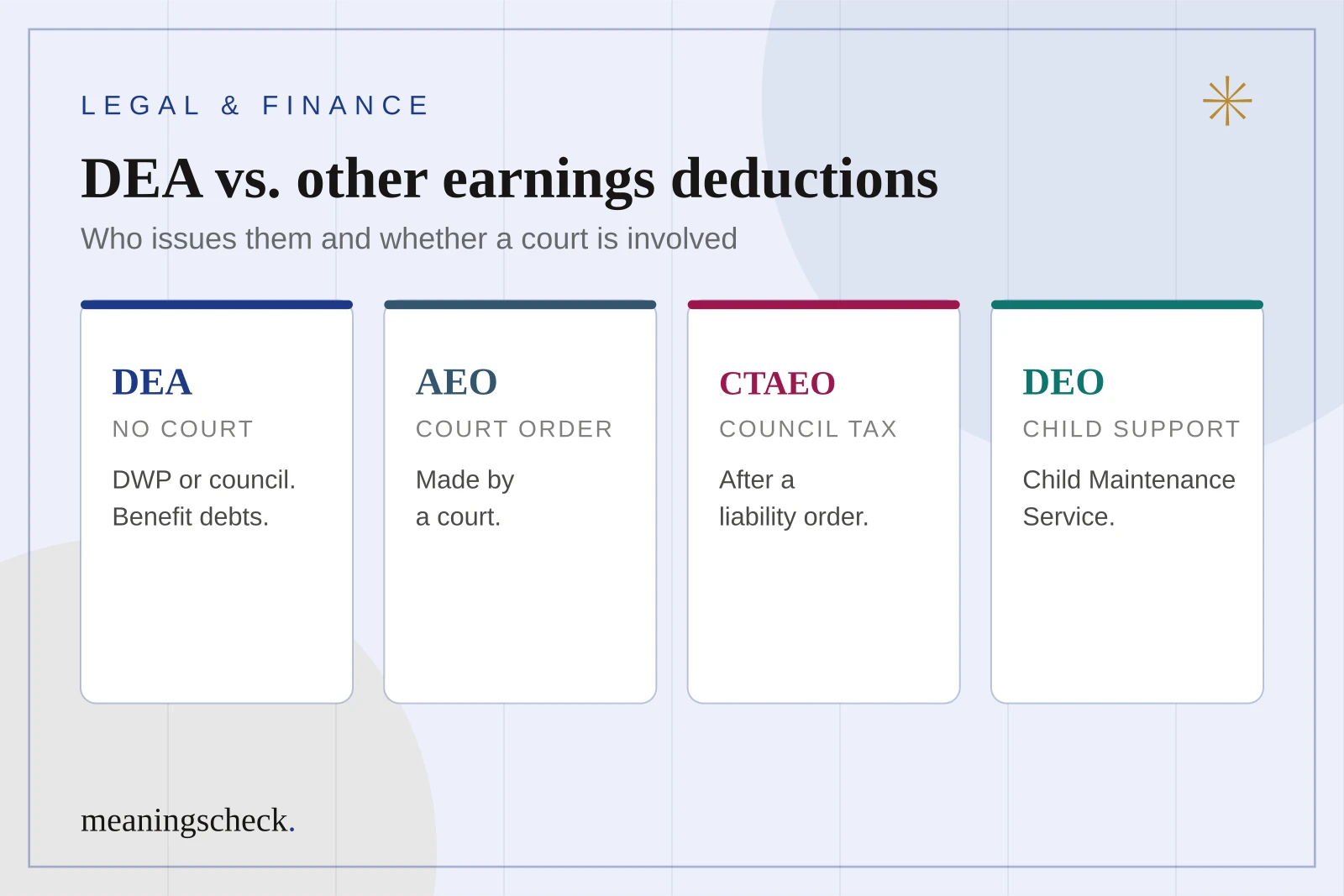
DEA vs. Attachment of Earnings Order and Other Deductions
The Short Answer: A DEA comes straight from the DWP or a council without court involvement. An Attachment of Earnings Order (AEO) is made by a court. Council Tax and child maintenance deductions have their own orders. Some orders take priority over a DEA.
| Deduction | Issued By | Court Needed? | Typical Debt |
|---|---|---|---|
| DEA (DWP) | DWP Debt Management | No | Benefit overpayments and other DWP debt |
| DEA (council) | Local council | No | Housing Benefit overpayments |
| Attachment of Earnings Order (AEO) | A court | Yes | Court debts, fines, maintenance |
| Council Tax Attachment of Earnings Order (CTAEO) | Council, after a liability order | Liability order from magistrates | Unpaid Council Tax |
| Deduction from Earnings Order (DEO) | Child Maintenance Service | No | Child maintenance |
Which Comes First?
The DWP guide explains a priority order. AEOs for maintenance or fines, Council Tax orders, and Child Maintenance Service orders rank above a DEA. Council Housing Benefit DEAs and DWP DEAs are non-priority and ranked by date. The guide also says student loan deductions are treated like a priority order.
Key takeaway: A DEA skips the courts. It doesn't jump the queue ahead of priority orders like child maintenance or Council Tax.
What If You Have More Than One Deduction?
The Short Answer: If you have several earnings deductions, priority orders (like child maintenance or Council Tax orders) are taken first. Non-priority DEAs follow in date order. Together, deductions can't take more than 40% of net pay. A DEA may be reduced to fit.
Here's how stacking works, based on the DWP guide:
- Priority orders first: AEOs for maintenance or fines, Council Tax orders, and Child Maintenance Service orders. Student loan deductions are treated like a priority order.
- Non-priority next: DWP DEAs and council Housing Benefit DEAs, in date order.
- The 40% cap: If total deductions would exceed 40% of net pay, the DEA is reduced so you keep at least 60%.
| Order of Deduction | Example |
|---|---|
| 1st (priority) | Child maintenance DEO |
| 2nd (priority) | Council Tax order |
| 3rd (treated as priority) | Student loan |
| 4th (non-priority, by date) | DWP DEA |
| 5th (non-priority, by date) | Council HB DEA |
Budgeting With a DEA
The Short Answer: Recalculate your budget using your new take-home pay, cover priority bills first (rent or mortgage, Council Tax, energy, food), and avoid high-cost borrowing to fill the gap. If the deductions make bills unaffordable, contact the DWP and a free debt adviser quickly.
A DEA lowers your take-home pay. A quick budget review helps:
- Work out your new net pay after the DEA and any admin fee.
- List priority bills first: housing, Council Tax, energy, food, and travel to work.
- Cut or pause non-essentials where possible.
- Avoid payday loans or high-cost credit to cover the shortfall.
- Ask for help early if the numbers don't add up.
| Priority Bill | Why It Comes First |
|---|---|
| Rent or mortgage | Keeps your home |
| Council Tax | Serious enforcement if unpaid |
| Energy | Essential for daily life |
| Food | Essential |
| Travel to work | Keeps your income coming in |
Free budgeting tools from Citizens Advice, StepChange, and National Debtline can help you build a realistic plan.
A Quick Guide for Employers
The Short Answer: When you receive a DEA notice, check the employee details, start deductions from the first payday on or after 22 days, calculate the percentage from net earnings using the correct table, pay the DWP by the 19th of the following month, and keep records. Report leavers within 10 days.
If you run payroll, here's a simple checklist based on the DWP guide:
- Check the notice: confirm the employee works for you. If not, tell the DWP within 10 days.
- Note the rate: standard (Table A), higher (Table B), or a fixed amount.
- Calculate net earnings: pay after income tax, Class 1 NI, and pension contributions.
- Apply the 60% rule: reduce the DEA if total deductions would exceed 40% of net pay.
- Tell the employee: show the deduction (and any £1 fee) on the payslip.
- Pay the DWP: by the 19th of the following month, with a payment schedule where required.
- Keep records: of every deduction and payment.
| Employer Task | When |
|---|---|
| Confirm employment | On receiving the notice |
| First deduction | Payday on/after 22 days from notice |
| Payment to DWP | By the 19th of the next month |
| Report leaver | Within 10 days |
Employers should follow the DWP's current employer guide on GOV.UK for full details.
DEAs and People Still on Benefits
The Short Answer: DEAs are aimed at people who aren't receiving benefits. If you're on benefits such as Universal Credit, the DWP usually recovers money owed by deducting it from your benefit payments instead.
The DWP guidance describes DEAs as a tool for recovering money from people "not in receipt of a benefit." For people still receiving benefits, debts are typically recovered through deductions from benefit payments. If your situation changes — for example, you start working and your benefit stops — the DWP may then consider other recovery options, including a DEA.
How a DEA Shows Up on Your Payslip
The Short Answer: Your payslip will usually show a separate deduction labeled as a DEA or similar, plus any £1 admin fee. Your employer must tell you the amount and how it was worked out.
Look for lines such as:
- "DEA" or "DWP deduction"
- "Admin fee" (up to £1)
If it's unclear, ask your payroll team for a breakdown.
Does a DEA Affect Your Credit or Job?
The Short Answer: A DEA isn't a court judgment. It doesn't create a County Court Judgment (CCJ). Your employer will know about it because they process it. It should be handled confidentially as part of payroll.
No CCJ
Because a DEA doesn't go through the courts, it doesn't result in a County Court Judgment.
Your Employer Will Know
Payroll staff must process the deduction. Treat it like any other confidential payroll matter. If you're worried about how your employer is handling it, free advice services can help.
Leaving Your Job
If you leave, deductions stop with that employer. Your employer must tell the DWP within 10 days. The debt doesn't disappear, though — the DWP may contact you again or issue a new DEA to a new employer.
Common Myths About DEAs
The Short Answer: Common myths are that a DEA needs a court, that it can take all your wages, that it's a fine for a crime, or that changing jobs cancels the debt. None of these is true.
| Myth | Fact |
|---|---|
| "A DEA needs a court order." | No — the DWP can issue it directly. |
| "They can take my whole wage." | No — you keep at least 60% of net pay. |
| "A DEA means I committed a crime." | No — it's a debt recovery tool. |
| "Changing jobs cancels the debt." | No — the debt remains. |
| "My employer can refuse." | No — employers must comply or risk a fine. |
| "There's nothing I can do." | You can check the maths, ask about a fixed rate, and get advice. |
Real-World Examples: How People Encounter DEAs
The Short Answer: People usually first hear about a DEA through a DWP letter, a payroll message, or a new payslip line. These typical scenarios show what's happening each time.
These are illustrative scenarios, not real cases.
The Payroll Email
HR: "We've received a DEA notice from the DWP. Deductions will start from the next payday after the 22-day period."
What it means: Your employer is legally required to start deductions.
The Payslip Surprise
Employee: "Why is there a £34 'DEA' line on my payslip?"
What it means: £33 DEA (11% of £300 net) plus a £1 admin fee.
The Struggle
Employee: "I can't afford this amount."
What to do: Call the number on the DEA letter and ask about a lower fixed rate. Contact a free debt adviser.
| Scenario | First Step |
|---|---|
| Employer received a notice | Read the DEA letter |
| Unexpected payslip deduction | Ask payroll for the calculation |
| Can't afford deductions | Call the DWP about a fixed rate |
| Think the debt is wrong | Ask about reconsideration |
Expert Insights: Why DEAs Exist and What They Mean for You
The Short Answer: DEAs give the DWP a faster, cheaper way to recover debt without court costs. The 60% rule and income-based rates aim to balance recovery with affordability. For employees, the most important steps are acting early and getting advice.
Faster Than Court
Before DEAs, recovering money from people no longer on benefits often meant going to court. DEAs let the DWP skip that step, which saves time and legal costs.
Income-Based Rates
The percentage rises with earnings. Lower earners pay less — or nothing at the standard rate if they earn under £100 a week.
Safeguards Matter
The 60% protection, the 22-day notice period, and the option to negotiate a fixed rate are important safeguards. Knowing them helps you plan.
Early Action Helps
Contacting the DWP early, before deductions start, can make it easier to agree an affordable repayment.
Real-World Patterns
- Employees: "What's this DEA on my payslip?"
- Employers: "When do we pay the DWP?"
- Advisers: "Have you checked the overpayment decision?"
DEA Glossary: Terms You'll See
The Short Answer: Key terms include DWP, overpayment, net earnings, standard and higher rates, fixed rate, protected earnings, AEO, CTAEO, DEO, and mandatory reconsideration.
| Term | Meaning |
|---|---|
| DWP | Department for Work and Pensions |
| Overpayment | Benefit paid that you weren't entitled to |
| Net earnings | Pay after tax, NI, and pension contributions |
| Standard rate | DEA rates from nil to 20% |
| Higher rate | DEA rates from 5% to 40% |
| Fixed rate | A set amount, often negotiated lower |
| Protected earnings | The 60% of net pay you must keep |
| AEO | Attachment of Earnings Order (court-made) |
| CTAEO | Council Tax Attachment of Earnings Order |
| DEO | Deduction from Earnings Order (child maintenance) |
| Mandatory reconsideration | Asking DWP to look again at a decision |
Want the short version of all this? Some people like a quick summary at the top of long guides — the habit our TLDR meaning guide explains. Here it is: a DEA takes a capped share of your pay to repay DWP debt. You also have options.
Related Legal and Financial Terms
The Short Answer: DEAs sit alongside other legal and money terms that affect everyday life, from inheritance to driving offences. Knowing the vocabulary makes official letters less intimidating.
Legal and financial words often come up when life changes. Inheritance terms are explained in our Legacy meaning guide. Driving-law abbreviations like OWI are covered in our OWI meaning guide. And if you're curious how faith-based finance handles interest, our Halal meaning guide touches on Islamic banking.
How to Explain a DEA Simply
The Short Answer: Say: "A DEA is when the government takes a small part of your wages to pay back benefits you were overpaid. Your employer handles it. You always keep at least 60% of your take-home pay."
- "It's a way to repay money owed to the DWP."
- "Your employer takes it from your wages."
- "No court is involved."
- "You keep at least 60% of your take-home pay."
- "You can ask for a lower amount if you're struggling."
Common Mistakes People Make With DEAs
The Short Answer: The biggest mistakes are ignoring the letter, contacting the wrong organization, assuming the debt is wrong without checking, not asking about a fixed rate, and assuming a new job ends the debt.
- Ignoring the notice. Act early.
- Calling the employer helpline instead of the number on your letter. Use the number on your DEA letter.
- Not checking who issued it. DWP and council DEAs are handled separately.
- Not asking about a fixed rate. It may be lower.
- Assuming a new job ends it. The debt remains.
Frequently Asked Questions (FAQs)
What is a Direct Earnings Attachment?
It's a way for the DWP or a council to recover money owed, usually benefit overpayments, by deducting it directly from your wages.
Does a DEA need a court order?
No. The DWP can issue a DEA without going to court.
How much can a DEA take?
It depends on your net pay. Standard rates range from nil to 20%, and higher rates from 5% to 40%. You must keep at least 60% of your net pay.
When does a DEA start?
From the next payday on or after 22 days after the date on the notice letter.
Can my employer charge me for a DEA?
Employers may take up to £1 per pay period as an admin fee.
Can I reduce my DEA payments?
You can contact the DWP to ask about a fixed deduction rate, which is usually lower.
What happens if I change jobs?
Deductions stop with your old employer. The debt remains, and the DWP may contact you or a new employer.
Does a DEA affect my credit rating?
A DEA isn't a court judgment. It doesn't create a CCJ.
Do DEAs apply in Northern Ireland?
No. The DWP's DEA regulations apply in England, Scotland, and Wales.
Final Thoughts
A Direct Earnings Attachment can feel alarming when it first appears on a letter or payslip. But the rules are clear. The deductions are based on your income. You always keep at least 60% of your net pay. You also have the right to ask questions and negotiate.
The most important step is the first one — read the letter, check the numbers, and get in touch early.
For more legal and money terms explained in plain English, explore our legal and finance guides.
Related terms
Share: · Post on X
Written by MeaningsCheck Team · Published
The MeaningsCheck team researches and writes plain-language explanations of slang, abbreviations, and everyday words — checked for accuracy, updated as language changes.