
What Does Dichotomy Mean? Dichotomy Definition, Examples, and False Dichotomies Explained (2026)
A dichotomy is a division into two parts that are opposed or entirely different, as in "the dichotomy between theory and practice." It comes from a Greek word meaning "cutting in two." A false dichotomy wrongly presents only two options when more exist.
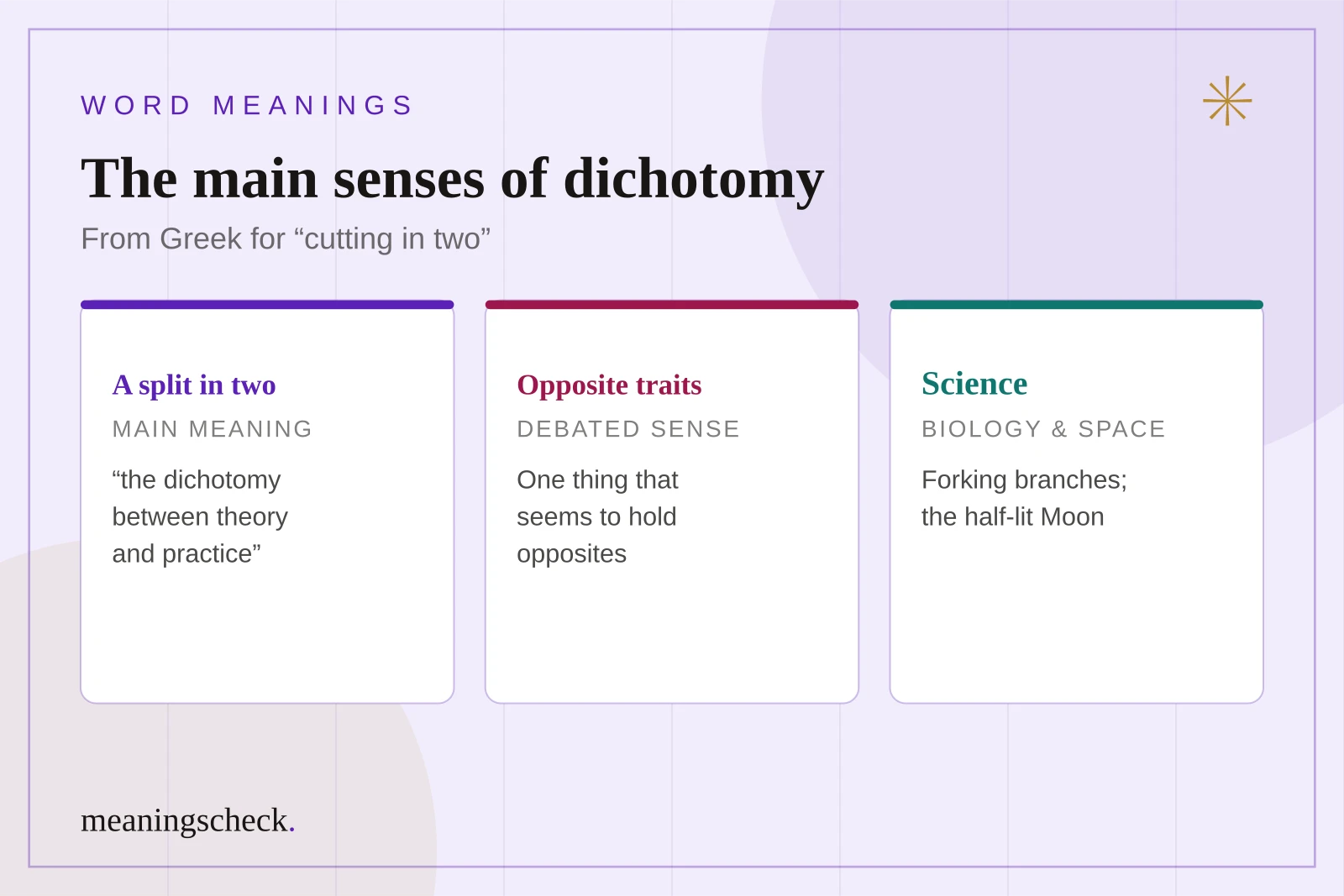
A dichotomy is a division into two parts that are opposed or entirely different. Think good vs. evil, theory vs. practice, or online vs. offline. When someone talks about "the dichotomy between work and play," they mean the sharp split between the two.
It's one of those words that sounds academic. Yet the idea behind it is simple: cutting something in two.
If you're asking what does dichotomy mean, this guide gives you the full picture. You'll learn the dichotomy definition, how to pronounce it, where it came from, real dichotomy examples, the popular false dichotomy fallacy, dichotomous thinking in psychology, and how dichotomy differs from paradox, contradiction, and duality.
Key takeaway: Dichotomy = a split into two contrasting parts. A false dichotomy = pretending there are only two options when there are more.
Executive Summary: Dichotomy at a Glance
Here's the quick version:
- Meaning: A division into two opposed or very different parts.
- Pronunciation: dye-KOT-uh-mee (/daɪˈkɒtəmi/).
- Part of speech: Noun. Plural: dichotomies.
- Origin: Greek dichotomía, "dividing in two." Merriam-Webster dates its first known English use to 1588.
- Common pattern: "the dichotomy between X and Y."
- Related words: Dichotomous (adjective), dichotomize (verb).
- Famous phrase: False dichotomy — a fallacy that offers only two choices when others exist.
- Science senses: Repeated forking in plants and the half-lit phase of the Moon or an inner planet.
- Usage debate: Some dictionaries accept dichotomy for "something with contradictory qualities." Others call that use incorrect.
What Does Dichotomy Mean? The Core Definition
The Short Answer: Dichotomy means a division into two groups or parts that are often opposed or mutually exclusive. Merriam-Webster gives "the dichotomy between theory and practice" as an example. The word stresses contrast: the two sides are clearly different.
The Main Meaning
At its heart, a dichotomy is a split into two. But not just any split. The two parts are usually:
- Opposed: good vs. evil.
- Very different: urban vs. rural.
- Mutually exclusive: something can't be fully both at once, like on vs. off.
Merriam-Webster defines it as a division into two groups that are often "mutually exclusive or contradictory." Dictionary.com adds a logic sense: the division of a class into two mutually exclusive subclasses.
The Formal Logic Definition
In logic and set theory, a true dichotomy has two features:
- Mutually exclusive: Nothing belongs to both parts.
- Jointly exhaustive: Everything belongs to one part or the other.
"Alive or not alive" is a strict dichotomy. Every living thing is one or the other, never both.
All Senses of Dichotomy
| Sense | Meaning | Example |
|---|---|---|
| General | A split into two opposed parts | "the dichotomy between work and play" |
| Logic | Dividing a class into two exclusive subclasses | "true or false" |
| Contradictory qualities | Something that seems to combine opposites | "a sartorial dichotomy" |
| Botany | Repeated forking into two branches | "dichotomous branching in ferns" |
| Astronomy | The half-lit phase of the Moon or an inner planet | "Venus at dichotomy" |
How to Pronounce Dichotomy
The Short Answer: Dichotomy is pronounced "dye-KOT-uh-mee," with the stress on the second syllable. Merriam-Webster also lists a less common "duh-KOT-uh-mee." The "ch" sounds like "k," not like the "ch" in "chair."
The word has four syllables: di-chot-o-my.
| Syllable | Sounds Like |
|---|---|
| di | "dye" |
| chot | "KOT" (stressed) |
| o | "uh" |
| my | "mee" |
Common Pronunciation Mistakes
- "dee-CHOT-uh-mee" — the "ch" is a hard "k."
- "DYE-ko-toe-my" — the stress belongs on "KOT."
- "die-CHOT-oh-my" — again, no "ch" sound.
A quick trick: it rhymes with the end of "lobotomy" and "anatomy." Those words share the same Greek "cutting" root.
Where Does the Word Dichotomy Come From?
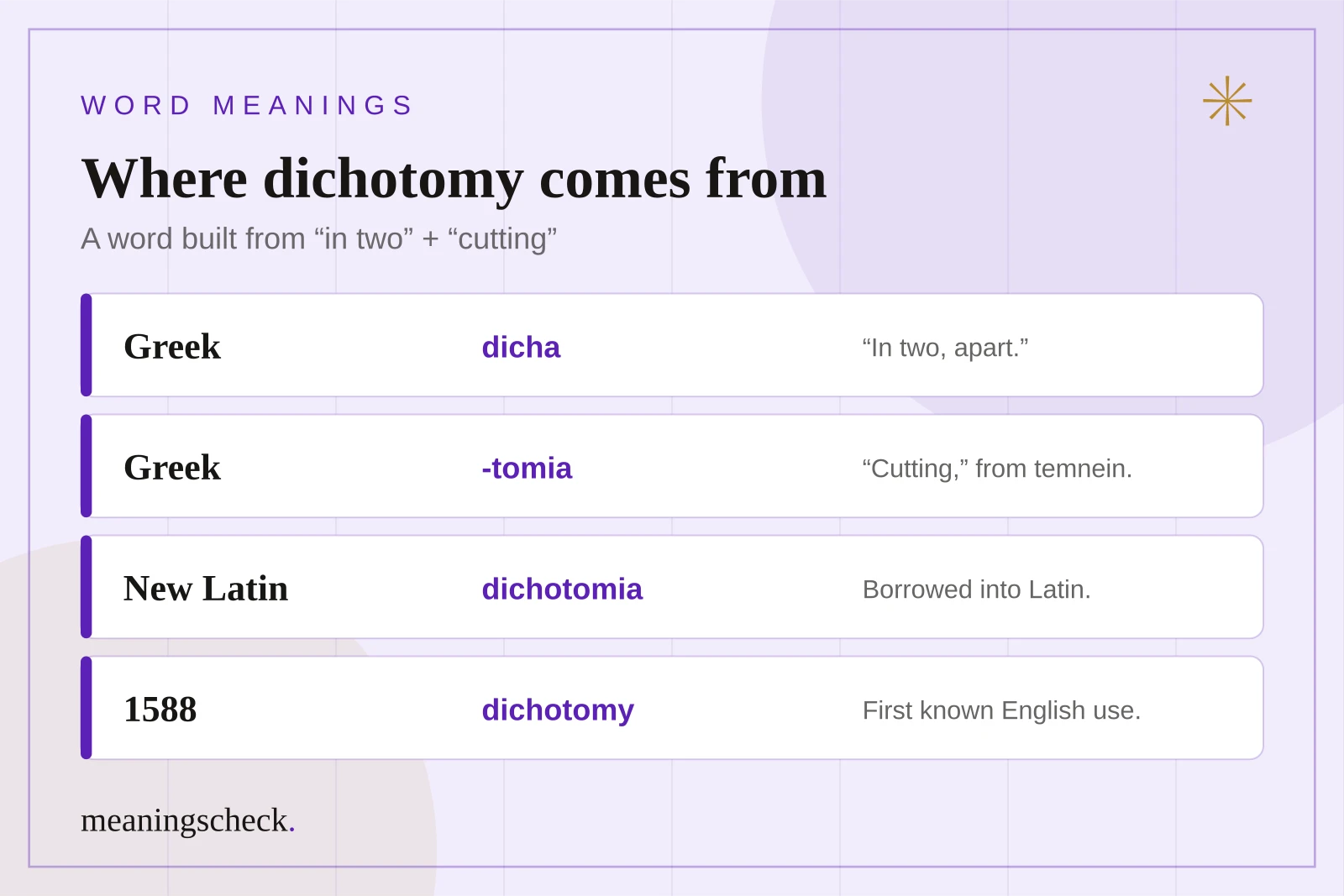
The Short Answer: Dichotomy comes from the Greek dichotomía, meaning "division into two parts," built from dicha ("in two") and temnein ("to cut"). It reached English through New Latin. Merriam-Webster dates its first known English use to 1588.
The Greek Roots
The word combines two Greek pieces:
- dicha — "in two, apart."
- -tomia — "cutting," from temnein, "to cut."
Put together, dichotomía meant "a cutting in two." Greek writers used it in logic and in describing the Moon's phases.
Cousins in English
That same "cut" root shows up in many English words:
| Word | Literal Meaning | Today's Meaning |
|---|---|---|
| Dichotomy | "cutting in two" | A split into two parts |
| Anatomy | "cutting up" | The structure of the body |
| Atom | "uncuttable" | The smallest unit of an element |
| Lobotomy | "cutting a lobe" | A brain operation |
| Appendectomy | "cutting out the appendix" | Removing the appendix |
| Tome | "a cut piece" (a section) | A large book |
Timeline
| Period | Milestone |
|---|---|
| Ancient Greece | Dichotomía used for division in logic and for the Moon's half-phase |
| Late Latin / New Latin | Borrowed as dichotomia |
| 1588 | First known English use, per Merriam-Webster |
| Later centuries | Extended to botany, astronomy, and everyday contrasts |
| Modern usage | "False dichotomy" becomes a common term in debate and critical thinking |
Key takeaway: Dichotomy literally means "a cut in two." Remembering the knife image helps you remember the meaning.
Dichotomy Examples in Sentences
The Short Answer: Dichotomy usually appears as "the dichotomy between X and Y" or "the X/Y dichotomy." For example: "There's a dichotomy between what people say and what they do." These examples show it in everyday, academic, and business settings.
Everyday Examples
- "There's a clear dichotomy between his public image and his private life."
- "The movie plays with the dichotomy of hero and villain."
- "Her style is a fun dichotomy: fancy dress, beat-up sneakers."
- "Many cities show a dichotomy between rich and poor neighborhoods."
Academic Examples
- "The essay challenges the dichotomy between nature and nurture."
- "Philosophers have long debated the mind-body dichotomy."
- "The study rejects a simple dichotomy of winners and losers."
Business Examples
- "Leaders face a dichotomy between short-term profit and long-term growth."
- "The report highlights the dichotomy between remote and office workers."
- "Our brand avoids the luxury-versus-budget dichotomy."
| Pattern | Example |
|---|---|
| the dichotomy between X and Y | "the dichotomy between work and rest" |
| the dichotomy of X and Y | "the dichotomy of light and dark" |
| the X/Y dichotomy | "the public/private dichotomy" |
| a false dichotomy | "That's a false dichotomy." |
| create a dichotomy | "The rule creates a dichotomy." |
| break down the dichotomy | "We need to break down that dichotomy." |
The Two Big Meanings: A Split vs. Contradictory Qualities
The Short Answer: The older meaning of dichotomy is a division into two opposed groups. A newer meaning describes one thing with seemingly contradictory qualities. Merriam-Webster accepts both. Dictionary.com says the second use is "generally considered incorrect."
This is where the word gets interesting — and a little controversial.
Meaning 1: A Division Into Two
"The dichotomy between rich and poor." Two groups, clearly separated. This is the original, uncontested meaning.
Meaning 2: Contradictory Qualities in One Thing
"He's a walking dichotomy: shy at work, wild on weekends." Here, one person seems to hold opposite traits. Merriam-Webster lists this sense, with the example of an elegant gown paired with ratty tennis shoes.
The Usage Debate
Dictionary.com takes a stricter view. Its usage note says dichotomy should refer to a division into two groups. It calls the "puzzling, contradictory situation" sense generally considered incorrect.
| Use | Example | Accepted By |
|---|---|---|
| Division into two | "the dichotomy between rich and poor" | Everyone |
| One thing, opposite traits | "she's a dichotomy" | Merriam-Webster; criticized by some guides |
| Any minor difference | "a dichotomy between blue and navy" | No one — too weak |
What Should You Do?
If you want to be safe, use dichotomy for two separate, contrasting things. For one thing with opposite qualities, words like paradox or contradiction are clearer. We cover the differences below.
Key takeaway: "The dichotomy between A and B" is always correct. "She's a dichotomy" is accepted by some dictionaries and frowned on by others.
What Is a False Dichotomy?
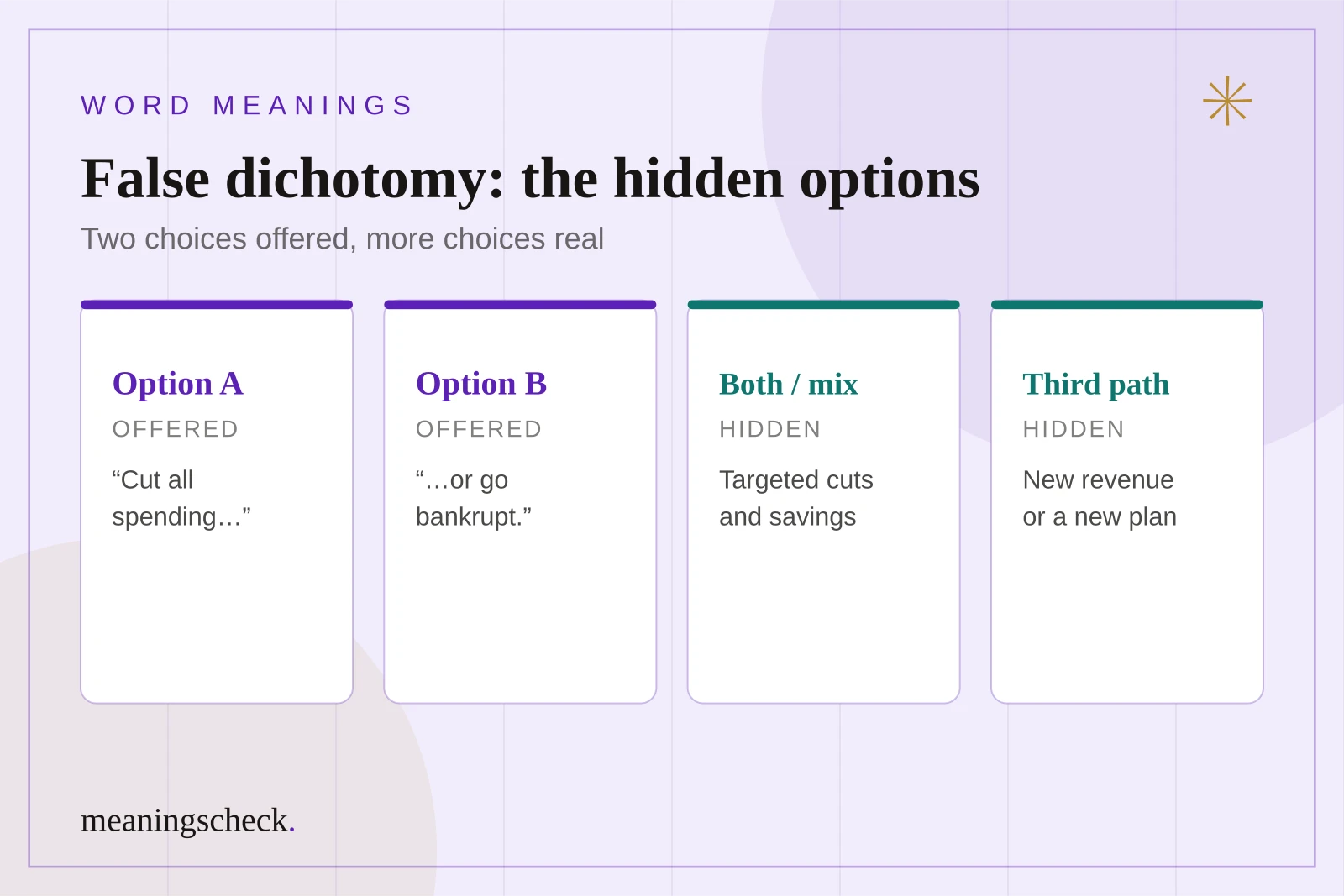
The Short Answer: A false dichotomy is a logical fallacy that presents only two choices when other options exist. "You're either with us or against us" is a classic example. It's also called a false dilemma, an either-or fallacy, or black-and-white thinking.
A false dichotomy (also called a false dilemma) pretends that a choice has just two options. In reality, there are more.
Classic Examples
- "You're either with us or against us."
- "If you don't love this city, leave."
- "Either we cut all spending or we go bankrupt."
- "You can be smart or creative — not both."
Each one hides middle ground, compromise, or a third path.
Why It Works on People
Two options feel simple and urgent. They make a hard choice look easy. Persuaders use false dichotomies to push people toward the option they want by making the alternative look terrible.
How to Spot One
Ask yourself:
- Are these really the only two options?
- Could both be partly true?
- Is there a middle ground or a third choice?
- Who benefits from framing it this way?
How to Respond
- "I don't think those are the only two options."
- "Couldn't we do a bit of both?"
- "What about a third approach?"
| False Dichotomy | Missing Options |
|---|---|
| "Work hard or be lazy." | Rest, balance, working smart |
| "Love it or leave it." | Stay and improve it |
| "Smart or creative." | Both, in different ways |
| "Cut everything or go broke." | Targeted cuts, new revenue |
| "Agree with me or you're wrong." | Partial agreement, new evidence |
Dichotomous Thinking: The Psychology Angle
The Short Answer: Dichotomous thinking means seeing things in all-or-nothing, black-and-white terms: perfect or a failure, good or bad. Psychologists list it as a common thinking trap, often called "all-or-nothing thinking." Recognizing it can help people think more flexibly.
What It Looks Like
- "If I don't get an A, I'm a failure."
- "She didn't text back. She must hate me."
- "One bad day means the whole week is ruined."
In each case, a complex situation shrinks into two extremes.
All-or-Nothing Thinking
In cognitive behavioral therapy (CBT), this pattern is often called all-or-nothing thinking. Psychiatrist David D. Burns listed it as a cognitive distortion in his popular 1980 book Feeling Good. The idea builds on the work of Aaron T. Beck, a founder of cognitive therapy.
Why It Matters
Black-and-white thinking can make setbacks feel bigger than they are. Noticing the "gray areas" is a common first step in more balanced thinking.
| Dichotomous Thought | More Balanced Thought |
|---|---|
| "I failed completely." | "Parts went well; parts need work." |
| "They're a terrible person." | "They made a bad choice." |
| "Everything is ruined." | "This part went wrong. I can fix some of it." |
| "I always mess up." | "I made a mistake this time." |
This section is for general information, not medical or mental health advice. If negative thinking is affecting your daily life, consider talking to a licensed professional.
Dichotomy in Science, Philosophy, and Literature
The Short Answer: In biology, dichotomy describes repeated two-way branching and the "dichotomous keys" used to identify species. In astronomy, it's the half-lit phase of the Moon or an inner planet. In philosophy and literature, famous dichotomies include mind vs. body and Apollonian vs. Dionysian.
Biology: Branching and Keys
Dichotomous branching happens when a growing tip splits into two equal branches, again and again. You can see it in some ferns, algae, and root systems.
A dichotomous key is a tool for identifying plants or animals. Each step gives two choices ("Leaves needle-shaped? Yes or no") until you reach the species.
Astronomy: Half-Lit Phases
In astronomy, dichotomy is the moment when the Moon, Mercury, or Venus appears exactly half-illuminated from Earth.
Statistics: Dichotomous Variables
A dichotomous variable has only two values: yes/no, pass/fail, smoker/non-smoker. Turning a continuous measure into two groups is called dichotomization.
Philosophy: Mind and Body
René Descartes argued that the mind and body are separate substances. This idea, called Cartesian dualism, is often described as the mind-body dichotomy.
Literature: Famous Opposites
- Friedrich Nietzsche contrasted the Apollonian (order, reason) and the Dionysian (chaos, emotion) in The Birth of Tragedy (1872).
- Robert Louis Stevenson's Strange Case of Dr Jekyll and Mr Hyde (1886) dramatizes the split between a respectable self and a hidden dark side.
- Charles Dickens opened A Tale of Two Cities (1859) with "It was the best of times, it was the worst of times."
| Field | Dichotomy Means | Example |
|---|---|---|
| Biology | Two-way branching | Fern fronds forking |
| Biology | Two-choice identification | Dichotomous key |
| Astronomy | Half-lit phase | Venus at dichotomy |
| Statistics | Two-value variable | Yes/no survey answer |
| Philosophy | Two opposed principles | Mind vs. body |
| Literature | Opposed forces or selves | Jekyll vs. Hyde |
Famous Dichotomies People Debate
The Short Answer: Well-known dichotomies include nature vs. nurture, mind vs. body, theory vs. practice, introvert vs. extrovert, and left brain vs. right brain. Many experts argue that some of these are really spectrums, not strict either-or splits.
| Dichotomy | What It Contrasts | Strict or Spectrum? |
|---|---|---|
| Nature vs. nurture | Genes vs. environment | Most scientists say both interact |
| Mind vs. body | Mental vs. physical | Debated in philosophy |
| Theory vs. practice | Ideas vs. doing | Often overlap |
| Introvert vs. extrovert | Inward vs. outward energy | Usually seen as a spectrum |
| Left brain vs. right brain | "Logical" vs. "creative" people | Not supported as personality types |
| Work vs. life | Job vs. personal time | Blurred by remote work |
| Urban vs. rural | City vs. country | Suburbs sit between |
The Left-Brain/Right-Brain Myth
You may have heard that people are "left-brained" (logical) or "right-brained" (creative). Brain-imaging research doesn't support that as a personality split. A widely reported 2013 University of Utah study of more than 1,000 brain scans found no evidence that people favor one hemisphere overall. It's a good example of a popular dichotomy that turns out to be false.
Nature and Nurture
The nature vs. nurture debate asks whether genes or environment shape us. Today, most researchers see it as both, working together — another dichotomy that softened over time. Religious law can work the same way: Islamic jurisprudence sorts actions into five categories, not just halal and haram, as our Halal meaning guide explains.
Dichotomy vs. Yin and Yang
The Short Answer: A dichotomy splits two things apart. Yin and yang, from Chinese philosophy, describes opposites that depend on each other and flow into each other. One stresses separation. The other stresses balance and connection.
People sometimes describe yin and yang as a dichotomy. It's a useful comparison because it shows what a dichotomy is not.
- In a strict dichotomy, the two parts are separate and don't overlap.
- In yin and yang, the two forces are complementary. Each contains a bit of the other, and neither makes sense alone. Think of night turning into day.
| Idea | Relationship Between the Two Sides | Example |
|---|---|---|
| Dichotomy | Separate, often opposed | "alive or not alive" |
| Yin and yang | Interdependent, balancing | Light and shadow shaping each other |
| Spectrum | A smooth range between two ends | Introvert to extrovert |
This is why some writers prefer to talk about tension or balance instead of a dichotomy. The word you pick changes how the relationship sounds.
Dichotomy in Art, Design, and Politics
The Short Answer: Artists use visual dichotomies like light and dark to create drama. Designers balance positive and negative space. In politics and media, "us vs. them" framing turns complex issues into two sides — sometimes helpfully, often too simply.
Art: Light and Dark
Painters have long used strong light-dark contrast. The Italian word chiaroscuro ("light-dark") names this technique, famously used by Caravaggio. The dichotomy of light and shadow gives a painting depth and drama.
Design: Positive and Negative Space
In graphic design, positive space is the subject. Negative space is the empty area around it. Good designs balance the two. Some famous logos hide a second image in the negative space.
Politics and Media: "Us vs. Them"
Political debates often get framed as two sides: left vs. right, for vs. against. That framing makes news easy to follow. However, most people hold a mix of views. Recognizing a false dichotomy in a headline is a key media-literacy skill.
| Area | Common Dichotomy | Watch Out For |
|---|---|---|
| Art | Light vs. dark | — (a deliberate technique) |
| Design | Positive vs. negative space | Unbalanced layouts |
| Politics | Left vs. right | Ignoring the middle |
| Media | Hero vs. villain | Oversimplified stories |
Dichotomy vs. Paradox, Contradiction, Duality, and Juxtaposition
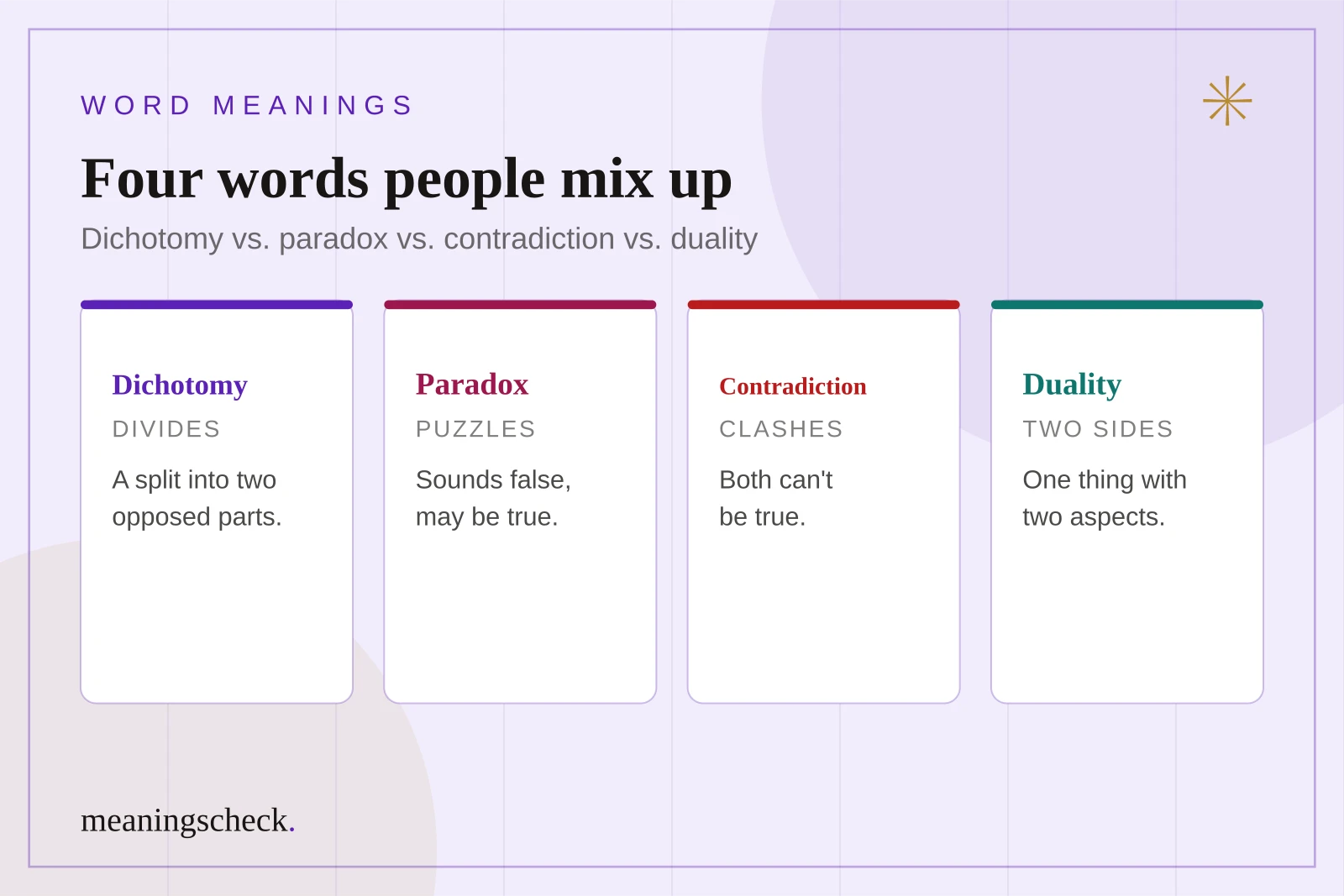
The Short Answer: A dichotomy splits things into two contrasting parts. A paradox is a statement that seems self-contradictory but may be true. A contradiction is two things that can't both be true. Duality means having two aspects. Juxtaposition places two things side by side for contrast.
These words often get mixed up:
| Word | Meaning | Example |
|---|---|---|
| Dichotomy | A split into two opposed parts | "the dichotomy between work and play" |
| Paradox | Seems contradictory, may be true | "Less is more." |
| Contradiction | Two claims that can't both be true | "It's raining and not raining." |
| Duality | Having two sides or aspects | "the duality of human nature" |
| Juxtaposition | Placing two things together for contrast | "a skyscraper beside a hut" |
| Binary | A system of two options | "a yes/no binary" |
| Dilemma | A hard choice between two options | "a moral dilemma" |
| Dualism | A belief in two basic principles | "Cartesian dualism" |
Dichotomy vs. Paradox
A dichotomy separates. A paradox puzzles. "Rich vs. poor" is a dichotomy. "The more you learn, the less you know" is a paradox.
Dichotomy vs. Duality
Duality describes one thing with two sides — like light behaving as both a wave and a particle. Dichotomy emphasizes the split between two things.
Dichotomy vs. Juxtaposition
Juxtaposition is a writing and art technique: putting contrasting things side by side. A writer might juxtapose two characters to highlight a dichotomy.
Dichotomy Synonyms and Antonyms
The Short Answer: Close synonyms include split, division, divide, contrast, separation, and polarity. Antonyms include unity, union, harmony, and wholeness. The best choice depends on whether you mean a division or a contrast.
Synonyms
| Synonym | Best Used When |
|---|---|
| Split | Casual writing |
| Division | Neutral, formal |
| Divide | Social or political groups ("the urban-rural divide") |
| Contrast | Emphasizing difference |
| Polarity | Two extremes, often opposites |
| Schism | A split within a group (especially religious) |
| Gulf | A wide separation ("a gulf between them") |
Antonyms
- Unity
- Union
- Harmony
- Wholeness
- Continuum (a smooth range instead of two boxes)
The Dichotomy Word Family
The Short Answer: Related forms include dichotomous (adjective), dichotomously (adverb), and dichotomize (verb, meaning to split into two). "Dichotomous key" and "dichotomous thinking" are common phrases.
| Word | Part of Speech | Example |
|---|---|---|
| Dichotomy | Noun | "a sharp dichotomy" |
| Dichotomies | Plural noun | "several dichotomies" |
| Dichotomous | Adjective | "dichotomous thinking" |
| Dichotomously | Adverb | "branching dichotomously" |
| Dichotomize | Verb | "Don't dichotomize the issue." |
| Dichotomization | Noun | "dichotomization of data" |
How to Use Dichotomy Correctly
The Short Answer: Use dichotomy for two clearly contrasting parts, usually with "between ... and ..." Avoid using it for small differences or for more than two groups. When describing one thing with opposite traits, consider "paradox" or "contradiction" instead.
Do
- "The novel explores the dichotomy between freedom and safety."
- "Critics call it a false dichotomy."
Don't
- "There's a dichotomy between the three plans." (A dichotomy has two parts.)
- "There's a dichotomy between blue and navy." (Too small a difference.)
- "a two-sided dichotomy" (Redundant — it's already two.)
Spelling Tip
It's dichotomy, not "dicotomy" or "dichotamy." Remember: di (two) + chot + omy, like "anatomy."
Dichotomy in Everyday Life and Work
The Short Answer: Everyday dichotomies include work vs. life, online vs. offline, saving vs. spending, and introvert vs. extrovert. At work, people talk about dichotomies like speed vs. quality and short-term vs. long-term goals.
At Home
- Saving vs. spending
- Screen time vs. outdoor time
- Cooking vs. takeout
At Work
- Speed vs. quality
- Remote vs. office
- Short-term profit vs. long-term growth
Online
- Public vs. private accounts
- Real life vs. online persona
Many of these feel like either-or choices. In practice, people often find a balance. That's why calling something a dichotomy can be useful for discussion — and why "false dichotomy" is such a handy counterpoint.
Real-World Examples: Dichotomy in Conversation
The Short Answer: You'll hear dichotomy in classrooms, meetings, reviews, and debates. These examples show how people use it and how to respond.
These are typical patterns, not quotes from real people.
In a Classroom
Teacher: "Today we'll look at the dichotomy between rural and urban life in the novel."
What it means: The book contrasts two ways of living.
In a Meeting
Manager: "We keep treating speed and quality as a dichotomy. Can we have both?"
What it means: The team is assuming a false either-or choice.
In a Review
Critic: "The film's dichotomy of light and shadow is stunning."
What it means: The movie uses strong visual contrast.
In a Debate
Speaker A: "Either we ban cars downtown or we accept pollution."
Speaker B: "That's a false dichotomy. What about better buses?"
| Setting | How Dichotomy Is Used |
|---|---|
| Classroom | Analyzing contrasts in texts |
| Meeting | Questioning either-or trade-offs |
| Review | Describing artistic contrast |
| Debate | Calling out false choices |
Expert Insights: Why Humans Love Dichotomies
The Short Answer: Splitting the world into two makes it easier to understand and remember. But real life is usually more complex. Good thinkers use dichotomies as a starting point, then look for the middle ground and the exceptions.
Two Boxes Are Easy
Our brains like simple categories. Two options are easy to compare, remember, and explain. That's why so many debates get framed as "this vs. that." The framing is so ubiquitous that we rarely notice it, to borrow another vocabulary word from our Ubiquitous meaning guide.
Useful, Then Limiting
A dichotomy can sharpen a discussion. "Theory vs. practice" helps us see a real gap. However, if we treat every issue as two boxes, we miss everything in between.
Spectrums Hide Behind Dichotomies
Many traits that look like dichotomies are actually spectrums: introvert to extrovert, short to tall, cautious to bold. Knowing this helps you spot oversimplified claims. Even "science vs. spirituality" can be a softer divide than it looks, as our Citrine meaning guide shows with a crystal people value for both its geology and its lore.
Language Shapes Thinking
The words we use can lock us into either-or thinking. Phrases like "both/and" or "to some extent" open up more options. Writers often swap "dichotomy" for "tension" when two ideas pull against each other but can coexist.
Real-World Patterns of Dichotomy
- Academic: "the nature/nurture dichotomy."
- Business: "the speed-versus-quality dichotomy."
- Debate: "that's a false dichotomy."
- Personal: "dichotomous, all-or-nothing thinking."
Dichotomy in Different Kinds of Writing
The Short Answer: In academic writing, dichotomy is common and expected. In business writing, it works when you're describing a clear trade-off. In casual speech, simpler words like "split" or "divide" often sound more natural.
| Writing Type | Is "Dichotomy" a Good Fit? | Simpler Alternative |
|---|---|---|
| Academic essay | Yes | — |
| Research paper | Yes | — |
| Business report | Usually | "trade-off," "divide" |
| News article | Sometimes | "split," "gap" |
| Text message | Rarely | "difference" |
| Kids' writing | Rarely | "opposites" |
Want a shorter way to summarize a long argument about dichotomies? Writers online often add a quick summary line, the habit our TLDR meaning guide explains.
Words With Two Opposite Meanings
The Short Answer: Some words contain their own dichotomy. They're called contronyms, or auto-antonyms. "Sanction" can mean approve or punish. "Dust" can mean add dust or remove it. Slang has them too: "peak" can mean amazing or unlucky.
A fun twist: some single words split into two opposite meanings.
| Word | Meaning 1 | Meaning 2 |
|---|---|---|
| Sanction | To approve | To penalize |
| Dust | To remove dust | To sprinkle with dust |
| Oversight | Supervision | A mistake from not noticing |
| Left | Remained | Departed |
| Peak (slang) | Amazing | Unlucky (UK) |
That last one shows how fast language splits. Our Peak meaning guide explains how "that's peak" means great in one place and unlucky in another. Older words shift too: our Legacy meaning guide shows how one word grew several senses.
How to Explain Dichotomy to a Kid
The Short Answer: Say: "A dichotomy is when you split something into two groups that are really different — like day and night, or hot and cold." Then add: "Sometimes people pretend there are only two choices when there are more. That's a false dichotomy."
Try this simple script:
- "Di" means two.
- "Dichotomy" means splitting into two very different groups.
- Examples: day and night, inside and outside, sweet and sour.
- A false dichotomy is pretending there are only two choices — like "pizza or nothing" when there's also pasta.
Quick Quiz: True Dichotomy or False Dichotomy?
The Short Answer: A true dichotomy has two options that cover everything and don't overlap. A false dichotomy leaves out real alternatives. Test yourself with these six examples.
| Statement | True or False Dichotomy? | Why |
|---|---|---|
| "A light switch is on or off." | True | No third state for a simple switch |
| "You're either a morning person or lazy." | False | Night owls aren't lazy |
| "A number is even or odd." | True | Every whole number is one or the other |
| "Buy this phone or fall behind." | False | Many other choices exist |
| "Alive or not alive." | True | Covers everything, no overlap |
| "Love math or hate it." | False | Most people are somewhere in between |
If you got all six, you can spot a false choice anywhere.
Common Mistakes With Dichotomy
The Short Answer: The biggest mistakes are mispronouncing the "ch," misspelling it, using it for more than two groups, using it for tiny differences, and saying "two-sided dichotomy."
- Saying "dee-CHOT-uh-mee." It's "dye-KOT-uh-mee."
- Spelling it "dichotamy." It's "dichotomy."
- Using it for three or more groups. A dichotomy has two parts.
- Using it for small differences. It implies a sharp contrast.
- Saying "two-sided dichotomy." That's redundant.
- Confusing it with paradox. A paradox puzzles. A dichotomy divides.
Frequently Asked Questions (FAQs)
What does dichotomy mean in simple words?
A dichotomy is a split into two very different or opposite parts, like good and evil.
How do you pronounce dichotomy?
It's pronounced "dye-KOT-uh-mee," with the stress on the second syllable.
What is an example of a dichotomy?
"The dichotomy between rich and poor" is a common example. Others include work vs. life and theory vs. practice.
What is a false dichotomy?
A false dichotomy is a fallacy that presents only two options when more exist, like "you're either with us or against us."
What is the difference between dichotomy and paradox?
A dichotomy divides things into two contrasting parts. A paradox is a statement that seems contradictory but may be true.
What does dichotomous mean?
Dichotomous is the adjective form. It means divided into two parts, as in "dichotomous thinking" or a "dichotomous key."
Can a person be a dichotomy?
Merriam-Webster accepts dichotomy for something with contradictory qualities. Some style guides disagree. "Paradox" may be the safer choice.
Where does the word dichotomy come from?
It comes from the Greek dichotomía, meaning "division into two parts." Merriam-Webster dates its first known English use to 1588.
What is dichotomous thinking?
It's all-or-nothing thinking, where situations are seen as only one extreme or the other. Psychologists list it as a common thinking trap.
Final Thoughts
Dichotomy is a big word for a simple idea: cutting something in two. It helps us name real contrasts — theory and practice, public and private, light and dark.
But the most useful lesson hiding in this word is its warning label. Not every choice is a dichotomy. When someone offers you only two options, it's worth asking: "What am I missing?"
For more words explained in plain language, explore our word meanings guides, and if you're double-checking a fact from memory, our IIRC meaning guide has the perfect shorthand.
Related terms
Share: · Post on X
Written by MeaningsCheck Team · Published · Updated
The MeaningsCheck team researches and writes plain-language explanations of slang, abbreviations, and everyday words — checked for accuracy, updated as language changes.