
What Does OWI Mean? OWI Meaning, OWI vs. DUI and DWI, and Which States Use It (2026)
OWI stands for "operating while intoxicated" (sometimes "operating while impaired"). It's the name for an impaired-driving offense in states like Iowa, Michigan, Wisconsin, and Indiana. It's similar to a DUI or DWI elsewhere. However, "operating" can cover more than driving.
OWI stands for "operating while intoxicated." It's the legal name for impaired driving in a handful of US states, including Iowa, Michigan, Wisconsin, and Indiana. If someone "got an OWI," they were charged with operating a vehicle while drunk or high.
In most other states, the same offense is called a DUI (driving under the influence) or a DWI (driving while intoxicated). The core idea is the same: it's illegal to drive impaired.
So what does OWI mean exactly? And why does it say "operating" instead of "driving"? That one word matters. In some states, operating a vehicle can include being in control of it even when it isn't moving.
This guide covers the OWI meaning, which states use it, OWI vs. DUI vs. DWI vs. OVI, legal BAC limits, what typically happens after an OWI, and other meanings of OWI you might see.
Key takeaway: OWI = operating while intoxicated. It's the impaired-driving charge in states like Iowa, Michigan, Wisconsin, and Indiana — the same basic idea as a DUI or DWI.
This article is general information, not legal advice. Laws and penalties vary by state and change over time. If you're facing a charge, talk to a licensed attorney in your state.
Executive Summary: OWI at a Glance
Here's the quick version:
- Stands for: Operating While Intoxicated (some sources say Operating While Impaired).
- Used in: Iowa, Michigan, Wisconsin, and Indiana, among others.
- Same idea as: DUI, DWI, OVI (Ohio), and OUI (Maine and Massachusetts).
- Key word: "Operating" can cover more than driving, such as sitting in a running car.
- Legal limit: 0.08% BAC for adult drivers in nearly every state. Utah uses 0.05%. Commercial drivers face 0.04%.
- Drugs count too: OWI can involve alcohol, cannabis, prescription medicine, or other drugs.
- Scale of the problem: NHTSA reports 12,429 people died in alcohol-impaired-driving crashes in 2023 — 30% of US traffic deaths.
- Other meanings: Office of War Information (a WWII US agency) and, in diving, Open Water Instructor.
What Does OWI Mean? The Core Definition
The Short Answer: OWI means "operating while intoxicated." It's a criminal or civil charge for operating a motor vehicle while impaired by alcohol, drugs, or both. States like Iowa, Michigan, Wisconsin, and Indiana use the OWI name instead of DUI or DWI.
The Literal Breakdown
- O — Operating
- W — While
- I — Intoxicated (or Impaired)
What "Intoxicated" Means Legally
In most states, you can be charged with OWI in two main ways:
- Per se: Your blood alcohol concentration (BAC) is at or above the legal limit, usually 0.08%.
- Impairment: Alcohol or drugs affect your ability to drive safely, even if your BAC is below the limit.
Many states also have rules about driving with certain controlled substances in your system.
Why "Operating" Instead of "Driving"?
"Operating" is a broader word. Depending on the state, it can include:
- Starting the engine.
- Sitting in the driver's seat with the engine running.
- Being in physical control of a vehicle that isn't moving.
That's why people are sometimes surprised to be charged while parked. Exact rules depend on each state's law and court decisions.
| Term | Literal Meaning | What It Covers |
|---|---|---|
| Operating | Controlling the vehicle | Can include a stopped, running car |
| While | At the same time | During operation |
| Intoxicated | Impaired by alcohol or drugs | BAC over the limit or impaired ability |
Which States Use OWI?
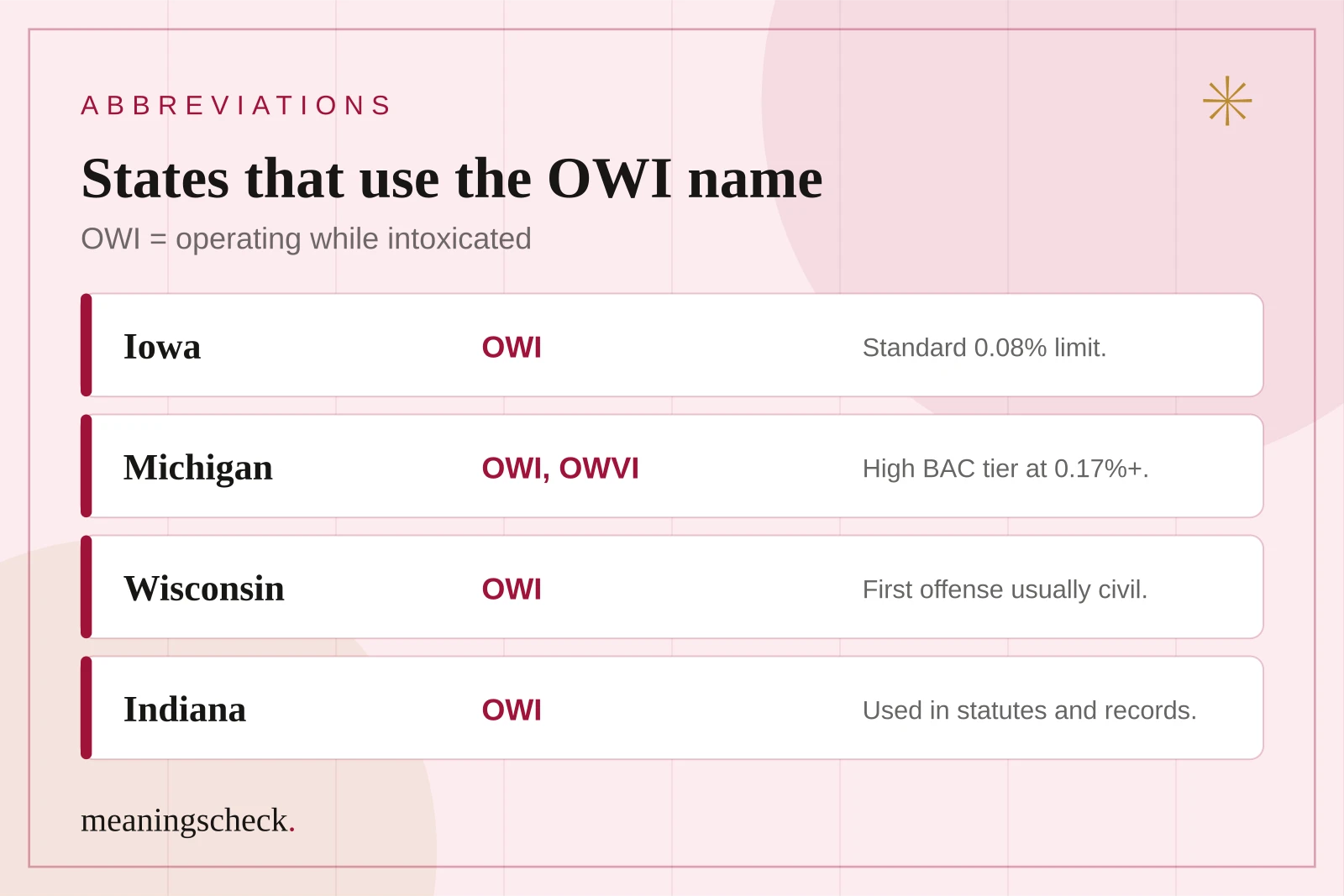
The Short Answer: OWI is the main term in Iowa, Michigan, Wisconsin, and Indiana. Most other states use DUI or DWI. Ohio uses OVI, and Maine and Massachusetts use OUI. The names differ. They all describe impaired driving.
Iowa
Iowa uses OWI for operating a motor vehicle while under the influence or with a BAC of 0.08% or more.
Michigan
Michigan uses OWI and also has related charges:
- OWVI — operating while visibly impaired, a lesser charge.
- High BAC — sometimes called the "super drunk" law, for a BAC of 0.17% or higher, which brings tougher penalties.
Wisconsin
Wisconsin uses OWI. It's unusual because a first OWI offense is generally a civil forfeiture, not a crime, according to the Wisconsin Legislative Reference Bureau — with exceptions, such as having a passenger under 16. Later offenses are criminal.
Indiana
Indiana also uses OWI in its laws and court records.
| State | Term | Notable Detail |
|---|---|---|
| Iowa | OWI | Standard 0.08% limit |
| Michigan | OWI, OWVI, High BAC | Tougher "High BAC" tier at 0.17%+ |
| Wisconsin | OWI | First offense generally civil, not criminal |
| Indiana | OWI | Uses OWI in statutes and records |
| Ohio | OVI | "Operating a vehicle impaired" |
| Maine, Massachusetts | OUI | "Operating under the influence" |
| Most other states | DUI or DWI | Driving under the influence / while intoxicated |
Key takeaway: OWI, DUI, DWI, OVI, and OUI are mostly different names for the same offense. The state you're in decides the name and the details.
OWI vs. DUI vs. DWI vs. OVI vs. OUI
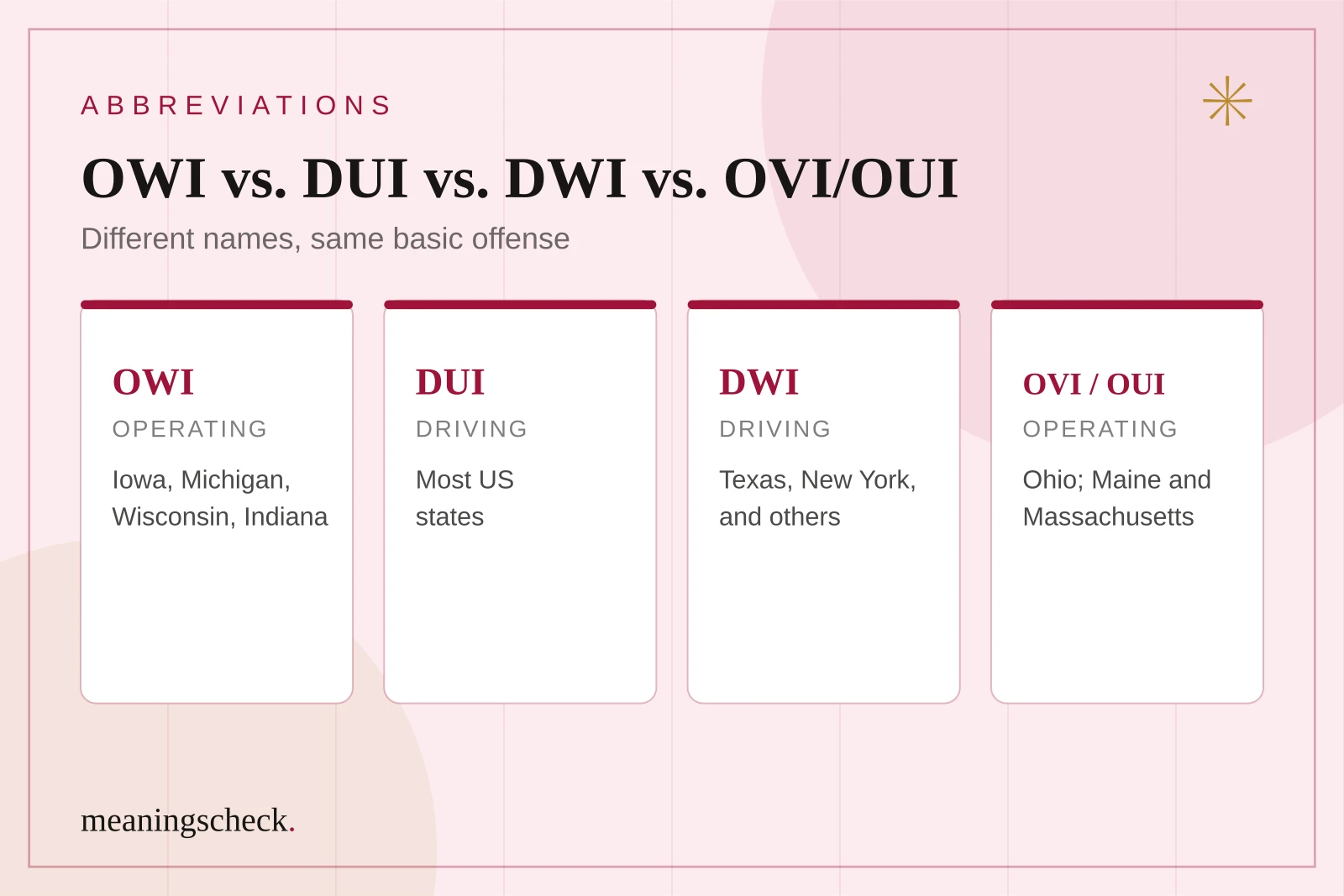
The Short Answer: All five describe impaired driving. DUI means "driving under the influence." DWI means "driving while intoxicated." OVI is Ohio's "operating a vehicle impaired." OUI means "operating under the influence." OWI means "operating while intoxicated." In some states, two terms describe different levels of offense.
| Abbreviation | Stands For | Where It's Used |
|---|---|---|
| OWI | Operating While Intoxicated | Iowa, Michigan, Wisconsin, Indiana |
| DUI | Driving Under the Influence | Most states |
| DWI | Driving While Intoxicated (or Impaired) | Texas, New York, and others |
| OVI | Operating a Vehicle Impaired | Ohio |
| OUI | Operating Under the Influence | Maine, Massachusetts |
| DWAI | Driving While Ability Impaired | New York, Colorado |
Are They the Same?
In everyday conversation, yes. People often say "DUI" for all of them.
Legally, it depends. A few states use two terms for different offenses. For example, some states treat DWI as more serious than DWAI (driving while ability impaired). Michigan separates OWI from OWVI.
"Driving" vs. "Operating"
Terms with "operating" (OWI, OVI, OUI) can sometimes reach situations where the car isn't moving. Terms with "driving" (DUI, DWI) traditionally focus on actually driving — though many DUI states also have "physical control" rules.
What BAC Counts as OWI?
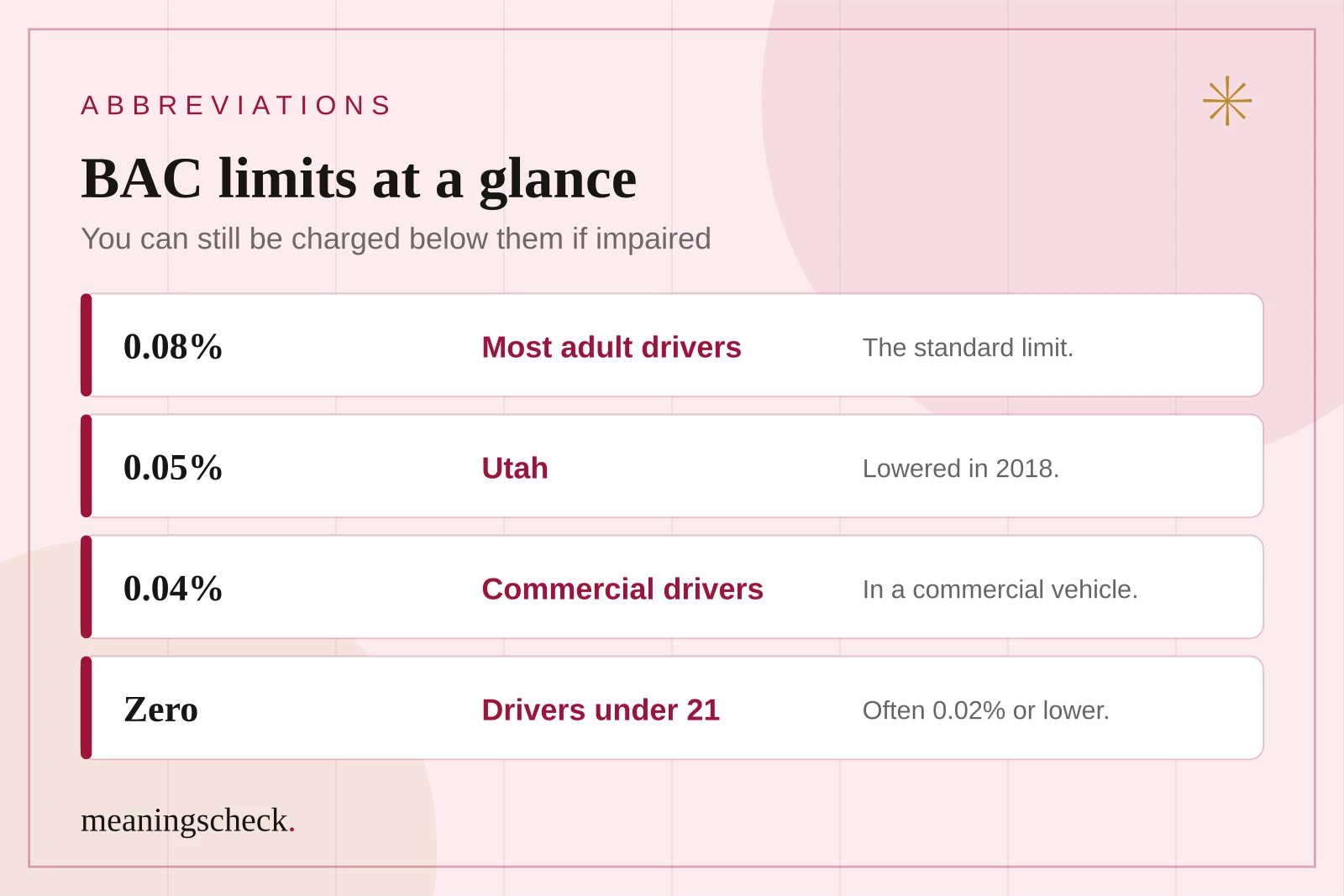
The Short Answer: For most adult drivers, the legal limit is 0.08% BAC. Utah's limit is 0.05%. Commercial drivers are held to 0.04% while driving commercial vehicles. Drivers under 21 face "zero tolerance" limits, often 0.02% or lower. You can also be charged below the limit if you're visibly impaired.
Blood Alcohol Concentration (BAC)
BAC measures how much alcohol is in your blood. A BAC of 0.08% means 0.08 grams of alcohol per 100 milliliters of blood.
The Main Limits
| Driver | BAC Limit |
|---|---|
| Adults 21+ (most states) | 0.08% |
| Adults in Utah | 0.05% (since 2018) |
| Commercial drivers (in a commercial vehicle) | 0.04% |
| Drivers under 21 | "Zero tolerance," often 0.02% or lower |
| Higher-penalty tiers (some states) | Often 0.15%–0.17%+ |
Commercial Drivers
Truck and bus drivers with a commercial driver's license (CDL) face a 0.04% limit under federal rules when driving a commercial vehicle. That matters for long-haul truckers, the over-the-road drivers covered in our OTR meaning guide.
No "Safe" Number of Drinks
BAC depends on body weight, sex, food, time, and how fast you drink. There's no reliable way to know you're under the limit by counting drinks. The safest choice is simple: don't drive after drinking.
How Do You Pronounce OWI?
The Short Answer: People say the letters: "O-W-I" (oh-double-you-eye). In conversation, many people in OWI states use it like a noun: "he got an O-W-I." Some just say "drunk driving."
| Written | Spoken |
|---|---|
| OWI | "oh-double-you-eye" |
| OWVI (Michigan) | "oh-double-you-vee-eye" |
| DUI | "dee-you-eye" |
| DWI | "dee-double-you-eye" |
Because it's spelled out, "an OWI" (not "a OWI") is correct. The letter O starts with a vowel sound.
What Usually Happens During an OWI Traffic Stop
The Short Answer: A typical OWI stop starts with a traffic violation or crash. The officer may ask questions, look for signs of impairment, and request field sobriety tests and a preliminary breath test. An arrest can lead to an official chemical test of breath, blood, or urine.
General information only. Procedures vary by state and situation.
1. The Stop
Officers usually need a reason to pull someone over, such as speeding, swerving, or a broken light. Some states also run sobriety checkpoints. Over the radio, you may hear an officer confirm dispatch with "10-4," the code our 10-4 meaning guide explains.
2. Observations
The officer looks and listens for signs like the smell of alcohol, slurred speech, or slow reactions.
3. Field Sobriety Tests
Many officers use the Standardized Field Sobriety Tests (SFSTs) developed with NHTSA:
- Horizontal gaze nystagmus — watching the eyes follow an object.
- Walk-and-turn — walking heel to toe in a line.
- One-leg stand — balancing on one foot while counting.
4. Preliminary Breath Test
A handheld preliminary breath test (PBT) may be used at the roadside to estimate BAC.
5. Arrest and Chemical Test
If arrested, the driver is usually asked to take an official chemical test — breath, blood, or urine. Refusing can trigger penalties under implied consent laws.
| Step | What Happens |
|---|---|
| Stop | Traffic violation, crash, or checkpoint |
| Observation | Officer checks for signs of impairment |
| Field tests | Eye, walking, and balance tests |
| PBT | Roadside breath estimate |
| Arrest | If the officer finds probable cause |
| Chemical test | Official breath, blood, or urine test |
Can You Get an OWI for Drugs?
The Short Answer: Yes. OWI covers impairment from drugs, not just alcohol. That includes illegal drugs, cannabis, and even legal prescription or over-the-counter medicines that make driving unsafe. Some states also punish driving with certain drugs in your system.
Cannabis
Even where cannabis is legal, driving while high is illegal. Unlike alcohol, there's no simple roadside BAC-style test for THC impairment. Officers may rely on observations and drug recognition evaluations instead. If someone has gone past "high" to sick and dizzy, the experience our Greened Out meaning guide describes, they definitely shouldn't drive.
Prescription and Over-the-Counter Medicine
Sleep aids, some allergy medicines, pain medications, and anxiety medicines can cause drowsiness. If they impair your driving, you can face an impaired-driving charge — even with a valid prescription.
Combining Substances
Mixing alcohol with drugs or medications can multiply impairment. Labels that warn "do not operate heavy machinery" apply to cars too.
| Substance | Can It Lead to OWI? |
|---|---|
| Alcohol | Yes |
| Cannabis | Yes, even where legal |
| Illegal drugs | Yes |
| Prescription medicine | Yes, if it impairs driving |
| Over-the-counter medicine | Yes, if it impairs driving |
What Happens After an OWI?
The Short Answer: Consequences depend on the state and the details. They often include license suspension, fines, possible jail time, required classes or treatment, an ignition interlock device, and higher insurance costs. Repeat offenses and high BAC levels usually bring tougher penalties.
General information only — not legal advice.
Common Consequences
- License suspension or revocation
- Fines and court costs
- Jail time (especially for repeat or aggravated offenses)
- Probation
- Alcohol or drug education or treatment
- Ignition interlock device — a breath test built into your car
- Higher car insurance rates
- A criminal record in most cases
Factors That Make It Worse
| Factor | Why It Matters |
|---|---|
| Prior offenses | Penalties usually increase with each one |
| High BAC | Many states add penalties above a set level |
| Child passenger | Often an aggravating factor |
| Crash with injury or death | Can lead to felony charges |
| Refusing a chemical test | Can trigger automatic license penalties |
Implied Consent
Every state has implied consent laws. By driving, you're considered to have agreed to chemical testing if lawfully arrested for impaired driving. Refusing a test usually leads to automatic penalties, such as license suspension.
Why People Talk to a Lawyer
The rules, deadlines, and options after an OWI are complex and state-specific. Many people consult a criminal defense attorney who handles OWI cases in their state. Some deadlines, like requesting a license hearing, can be short.
Key takeaway: An OWI can affect your license, money, insurance, and record. Details vary widely by state. That's why local legal advice matters.
OWI by the Numbers
The Short Answer: According to NHTSA, 12,429 people died in alcohol-impaired-driving crashes in the US in 2023. That was 30% of all traffic deaths and a 7.6% drop from 2022. Impaired driving remains one of the leading causes of road deaths.
The National Highway Traffic Safety Administration (NHTSA) tracks impaired-driving deaths every year. According to its 2023 data:
- 12,429 people were killed in alcohol-impaired-driving crashes.
- That was 30% of the 40,901 total traffic deaths.
- Deaths fell 7.6% from 13,458 in 2022.
- An estimated 253 children were killed in alcohol-impaired-driving crashes.
| 2023 Figure (NHTSA) | Number |
|---|---|
| Total traffic deaths | 40,901 |
| Alcohol-impaired-driving crash deaths | 12,429 |
| Share of all traffic deaths | 30% |
| Change from 2022 | −7.6% |
| Children killed in these crashes | 253 |
You can read the full figures in NHTSA's Alcohol-Impaired Driving: 2023 Data fact sheet.
How to Avoid an OWI
The Short Answer: Plan a sober ride before you drink. Use a designated driver, a rideshare, a taxi, public transit, or stay the night. If a friend is impaired, help them find another way home.
Before You Go Out
- Choose a designated driver who won't drink.
- Save a rideshare app or taxi number.
- Plan to stay over if needed.
During the Night
- Pace yourself and eat food.
- Remember that coffee and cold showers don't lower BAC. Only time does.
If a Friend Is Impaired
- Offer a ride or call one.
- Hold their keys if you can do it safely.
- A quick "dw, I'll drive" can save a life — our DW meaning guide covers that reassuring shorthand.
| Option | Good For |
|---|---|
| Designated driver | Groups going out together |
| Rideshare or taxi | Most nights out |
| Public transit | Cities with late service |
| Staying over | Parties at a friend's home |
| Walking (with friends) | Short, safe distances |
OWI for Drivers Under 21
The Short Answer: Drivers under 21 face "zero tolerance" laws in every state, often at a BAC of 0.02% or lower. Even a small amount of alcohol can mean license suspension. Standard OWI charges also apply if an underage driver reaches 0.08% or is impaired.
Because the legal drinking age is 21, states set much lower limits for younger drivers. Consequences can include:
- License suspension, sometimes for months.
- Fines and required classes.
- Higher insurance costs that can last for years.
- Effects on school, sports, or scholarships, depending on the program.
| Situation | Typical Result |
|---|---|
| Under 21, small amount of alcohol | Zero-tolerance penalties |
| Under 21, 0.08%+ or impaired | Full OWI charge possible |
| Under 21, refuses testing | Implied-consent penalties |
The message for teens is simple: any drinking means no driving.
OWI on Boats, Snowmobiles, and ATVs
The Short Answer: Impaired-operation laws often go beyond cars. Many states ban operating boats, snowmobiles, and ATVs while intoxicated. Some states use OWI-style wording for these vehicles too. Penalties and limits vary.
The word "operating" fits more than cars. In many states, you can face charges for operating these while impaired:
- Boats (often called boating under the influence, or BUI)
- Snowmobiles
- ATVs and off-road vehicles
- Mopeds and some e-bikes, depending on the state
Lakes and trails in Midwestern states like Wisconsin and Michigan see heavy boat and snowmobile traffic. Check your state's rules before heading out.
OWI in Records, Forms, and the News
The Short Answer: You'll see "OWI" in court records, police reports, news headlines, job background checks, and insurance forms in states that use the term. "Arrested for OWI" in a headline means the person was charged, not necessarily convicted.
In the News
"Man arrested for OWI after crash" means police charged someone with operating while intoxicated. An arrest or charge isn't the same as a conviction.
In Court Records
Court databases in OWI states list charges like "OWI 1st" (first offense) or "OWI 2nd" (second offense). Terms like "aggravated OWI" usually mean extra factors were involved, such as a high BAC.
On Forms
Job applications and insurance forms may ask about OWI, DUI, or DWI convictions. Answer honestly and, if needed, ask a lawyer how to describe your record.
| Phrase | Meaning |
|---|---|
| "Arrested for OWI" | Charged; not yet convicted |
| "OWI 1st" | First offense |
| "OWI 2nd" / "3rd" | Repeat offense |
| "Aggravated OWI" | Extra factors (like high BAC) |
| "OWVI" (Michigan) | Operating while visibly impaired |
| "Pled to OWI" | Accepted a plea to the charge |
Other Meanings of OWI
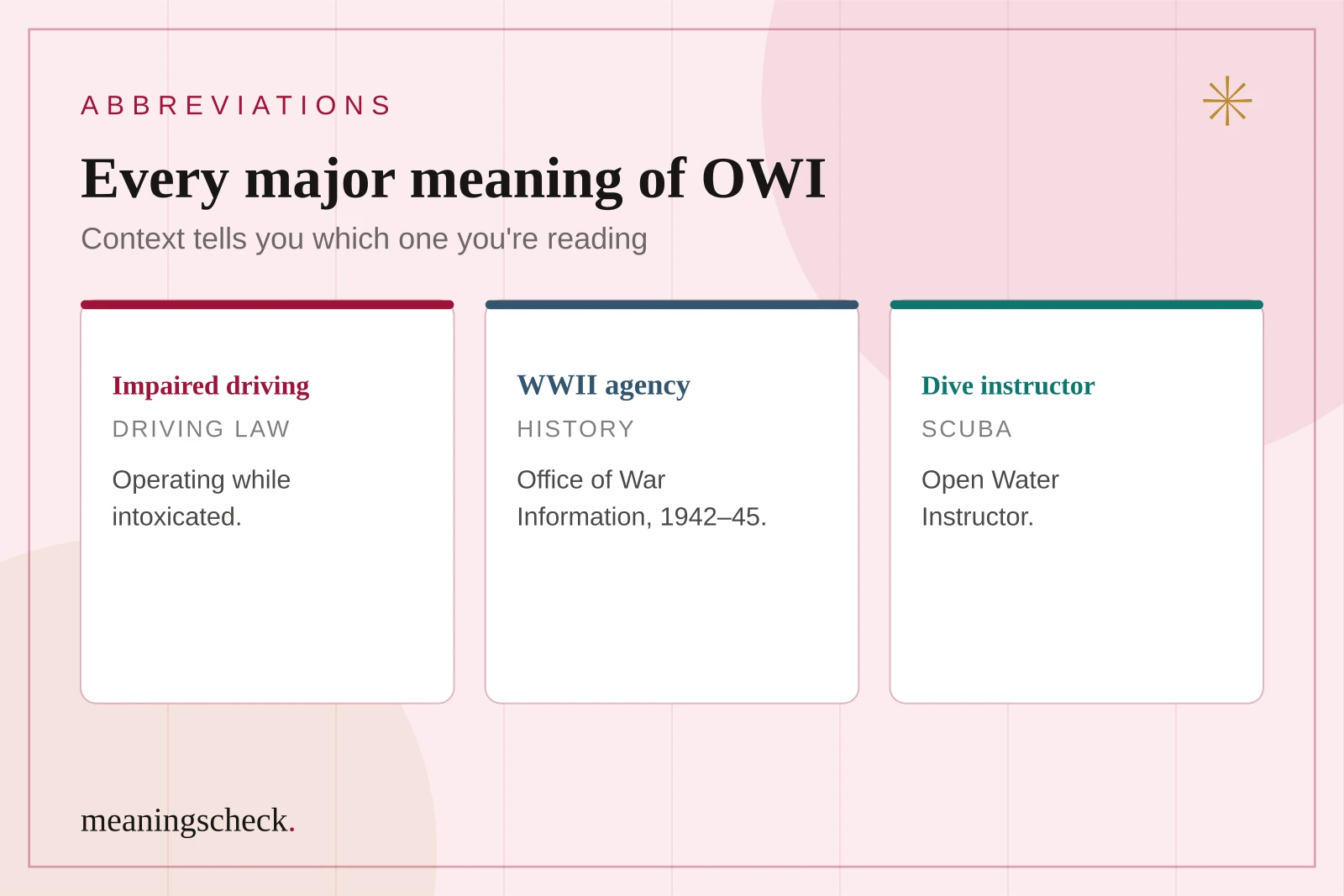
The Short Answer: Outside of driving law, OWI can mean the Office of War Information, a US government agency during World War II (1942–1945). In scuba diving, some agencies use OWI for Open Water Instructor. Context makes the meaning clear.
Office of War Information
The Office of War Information (OWI) was a US government agency created in 1942 during World War II. It handled wartime news, posters, radio, and film to inform the public and support the war effort. It was dissolved in 1945. Historians and museums often reference OWI posters and photographs.
Open Water Instructor (Scuba)
In scuba diving, some training agencies use OWI for Open Water Instructor — a professional who teaches beginner divers.
Other Uses
You may also see OWI in company names, product codes, or local organizations. Context will tell you which one applies.
| Context | OWI Means | Example |
|---|---|---|
| Driving law | Operating While Intoxicated | "charged with OWI" |
| History | Office of War Information | "an OWI poster from 1943" |
| Scuba diving | Open Water Instructor | "she's a certified OWI" |
How to Tell Which OWI Someone Means
The Short Answer: If OWI appears with words like arrest, charge, BAC, or license, it means operating while intoxicated. With WWII, posters, or propaganda, it's the Office of War Information. With diving or certification, it's Open Water Instructor.
| Clue | Likely Meaning |
|---|---|
| "arrested," "charged," "BAC," "license" | Operating While Intoxicated |
| "WWII," "poster," "propaganda," "1943" | Office of War Information |
| "scuba," "dive shop," "certified" | Open Water Instructor |
| A court record in Iowa or Wisconsin | Operating While Intoxicated |
Expert Insights: Why States Use Different Names
The Short Answer: Each state writes its own traffic laws. The names grew up separately. Some lawmakers chose "operating" to cover people in control of a stopped vehicle. The differences are mostly in wording. Still, small legal details can matter a lot in court.
State Laws, State Words
There's no single national impaired-driving statute for everyday drivers. Each state writes its own law. Each one picked its own name. That's why a neighbor across the state line might call it a DUI while you call it an OWI.
Why "Operating" Matters
Lawmakers who chose "operating" often wanted to cover people who are in control of a car without driving it — for example, sitting behind the wheel with the engine running. Courts in each state decide exactly where the line is.
The 0.08% Standard
By 2004, every state had adopted 0.08% as the standard adult limit, pushed by federal highway funding rules. Utah went further, lowering its limit to 0.05% in 2018.
Names Change Over Time
States sometimes rename offenses. When a law changes, older records may use a different abbreviation than newer ones. That's one reason legal research needs care.
Real-World Patterns of OWI
- News: "arrested for OWI."
- Courts: "OWI 1st offense."
- Michigan: "OWI" vs. "OWVI" vs. "High BAC."
- Wisconsin: a civil first offense in most cases.
OWI in Texting and Conversation
The Short Answer: People rarely use OWI as texting slang. When it shows up in messages, it's usually about a real legal situation: "he got an OWI last night." In OWI states, people say "OWI" the way others say "DUI."
You might hear:
- "He got an OWI last weekend."
- "She's doing community service for an OWI."
- "Don't drive — you'll get an OWI."
If someone shares news like this, a supportive reply helps: "That's rough. Are you okay? Do you need a ride to court?" It's a serious situation, not a joke.
How an OWI Can Affect Jobs and Travel
The Short Answer: An OWI conviction can show up on background checks, affect jobs that involve driving, and put a commercial driver's license at risk. It can also complicate international travel. Canada, for example, may deny entry to visitors with impaired-driving convictions.
Jobs
Many employers run background checks. A conviction can matter most for jobs that involve:
- Driving (delivery, rideshare, sales routes)
- Commercial vehicles (trucks and buses)
- Professional licenses (some healthcare, legal, and education roles)
Commercial Drivers
Under federal rules, a CDL holder convicted of impaired driving generally faces disqualification from commercial driving for at least one year for a first offense — even if it happened in a personal car. Repeat offenses can lead to much longer disqualification.
Travel
Some countries restrict entry for people with impaired-driving convictions. Canada is the best-known example. Travelers with a conviction may need special permission before visiting.
| Area | Possible Effect |
|---|---|
| Background checks | Conviction may appear |
| Driving jobs | Harder to get or keep |
| CDL holders | Disqualification of at least one year (first offense) |
| International travel | Possible entry restrictions (e.g., Canada) |
OWI vs. Reckless Driving
The Short Answer: OWI is about impairment. Reckless driving is about dangerous driving behavior, whether or not you're impaired. In some cases, an OWI charge may be reduced to a lesser offense through a plea, depending on the state and the facts.
The two charges overlap but aren't the same:
- OWI requires impairment (or BAC over the limit).
- Reckless driving requires dangerous driving, like excessive speeding or weaving through traffic.
Someone can be charged with both. In some states, prosecutors and defense attorneys negotiate a plea to a lesser charge. Whether that's possible depends on state law, the evidence, and the person's record.
| Charge | Main Element | Example |
|---|---|---|
| OWI | Impairment or BAC over the limit | Driving at 0.10% BAC |
| Reckless driving | Dangerous driving | Speeding through a school zone |
| Both | Impaired and dangerous | Drunk driving at high speed |
OWI and Your Insurance
The Short Answer: An OWI usually raises car insurance costs. Some drivers must file an SR-22 or similar form that proves they carry required insurance. Rates and rules vary by state and insurer.
After an OWI, insurers often see you as a higher risk. Common effects:
- Higher premiums for several years.
- Policy cancellation or non-renewal by some insurers.
- An SR-22 (or similar) filing requirement in many states to prove coverage.
| Insurance Effect | What It Means |
|---|---|
| Higher premium | You pay more each month |
| SR-22 filing | Proof of insurance sent to the state |
| Non-renewal | Your insurer may drop you |
| High-risk insurer | You may need a specialized company |
Insurance rules vary. Check with your insurer or a licensed agent for your situation.
Legal money terms differ by country too. In the UK, for example, a "DEA" lets the government recover benefit debts from wages, as our Direct Earnings Attachment meaning guide explains.
OWI Myths vs. Facts
The Short Answer: Many common beliefs about impaired driving are wrong. Coffee doesn't sober you up. You can be charged below 0.08%. Legal cannabis doesn't make driving high legal. And sitting in a parked car can count in some states.
| Myth | Fact |
|---|---|
| "Coffee sobers you up." | Only time lowers BAC. |
| "Under 0.08% means I'm fine." | You can be charged if impaired at any BAC. |
| "Legal weed means legal to drive high." | Driving high is illegal everywhere. |
| "I can't get an OWI in a parked car." | In some states, physical control can count. |
| "One beer per hour keeps me safe." | BAC varies by person and situation. |
| "Prescription meds are always okay." | Not if they impair your driving. |
Key takeaway: The only fully safe plan is a sober driver.
OWI Glossary: Terms You'll Hear
The Short Answer: OWI cases come with their own vocabulary: BAC, PBT, SFST, implied consent, ignition interlock, SR-22, and more. This quick glossary explains each one in plain English.
| Term | Plain-English Meaning |
|---|---|
| BAC | Blood alcohol concentration |
| Per se | Over the legal limit, regardless of behavior |
| PBT | Preliminary (roadside) breath test |
| SFST | Standardized field sobriety tests |
| Implied consent | Driving means agreeing to chemical testing after a lawful arrest |
| Refusal | Declining an official chemical test |
| Ignition interlock | A breath-test device that must be passed to start the car |
| SR-22 | A form proving you carry required insurance |
| OWVI | Michigan's "operating while visibly impaired" |
| Aggravated OWI | An OWI with extra factors, like high BAC |
| Plea | An agreement to plead guilty to a charge, sometimes a lesser one |
How to Talk to a Teen About OWI
The Short Answer: Keep it simple and practical: "Never drive after drinking or using drugs. Never ride with someone who has. Call me anytime for a ride — no lecture that night." A clear plan matters more than scare tactics.
Parents and teachers can make the message stick with a few steps:
- Explain the term. "OWI means operating a car while drunk or high. It's illegal and dangerous."
- Share the stakes. License loss, fines, a record, and — most of all — the risk of hurting someone.
- Make a ride plan. Agree on a code word or text they can send for a pickup.
- Promise a safe call. Many families agree to talk about it the next day, not in the moment.
- Model it. Kids notice when adults choose a sober driver.
| Message | Why It Works |
|---|---|
| "Call me anytime for a ride." | Removes the reason to risk it |
| "Never ride with an impaired driver." | Protects passengers too |
| "Medicine can impair you." | Covers more than alcohol |
Common Mistakes People Make With OWI
The Short Answer: The biggest mistakes are assuming OWI only applies to moving cars, thinking legal drugs can't lead to OWI, confusing an arrest with a conviction, and assuming every state's rules are the same.
- Thinking you must be driving. "Operating" can be broader.
- Assuming prescriptions are safe to drive on. Not if they impair you.
- Confusing arrest with conviction. A charge isn't a verdict.
- Assuming all states match. Names, limits, and penalties differ.
- Ignoring deadlines. Some license-hearing deadlines are short.
Frequently Asked Questions (FAQs)
What does OWI stand for?
OWI stands for "operating while intoxicated." Some sources say "operating while impaired."
Is an OWI the same as a DUI?
In everyday terms, yes. Both describe impaired driving. The name depends on the state. Legal details can differ too.
Which states use OWI?
Iowa, Michigan, Wisconsin, and Indiana are the best-known states that use the OWI name.
Can you get an OWI without driving?
In some states, yes. "Operating" can include being in physical control of a running vehicle, even if it isn't moving.
What BAC is an OWI?
In most states, 0.08% for adults. Utah's limit is 0.05%. You can also be charged below the limit if impaired.
Can you get an OWI for weed?
Yes. Driving while impaired by cannabis is illegal, even where cannabis is legal.
Is a first OWI a crime?
Usually, yes. Wisconsin is an exception: a first OWI is generally a civil forfeiture, with some exceptions.
What does OWVI mean?
In Michigan, OWVI means "operating while visibly impaired," a lesser charge than OWI.
What was the OWI in World War II?
The Office of War Information was a US agency from 1942 to 1945 that handled wartime news and propaganda.
Final Thoughts
OWI is a short abbreviation with serious weight. It means operating a vehicle while impaired — the same basic offense other states call a DUI or DWI. The word "operating" is the twist: in some states, it can apply even when the car isn't moving.
The best way to never need this article again? Plan a sober ride before the night starts.
For more abbreviations explained clearly, explore our abbreviation guides, including professional and legal terms like MO.
Related terms
Share: · Post on X
Written by MeaningsCheck Team · Published · Updated
The MeaningsCheck team researches and writes plain-language explanations of slang, abbreviations, and everyday words — checked for accuracy, updated as language changes.