
What Does 10-4 Mean? 10-4 Meaning, Ten-Code History, and How to Use It in Texts (2026)
10-4 (said "ten-four") means "message received," "understood," or simply "OK." It's one of the radio ten-codes created for police in the late 1930s. Truckers and CB radio users spread it, and today people also use it in texts to say "got it."
10-4 means "message received" or "OK." Said out loud as "ten-four," it's a quick way to confirm you heard and understood something. If a dispatcher says "Meet me at the north gate" and you answer "10-4," you're saying "Got it."
The phrase started on police radio in the late 1930s. Then truckers and CB radio fans made it famous. Today you'll hear it on job sites, in movies, and even in text messages.
So what does 10-4 mean in each of those places? This guide covers the 10-4 meaning, where the ten-codes came from, why they start with "10," how 10-4 compares to Roger, Copy that, and Wilco, other common ten-codes like 10-20, and how to use 10-4 in texts today.
Key takeaway: 10-4 = "message received" / "understood" / "OK." It's a radio code that became everyday slang.
Executive Summary: 10-4 at a Glance
Here's the quick version:
- Meaning: "Message received," "understood," "OK."
- Said as: "Ten-four."
- Origin: The ten-codes, credited to Charles Hopper, communications director for the Illinois State Police, created between 1937 and 1940, according to Dictionary.com.
- Standardized by: APCO, the Association of Public-Safety Communications Officials.
- Made famous by: The 1950s TV show Highway Patrol, CB radio, and C. W. McCall's 1975 song "Convoy."
- Famous phrase: "10-4, good buddy."
- Similar to: Roger, Copy that, Affirmative, Got it.
- Today: Many agencies prefer plain language for multi-agency emergencies, following FEMA's NIMS guidance.
- In texting: "10-4" means "got it," often with a playful tone.
What Does 10-4 Mean? The Core Definition
The Short Answer: 10-4 is a radio code meaning "acknowledged" — I received your message and understand it. In everyday speech and texts, it simply means "OK" or "got it." It confirms receipt. It doesn't necessarily mean you agree.
The Radio Meaning
On two-way radio, 10-4 is an acknowledgment. It tells the other person: "I heard you clearly, and I understand."
- Dispatcher: "Unit 12, return to station."
- Officer: "10-4."
The Everyday Meaning
Outside radio, people use 10-4 as a casual "OK":
- "Can you grab milk on the way home?" — "10-4."
- "Meeting moved to 3." — "10-4, thanks."
Acknowledgment vs. Agreement
Strictly speaking, 10-4 means "message received," not "I agree" or "I'll do it." On radio, "Wilco" ("will comply") means you'll follow instructions. In casual use, though, 10-4 usually implies you'll go along with the plan.
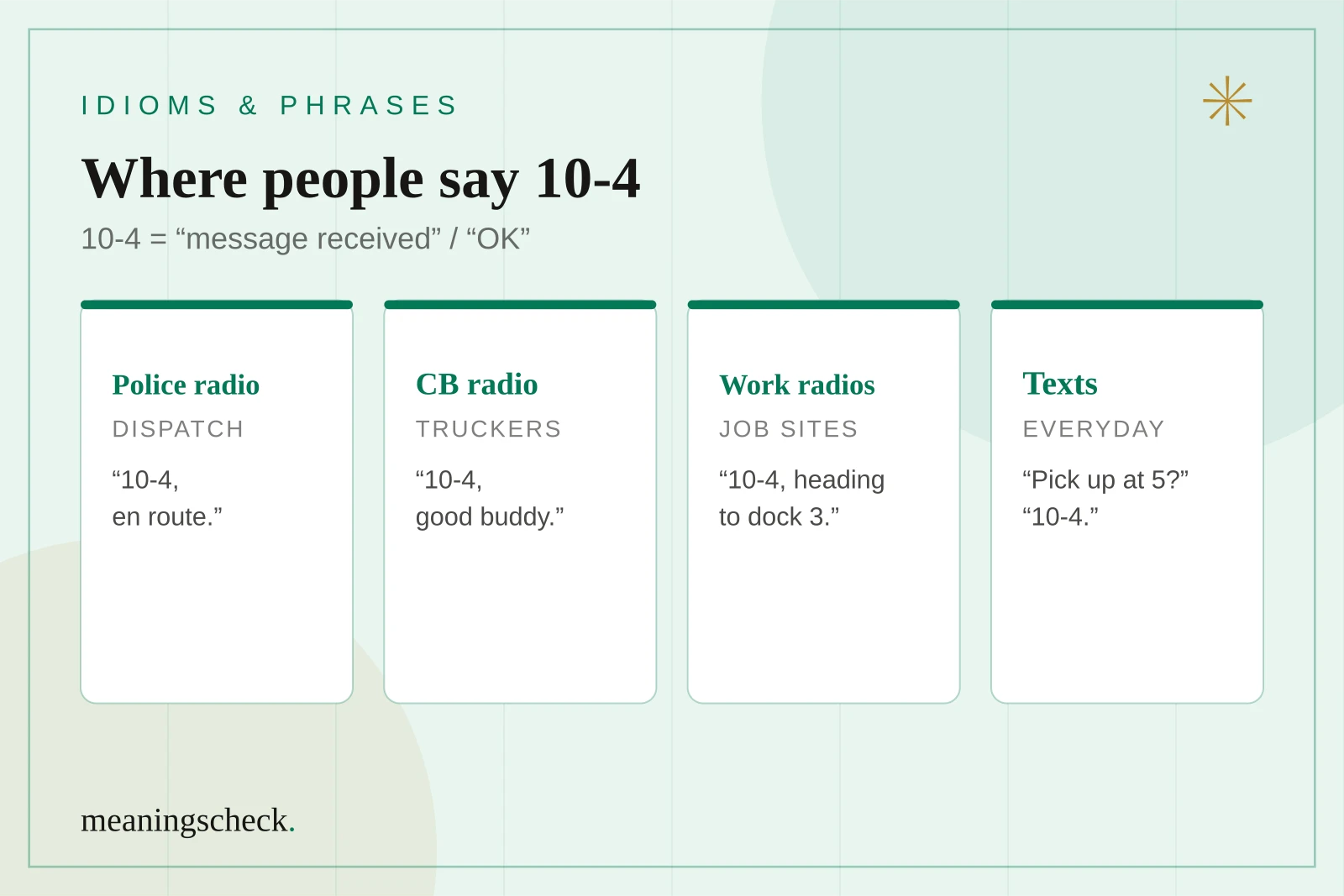
| Context | 10-4 Means | Example |
|---|---|---|
| Police radio | Message received | "10-4, en route." |
| Trucking / CB radio | Understood | "10-4, good buddy." |
| Workplace radio | Got it | "10-4, heading to dock 3." |
| Text message | OK, will do | "10-4 👍" |
| Movies and TV | Classic radio talk | "10-4, over and out." |
How Do You Say 10-4?
The Short Answer: Say "ten-four." Never "one-zero-four." In writing, it's usually "10-4," though you'll also see "ten-four," "10 4," and "10/4" in casual texts.
| Written | Spoken |
|---|---|
| 10-4 | "ten-four" |
| ten-four | "ten-four" |
| 10 4 | "ten-four" |
| 10/4 | "ten-four" (casual text) |
A Note on "10/4"
In texts, "10/4" can look like a date (October 4 or April 10). The hyphen version, 10-4, avoids that confusion.
Where Did 10-4 Come From?
The Short Answer: 10-4 is one of the "ten-codes" created for police radio in the late 1930s. Dictionary.com credits Charles Hopper of the Illinois State Police, who developed them between 1937 and 1940. The Association of Public-Safety Communications Officials (APCO) helped standardize them.
Early Police Radio Problems
Early police radios had a problem: the first part of a message often got cut off or garbled. Short, numbered codes made messages faster and clearer.
Charles Hopper and the Ten-Codes
Dictionary.com credits Charles Hopper, communications director for the Illinois State Police, with creating the ten-codes between 1937 and 1940. Each code paired "10" with a number, and 10-4 became "acknowledgment."
APCO Standardization
The Association of Public-Safety Communications Officials (APCO) helped standardize and spread the codes so agencies could understand each other. APCO later expanded the list.
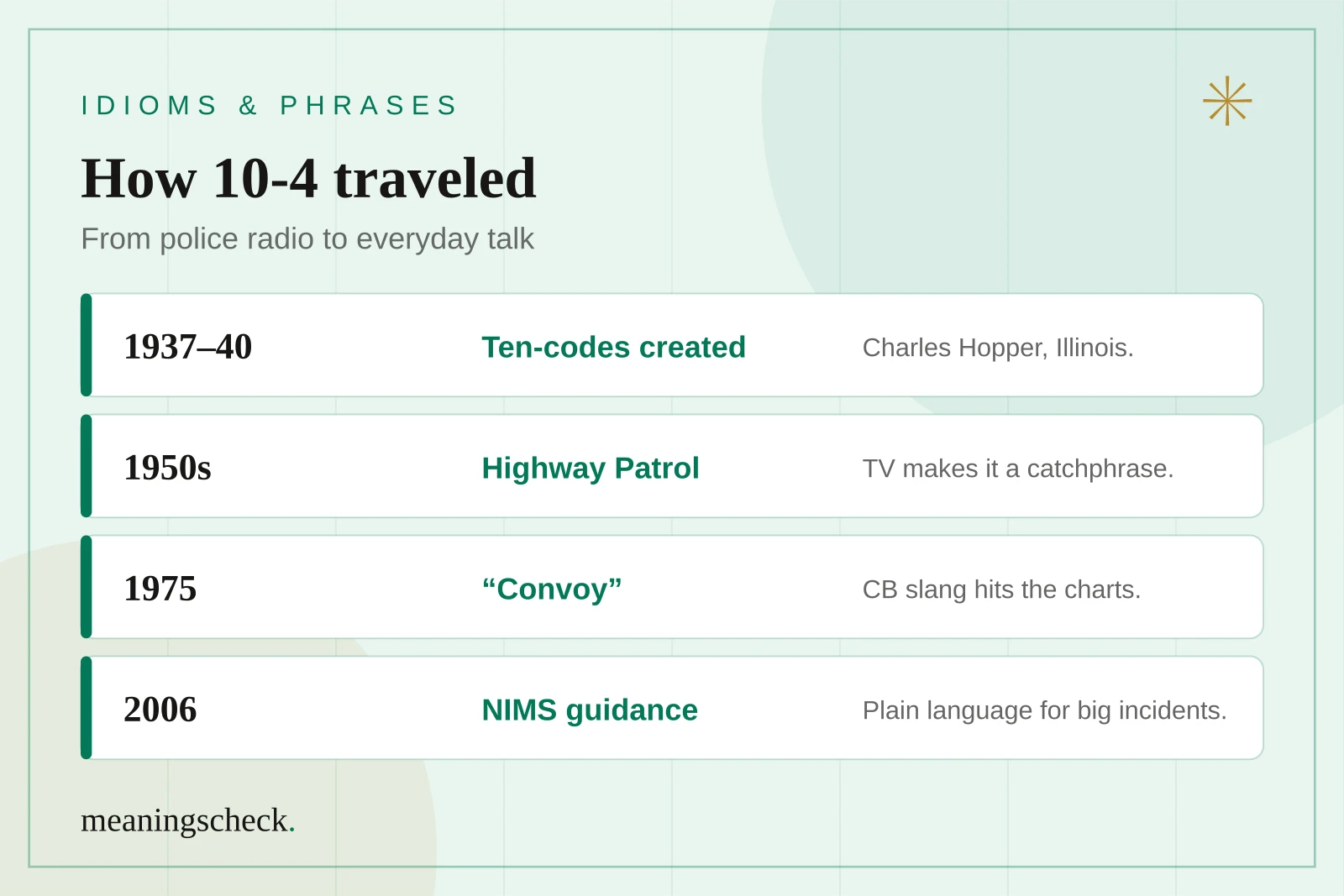
Timeline
| Period | Milestone |
|---|---|
| 1937–1940 | Charles Hopper develops the ten-codes for Illinois State Police radio |
| Around 1940 | APCO helps standardize and spread the codes |
| 1950s | TV's Highway Patrol, starring Broderick Crawford, makes "10-4" famous |
| 1970s | CB radio boom among truckers and drivers |
| 1975 | C. W. McCall's song "Convoy" spreads CB slang |
| 1978 | Convoy becomes a movie |
| 2006 | FEMA's NIMS guidance requires plain language for multi-agency incidents |
| Today | Still used by truckers, some agencies, and texters |
Key takeaway: 10-4 began as police radio shorthand in the late 1930s and spread to the public through TV and CB radio.
Why Do Ten-Codes Start With "10"?
The Short Answer: The "10" acted as a buffer. Early radio equipment needed a moment to start transmitting clearly, and the first syllable could be lost. Starting with "10" meant the important number — like "4" — came through clearly.
Dictionary.com explains that the "10" served as a placeholder. It gave older radio equipment time to warm up so the second part of the code wasn't lost.
Think of it like clearing your throat before speaking. The "10" catches the cut-off. The "4" carries the meaning.
| Part | Job |
|---|---|
| "10" | Buffer, signals a code is coming |
| "4" | The actual message: acknowledged |
How 10-4 Became Famous
The Short Answer: TV and music carried 10-4 from police radios to living rooms. The 1950s show Highway Patrol made it a catchphrase. In the 1970s, the CB radio craze among truckers — and songs like "Convoy" — made "10-4, good buddy" part of pop culture.
Highway Patrol (1950s)
The TV drama Highway Patrol, starring Broderick Crawford, featured officers using radio codes. Dictionary.com and Mental Floss both credit the show with spreading "10-4" to a wide audience.
The CB Radio Boom (1970s)
In the 1970s, citizens band (CB) radio exploded in popularity, especially among truckers. Drivers used CB to share road conditions, warn about speed traps, and pass the time on long hauls. Ten-codes became part of the culture.
"Convoy" (1975)
C. W. McCall's novelty hit "Convoy" told the story of truckers talking on CB radio. It was full of CB slang and was later made into a 1978 film.
"10-4, Good Buddy"
This friendly CB sign-off became a pop-culture catchphrase. It meant "got it, friend."
| Pop Culture Moment | Role in Spreading 10-4 |
|---|---|
| Highway Patrol (1950s) | Made "10-4" a TV catchphrase |
| CB radio craze (1970s) | Brought codes to everyday drivers |
| "Convoy" (1975) | Put CB slang on the radio charts |
| Convoy film (1978) | Brought the song's story to theaters |
| Movies and cartoons | Kept "10-4" alive for new generations |
10-4 in Trucking and CB Radio
The Short Answer: Truckers still use 10-4 on CB radio to say "understood." It's part of a colorful trucker vocabulary that also includes "What's your 20?" (where are you?), "Smokey" (police), and "breaker" (a request to talk on the channel).
Long-haul drivers — the over-the-road truckers covered in our OTR meaning guide — helped keep CB slang alive.
Common CB Phrases
| CB Phrase | Meaning |
|---|---|
| 10-4 | Understood, OK |
| What's your 20? | Where are you? (from 10-20) |
| Breaker, breaker | I'd like to talk on this channel |
| Smokey / Smokey Bear | Police officer (especially highway patrol) |
| Good buddy | Friend |
| Hammer down | Driving fast |
| Back door | Behind you |
| Handle | Your CB nickname |
Example CB Exchange
- Driver 1: "Breaker 1-9, what's your 20?"
- Driver 2: "Mile marker 112, northbound."
- Driver 1: "10-4, see you at the truck stop."
CB Radio Basics: Channel 19, Channel 9, and Handles
The Short Answer: CB radio in the US has 40 channels. Truckers traditionally gather on channel 19, which is why you hear "Breaker 1-9." Channel 9 is set aside for emergencies. Users pick a "handle," or nickname, instead of using real names.
If you've ever wondered how trucker radio works, here are the basics:
- 40 channels: US CB radio uses 40 channels.
- Channel 19: The informal trucker channel. "Breaker 1-9" means "I'd like to talk on channel 19."
- Channel 9: Reserved for emergencies and traveler assistance.
- No license needed: In the US, the FCC doesn't require a license for regular CB use.
- Handles: Drivers use fun nicknames like "Night Owl" or "Big Mike."
| CB Term | Meaning |
|---|---|
| Channel 19 | Main trucker channel |
| Channel 9 | Emergency channel |
| Breaker | Asking to join the conversation |
| Handle | Your CB nickname |
| Skip | Signals bouncing long distances |
| Ears | A CB radio ("got your ears on?") |
Where You'll Hear 10-4 Today
The Short Answer: Today, 10-4 is common on construction sites, warehouses, event staff radios, security teams, school walkie-talkies, and trucker CB. Pilots usually say "Roger" or "Wilco" instead, because aviation uses its own standard phrases.
| Setting | Do People Say 10-4? |
|---|---|
| Construction sites | Often |
| Warehouses and docks | Often |
| Event staff and security | Often |
| Retail stores with radios | Sometimes |
| Trucker CB radio | Very common |
| Police dispatch | Varies by agency |
| Aviation | Rarely — "Roger" and "Wilco" are standard |
| Text messages | Common, casual |
Why Aviation Is Different
Pilots and air traffic controllers follow strict standardized phrases. "Roger" (received) and "Wilco" (will comply) are the norm, not ten-codes.
10-4 Across Generations
The Short Answer: Baby boomers and Gen X often remember 10-4 from TV and the 1970s CB craze. Millennials know it from movies and parents. Gen Z and Gen Alpha use it in texts as a playful, retro "got it."
| Group | How They Know 10-4 | Typical Use |
|---|---|---|
| Baby boomers | Highway Patrol, CB craze | "10-4, good buddy" |
| Gen X | 1970s CB culture, cop shows | "10-4" on work radios |
| Millennials | Movies, parents | "10-4" in work chats |
| Gen Z / Gen Alpha | Memes, family texts | "10-4 🫡" in texts |
These are tendencies, not rules. Plenty of people of every age say "10-4."
Common Ten-Codes Besides 10-4
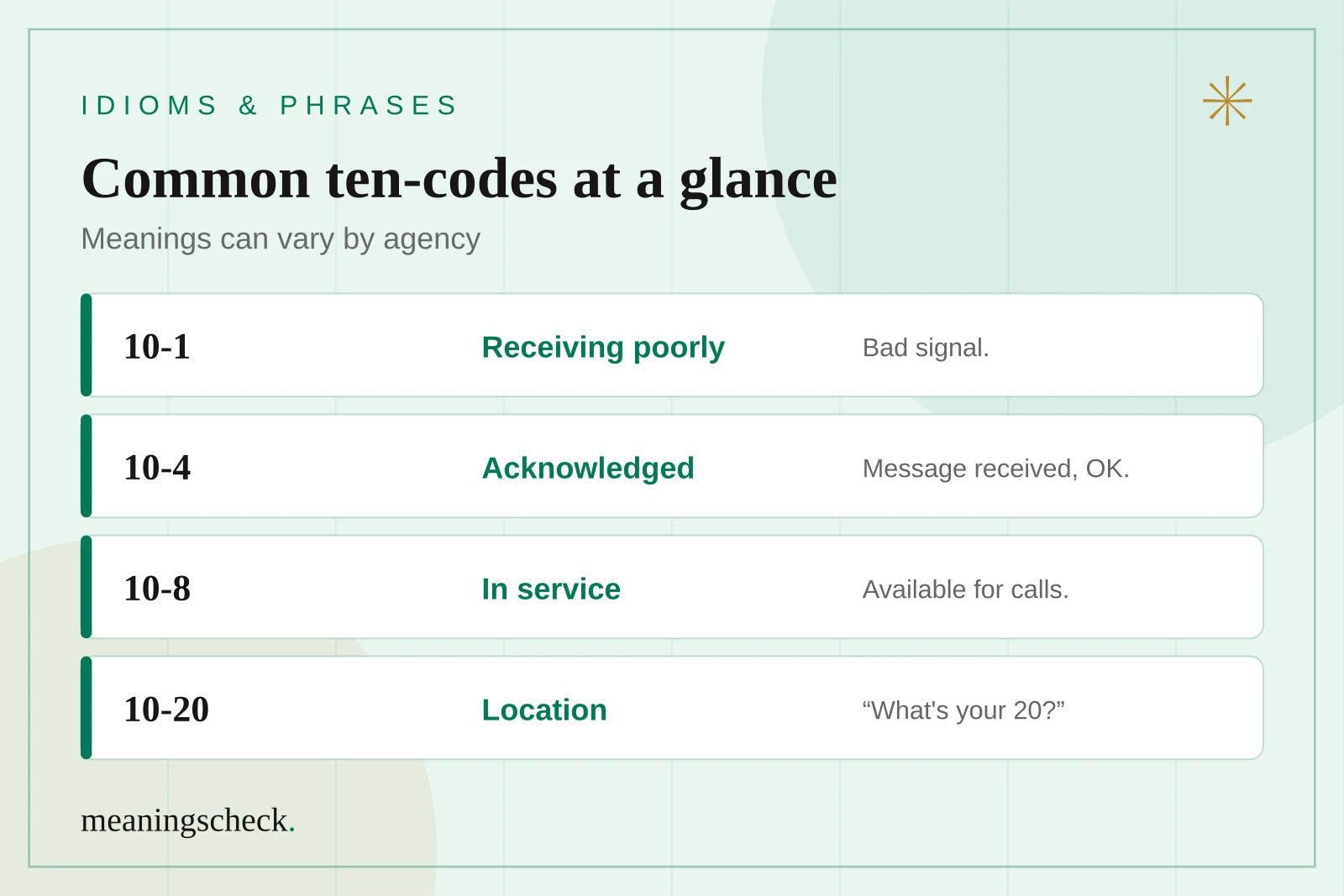
The Short Answer: Other well-known ten-codes include 10-1 (poor reception), 10-7 (out of service), 10-8 (in service), 10-9 (repeat), and 10-20 (location). Meanings can vary between agencies, which is one reason many now use plain language.
Ten-code lists were never perfectly uniform. These are commonly cited meanings:
| Code | Common Meaning |
|---|---|
| 10-1 | Receiving poorly |
| 10-2 | Receiving well |
| 10-3 | Stop transmitting |
| 10-4 | Acknowledged / OK |
| 10-7 | Out of service |
| 10-8 | In service |
| 10-9 | Repeat |
| 10-20 | Location |
| 10-33 | Emergency traffic |
"What's Your 20?"
10-20 means "location." "What's your 20?" means "Where are you?" It's one of the most famous ten-codes after 10-4.
Codes Vary
One department's "10-50" might not match another's. That inconsistency is a big reason agencies moved toward plain language.
Do Police Still Use 10-4?
The Short Answer: Some do. Many agencies now favor plain language, though. FEMA's National Incident Management System (NIMS) requires plain language for multi-agency, multi-jurisdiction incidents and encourages it for daily use. Routine use of 10-codes within a department wasn't banned.
The Plain-Language Push
During large emergencies, responders from different agencies may use different codes. A "10-code" that means one thing to one department can mean something else to another.
FEMA's NIMS guidance addressed this:
- A December 2006 NIMS alert said plain language is required for multi-agency, multi-jurisdiction, and multi-discipline events.
- The same guidance strongly encouraged plain language for everyday operations — but didn't abolish ten-codes for routine internal use.
- DHS released a Plain Language Guide in 2008.
What That Means Today
You might hear "10-4" from some officers and dispatchers. Others simply say "copy," "received," or "understood."
| Situation | Typical Language |
|---|---|
| Multi-agency emergency | Plain language |
| Routine dispatch (some agencies) | Ten-codes or plain language |
| Trucker CB radio | Ten-codes common |
| Movies and TV | "10-4" for flavor |
Key takeaway: Ten-codes aren't gone. But for big emergencies, clear plain English is the standard.
Radio Etiquette: How to Talk on a Two-Way Radio
The Short Answer: Good radio talk is short and clear. Think before you press the button, say who you're calling and who you are, keep the message brief, and confirm with "10-4," "copy," or "received." Don't talk over others.
Whether you're on a construction site, at an event, or on a CB channel, these habits help:
- Listen first. Make sure the channel is clear.
- Think before you key. Know what you'll say.
- Identify. "Dock 3, this is Gate 1."
- Keep it short. One idea per message.
- Pause after pressing the button so your first word isn't cut off — the same problem the "10" prefix solved.
- Confirm. "10-4," "copy," or "received."
- Ask to repeat clearly. Military radio prefers "say again."
| Do | Don't |
|---|---|
| "Gate 1 to Dock 3, truck arriving." | Ramble about unrelated things |
| Wait for the channel to clear | Talk over someone |
| Confirm with "10-4" | Leave messages unanswered |
| Use plain words in emergencies | Use obscure codes others won't know |
The Phonetic Alphabet and Other Radio Talk
The Short Answer: Radio operators spell words with a phonetic alphabet so letters aren't confused: Alfa, Bravo, Charlie, Delta, and so on. Older radio alphabets used "Roger" for R, which is why "Roger" means "received."
Letters like B, D, and P sound alike over static. A phonetic alphabet gives each letter a clear word. The version used internationally today — Alfa, Bravo, Charlie — dates to the 1950s.
| Letter | Word | Letter | Word |
|---|---|---|---|
| A | Alfa | N | November |
| B | Bravo | O | Oscar |
| C | Charlie | P | Papa |
| D | Delta | R | Romeo |
| E | Echo | S | Sierra |
| F | Foxtrot | T | Tango |
| G | Golf | X | X-ray |
Where "Roger" Came From
Before "Romeo," older alphabets used "Roger" for R. Since R stood for "received," "Roger" became radio shorthand for "message received" — the same job as 10-4.
10-4 in Movies, TV, and Games
The Short Answer: Cop shows, trucker movies, cartoons, and video games use 10-4 to signal "radio talk." The 1977 film Smokey and the Bandit is famous for its CB radio culture, and countless police dramas have characters answer dispatch with "10-4."
Screenwriters love 10-4 because audiences instantly recognize it:
- Police dramas: Officers answer dispatch with "10-4."
- Trucker films: Smokey and the Bandit (1977) celebrated CB slang and highway banter.
- Cartoons: Characters say "10-4, good buddy" for a laugh.
- Video games: Radio chatter in driving and action games often includes ten-codes.
| Medium | How 10-4 Is Used |
|---|---|
| Police TV | Realistic dispatch talk |
| Trucker films | CB culture and humor |
| Cartoons | Retro jokes |
| Games | Immersive radio chatter |
Other Number Slang: 411, 24/7, 86, and More
The Short Answer: 10-4 belongs to a family of number slang. "411" means information, "24/7" means all the time, "86" means to cancel or get rid of something, and "911" means emergency. Internet culture keeps inventing new ones.
| Number Slang | Meaning | Origin |
|---|---|---|
| 10-4 | OK, message received | Police radio ten-codes |
| 10-20 | Location | Police radio ten-codes |
| 411 | Information, the details | US directory assistance number |
| 911 | Emergency | US emergency phone number |
| 24/7 | All day, every day | Hours in a day / days in a week |
| 86 | Cancel, remove, refuse service | Restaurant slang |
Newer Number Memes
Internet culture keeps adding numbers with new meanings. Kids and teens shout "6 7" and "41" as viral memes, explained in our 6 7 meaning and 41 meaning guides. Unlike 10-4, those don't have a fixed meaning.
10-4 vs. Roger, Copy That, Wilco, and Affirmative
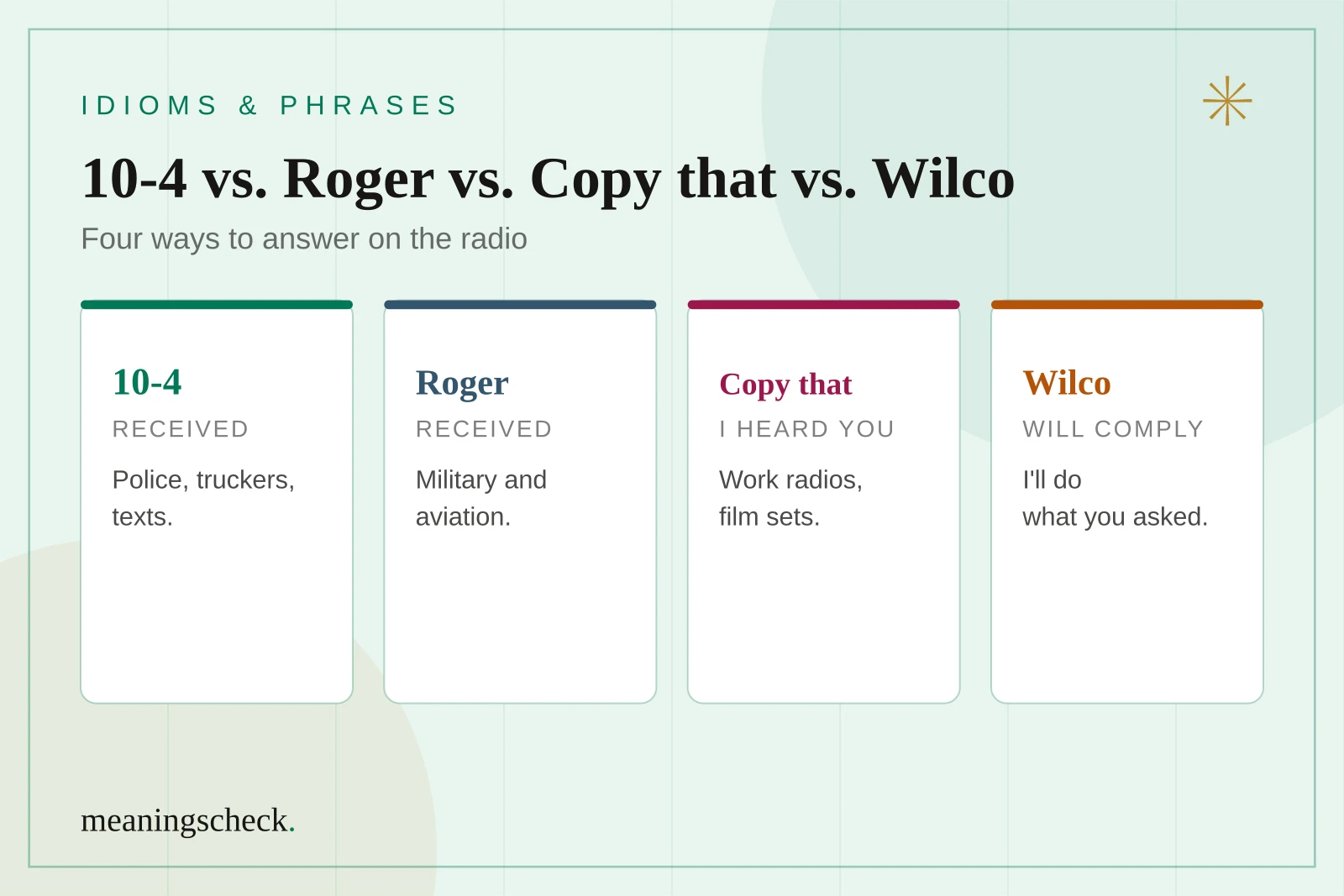
The Short Answer: 10-4, Roger, and Copy that all mean "message received." Wilco means "will comply." Affirmative means "yes." Over means "I'm done talking, your turn." Out means "conversation over."
| Term | Meaning | Where It's Common |
|---|---|---|
| 10-4 | Message received / OK | Police, trucking, casual |
| Roger | Message received | Military, aviation |
| Copy / Copy that | I heard you | Police, film sets, work radios |
| Wilco | Will comply | Military, aviation |
| Affirmative | Yes | Military, formal radio |
| Negative | No | Military, formal radio |
| Over | Your turn to speak | Two-way radio |
| Out | Conversation finished | Two-way radio |
10-4 vs. Roger
Roger comes from an old radio spelling alphabet, where "Roger" stood for the letter R — for "received." Both mean "message received."
10-4 vs. Wilco
Wilco means "will comply" — you'll do what was asked. 10-4 just confirms you heard it.
"Over and Out" Is Technically Wrong
"Over" means "your turn." "Out" means "I'm done." Saying both at once is contradictory in strict radio procedure — though movies use it all the time.
What Does 10-4 Mean in Texting?
The Short Answer: In texts, 10-4 means "got it" or "OK." It often sounds playful, a bit retro, or slightly formal, depending on who sends it. "10-4 👍" usually means "Understood, I'm on it."
People use 10-4 in texts to confirm plans quickly:
- "Pick up at 5?" — "10-4."
- "Don't forget the cake!" — "10-4 🫡"
- "Meeting's canceled." — "10-4, thanks."
The Tone of 10-4 in Texts
| Sender | Tone |
|---|---|
| Parent | Friendly, a bit dad-joke-ish |
| Coworker | Efficient, professional-casual |
| Friend | Playful or ironic |
| Partner | Cute "will do" |
Similar Text Replies
10-4 sits alongside other quick acknowledgments like "k," "bet," "igh," and "rd." Our IGH meaning guide covers "igh" ("alright"), and our RD meaning guide covers "rd."
15 Ways to Use 10-4 in Everyday Messages
The Short Answer: Use 10-4 whenever you'd say "OK, got it" — for plans, chores, work tasks, and reminders. Add a word or emoji to make it warmer, like "10-4, thanks!" or "10-4 🫡."
Plans
- "Pick you up at 7?" — "10-4."
- "Bring chairs to the picnic." — "10-4, I've got four."
- "Running 10 min late." — "10-4, no rush."
Chores and Errands
- "Grab eggs on your way." — "10-4 🥚"
- "Take out the trash tonight." — "10-4."
- "Water the plants while I'm away." — "10-4, will do."
Work
- "Send me the slides by noon." — "10-4."
- "Client call at 3." — "10-4, joining."
- "Use the new template from now on." — "10-4, thanks."
Reminders
- "Don't forget your ID." — "10-4!"
- "Doctor's appointment tomorrow." — "10-4, on my calendar."
- "Charge your phone before the trip." — "10-4."
Playful
- "Snacks or you're not coming." — "10-4, captain 🫡"
- "No spoilers!" — "10-4, lips sealed 🤐"
- "Text me when you land." — "10-4, good buddy."
10-4 Meaning From a Girl or a Guy
The Short Answer: From anyone, 10-4 means "OK, got it." From a crush, it's friendly and a little playful. It isn't flirty on its own. It usually just confirms a plan.
When It Confirms Plans
- "See you at 7?" — "10-4."
That's a yes. They'll be there.
When It's Playful
- "Bring snacks or you're not invited 😤" — "10-4, captain 🫡"
Lighthearted and fun.
When It Feels Dry
A lone "10-4" after a long, emotional message can feel cold. In those moments, a warmer reply works better.
| Situation | How 10-4 Lands |
|---|---|
| Making plans | Clear, friendly |
| Joking around | Playful |
| Responding to bad news | Too cold |
| Work instructions | Efficient |
How to Reply When Someone Says 10-4
The Short Answer: Usually you don't need to reply — 10-4 closes the loop. If you want, a thumbs-up, "thanks," or "great" works. On radio, the conversation often just ends there.
On Radio
The exchange usually ends after "10-4." No further reply needed.
In Texts
- "👍"
- "Thanks!"
- "Perfect, see you then."
When It's Playful
- "10-4, good buddy 😂"
- "Over and out 🫡"
When to Use 10-4 (and When Not To)
The Short Answer: Use 10-4 for quick confirmations with friends, family, and casual coworkers. Skip it when someone shares something emotional, in formal emails, or in real emergency radio traffic where plain language is expected.
| Situation | Use 10-4? | Better Option |
|---|---|---|
| Confirming a pickup time | Yes | "10-4!" |
| Coworker chat | Usually | "10-4, on it." |
| Formal email | No | "Understood, thank you." |
| Friend shares bad news | No | "I'm so sorry. I'm here." |
| Multi-agency emergency radio | No | Plain language |
Real-World Examples: 10-4 in Everyday Conversations
The Short Answer: You'll hear 10-4 on radios, job sites, film sets, and in family group chats. These examples show what it means each time.
These are typical patterns, not quotes from real people.
On a Job Site
Supervisor (radio): "Forklift needed at dock 3."
Worker: "10-4, on my way."
What it means: Message received, heading there.
In a Family Chat
Mom: "Dinner at 6, don't be late."
Teen: "10-4."
What it means: Got it.
Between Truckers
Driver: "Heavy traffic at exit 40."
Other driver: "10-4, thanks for the heads-up."
At Work
Manager: "Please send the report by Friday."
Employee: "10-4."
What it means: Understood.
| Setting | 10-4 Signals |
|---|---|
| Job site radio | Message received |
| Family chat | OK |
| CB radio | Understood |
| Work chat | Will do |
Expert Insights: Why 10-4 Outlived Its Origins
The Short Answer: 10-4 is short, rhythmic, and easy to hear over noise. Pop culture made it familiar to millions who never touched a police radio. Even as agencies shift to plain language, 10-4 survives as a friendly, slightly nostalgic way to say "got it."
Built for Clarity
Short codes cut through static and noise. "Ten-four" is crisp and hard to mishear.
Pop Culture Locked It In
TV, music, and movies turned a technical code into a catchphrase. Many people learned "10-4" from screens, not radios.
Nostalgia and Personality
Using 10-4 in a text adds personality. It feels a bit retro and fun compared with a plain "ok."
Plain Language Wins in Emergencies
For life-or-death coordination, clarity matters more than tradition. That's why NIMS guidance pushes plain language for multi-agency incidents. Slang survives where stakes are lower.
Real-World Patterns of 10-4
- Truckers: "10-4, good buddy."
- Work radios: "10-4, on it."
- Texts: "10-4 🫡."
- Movies: "10-4, over and out."
10-4 in Group Chats and Work Chats
The Short Answer: In group chats, 10-4 confirms plans or tasks quickly. In work chats, it's a friendly way to acknowledge instructions without a long reply.
Group-chat examples:
- "Everyone bring a dish Saturday." — "10-4!"
- "Leaving in 10." — "10-4 🚗"
Work-chat examples:
- "Client call moved to 2pm." — "10-4, updated my calendar."
- "Can you review this doc?" — "10-4, will do by EOD."
10-4 for Parents and Teachers
The Short Answer: If a kid texts "10-4," they mean "OK, got it." It's harmless and often playful. Kids may have picked it up from movies, games, or family members.
Parents might see:
- "Home by 9." — "10-4."
- "Feed the dog." — "10-4 🫡"
It's a great conversation starter about radio history and how codes made communication faster.
Is 10-4 Professional?
The Short Answer: In casual workplaces, 10-4 is fine and friendly. In formal emails or with clients, say "Understood" or "Thank you, I'll take care of it." On emergency radio, follow your agency's rules.
| Casual | Professional |
|---|---|
| "10-4" | "Understood." |
| "10-4, on it" | "I'll take care of it." |
| "10-4 🫡" | "Thanks — confirmed." |
10-4 Variations and Spellings
The Short Answer: You'll see 10-4, ten-four, 10 4, 10/4, and "10-4 good buddy." All mean "message received" or "OK."
| Variation | Meaning |
|---|---|
| 10-4 | OK, understood |
| ten-four | Same, spelled out |
| 10 4 | Casual text spelling |
| 10/4 | Casual (can look like a date) |
| 10-4 good buddy | Friendly CB-style "got it" |
| big 10-4 | Strong "absolutely understood" |
How to Explain 10-4 to a Kid
The Short Answer: Say: "10-4 is radio talk for 'got it.' Police and truck drivers say it to show they heard a message."
- "10-4 means 'got it.'"
- "Police and truckers used it on radios."
- "You say it 'ten-four.'"
- "You can use it to answer a text like 'Clean your room' — '10-4!'"
Quick Quiz: Which Radio Phrase Fits?
The Short Answer: Match each situation to the best radio phrase: 10-4 or Roger for "received," Wilco for "will comply," "say again" to ask for a repeat, and plain language in emergencies.
| Situation | Best Phrase |
|---|---|
| You heard the message and understand | 10-4 / Roger / Copy |
| You'll follow the instruction | Wilco |
| You didn't catch it | Say again |
| You're asking where someone is | What's your 20? |
| Multi-agency emergency | Plain language |
| You're done talking, your turn | Over |
If you got all six, you're ready for the radio.
Common Mistakes People Make With 10-4
The Short Answer: The biggest mistakes are thinking 10-4 means "I agree," using it in formal emails, saying "over and out" together, writing "10/4" (which looks like a date), and using it after emotional news.
- Treating it as agreement. It means "message received."
- Using it in formal emails. Say "Understood."
- Saying "over and out." Technically contradictory.
- Writing "10/4." It can look like a date.
- Replying "10-4" to bad news. Too cold.
Frequently Asked Questions (FAQs)
What does 10-4 mean?
10-4 means "message received," "understood," or simply "OK."
Where does 10-4 come from?
It comes from the ten-codes, credited to Charles Hopper of the Illinois State Police, created between 1937 and 1940.
Why do truckers say 10-4?
Truckers adopted ten-codes on CB radio, especially during the 1970s CB boom. "10-4" became their way to say "got it."
What does 10-4 good buddy mean?
It's a friendly CB phrase meaning "Understood, friend."
Do police still say 10-4?
Some do. Many agencies prefer plain language, which FEMA's NIMS requires for multi-agency incidents.
What's the difference between 10-4 and Roger?
Both mean "message received." Roger comes from an old radio alphabet word for the letter R ("received").
What does 10-4 mean in a text?
In texts, 10-4 means "OK" or "got it," often with a playful tone.
What does 10-20 mean?
10-20 means "location." "What's your 20?" means "Where are you?"
Is it rude to reply 10-4?
Not usually. It can feel cold if someone shares something emotional.
Final Thoughts
10-4 started as a practical fix for crackly police radios in the late 1930s. TV shows, truckers, and CB radio turned it into one of America's best-known catchphrases. Today it lives on in work radios, movies, and text messages.
Next time someone asks you to do something, you can answer like a seasoned dispatcher: "10-4."
For more phrases and sayings explained clearly, explore our idioms and phrases guides. And if you've ever wondered what police mean by an "OWI," our OWI meaning guide explains that one too.
Related terms
Share: · Post on X
Written by MeaningsCheck Team · Published
The MeaningsCheck team researches and writes plain-language explanations of slang, abbreviations, and everyday words — checked for accuracy, updated as language changes.