
What Does Legacy Mean? A Guide to Family, Law, Tech, and Education
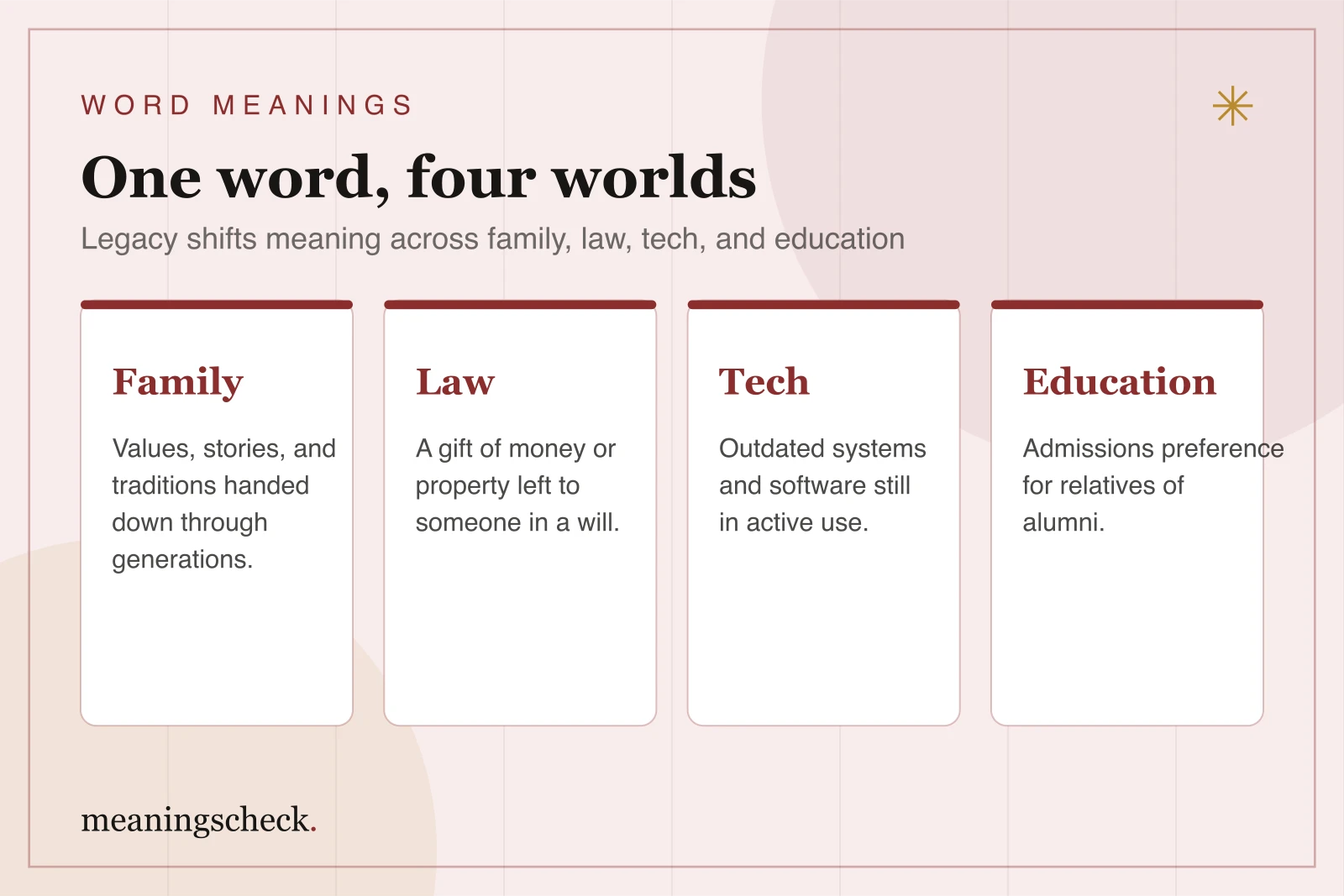
A legacy is something handed down by an ancestor or predecessor — depending on context, a legal gift of money (an inheritance), an enduring cultural impact, outdated computer software, or preferential treatment in college admissions.
When we hear the word "legacy," we often picture a billionaire's financial inheritance or a historical leader's enduring impact. But this versatile word lives a double life. While a legacy represents a beautiful, generational gift in personal contexts, stepping into a corporate IT department turns that same word into an expensive, outdated nightmare.
If you ask an estate lawyer, a software engineer, and an Ivy League admissions officer to define the word, you will get three entirely different answers. In this guide — part of our plain-language meaning guides — we break down the true meaning of legacy across its five primary contexts: personal life, legal estate planning, technology, traditional media, and modern college admissions.
The Short Answer: Decoding the Meaning of Legacy
The Short Answer: At its core, a legacy is something handed down by an ancestor or predecessor. Depending on the context, it can refer to a legal gift of money (an inheritance), an enduring cultural impact, outdated computer software, or preferential treatment in college admissions.
A Gift From the Past: The Core Definition
If you open the Merriam-Webster dictionary, the foundational legacy meaning is defined simply as "something transmitted by or received from an ancestor or predecessor or from the past."
It is derived from the Latin word legatus, which means "ambassador" or "envoy." Historically, a legacy was a person sent on a mission to represent someone else. Over centuries, the definition shifted from the person doing the representing to the thing being represented or handed down.
Today, it acts as a bridge between the past and the future. It is the tangible or intangible footprint that someone (or something) leaves behind after they are gone. It is the ultimate answer to the human question: "Did I matter?"
The Beauty vs. The Burden: How Context Changes the Word
One of the most fascinating aspects of the word is its inherent contradiction. The context completely dictates whether the word is positive or negative. In that respect it behaves much like internet acronyms such as the ASL meaning, which flips entirely depending on who is speaking.
In human terms, a legacy is almost always framed as a beautiful, positive achievement. Leaving behind a massive charitable foundation or passing down a thriving family business is viewed as the pinnacle of a successful life.
However, in the corporate and technological world, the word is universally despised. A "legacy system" is a burden. It implies that something is old, broken, stubborn, and desperately needs to be replaced, but the company is too entrenched in the past to move forward. It is the difference between handing down a beautiful antique watch and handing down a clunky, broken fax machine.
The Legacy Meaning in Life and Culture
The Short Answer: In personal life and culture, the word refers to the enduring impact of a person's character, values, and actions. It is how your loved ones and society remember you after you pass away, extending far beyond pure financial wealth.
What is the family legacy's meaning?
When people search for the family legacy meaning, they are often confusing it with a simple financial inheritance — it is one of those word meanings that shifts entirely with context. While money is certainly a factor, a true family legacy is exponentially deeper.
A family legacy is the transfer of core values, generational traditions, and moral character. It is the answer to how your children and grandchildren interact with the world. If a grandfather built a local business based on extreme honesty and community service, the money that business generates is the inheritance. The community's deep respect and the children's inherited work ethic? That is the legacy.
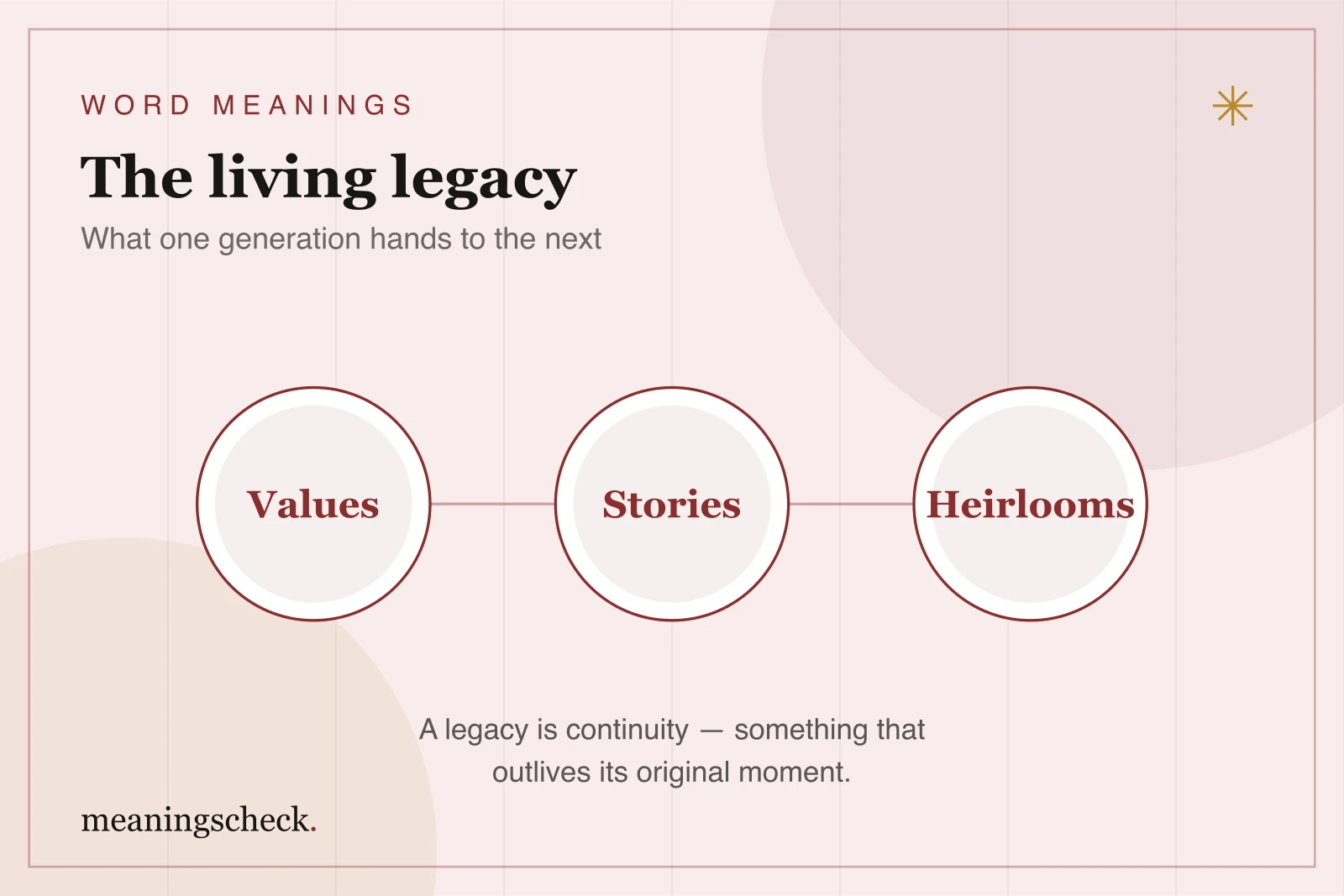
Financial wealth can be squandered in a single generation by poor decision-making. A strong legacy meaning in life built on education, emotional intelligence, and resilience equips the next generation to rebuild that wealth even if they lose it.
The Legacy Meaning in History: Leaving an Enduring Mark
Stepping back from the individual family unit, we must look at the macro scale. The legacy meaning in history refers to the long-lasting, often permanent impact of an era, an event, or a global leader.
Historical legacies are rarely purely positive; they are often deeply complex and polarizing.
For example, the legacy of the Roman Empire includes the foundation of modern Western law and the invention of concrete. The legacy of the Industrial Revolution includes massive leaps in human life expectancy but also the genesis of modern climate change. We are currently living inside the consequences of the legacy of decisions made by people who died centuries ago.
Real-World Examples: How to Build Your Legacy Today
If you are reading this and wondering how to actively build your own legacy, you must understand that it is not a passive event that happens after you die. It is an active construction project that you are building right now.
According to psychological experts at organizations like The Legacy Project, you can begin shaping your impact today through three actionable pillars:
- Mentorship: You do not need to be a billionaire to leave a mark. Mentoring a junior employee or coaching a youth sports team permanently alters the trajectory of those individuals' lives.
- Philanthropy: Setting up a small, recurring scholarship fund or donating time to a local shelter creates a ripple effect of generosity.
- Documentation: Write down your family history, your failures, and the lessons you learned. Do not let your lived experience die with you; hand it down as a blueprint for your descendants.
The Corporate World: Legacy Media Meaning and Tech
The Short Answer: In the corporate sector, the word is used to describe systems or institutions that existed before the digital revolution. "Legacy media" refers to traditional TV and print newspapers, while "legacy software" refers to outdated, hard-to-replace computer systems.
Decoding the Legacy Media Meaning
If you follow modern journalism or political commentary, you have likely encountered the term "legacy media." But what exactly does the legacy media meaning refer to in the 2020s?
Legacy media (often used interchangeably with "mainstream media" or "traditional media") refers to mass communication institutions that dominated the landscape before the invention of the internet. This includes major print newspapers (like The New York Times), broadcast television networks (like ABC and CBS), and terrestrial radio.
Today, these institutions are locked in a fierce battle for survival against "new media" — independent podcasters, Substack newsletter writers, and YouTube commentators. These digital creators speak in fast-moving internet slang and package stories as a quick TLDR summary rather than a 6pm broadcast. When a modern critic uses the term "legacy media," they are often implying that the institution is slow, outdated, and losing its grip on the modern cultural narrative.
The IT Burden: What is Legacy Software?
Walk into any corporate IT department and mention "legacy software," and you will likely hear a collective groan.
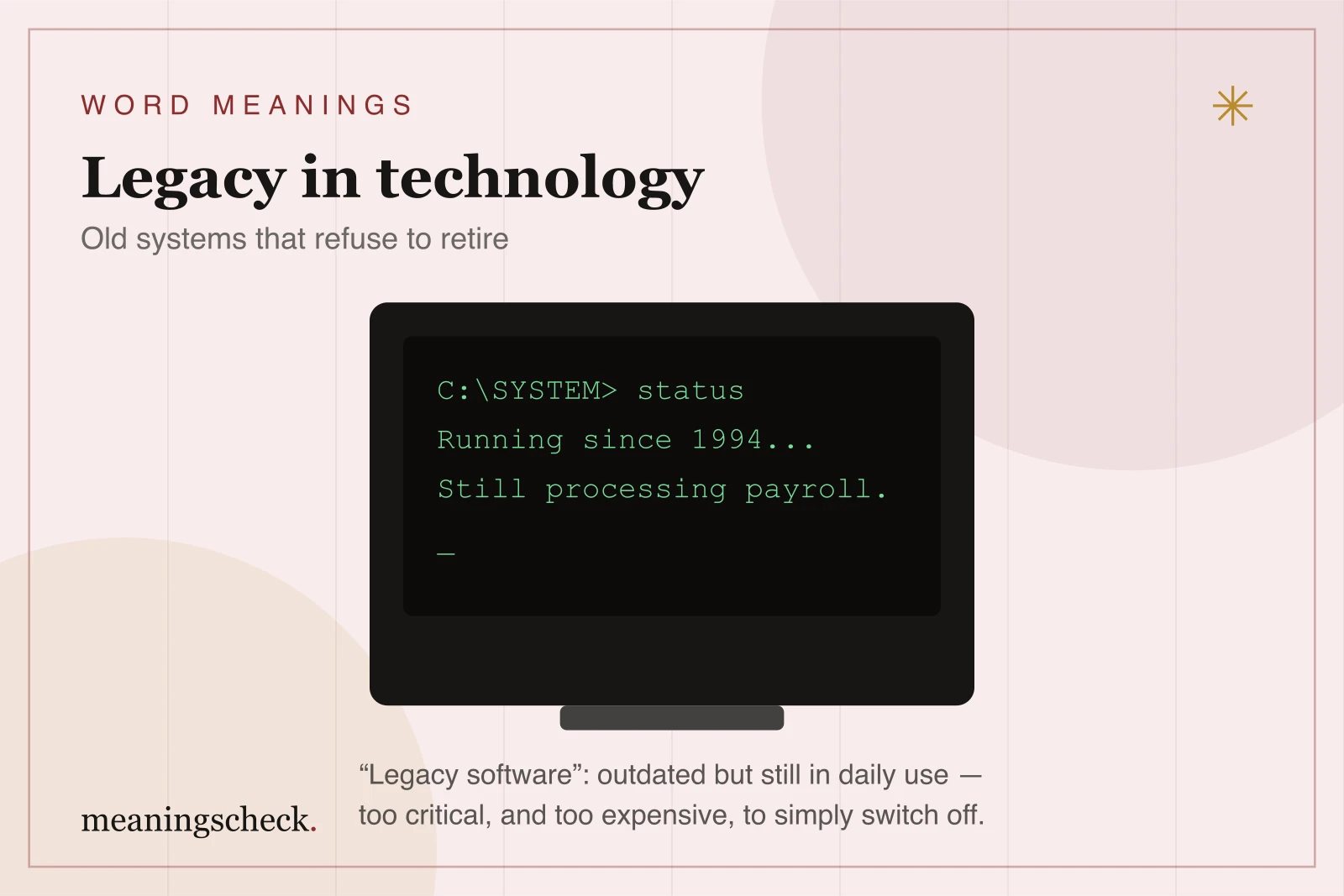
In technology, a legacy system is an outdated computing software or hardware system that is still in use. Why would a billion-dollar company use old software? Because replacing it is terrifyingly complex and expensive.
Imagine a major international bank. They might be running their core transaction database on code written in the 1980s (like COBOL). To upgrade that system, they would have to shut down the bank, risk losing millions of records, and spend billions of dollars. So, they keep patching the old, clunky system. It becomes a massive technical debt — a technological legacy that holds the company hostage.
Comparison Table: Life vs. Technology Contexts
| Context | What is Handed Down? | Emotional Connotation | Action Required |
|---|---|---|---|
| Personal / Family | Values, traditions, wealth, character. | Highly Positive (A Gift) | Nurture and protect it for the next generation. |
| Technology / IT | Outdated code, clunky hardware, technical debt. | Highly Negative (A Burden) | Spend millions of dollars to replace or patch it. |
| Media / Journalism | Traditional broadcasting and print institutions. | Neutral / Declining | Adapt to the digital landscape or face extinction. |
The Educational Divide: The Legacy Student's Meaning
The Short Answer: In higher education, a "legacy student" is a college applicant who receives preferential treatment during the admissions process because one of their parents or grandparents previously attended that specific university.
College Admissions and Preferential Treatment
If you are applying to a prestigious university, you must understand the legacy student meaning. It is one of the most powerful and highly criticized advantages in the American educational system.
When a university admissions office reviews an application, they look at grades, test scores, and extracurricular activities. However, if the applicant's parent is an alumnus of that school, the applicant is flagged as a "legacy."
Historically, elite institutions like Harvard, Yale, and Princeton have given significant preferential treatment to these applicants. The justification from the universities is that it builds generational loyalty and encourages alumni parents to donate massive sums of money to the school's endowment fund.
The Modern Controversy Surrounding Alumni Ties
While it used to be a quiet, accepted reality of higher education, the legacy student meaning has recently exploded into a massive cultural and legal controversy.
Following the 2023 Supreme Court ruling that struck down race-based affirmative action in college admissions, public scrutiny immediately pivoted to legacy admissions. Critics argue that legacy preferences are fundamentally unfair and anti-meritocratic. They point out that legacy applicants are overwhelmingly wealthy and white, meaning the practice essentially acts as "affirmative action for the rich."
In 2026, several states and high-profile universities have begun voluntarily banning the practice of considering alumni ties in admissions, arguing that an applicant's worth should be judged purely on their own academic merit, not their parents' history.
Estate Planning: The Legal Meaning of Legacy
The Short Answer: In a strict legal and financial context, a legacy is a specific gift of personal property or money left to a beneficiary in a testament. It is a vital component of estate planning and generational wealth transfer.
Bequests, Wills, and Inheritance
When you sit down with a lawyer to draft your testament, the legacy meaning becomes highly rigid and technical.
In legal terminology, a legacy (often used interchangeably with the word bequest) is a gift of personal property or money directed by a will. The person leaving the gift is the testator, and the person receiving the gift is the legatee.
For example, if you write in your will, "I leave $50,000 to my eldest daughter, and my collection of vintage watches to my nephew," both the money and the watches are legally classified as legacies. This is the mechanical, legal vehicle used to execute the emotional meaning of legacy we discussed earlier in the article.

Legacy vs. Devise: A Guide to Leaving Property
If you are currently doing your estate planning, it is absolutely critical to understand the difference between a "legacy" and a "devise." Many people use these words incorrectly, which can cause massive headaches in probate court.
A legacy (or bequest) applies only to personal property and cash. This includes bank accounts, stocks, cars, jewelry, and art.
A devise applies only to real property. Real property means real estate — land, houses, and commercial buildings.
If you leave your house to your son, you have legally devised the property to him. If you leave him $100,000 to pay the mortgage, you have left him a legacy. Understanding this subtle legal distinction ensures your final wishes are executed smoothly and without legal challenges from competing heirs.
Comparison Table: Legal Estate Planning Terms
| Legal Term | What Does it Cover? | Example | Who Receives It? |
|---|---|---|---|
| Legacy (or Bequest) | Cash, bank accounts, and personal property. | $50,000 cash; a vintage car; a stock portfolio. | The Legatee |
| Devise | Real estate and physical land. | A family home; a commercial building; a farm. | The Devisee |
| Inheritance | The broad, umbrella term for all assets received. | The total combination of the house and the cash. | The Heir |
Expert Insights: Why We Care About What We Leave Behind
The Short Answer: Humans are psychologically wired to care about their legacy because it provides a sense of immortality. Leaving behind a positive impact on our family or society satisfies our deep, existential need to know that our brief lives actually mattered.
The Psychology of Generational Impact
Why do we care so deeply about what is the meaning of legacy? If we are gone, why does it matter what happens to our money, our companies, or our reputation?
Psychologists refer to this as "generativity," a term coined by psychoanalyst Erik Erikson. As human beings reach middle age, we naturally shift our focus from personal ambition (building our own careers) to generativity (guiding and providing for the next generation).
We care about our family legacy meaning because it is our only defense against mortality. We cannot live forever, but our ideas, our wealth, and our values can. By actively shaping what we leave behind, we achieve a form of symbolic immortality. We ensure that our brief time on this planet echoes into the future.
Whether you are writing a complex legal will, mentoring a young student, or simply trying to be a good parent, you are actively writing the final chapter of your life story. Make sure it is a story worth reading.
Frequently Asked Questions (FAQs)
What is the meaning of legacy?
The core meaning of legacy refers to something handed down from the past. Depending on the exact context, it can be a financial inheritance left in a will, the enduring historical impact of a great leader, or an outdated piece of computer software.
What does the legacy media meaning refer to?
The legacy media meaning refers to traditional, pre-internet mass communication institutions. This includes major print newspapers, broadcast television networks, and radio stations that are currently competing against modern digital creators and social media platforms.
What is the legacy student meaning in college?
The term "legacy student" refers to a college applicant who is given preferential treatment during the university admissions process because their parent, grandparent, or sibling is an alumnus of that specific school.
What is the family legacy's meaning?
The family legacy meaning goes far beyond a simple financial inheritance. It refers to the transfer of generational wealth, core moral values, family traditions, and character traits from parents to their children and grandchildren.
What is the legacy's meaning in history?
The legacy meaning in history refers to the long-lasting, permanent impact of an era, a war, a cultural movement, or a world leader. It is the residual consequence (whether positive or negative) that society still lives with today.
What is the difference between a legacy and a devise in a will?
In legal estate planning, a legacy refers specifically to a gift of personal property or cash (like a bank account or a car). A devise refers specifically to a gift of real estate or physical land (like a family home).
Related terms
Share: · Post on X
Written by MeaningsCheck Team · Published
The MeaningsCheck team researches and writes plain-language explanations of slang, abbreviations, and everyday words — checked for accuracy, updated as language changes.