
What Does WYLL Mean? The Complete Guide to the WYLL Meaning in Text and Slang
WYLL stands for "What You Look Like?" — an informal question used on Snapchat, dating apps, and anonymous chats to ask for a selfie or "face reveal" from someone you have only met online.
The modern internet is built almost entirely on anonymity. Between carefully curated Instagram feeds, cartoon avatars, and faceless gaming profiles, it is incredibly easy to spend hours talking to someone online without having the slightest clue what they look like in the real world. Eventually, human curiosity takes over, and the digital veil must be pierced by the internet's most direct, unavoidable acronym.
If you are wondering what does wyll mean, you have likely just received a direct demand for physical proof of your identity. While this four-letter abbreviation might seem like a harmless question between teenagers flirting on Snapchat, it is actually one of the most high-stakes, potentially dangerous acronyms in digital communication.
In this comprehensive guide, we are going to unpack exactly what this slang means, explore the psychology of the "Bitmoji" culture, and provide critical cybersecurity warnings on how to safely handle this demand from a stranger.
The Core Definition: Decoding the WYLL Meaning Slang
The Short Answer: The primary wyll meaning slang stands for "What You Look Like?" It is an informal, highly direct question used across anonymous chat platforms and social media to request a physical photo or "face reveal" from another user.
The Literal Translation: "What Do You Look Like?"
To fully understand this digital phenomenon, we must establish the literal translation. When a user types these four letters, they are aggressively shortening the question, "What do you look like?"
Like most Gen Z digital slang, this abbreviation completely ignores proper grammar and punctuation. It drops verbs and ignores capitalization entirely to save precious milliseconds while typing on a smartphone. It is almost always typed entirely in lowercase letters ("wyll"), as capitalizing the acronym is generally perceived as aggressive or overly demanding in casual chat environments.
You will rarely see this acronym used between close friends or family members, because they already know your physical appearance. Close friends who miss seeing you send the far warmer MYF meaning ("Miss Your Face") instead. Instead, this abbreviation thrives exclusively in the "stranger danger" zones of the internet. It is the ultimate digital checkpoint when two anonymous users transition into a more personal relationship — the visual follow-up to the location question behind the WYF meaning.
Piercing the Digital Avatar: Why It Dominates Social Media
Why has the wyll meaning become so universally dominant across every major platform? Because the modern internet allows everyone to hide.
When you log onto Discord, Reddit, or Omegle, you are completely faceless. You are represented by an anime profile picture, a video game character, or a blank silhouette. When two anonymous users strike up a conversation and begin to feel a genuine connection, the human brain naturally desires to put a physical face to the digital voice. Early chatrooms handled the same curiosity with the ASL meaning ("Age, Sex, Location?"); WYLL simply skips straight to the photo.
Typing out "Can you please send me a picture of your face so I know what you look like?" feels incredibly formal, desperate, and creepy. By compressing that massive, awkward request into four simple letters, the sender artificially lowers the emotional stakes of the conversation. It makes a highly invasive question feel casual, quick, and routine.
Common Misinterpretations: "Will" and "Whatever"
While the overwhelming standard for this abbreviation is "What You Look Like," the internet is a chaotic place. In very rare, highly specific contexts, older users or those unfamiliar with slang might misinterpret the acronym.
Occasionally, users might assume it is simply a typographical error for the name "Will." Alternatively, some incredibly obscure definitions claim it stands for "Whatever You Like," used as a passive response to a question.
However, you can safely discard these secondary definitions 99% of the time. If you are having a conversation with someone you have never met face-to-face, and they send you these four letters, they are absolutely demanding a selfie.
The Visual App Ecosystem: The WYLL Meaning Text Snapchat Relies On
The Short Answer: On Snapchat, the acronym is used to bypass the app's default cartoon avatars. The wyll meaning text snapchat users rely on is a demand to see the physical person hiding behind the highly idealized, digital Bitmoji profile picture.
The Bitmoji Culture: Demanding Physical Truth
As an authoritative source on digital communication, we must address a massive platform-specific gap that most dictionaries completely ignore. Why is this acronym so incredibly popular on Snapchat, an app where you already have a profile picture?
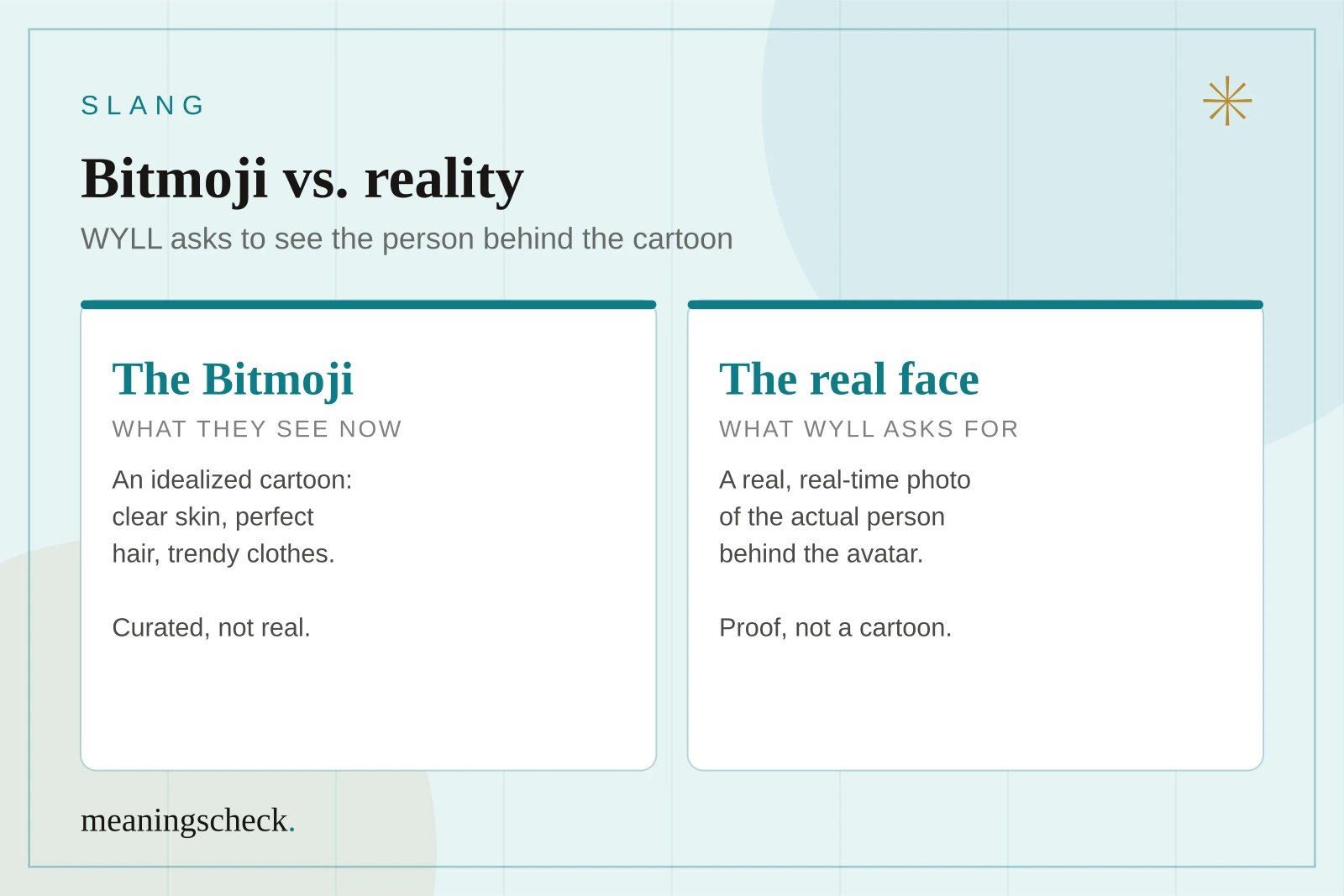
To understand the wyll meaning text snapchat ecosystem, you have to understand the culture of the "Bitmoji." When you create a Snapchat account, you design a digital cartoon avatar of yourself. Users intentionally design their Bitmojis to be highly idealized versions of themselves—clearer skin, perfect hair, and trendy digital clothing.
Because everyone is hiding behind a perfectly curated cartoon, the visual truth is obscured. That gap is also why real face reveals can draw harsh comments like the chopped meaning, Gen Z slang for "ugly." When a user sends this acronym on Snapchat, they are explicitly saying, "I am tired of talking to your cartoon avatar. Send me a real, real-time photo of your actual face." It is a demand to pierce the digital veil.
Decoding the WYLL Meaning From a Girl on Dating Platforms
When this acronym leaps off of Snapchat and lands on modern dating apps like Tinder, Yubo, or Bumble, the psychological intent shifts dramatically.
If you are a young man trying to decode the wyll meaning from a girl, you must understand the safety dynamics of modern online dating. Women use this exact acronym as a defensive mechanism to verify a man's identity. They are trying to ensure they are not talking to a "catfish" (someone using fake photos) before they invest any more emotional energy into the digital conversation.
If a girl matches with you, but your profile only features pictures of your car, photos where you are wearing sunglasses, or distant group shots, she will inevitably send you this acronym. It is not an insult; it is a required safety check. She is demanding a clear, unobstructed "face reveal" to verify that the person she is talking to actually matches the profile.
Comparison Table: Anonymous vs. Visual Platform Usage
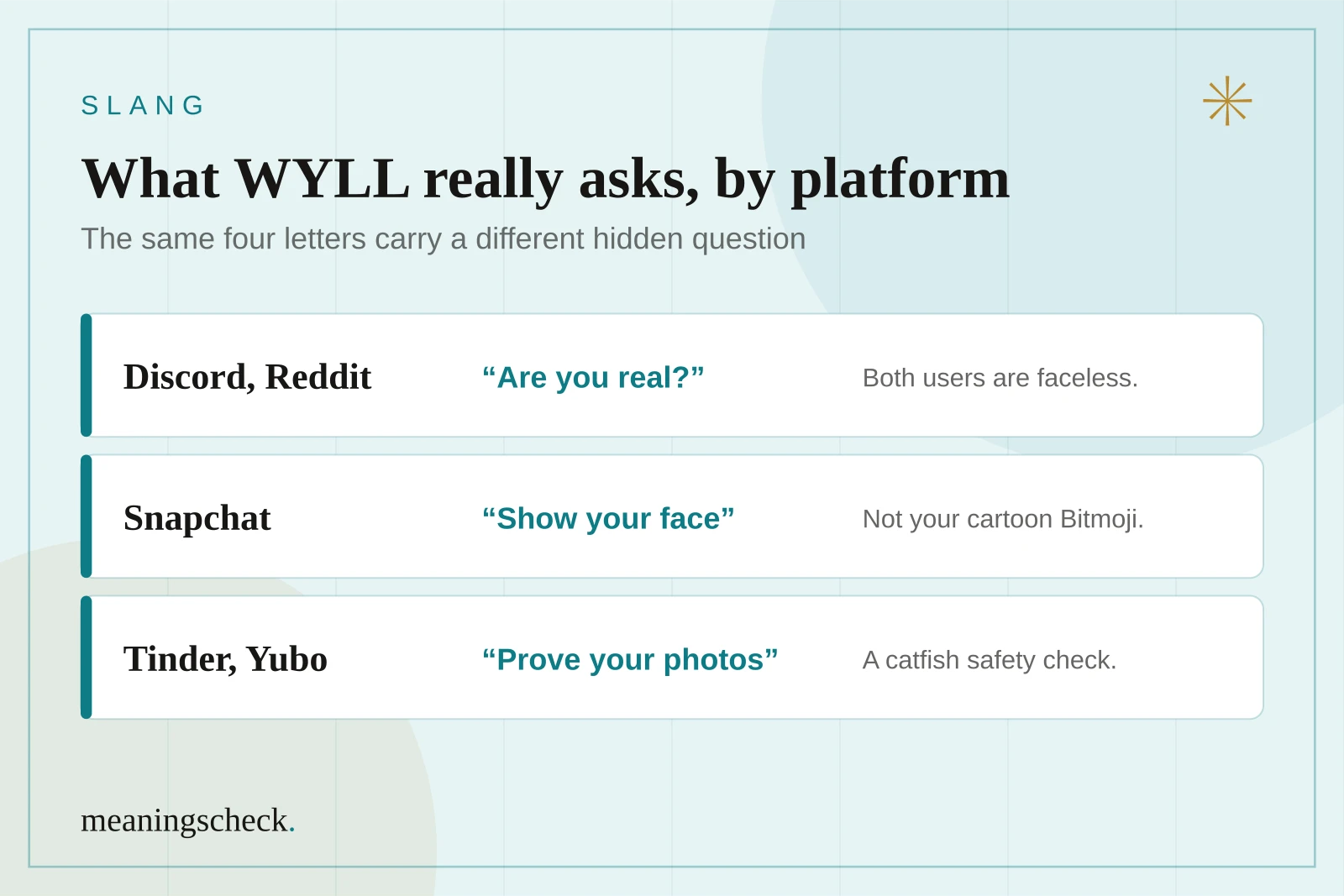
| Platform Type | Primary Sender Intent | The Digital Context | The Hidden Meaning |
|---|---|---|---|
| Anonymous (Discord, Reddit) | Establishing baseline physical identity. | Both users are completely faceless. | "Are you a real person or a bot?" |
| Visual App (Snapchat) | Piercing the idealized cartoon avatar. | Users are hiding behind Bitmojis. | "I want to see your real face, not your cartoon." |
| Dating App (Tinder, Yubo) | Verifying identity to avoid catfishes. | Profile pictures are unclear or suspicious. | "Prove to me that you actually look like your photos." |
YMYL Safety Warning: The Severe Risks of the WYLL Meaning in Chat
The Short Answer: Sending a clear selfie to a stranger poses a massive cybersecurity and personal safety risk. Malicious actors use the wyll meaning in chat to harvest real photos for reverse-image searching, extortion, and creating fake profiles.
The Danger of Sending Face Reveals to Anonymous Strangers
Because this acronym is treated as harmless, everyday teen slang, many young users immediately comply with the demand without a second thought. As trusted experts in internet safety, we must emphasize that your physical face falls strictly under YMYL (Your Money or Your Life) privacy protocols.
When a stranger sends you the wyll meaning slang, they are asking for the most sensitive piece of biometric data you possess: your face. If you reply by sending a clear, unobstructed selfie to a random user on an anonymous platform like Omegle or a Discord server, you are opening the door to severe digital consequences.
You have no idea who is on the other side of the screen. They could be a predator, a data scraper, or an extortionist. Once you send a photo of your face over the internet, you permanently lose control of that image. It can be screenshotted, saved, and weaponized against you in seconds. And if a "wyll" request ever escalates into a demand for explicit photos, it has crossed into NSFW meaning territory — block and report the account immediately.
Catfishing, Reverse Image Searches, and Digital Blackmail
Why do malicious actors want your face? The primary threat is the terrifying accuracy of modern reverse-image search engines.
If a scammer sends the Wyll meaning in chat and you reply with a selfie, they can run that photo through advanced AI facial recognition software. Within seconds, the software can scan the entire internet and locate your personal Instagram, your Facebook profile, your LinkedIn account, and even your family members' profiles.
Once they have your real identity, they can initiate a digital blackmail scheme, threatening to send embarrassing chat logs to your family or employer unless you pay them. Alternatively, they can simply steal your selfie and use it to create a highly convincing "catfish" profile to scam other people online. Never treat a demand for a photo from a stranger as a casual, harmless request.
Real-World Examples: How to Safely Reply to the Demand
The Short Answer: You are never obligated to send a photo to a stranger. You can safely reply by deflecting the demand with a funny meme, pivoting the conversation to a new topic, or sending a highly obscured, context-free photo if you truly feel safe.
The Deflection Strategy: Using Memes to Protect Your Identity
When you receive the wyll meaning in text, you are often caught in an incredibly awkward social dilemma. You want to keep the conversation flowing and show that you are fun to talk to, but you also need to strictly protect your digital privacy.
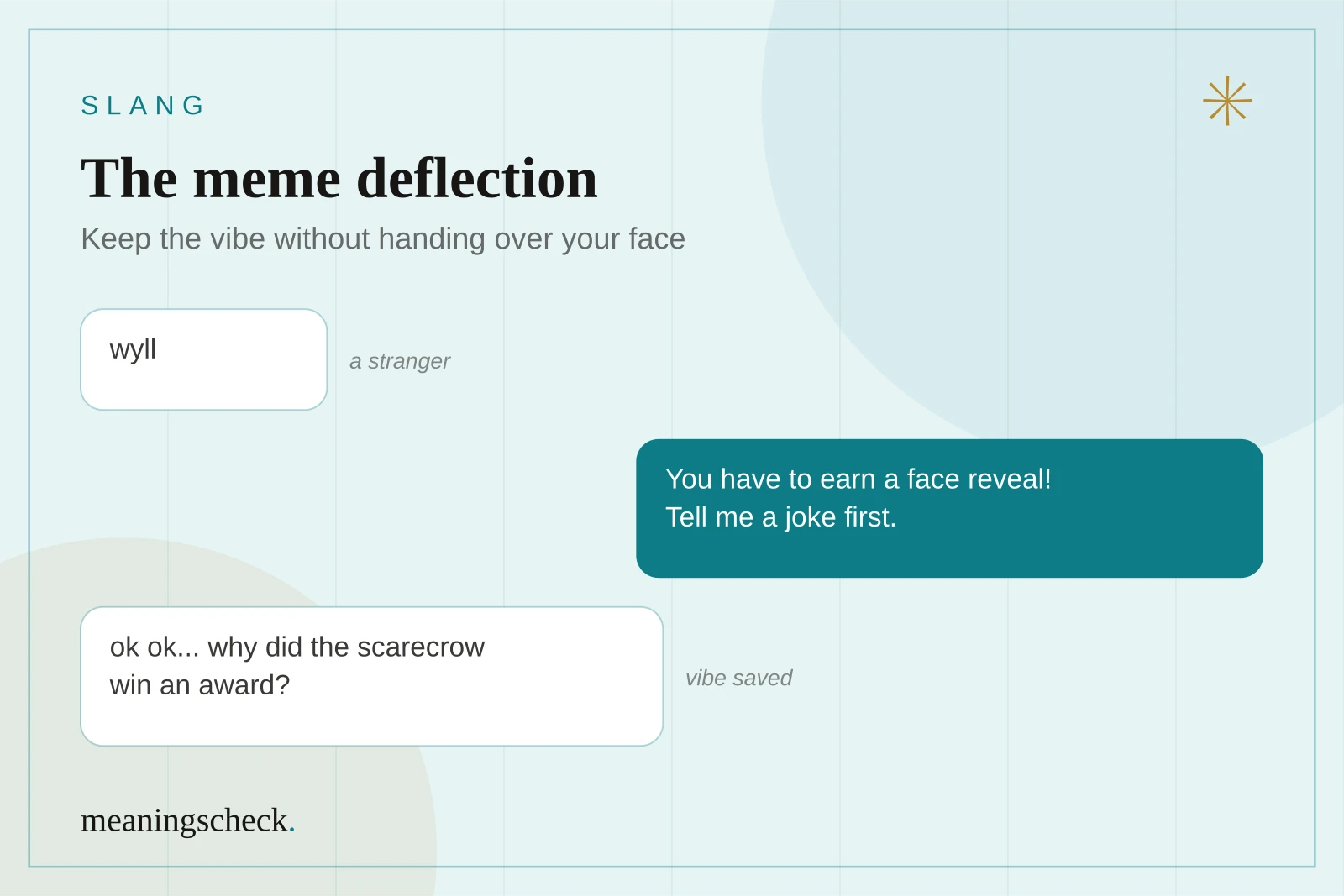
The most effective, culturally acceptable way to navigate this demand without ruining the vibe is the "Meme Deflection Strategy." Instead of sending a photo of your actual face, you send a highly exaggerated, funny photo to playfully reject the request.
- Deflection 1 (The Celebrity): Reply with an incredibly unflattering paparazzi photo of a celebrity (like Danny DeVito or Steve Buscemi) and say, "This is me. I just woke up."
- Deflection 2 (The Animal): Send a picture of a grumpy, wet cat or a bizarre-looking fish and say, "Please be nice, I'm insecure about my nose."
- Deflection 3 (The Text Pivot): If you don't want to send an image at all, simply reply with text: "You have to earn a face reveal! Tell me a joke first."
These deflections perfectly satisfy the social rhythm of the conversation. They keep the tone light and engaging while acting as an impenetrable shield for your real-world identity. If the sender gets angry that you won't send a real selfie, they are a massive red flag, and you should block them immediately.
The Direct Approach: Sending Safe, Context-Free Selfies
What if you have been talking to this person for weeks, you genuinely trust them, and you actually want to fulfill their "wyll" request? If you decide to send a real selfie, you must employ strict cybersecurity best practices.
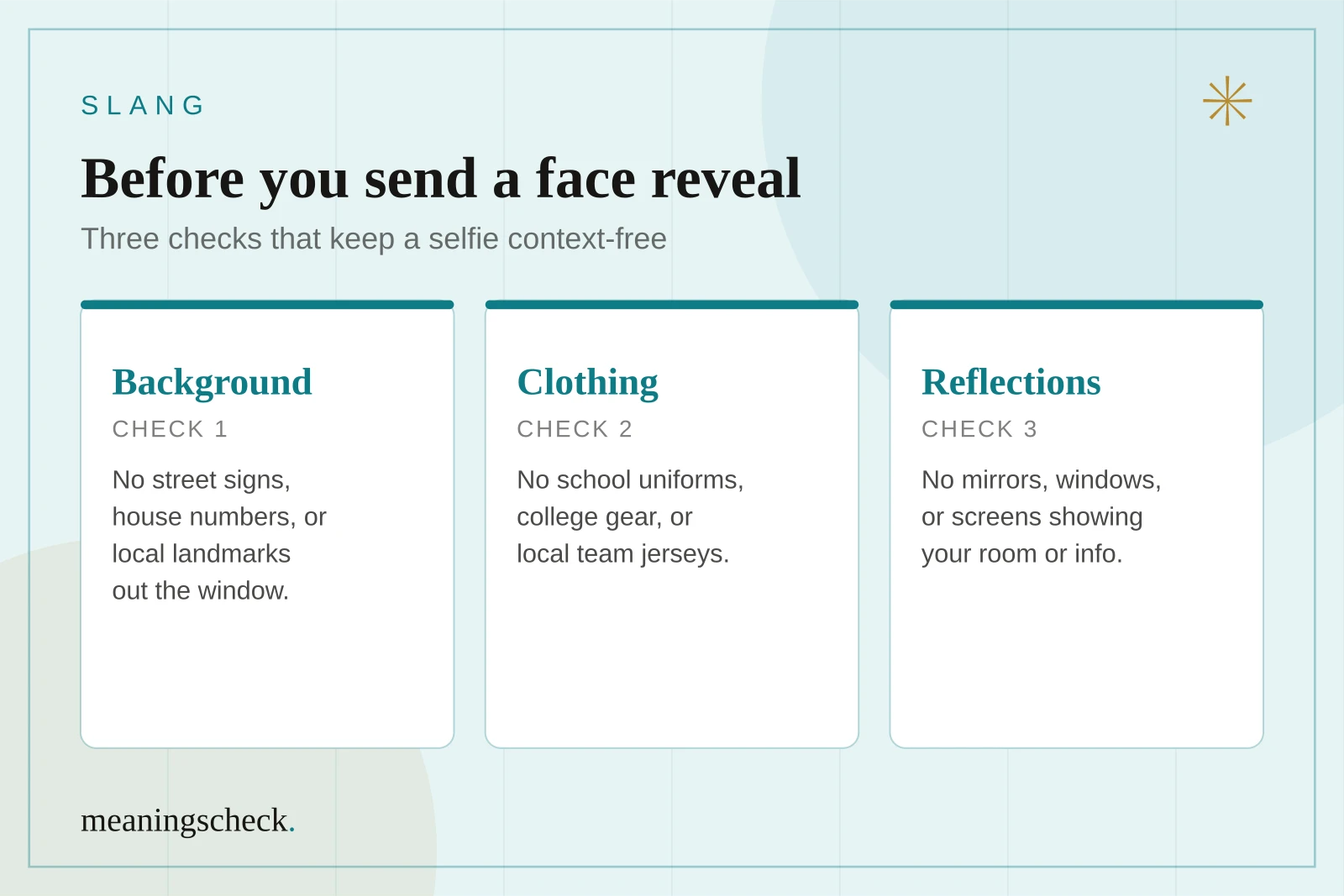
Never take a photo that accidentally reveals your geographical location or your daily routine. If you are going to send a face reveal to an internet friend, ensure the photo is completely "context-free."
- Check the Background: Make sure there are no street signs, house numbers, or recognizable local landmarks visible out the window behind you.
- Check Your Clothing: Never send a photo where you are wearing a local high school uniform, a college sweatshirt, or a local sports team jersey that narrows down your city.
- Check for Reflections: Ensure that mirrors, windows, or shiny objects are not reflecting sensitive information (like your computer screen or your bedroom layout) into the camera lens.
By sending a tight, closely cropped photo against a blank, neutral wall, you satisfy their curiosity while providing absolutely zero actionable data to a potential stalker.
Comparison Table: Reply Frameworks Based on Safety Levels
| Your Comfort Level | The Sender's Profile | Your Safe Reply Strategy |
|---|---|---|
| Zero Trust | Stranger with no profile picture. | Send a picture of a meme or a funny animal. Deflect entirely. |
| Medium Trust | Someone you matched with on a dating app. | Send a closely cropped, context-free selfie against a blank wall. |
| High Trust | A verified internet friend you have known for months. | Send a standard selfie, but continue to avoid showing identifying backgrounds. |
Frequently Asked Questions (FAQs)
What does WYLL mean fundamentally?
Fundamentally, if you are asking what WYLL means, it is an abbreviation for "What You Look Like?" It is a direct, casual demand sent by an internet user requesting a physical selfie, video, or detailed physical description of the person they are chatting with.
What is the WYLL meaning in text on Snapchat?
Because Snapchat users hide behind highly idealized cartoon avatars (Bitmojis), the WYLL meaning Snapchat users rely on is a specific demand to pierce the digital veil. The sender is explicitly asking to see your real, physical face instead of your cartoon representation.
Is it safe to reply to the WYLL meaning slang on anonymous apps?
No, it is highly dangerous to immediately reply with a clear selfie on anonymous apps like Omegle, Yubo, or Discord. Sending your face to a stranger opens you up to reverse-image searching, digital stalking, and severe extortion schemes.
How should I reply to the WYLL meaning in chat?
If you want to protect your privacy, you should reply to the WYLL meaning in chat by playfully deflecting the request. You can send a funny meme, a picture of a celebrity, or tell them they have to "earn" a face reveal by keeping the conversation interesting.
Why do girls send WYLL on Tinder and Bumble?
If you are trying to decode the WYLL meaning from a girl on a dating app, it is almost always a safety verification check. She is demanding a clear, current photo to ensure you match your profile pictures and to verify that she is not talking to a "catfish."
Does WYLL ever mean "Whatever You Like"?
In extremely rare, highly obscure contexts, older internet users might mistakenly use it as an abbreviation for "Whatever You Like." However, if you are talking to anyone under the age of 30 online, you can confidently assume they are demanding a photo of your face.
Related terms
Share: · Post on X
Written by MeaningsCheck Team · Published
The MeaningsCheck team researches and writes plain-language explanations of slang, abbreviations, and everyday words — checked for accuracy, updated as language changes.