
What Does TYSM Mean? TYSM Meaning in Text, How to Reply, and When to Use It (2026)
TYSM stands for "thank you so much" — a warm, casual way to show extra gratitude in texts, DMs, and comments. It's stronger than "ty" (thank you) and is usually answered with "np," "ofc," or "anytime."
TYSM means "thank you so much." It's a quick, warm way to say thanks in a text, DM, or comment — stronger than a plain "ty," and friendlier than "thanks." When someone sends "tysm!!" after you help them, they're genuinely grateful.
Simple, right? Mostly. But TYSM has a few layers worth knowing.
The same four letters can sound gushing, polite, sarcastic, or even cold, depending on punctuation and context. There's also a viral TikTok meme — "aw tysm" — that turned the phrase into a joke you may not want to repeat. So if you're asking what does TYSM mean, here's the full picture.
You'll learn the TYSM meaning in text, where texting thank-yous came from, how TYSM compares to TY, THX, and TYVM, how people use it on Instagram, TikTok, and Discord, the best ways to reply, and when you should spell it out instead.
Key takeaway: TYSM is real gratitude in shorthand. The abbreviation saves time — it doesn't make the thanks any less sincere.
Executive Summary: TYSM at a Glance
Here's everything you need in thirty seconds:
- Definition: TYSM stands for "thank you so much."
- Strength: It's warmer than TY ("thank you") and THX ("thanks"), and more casual than TYVM ("thank you very much").
- Tone: Friendly and sincere. More letters ("tysmmm") or emojis ("tysm 🥹") mean even more gratitude.
- Best replies: "np," "ofc," "anytime," "of course!" or a heart reaction.
- Professional use: Fine with close coworkers in chat. In emails, write "Thank you so much" in full.
- Watch out for: The "aw tysm" meme, a 2021 TikTok joke based on how the phrase sounds like "autism."
What Does TYSM Mean? The Core Definition
The Short Answer: TYSM stands for "thank you so much." It's a casual, warm abbreviation used in texts, DMs, and comments to show extra gratitude — more than a quick "ty" but less formal than writing the full sentence.
The Literal Translation: "Thank You So Much"
The TYSM meaning in text is exactly what it looks like: Thank You So Much. Each letter stands for one word.
It's an initialism. If anyone says it out loud, they spell it: "T-Y-S-M." Most people just say the full phrase in conversation. TYSM lives almost entirely in typing.
You'll see it everywhere: "tysm for the help!", "omg tysm 😭", "tysm for 10k followers!!" In every case, the meaning is the same. Someone is grateful and wants you to know.
Why "So Much" Matters
"Thank you" is polite. "Thank you so much" is personal.
That small intensifier changes the feeling of the message. "Ty" can sound like a reflex — the texting version of holding a door. "Tysm" says the favor actually meant something.
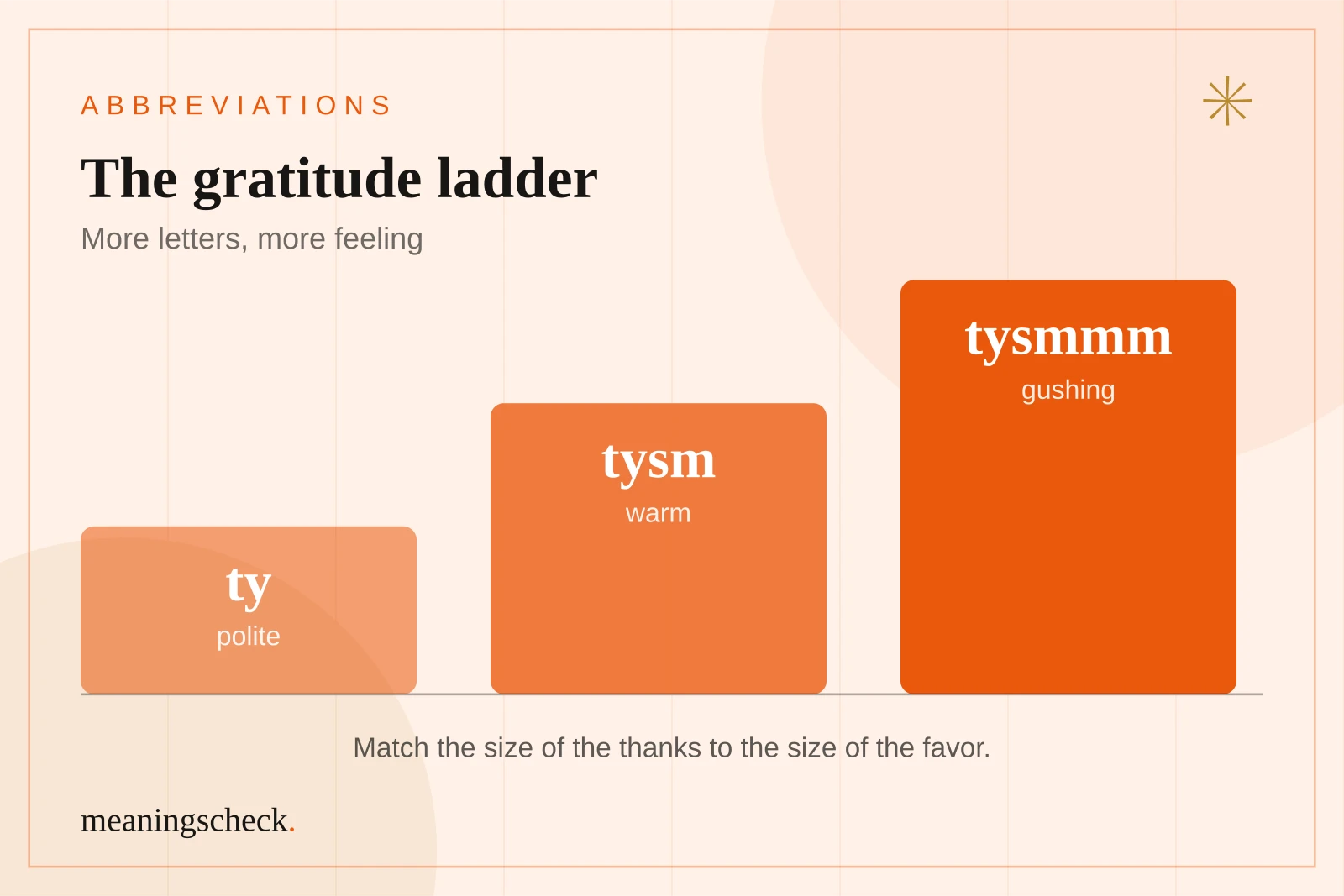
Think of it as a volume knob for gratitude. TY is a nod. TYSM is a warm smile. TYSMMM with three emojis is a hug.
Where TYSM Came From
Abbreviated thank-yous are nearly as old as online chat. In the days of chat rooms, instant messengers, and online games, typing speed mattered. "Ty," "thx," and "tyvm" became everyday shorthand.
TYSM grew more common as social media made texting more emotional and expressive. On platforms like Instagram, Twitter, and later TikTok, people wanted thank-yous that sounded warm — not just efficient. "Thank you so much" hit that note. TYSM became its fast, friendly abbreviation.
Today, it's one of the most widely understood texting abbreviations, used by teens, parents, and small businesses alike.
The Gratitude Ladder: How Thankful Is TYSM?
Not every thank-you carries the same weight. Here's how the common versions stack up:
| Abbreviation | Stands For | Warmth | Typical Use |
|---|---|---|---|
| ty | Thank you | Low–medium | Quick, polite thanks |
| thx / thnx | Thanks | Low | Fast, casual, a bit flat |
| tysm | Thank you so much | High | Warm, sincere gratitude |
| tyvm | Thank you very much | Medium–high | Slightly formal — or sarcastic |
| tysmmm | Thank you so much (extra) | Very high | Gushing, excited thanks |
| ily tysm | I love you, thank you so much | Maximum | Close friends and family |
TYSM Meaning in Text: Reading the Tone
The Short Answer: In texts, TYSM is almost always warm and sincere. Exclamation points, extra letters, and emojis make it warmer. A flat "ty." with a period can feel cold — and "wow tysm" after something bad is usually sarcastic.
Punctuation and Emojis Change Everything
The four letters don't change. The details around them do:
- "tysm" — sincere and relaxed. The default.
- "tysm!!" — genuinely excited or relieved.
- "TYSM" — loud, happy gratitude, often after big news.
- "tysm 🥹" — touched, almost emotional.
- "tysmmmm" — gushing; the extra letters stretch the feeling.
- "ty." — with a period, can feel curt or annoyed.
That last one surprises people. In texting, a period at the end of a short message often reads as cold. "ty." can sound like "fine, thanks, we're done here." If you want warmth, TYSM with an exclamation point is the safer choice.
Key takeaway: "tysm!!" is warm. "ty." is often cold. Punctuation is tone of voice in text.
Is TYSM Ever Sarcastic?
Yes, occasionally. When someone does something unhelpful, "wow tysm" can drip with sarcasm:
- "You ate the last slice? wow tysm."
- "Thanks for telling me the meeting moved after it started. tysm."
Context makes it obvious. If the "favor" was actually a problem, TYSM is sarcastic. It's the gratitude version of an eye-roll — close cousin to the exasperated energy behind the BFFR meaning.
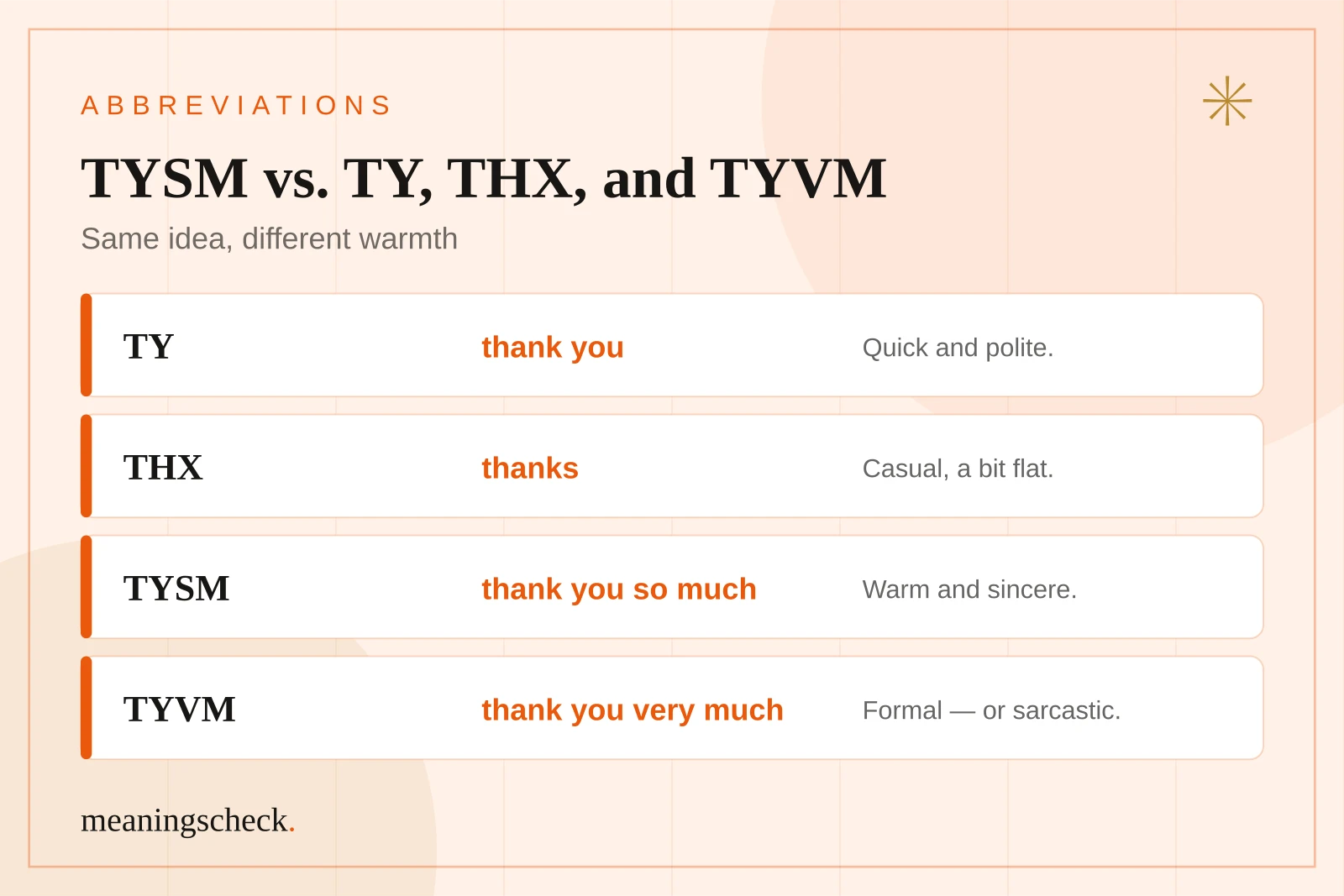
TYSM vs. TY, THX, TYVM, and TYY
| Abbreviation | Meaning | When It Fits | Watch Out |
|---|---|---|---|
| TY | Thank you | Quick, routine thanks | Can feel minimal |
| THX | Thanks | Super casual exchanges | Can feel flat or rushed |
| TYY | Thank you (playful) | Friendly, cute thanks | Very informal |
| TYSM | Thank you so much | Real favors and kindness | Too casual for formal emails |
| TYVM | Thank you very much | Polite or old-school thanks | Can read as sarcastic |
Here's a subtle point: TYVM is riskier than TYSM. "Thank you very much" is a phrase people often use sarcastically in speech ("well, thank you very much"). TYVM can carry that edge. TYSM rarely does unless the context is clearly negative.
TYSM on Instagram, TikTok, Snapchat, and Discord
The Short Answer: On Instagram and TikTok, TYSM thanks people for comments, birthday wishes, and follower milestones. On Snapchat it's quick gratitude between friends. On Discord, it's how people thank someone who answered their question.
TYSM on Instagram
Instagram runs on appreciation. You'll see TYSM in:
- Birthday replies: "tysm everyone for the birthday wishes 🥹"
- Comment replies: "tysm!! ❤️" under a compliment.
- Milestone posts: "tysm for 10k!!"
- Small-business posts: "tysm for all the orders this week!"
For creators and small shops, TYSM is a quick way to make followers feel seen without writing a paragraph every time.
TYSM on TikTok
TikTok creators reply "tysm" to supportive comments constantly. It's also common in captions thanking followers for going viral: "tysm for 1 million views 😭."
TikTok is also where the "aw tysm" meme lives — more on that below.
TYSM on Snapchat and iMessage
In private chats, TYSM is straightforward gratitude between friends:
- "tysm for the ride"
- "omg tysm for the birthday gift"
- "tysm, hmu if you ever need anything" — pairing thanks with an open invitation, the friendly move explained in our HMU meaning guide.
TYSM on Discord and in Gaming
On Discord servers, TYSM is the standard way to thank someone who helped:
- A modded game finally works: "it worked!! tysm"
- Someone shares a guide: "tysm, this saved me hours"
- A teammate carries the match: "tysm for the revive"
In help channels, a quick "tysm" tells the helper their answer worked — which matters more than people realize.
Volunteer moderators and helpers often answer dozens of questions a day. A short "it worked, tysm!" closes the loop, confirms the fix for anyone reading later, and keeps people willing to help the next person who asks.
Group Thank-Yous
Group chats have their own TYSM etiquette. After a surprise party or a group gift, one "tysm guys 😭❤️" to the whole chat is perfect. You don't need to thank each person individually in the group — though a private message to the organizer is a nice touch.
When the group thanks you, a simple "ofc!! love y'all" covers everyone at once.
Comparison Table: TYSM Across Platforms
| Platform | Typical Use | Example | Tone |
|---|---|---|---|
| Birthday and comment replies | "tysm everyone 🥹" | Warm, public | |
| TikTok | Replies and milestone captions | "tysm for 1M views" | Excited |
| Snapchat / iMessage | Private thanks | "tysm for the ride" | Personal |
| Discord | Thanks for help or carries | "it worked!! tysm" | Relieved |
| Group chats | Thanks to the whole group | "tysm guys for the surprise" | Affectionate |
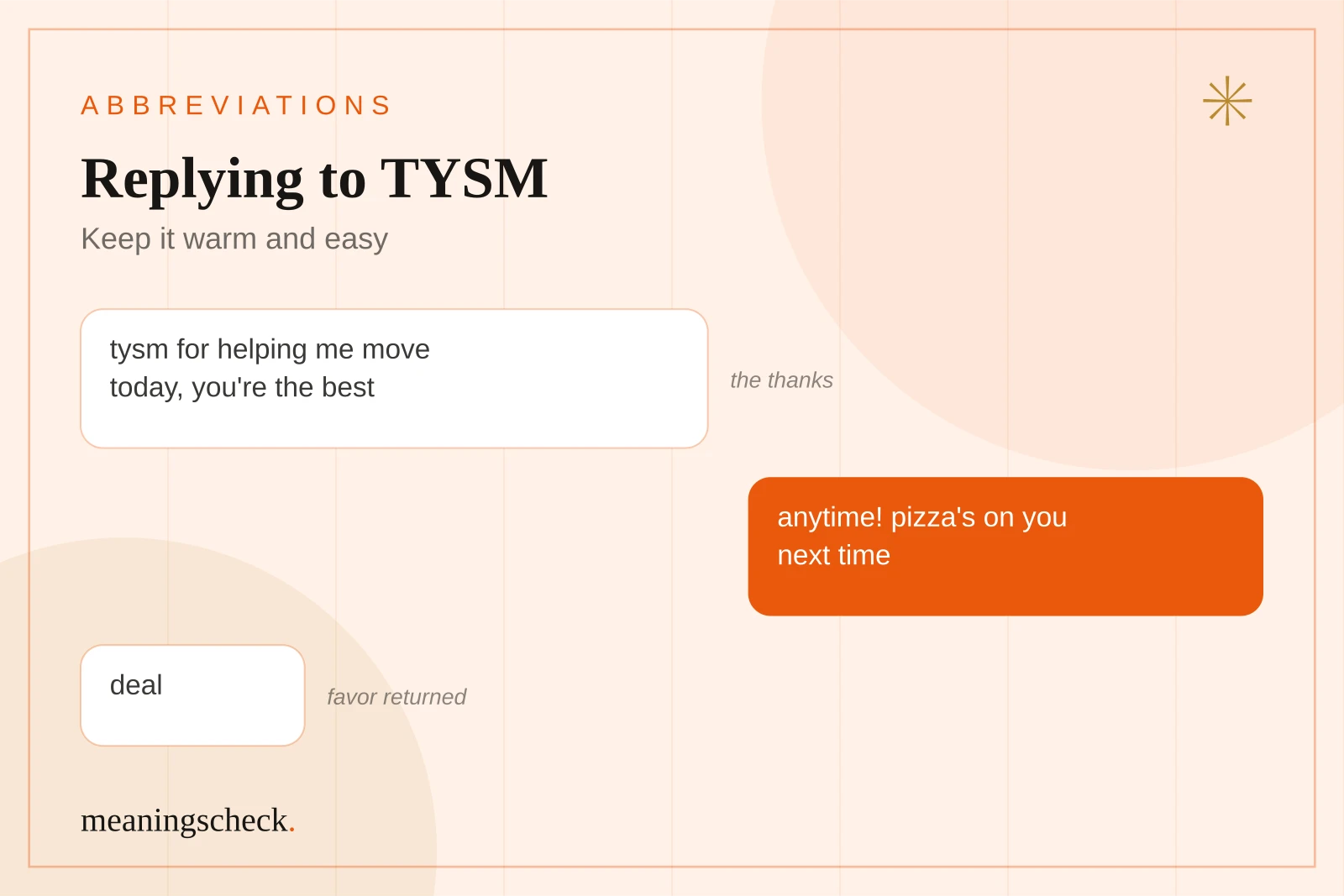
How to Reply to TYSM (With Examples)
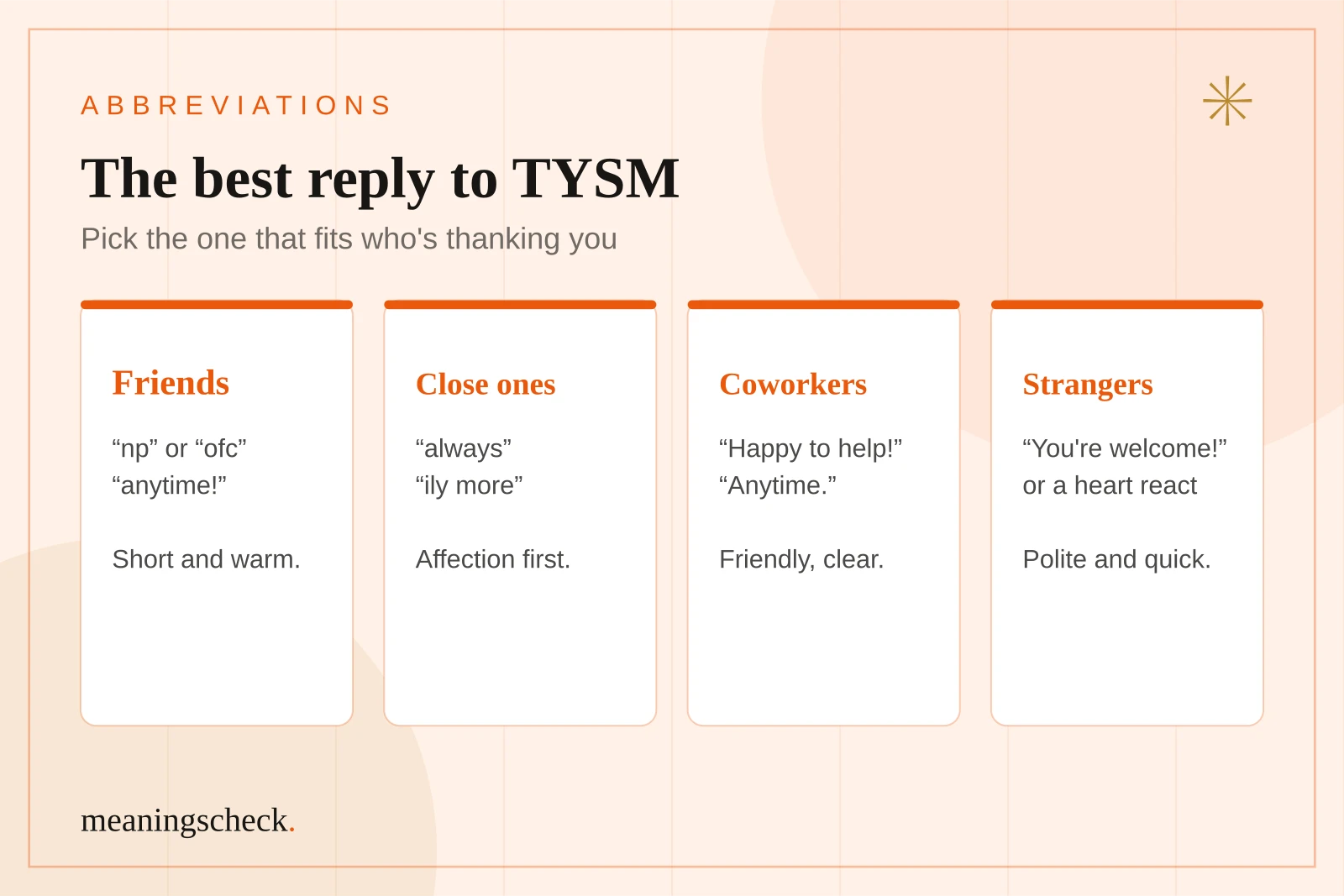
The Short Answer: The easiest replies to TYSM are "np" (no problem), "ofc" (of course), "anytime," or a heart reaction. With close friends, "ily" or "always" works. At work, "Happy to help!" is the safest choice.
Quick Replies for Friends
Short and warm is perfect:
- "np!"
- "ofc ❤️"
- "anytime"
- "ofc ofc"
- "you're welcome!"
Warmer Replies for Close Friends and Family
When the thank-you is personal, match the warmth:
- "always, ily"
- "of course, you'd do the same for me"
- "anything for you 🫶"
Replies at Work
Keep it friendly and clear:
- "Happy to help!"
- "Anytime — let me know if you need anything else."
- "Of course!"
Replying to Strangers or Followers
A heart reaction or "You're welcome!" is enough. If you're a creator replying to hundreds of comments, a heart is perfectly polite.
"No Problem" vs. "You're Welcome"
Here's a small etiquette debate. Some people — often older generations — feel that "no problem" implies the favor could have been a problem. They prefer "you're welcome."
Many younger people see it the other way around. To them, "no problem" sounds relaxed and generous, while "you're welcome" can sound stiff.
Neither is wrong. If you're replying to someone older or in a formal setting, "you're welcome" is the safe bet. With friends, "np" is completely normal.
Comparison Table: The Best Reply by Situation
| Situation | Best Reply | Why It Works |
|---|---|---|
| Friend thanks you for a favor | "anytime!" | Warm and generous |
| Best friend thanks you | "always, ily" | Matches the closeness |
| Coworker thanks you | "Happy to help!" | Friendly and professional |
| Manager thanks you | "Of course — glad it helped." | Polite and confident |
| Follower thanks you in comments | A heart reaction | Quick and kind |
| Someone thanks you sarcastically | "lol my bad" | Defuses the tension |
TYSM vs. "Thank You So Much": Does the Abbreviation Matter?
The Short Answer: For everyday favors, TYSM and the full phrase land about the same. For bigger moments — a gift, a long favor, a hard week someone helped you through — the full words feel more intentional and are worth the extra seconds.
Abbreviations save time. That's their whole point. But time is also part of what makes a thank-you feel meaningful.
Here's a useful way to think about it. The bigger the favor, the more the effort of your thanks should match it.
- Someone sends you a link you asked for → "tysm!" is perfect.
- Someone covers your shift so you can see family → "Thank you so much, seriously. I owe you."
- Someone drives you to the hospital at 3 a.m. → Say it in person. Then text it too.
TYSM isn't less sincere than the full phrase. It's just lighter. Use it where lightness fits, and reach for full words when the moment is heavy.
Key takeaway: Match the weight of your thanks to the weight of the favor. TYSM for everyday kindness, full words for big moments.
15 Ways to Say "Thank You So Much" Without TYSM
The Short Answer: You can swap TYSM for casual phrases like "you're a lifesaver" or "appreciate you," heartfelt ones like "I can't thank you enough," or professional ones like "I really appreciate your help." Pick the tone that fits the relationship.
Want variety? Here are 15 alternatives, sorted by tone:
| Phrase | Tone | Best For |
|---|---|---|
| "You're a lifesaver" | Casual, grateful | Friends who bailed you out |
| "Appreciate you" | Casual, warm | Friends and close coworkers |
| "You're the best" | Casual, affectionate | Friends and family |
| "Thanks a million" | Playful | Light favors |
| "Ty ty" | Playful, Gen Z | Quick chats |
| "Ilysm, thank you" | Very warm | Best friends, partners |
| "I owe you one" | Casual, sincere | Favors you'll return |
| "I can't thank you enough" | Heartfelt | Big, meaningful help |
| "This means so much to me" | Heartfelt | Gifts and kind gestures |
| "You made my day" | Heartfelt, upbeat | Compliments and surprises |
| "I really appreciate your help" | Professional | Coworkers and clients |
| "Thank you for your time" | Professional | Interviews and meetings |
| "I'm grateful for your support" | Professional, warm | Mentors and managers |
| "Many thanks" | Formal | Emails |
| "Thank you so much" (spelled out) | Universal | Anywhere |
The full phrase sits at the bottom for a reason: it works everywhere. When in doubt, just write it out.
Is TYSM Professional? Using It at Work
The Short Answer: TYSM is fine in casual chat with coworkers you know well. In emails, with clients, or with senior leaders, spell it out — "Thank you so much" is warm, clear, and perfectly professional.
Here's good news: the full phrase "thank you so much" is completely professional. You don't need to swap it for something stiff. You just need to write the words instead of the initials.
In a relaxed Slack or Teams channel, "tysm for jumping on that!" is friendly and normal. Many teams use it daily.
In an email to a client, a recruiter, or your CEO, TYSM can read as rushed. Spelling it out takes two extra seconds and signals care.
| Casual | Professional Alternative |
|---|---|
| "tysm for the help!" | "Thank you so much for your help!" |
| "tysm, this is perfect" | "Thank you — this is exactly what I needed." |
| "tysm for the quick reply" | "I really appreciate the quick response." |
| "tysm everyone!!" | "Thank you all for your hard work this week." |
We recommend one rule: if the thank-you will be read slowly, write it out. Emails, cards, and formal messages deserve full words. Fast chats can use TYSM.
TYSM in Customer Service and Small Business
The Short Answer: Casual brands — clothing shops, creators, cafés — can use TYSM in social replies to sound friendly and human. Formal brands like banks, law firms, and healthcare providers should spell out "thank you."
More businesses now reply to customers the way friends text each other. A small online shop replying "tysm for your order!! 💕" under an Instagram post feels warm and personal. It matches the platform's tone.
That works best when:
- The brand voice is already casual. A streetwear shop can say "tysm." A bank shouldn't.
- The channel is social. Instagram comments and TikTok replies suit TYSM. Order confirmation emails usually don't.
- The customer is happy. "Tysm for the kind review!" is great. Replying "tysm" to a complaint can sound dismissive.
For complaints, refunds, or anything sensitive, full sentences show more care: "Thank you so much for letting us know — we're fixing this today."
Quick Thanks Around the World
The Short Answer: Many languages have their own fast, warm thank-yous. Spanish speakers write "mil gracias," French speakers shorten "merci" to "mrc," and Brazilian Portuguese texters shorten "obrigado" to "obg."
TYSM is an English habit. The urge to thank people quickly, though, is universal:
| Language | Full Phrase | Quick Version | Meaning |
|---|---|---|---|
| English | Thank you so much | TYSM | Thank you so much |
| Spanish | Muchas gracias | "mil gracias" | A thousand thanks |
| French | Merci beaucoup | "mrc" / "merci bcp" | Thanks a lot |
| Brazilian Portuguese | Muito obrigado/a | "obg" | Thank you |
| Urdu / Hindi | Bohat shukriya | "shukriya" | Many thanks |
| Arabic | Shukran jazeelan | "shukran" | Thank you very much |
If you text across languages, these quick versions are handy — and they show the same friendly effort TYSM does in English.
The "Aw TYSM" Meme: What It Means and Why to Be Careful
The Short Answer: "Aw tysm" is a TikTok meme where someone reads "aw tysm" out loud as "autism." According to Know Your Meme, it started with a June 2021 comedy video and spread through TikTok and Reddit. Many people find jokes that use autism as a punchline hurtful.
If you've seen "aw tysm" on TikTok and felt confused, here's the story. Read quickly, "aw tysm" sounds a bit like "autism." Comedians turned that into a joke: one person replies "aw tysm" to a compliment. The other pretends to hear "autism?"
Know Your Meme traces the trend to a June 2021 sketch by TikToker @Jax.mp4. Copycat videos followed, and a related format spread on Reddit's r/me_irl. The meme had another wave of popularity in 2023.
Why It's Worth Thinking Twice
Here's our honest take. The joke depends on treating autism — a real neurological difference that millions of people live with — as the punchline. Many autistic people and their families find that kind of humor dismissive or hurtful.
You don't need to avoid typing "aw tysm" as a genuine thank-you. That's still just gratitude. But if you're making the joke, consider whether anyone in the conversation might be on the receiving end of it.
Key takeaway: "Aw tysm" as a thank-you is fine. Using it as an autism joke can hurt people — skip that version.
Expert Insights: Why Abbreviated Thanks Still Counts
The Short Answer: Research on gratitude shows that thank-yous matter more than people expect, even short ones. TYSM works because it's fast enough to send in the moment — and a thank-you sent right away often beats a perfect one sent never.
Gratitude Is More Powerful Than We Think
Psychologists have found that people consistently underestimate how much their thanks matter. In a 2018 study in Psychological Science, researchers Amit Kumar and Nicholas Epley found that people writing thank-you letters underestimated how surprised and happy the recipients would feel — and overestimated how awkward the recipients would find it.
The lesson for texting? Don't skip the thank-you because it feels small. Even "tysm" lands better than you think.
Gratitude Builds Relationships
Psychologist Sara Algoe's "find, remind, and bind" theory describes gratitude as social glue. Expressing thanks helps people find good relationships, reminds them of the ones they have, and binds them closer together.
TYSM is a tiny piece of that process. Every quick thank-you is a signal: "I noticed what you did. It mattered."
The Effort Paradox
Some people worry that abbreviating thanks makes it lazy. It's a fair concern — "ty" can feel like a shrug.
But here's the counterintuitive part: speed is part of sincerity. A thank-you sent immediately, in the moment, often feels more genuine than a polished one sent days later. TYSM makes instant gratitude easy. The "so much" keeps it warm.
The trick is matching the medium. In a fast chat, TYSM is perfect. For a big favor — someone drove you to the airport at 4 a.m. — write it out, or say it in person.
Why "tysmmm" Feels Warmer
Ever notice that stretching a word makes it feel more emotional? "Thanks" vs. "thanksss." "So good" vs. "sooo good." "Tysm" vs. "tysmmm."
Researchers have studied this. In a 2011 paper, Samuel Brody and Nicholas Diakopoulos looked at word lengthening on Twitter — words like "cooooool" — and found that stretched words were strongly linked to sentiment. People lengthen words when they feel something more intensely.
That's why "tysmmm" reads as gushing. The extra letters are the texting equivalent of saying "thank you" with your whole chest. You don't need a dictionary to understand it — your brain reads the stretch as emotion.
When Gratitude Goes Dry
Gratitude can also go wrong. A bare "ty." in response to a huge favor can feel worse than no reply at all. It's the gratitude version of dry texting — technically polite, emotionally empty.
If someone went out of their way for you, upgrade:
- "ty." → "tysm!!"
- "tysm" → "tysm, seriously, you saved my whole day"
- "tysm" → "tysm, let me buy you coffee this week"
Specific Thanks Beat Generic Thanks
One more insight from gratitude research: specific thanks land better than generic ones. "Tysm" is nice. "Tysm for staying late to help me finish the slides — I couldn't have done it alone" is memorable.
Specifics prove you noticed. They show the other person exactly what their effort meant. If you want your TYSM to hit harder, add one detail about what they did and why it mattered.
Thank-You Texts vs. Thank-You Notes
Handwritten thank-you notes haven't disappeared — they've just become special. Because they take effort, they signal more care than any text.
That creates a simple hierarchy. A text with "tysm" is everyday gratitude. A longer message with specifics ("tysm for the birthday dinner, the cake was perfect") is warmer. A handwritten card is the gold standard for weddings, job interviews, and big favors.
Real-World Examples of TYSM
- Creators on TikTok and Instagram routinely post "tysm for 10k" or "tysm for 1M views" to thank followers for milestones.
- Know Your Meme documented how "aw tysm" became a meme format in 2021 and resurged in 2023.
- Discord help channels run on "it worked, tysm!" — a short reply that tells helpers their advice actually solved the problem.
How to Use TYSM Correctly: A Quick Style Guide
The Short Answer: Use TYSM for real favors in casual chats, add an exclamation point or emoji for warmth, avoid a bare "ty." when you mean it, and spell out "thank you so much" in emails and formal messages.
Follow these simple rules:
- Match the favor. Small favor? "ty" is fine. Real help? TYSM.
- Add warmth with punctuation. "tysm!" or "tysm 🥹" beats a flat "tysm."
- Avoid the cold period. "ty." can read as annoyed.
- Write it out when it matters. Emails, cards, and big favors deserve full words.
- Skip the autism joke. Use "aw tysm" only as genuine thanks.
| Do | Don't |
|---|---|
| "tysm for helping me study!" | "ty." after someone spent hours helping you |
| "Thank you so much for the opportunity." (email) | "tysm for the interview" (to a recruiter) |
| "tysmmm 🥹" for a thoughtful gift | "tyvm" when you don't mean it sarcastically |
| A heart react on a follower's kind comment | Ignoring a sincere thank-you entirely |
TYSM for Parents and Older Readers
The Short Answer: If your kid texts "tysm," they're genuinely thanking you — it's not lazy or rude. If you want to use it yourself, it works well in casual texts. Just know that teens read a bare "ty." as cold. Add an exclamation point instead.
Parents sometimes see abbreviations as a sign that kids don't care. With TYSM, the opposite is true. Choosing "thank you so much" over a plain "ty" is a deliberate step up in warmth.
A few tips for texting across generations:
- Read TYSM as heartfelt. "tysm mom" means what "thank you so much, Mom" would mean out loud.
- Watch your periods. A parent's "Ok." or "Thanks." can feel cold to a teenager, even when it isn't meant that way.
- Try it back. "Tysm for doing the dishes!" from a parent usually lands as playful and kind.
- Spell it out for big moments. Graduations, birthdays, and hard weeks deserve full sentences — from either side.
Texting styles change by generation. Gratitude reads the same everywhere. A quick, warm thank-you is never the wrong move.
Common Mistakes People Make With TYSM
The Short Answer: The most common TYSM mistakes are using it in formal emails, sending a cold "ty." for a big favor, confusing TYVM's sarcastic edge with TYSM's warmth, and repeating the "aw tysm" autism joke.
- Using TYSM with a hiring manager. Write "Thank you so much" in full.
- Under-thanking a big favor. A quick "ty" for a huge favor can sting.
- Using TYVM by accident. It can sound sarcastic. TYSM is the warmer pick.
- Making the "aw tysm" joke. It's a punchline about autism. It can hurt.
- Overusing it in a single chat. Ten "tysm" messages in a row can start to feel automatic. Mix in specifics: "tysm, the notes were perfect."
Other Meanings of TYSM
The Short Answer: In everyday use, TYSM almost always means "thank you so much." There's no widespread alternate meaning — if a website lists something else, treat it with caution.
Unlike many abbreviations, TYSM is refreshingly consistent. Whether it's in a text, a comment, a Discord server, or a group chat, it means thank you so much.
You might occasionally see playful variations:
- "tysmmm" — the same meaning, stretched for emphasis.
- "ty sm" — spaced out, same meaning.
- "tyy" — a cute, playful "thank you," not "thank you so much."
Some low-quality websites invent extra definitions for TYSM. In real conversations, you can safely read it as gratitude every time — unless the context is clearly sarcastic. Like TLDR, it's one of those abbreviations nearly everyone online already knows.
Frequently Asked Questions (FAQs)
What does TYSM mean in text?
TYSM means "thank you so much." It's a warm, casual way to show extra gratitude in texts, DMs, and comments, as in "tysm for the ride!"
What does TYSM mean on TikTok?
On TikTok, TYSM usually means "thank you so much" — creators use it to thank followers for comments and milestones. "Aw tysm" can also refer to a meme that plays on how the phrase sounds like "autism."
What's the difference between TY and TYSM?
TY means "thank you" and works for quick, routine thanks. TYSM means "thank you so much" and shows more warmth and appreciation.
How do you reply to TYSM?
Common replies are "np," "ofc," "anytime," "you're welcome," or a heart reaction. At work, "Happy to help!" is a safe, friendly choice.
Is TYSM rude?
No. TYSM is friendly and sincere. It's only too casual for formal situations, like emails to clients or job applications, where you should write "thank you so much" in full.
Is TYSM professional?
It's fine in casual chats with coworkers you know well. In emails and formal messages, spell it out — "Thank you so much" is perfectly professional.
What does TYVM mean?
TYVM means "thank you very much." It's slightly more formal than TYSM — and because people often say "thank you very much" sarcastically, it can sometimes carry an edge.
What does "aw tysm" mean?
"Aw tysm" usually means "aww, thank you so much." It's also a 2021 TikTok meme where people pretend to hear "autism." The meme can be hurtful. It's best to use the phrase only as genuine thanks.
What does TYSM mean from a girl or a guy?
From anyone, TYSM means "thank you so much." From a crush, "tysm 🥹" or "tysmmm" can hint that your kindness really landed. The extra warmth is a good sign. It's still mainly gratitude, though.
What does "tysmmm" mean?
"Tysmmm" means the same as TYSM — "thank you so much" — with extra feeling. Stretching the last letter shows the sender is especially grateful or excited.
What does "ily tysm" mean?
"Ily tysm" means "I love you, thank you so much." It's a very warm thank-you, usually between close friends, partners, or family.
Final Thoughts
TYSM is four letters of genuine gratitude. It's fast enough to send in the moment, warm enough to feel personal, and understood by almost everyone online.
The details matter, though. An exclamation point makes it brighter. A cold period makes it chilly. TYVM can tip into sarcasm. And the "aw tysm" meme carries baggage worth knowing about.
So use it freely in chats, spell it out when the moment deserves full words, and never skip a thank-you just because it feels small. Research says your thanks matter more than you think. And if you're lowkey grateful this guide cleared things up? Well — tysm for reading.
Related terms
Share: · Post on X
Written by MeaningsCheck Team · Published
The MeaningsCheck team researches and writes plain-language explanations of slang, abbreviations, and everyday words — checked for accuracy, updated as language changes.