
What Does BFFR Mean? BFFR Meaning in Text, TikTok, and How to Respond (2026)
BFFR stands for "be f***ing for real" — a blunt slang way to tell someone to get serious, stop exaggerating, or stop lying. It's often aimed at ridiculous claims, prices, or situations, as in "$9 for fries? bffr."
BFFR means "be f***ing for real." It's a blunt way of saying "be serious," "stop lying," or "are you kidding me?" People drop it under wild claims, ridiculous prices, and hot takes they refuse to accept.
It's short. It's sharp. And it contains a swear word — which matters more than most people realize.
If you're wondering what does BFFR mean in a comment or text you just got, the answer depends on who sent it and what they were reacting to. Between friends, it's usually playful disbelief. Aimed at a stranger, it can be a real call-out.
This guide breaks it all down: the BFFR meaning in text, where "be for real" came from, how BFFR exploded on TikTok in 2022, how it compares to FR, FRFR, and BFR, when it's rude, and exactly how to respond.
Key takeaway: BFFR is a reality check. It tells the other person, "I'm not buying it — get serious."
Executive Summary: BFFR at a Glance
Here's everything that matters in thirty seconds:
- Definition: BFFR stands for "be f***ing for real" — a demand to get serious or stop exaggerating.
- Main uses: Calling out lies, reacting to absurd prices or news, rejecting bad takes, and teasing friends.
- Origin: "For real" and "be for real" are much older. According to Dictionary.com, the abbreviation BFFR took off on social media in 2022, mainly through TikTok.
- Tone: Exasperated, skeptical, sometimes playful. Always informal.
- Profanity: The middle F stands for a swear word. Treat BFFR like mild profanity.
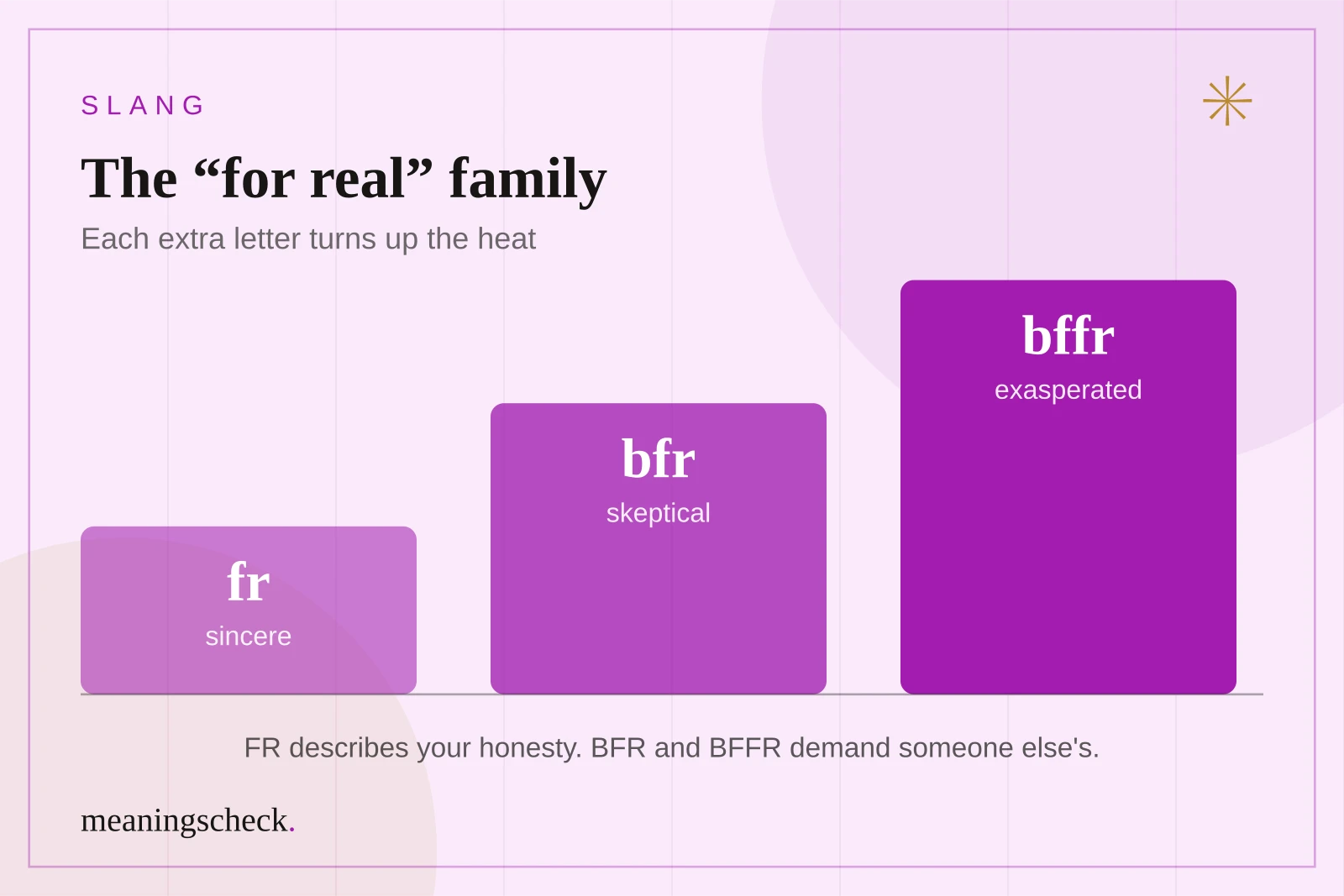
- Softer cousins: BFR ("be for real"), FR ("for real"), and FRFR ("for real, for real").
What Does BFFR Mean? The Core Definition
The Short Answer: BFFR stands for "be f***ing for real." It's a blunt, informal way to tell someone to get serious, stop lying, or stop exaggerating — or to react to something so absurd you can't believe it.
The Literal Translation: "Be F***ing For Real"
The BFFR meaning in slang is a four-letter shortcut for an angry little sentence: be f***ing for real. The first B is "be." The middle FF is the swear word plus "for." The R is "real."
Remove the profanity and you get a phrase you've heard your whole life: "be for real." It means "be honest," "be serious," or "come on, really?" The swear word just turns the volume up.
That's why BFFR feels stronger than a simple "really?" It's not a question. It's a demand for honesty, delivered with an eye-roll.
What People Actually Mean When They Say BFFR
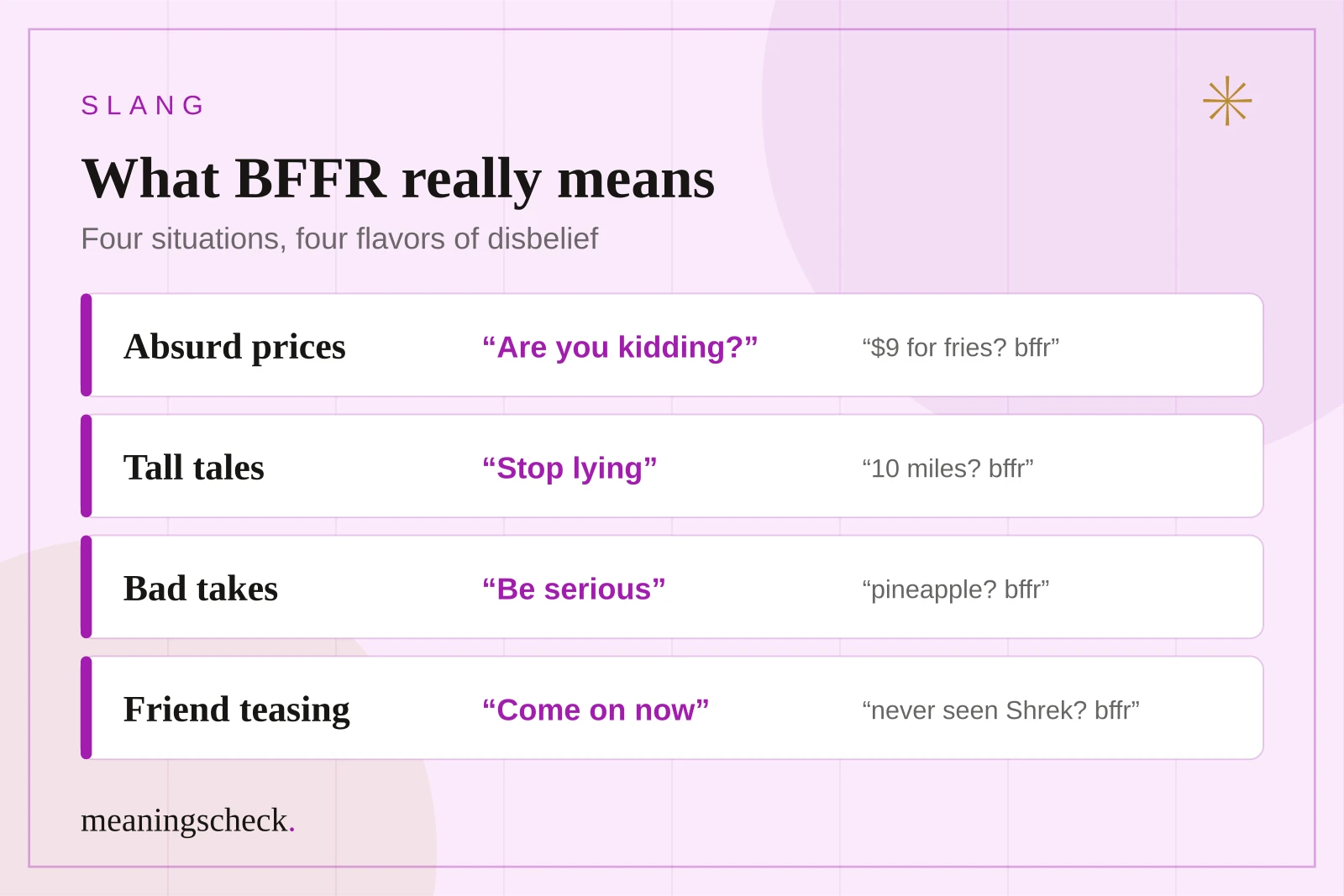
BFFR shows up in four main situations. Each one carries a slightly different flavor.
| Situation | Example | What It Really Means |
|---|---|---|
| Absurd prices | "$9 for fries? bffr" | "This is ridiculous." |
| Tall tales | "you ran 10 miles before school? bffr" | "I don't believe you." |
| Bad takes | "pineapple is the best topping? bffr" | "You can't be serious." |
| Friendly teasing | "you've never seen Shrek? bffr" | "Come on, really?" |
Notice the pattern. BFFR almost always reacts to something someone said or something that happened. It's a reply, not an opener.
Where BFFR Came From
BFFR is new. The idea behind it isn't.
"For real" has been an American English phrase for generations, meaning "genuinely" or "seriously." In the 1990s, people said "get real" to shut down nonsense. By the 2000s, "be for real" had become a common way to accuse someone of joking, lying, or stretching the truth.
According to Dictionary.com's entry on BFFR, the stronger phrase "be f***ing for real" was already appearing on social media by the late 2000s — it cites a tweet from June 2009. Entertainment site Dexerto notes that the phrase has roots in African American Vernacular English (AAVE), where "be for real" was common long before it went viral.
Then came 2022. Dictionary.com says the abbreviation BFFR became popular on social media starting that year, mostly through TikTok. Dexerto traces the boom to a mid-2022 remixed soundbite from rapper Slump6s, which spread across TikTok and Twitter.
One more twist: before 2022, "bffr" was sometimes just a playful spin on BFF (best friends forever). The new meaning completely took over.
Timeline: How "For Real" Became BFFR
| Era | What Happened | Why It Matters |
|---|---|---|
| Decades ago | "For real" means "genuinely" in everyday American English. | The core idea of sincerity is set. |
| 1990s | "Get real" becomes a popular put-down. | Demanding honesty becomes a slang move. |
| 2000s | "Be for real" spreads, especially in AAVE. | The exact phrase BFFR is built on takes hold. |
| June 2009 | Dictionary.com cites an early tweet of "be f***ing for real." | The intensified version appears online. |
| Mid-2022 | A remixed soundbite helps BFFR explode on TikTok (per Dexerto). | The abbreviation goes mainstream. |
| Today | BFFR is standard reaction slang on TikTok, X, and in group chats. | It's now a go-to call-out. |
Is BFFR a Swear Word?
Technically, yes. The middle F stands for the F-word.
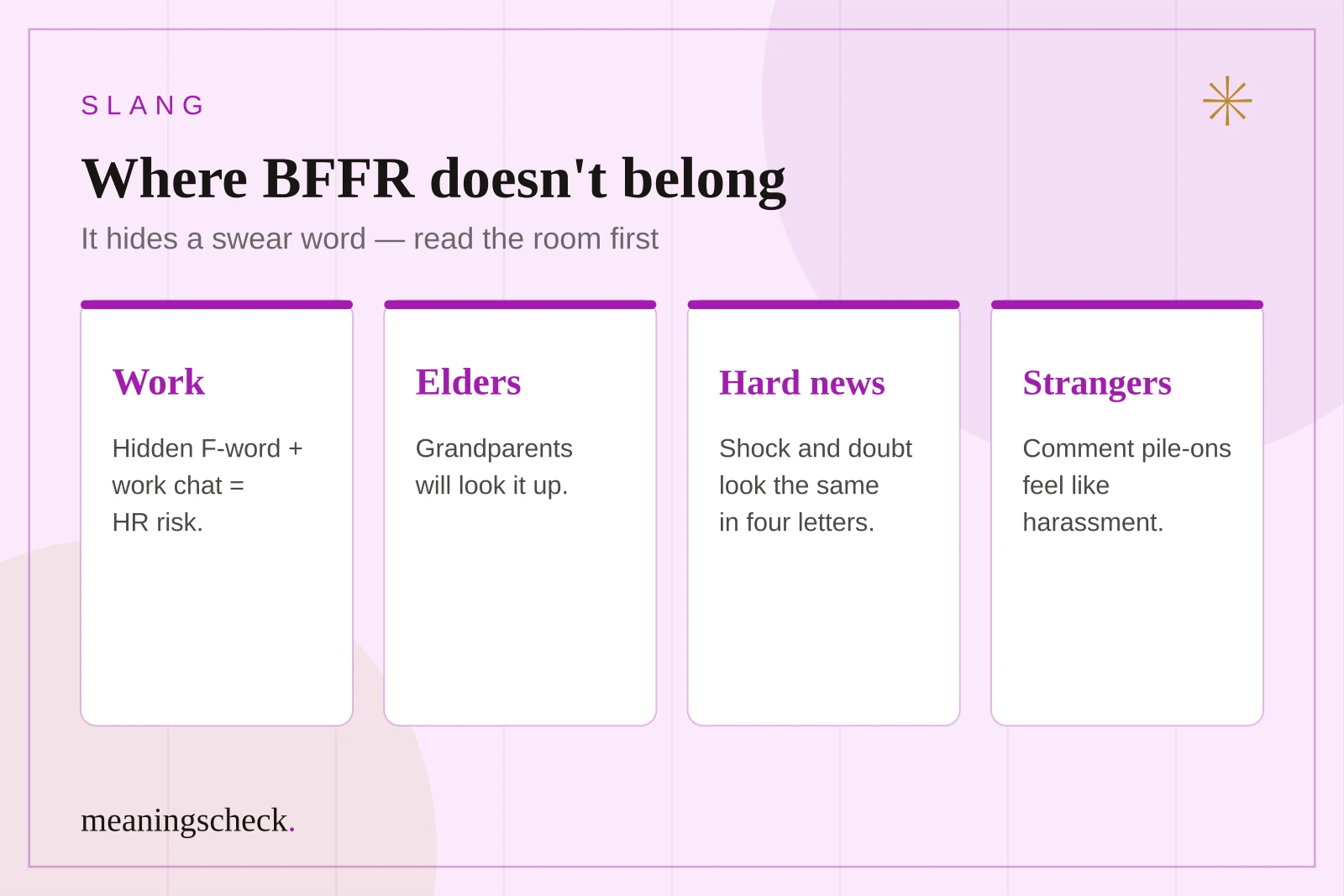
That's easy to forget because the letters hide it. But anyone who knows the abbreviation knows what it stands for. So treat BFFR the way you'd treat WTF or FFS: fine with friends, not fine with your grandmother, your teacher, or your boss.
It's also why softer versions exist. BFR ("be for real") delivers the same message without the profanity.
BFFR Meaning in Text: How to Read the Tone
The Short Answer: In a text, BFFR's tone depends on its target. Aimed at a price, the weather, or the news, it's harmless venting. Aimed at a friend's joke, it's teasing. Aimed at someone's honesty in an argument, it's a genuine accusation.
Aimed at Things vs. Aimed at People
The single biggest clue is what BFFR is reacting to.
Aimed at things, it's venting. "Rent went up again? bffr." "It's snowing in April? bffr." Nobody's being accused of anything. The sender is just exasperated at the universe.
Aimed at people, it's a challenge. "You said you'd be here at 6. It's 8. bffr." Now it's personal. The sender is calling out behavior and expects an answer.
Most BFFR texts land in the first group. That's why the word usually feels funny rather than mean.
Capitalization and Emojis Change Everything
Like most slang, BFFR's tone shifts with how it's typed:
- "bffr" (lowercase) — the default. Exasperated but casual.
- "BFFR" (all caps) — loud. The sender is genuinely annoyed or shocked.
- "bffr 💀" — playful. The skull emoji means "this is so absurd I'm dead."
- "bffr 😭" — dramatic disbelief, often laughing.
- "bffr." (with a period) — cold. A period on slang usually signals real irritation.
- "cmon bffr" — friendly exasperation, like rolling your eyes at a friend.
Key takeaway: Lowercase BFFR with a 💀 or 😭 is teasing. All-caps BFFR with a period is a real call-out.
BFFR vs. FR, FRFR, BFR, and Be So For Real
BFFR has a whole family. They all play with the idea of "for real," but they do different jobs.
| Slang | Stands For | Job | Example |
|---|---|---|---|
| FR | For real | Agreeing or emphasizing | "that test was hard fr" |
| FRFR | For real, for real | Strong sincerity | "i'm done with him frfr" |
| BFR | Be for real | Mild "be serious" | "bfr, you're not quitting" |
| BFFR | Be f***ing for real | Strong "be serious" | "$9 fries? bffr" |
| Be so for real | — | Playful disbelief | "be so for real right now" |
Here's the key difference. FR and FRFR describe your own honesty. "I'm tired fr" means "I'm genuinely tired." BFR and BFFR demand honesty from someone else. "Bffr" means "you be honest." And when someone wants to swear they're telling the truth, they reach for oath slang like the ONB meaning ("on bro").
Mixing them up can flip your meaning. "I'm going to the gym frfr" is a promise. "I'm going to the gym bffr" makes no sense — you can't tell yourself to stop lying.
BFFR Meaning on TikTok, X, Instagram, and Snapchat
The Short Answer: On TikTok, BFFR is a comment-section reaction to wild storytimes, prices, and hot takes. On X it powers quote-tweet call-outs. On Instagram and Snapchat it's mostly shared between friends as playful disbelief.
BFFR Meaning on TikTok
TikTok is BFFR's home turf. The app runs on storytimes, hot takes, and "day in my life" videos — content that practically begs for a reality check.
You'll see BFFR in comments like:
- "a 5-year relationship and he forgot your birthday? bffr"
- "this 'cheap' grocery haul was $300. bffr"
- "she 'just woke up like this' bffr 💀"
On TikTok, BFFR is often crowd-sourced skepticism. When a storytime sounds too wild to be true, the top comments fill up with BFFR. It's the community collectively saying, "we're not buying it."
The Daily Dot notes that the word is usually typed in lowercase on the app, matching Gen Z's general habit of avoiding capital letters.
Creators have noticed, too. Some now pin a comment answering the inevitable BFFR replies with receipts — a screenshot, a follow-up video, or a "part two" that proves the story was real.
BFFR Meaning on X (Twitter)
On X, BFFR is a quote-tweet weapon. Someone posts a bold claim. Someone else quote-tweets it with a single word: "bffr."
It's efficient and devastating. One four-letter reply tells everyone that the original post is ridiculous — no argument needed. Dictionary.com's examples show exactly this kind of use, from complaints that Walmart still didn't accept Apple Pay in 2022 to people venting about recipes that start with "cut one onion."
BFFR on Instagram and Snapchat
On Instagram and Snapchat, BFFR is more personal. Friends use it in DMs and story replies:
- Reply to a story of someone skydiving: "bffr when did you get this brave"
- Reply to a friend's new haircut: "bffr this is so good"
- Reply to a meme: "bffr this is literally us"
Notice that BFFR can even be positive here. "Bffr this is so good" means "are you serious? this is amazing." The disbelief is the compliment.
BFFR in News and Pop Culture Reactions
BFFR is also the internet's favorite reaction to surprising headlines. Fans use it when a beloved show gets canceled, a star athlete gets traded, or a celebrity makes a baffling announcement:
- "they canceled it after ONE season? bffr"
- "traded him for a draft pick? bffr"
- "a $40 concert ticket turned into $400 with fees. bffr"
In these moments, BFFR isn't aimed at a person in the chat. It's aimed at the world. That makes it one of the safest ways to use the word.
BFFR in Reviews and Shopping
Some of the most relatable BFFR moments happen at the checkout. Rising prices and shrinkflation — when products quietly get smaller while prices stay the same — are perfect BFFR fuel:
- "the chip bag is half air now? bffr"
- "$18 for a salad bffr"
- "free shipping over $100?? bffr"
In product reviews and haul videos, BFFR works like a one-word rating. It tells other shoppers, "this price (or this quality) is unacceptable." Brands notice when their comment sections fill up with it.
BFFR in Gaming and Discord
Gamers use BFFR to react to unfair moments: "he one-shot me through a wall? bffr." It's also a classic reaction to teammates' bad decisions: "you pushed alone again? bffr."
Comparison Table: BFFR Across Platforms
| Platform | Typical Use | Example | Usual Tone |
|---|---|---|---|
| TikTok | Comments on storytimes and hauls | "this was 'cheap'? bffr" | Skeptical, funny |
| X (Twitter) | Quote-tweets on bad takes | "bffr" (alone) | Sharp call-out |
| Story replies and DMs | "bffr this pic is so good" | Playful, even complimentary | |
| Snapchat | Private chats | "you're late AGAIN bffr" | Friendly exasperation |
| Discord / gaming | Reactions to plays | "one-shot through a wall? bffr" | Frustrated, joking |
BFFR From a Girl, a Guy, or a Friend
The Short Answer: From a friend, BFFR is usually playful teasing. From a girl or guy you're talking to, it's mostly banter — a way to tease and keep things light. It only turns serious when it's attached to a real complaint, like being ignored or lied to.
Friendly Teasing vs. Real Frustration
Between friends, BFFR is a love language of sorts. "You've never had Chick-fil-A? bffr" isn't an attack. It's an invitation to laugh.
Real frustration looks different. It usually comes with:
- Specific complaints: "You said you'd call. You didn't. bffr."
- No emojis or a cold period.
- All caps or repeated messages.
If you see those signals, the person isn't teasing. They want an explanation.
BFFR in Dating Chats
In early dating conversations, BFFR is mostly banter. Teasing is a classic way to flirt, and BFFR is built for it:
- "you think you can beat me at Mario Kart? bffr 😂"
- "you've never seen a single Marvel movie? bffr"
- "you're 'not a morning person' but you texted me at 6am? bffr"
These are playful challenges. Answer in the same spirit and the conversation gets more fun.
The exception is when BFFR shows up in a real argument: "you said you were busy but you posted from a party? bffr." That's not banter. That's a trust problem. It deserves a real conversation.
Key takeaway: BFFR + emojis + something silly = flirting or teasing. BFFR + a specific broken promise = a genuine call-out.
BFFR in Group Chats
The Short Answer: In group chats, BFFR is mostly a reaction to plans falling apart, friends bailing, or someone's outrageous claim. It's almost always teasing — the group's way of keeping each other honest.
Group chats are BFFR heaven. Picture a typical Friday:
- Someone cancels plans for the third week in a row: "bffr 😭"
- Someone claims they "barely studied" and got an A: "bffr"
- Someone says they're "five minutes away" while still at home: "BFFR"
In a group setting, BFFR is social accountability with a laugh. It calls out the flaky friend or the humble-bragger without starting real drama. Everyone knows it's a joke — mostly.
Watch for one thing. When the same person gets "bffr" every time they post, the teasing can start to sting. If you notice that, ease off. Running jokes stop being fun when they always land on the same friend.
BFFR Across Generations
The Short Answer: Every generation has its own "be for real." Millennials said "get real" and "as if," Gen X said "get outta here," and older generations said "you're pulling my leg." BFFR is simply Gen Z's sharper, swear-boosted version.
The urge to call out nonsense is timeless. Only the words change.
| Generation | Their "BFFR" | Tone |
|---|---|---|
| Silent Generation / Boomers | "You're pulling my leg." | Gentle disbelief |
| Gen X | "Get outta here." | Playful shock |
| Millennials | "Get real." / "As if!" | Sarcastic eye-roll |
| Gen Z | "Bffr." | Blunt, exasperated |
| Gen Alpha | "Be so for real." / "Bffr." | Dramatic, meme-heavy |
"As if!" became a 1990s catchphrase thanks to the movie Clueless (1995). "Get real" ruled the same era. BFFR does the same job — it just adds a hidden swear word and fits in a comment box.
Understanding this helps across age gaps. If a parent says "get real" and a teen says "bffr," they're saying the same thing. They just learned different slang.
When Parents Use BFFR
Here's a fun twist: more parents are picking up BFFR from their kids. Usually they use it correctly ("you want a new phone already? bffr"). Sometimes they don't realize what the middle F stands for.
If your mom texts "bffr" about the dishes, don't panic. She's probably just learned it from TikTok. And if a parent asks what it means, the honest answer — "it's 'be for real' with a swear in the middle" — is usually enough to settle whether it belongs in the family group chat.
How to Respond to BFFR (With Examples)
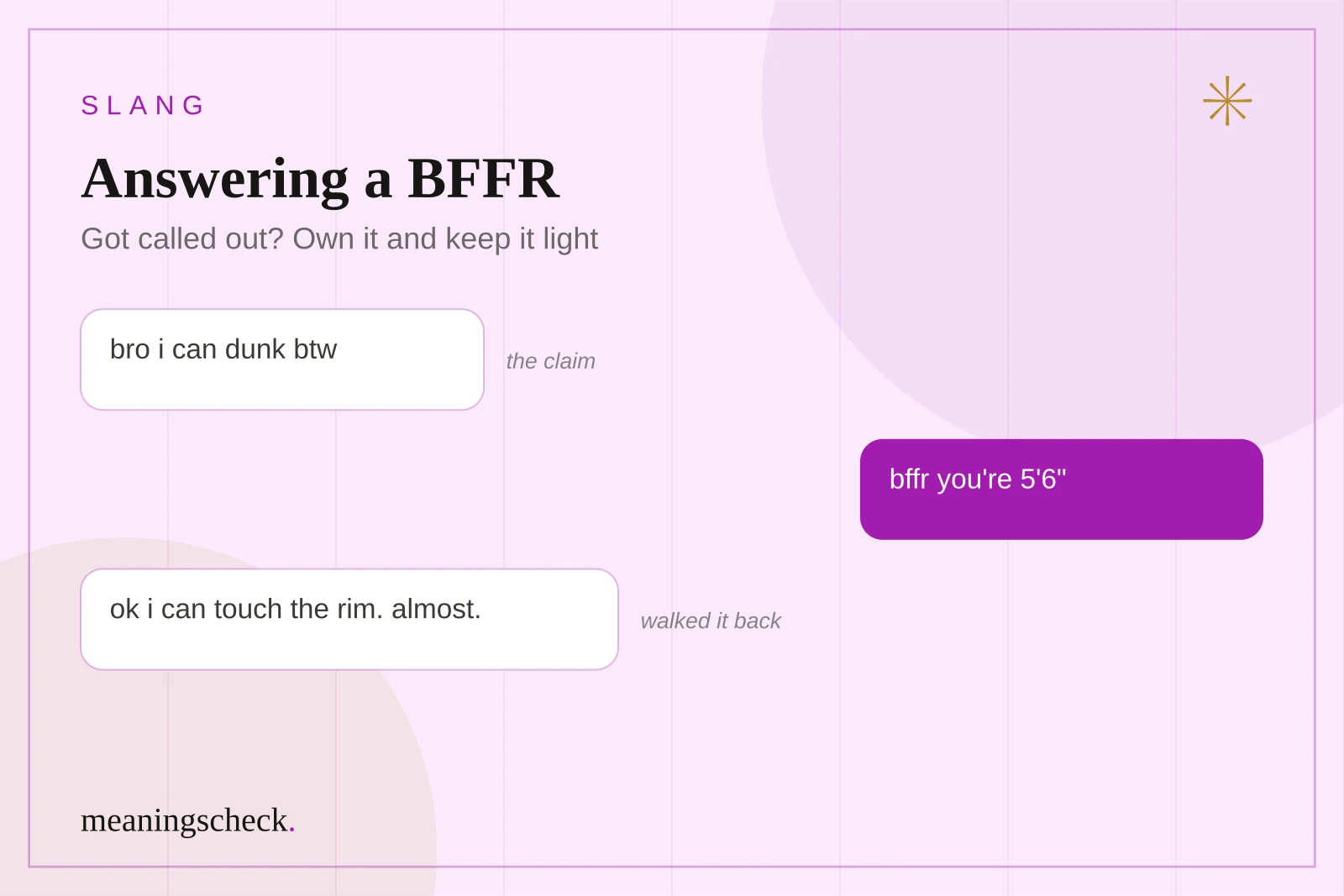
The Short Answer: If you were joking, lean into it. If you were serious, back it up with proof. If it's a real argument, skip the slang and answer honestly. And if it's about something absurd, simply agree — they're venting, not attacking you.
If You Were Joking or Exaggerating
Own it. Laughing at yourself is the fastest way to keep things light:
- "ok fine, it was 2 miles. but they were hard miles 😂"
- "lmao you caught me"
- "i said what i said 😌" (if you want to double down playfully)
If You Were Serious
Back it up. BFFR is a challenge. Meet it with evidence:
- "i'm so for real, look" (and send the screenshot)
- "frfr, i'll show you tomorrow"
- "no cap, i really did it"
If They're Venting About Something Else
When BFFR targets a price, the weather, or the news, just join in:
- "right?? i paid $7 for a coffee yesterday"
- "the economy is a joke fr"
- "bffr is right, this is insane"
If It's a Real Argument
Drop the slang. Short, honest words calm things down faster than more abbreviations:
- "You're right. I should've called. I'm sorry."
- "I get why you're upset. Can we talk tonight?"
Matching their energy with another BFFR almost always escalates the fight.
How to Use BFFR Correctly: A Quick Style Guide
The Short Answer: Put BFFR after the thing you can't believe, keep it lowercase for teasing, add an emoji to soften it, and switch to BFR or a full sentence when the setting is polite or the topic is serious.
Want to use BFFR like a native speaker? Follow these rules:
- React, don't open. BFFR responds to something. Starting a conversation with it makes no sense.
- Put it after the claim. "$9 for fries? bffr" reads naturally. "Bffr $9 for fries" works too. It just reads less smoothly.
- Soften with emojis. A 💀 or 😭 tells people you're laughing, not attacking.
- Downgrade when needed. Swap to BFR or "are you serious?" around family, at school, or in mixed company.
- Never use it on grief or bad news. Shock and doubt look identical in four letters.
| Do | Don't |
|---|---|
| "you've never had pizza? bffr 😭" | "you lost your job? bffr" (sounds like doubt) |
| "bffr this is so good" (as praise) | "BFFR." in a work chat |
| "bfr, you're not quitting" (milder) | "bffr" under a stranger's personal story |
| "the price went up again bffr" | "bffr" as your reply to everything |
Is BFFR Rude? Where Not to Use It
The Short Answer: BFFR is rude in the wrong setting because it contains the F-word and accuses someone of not being serious. Keep it for close friends and casual online spaces. Avoid it at work, at school, with older relatives, and in conversations about serious news.
Because BFFR hides a swear word, it's easy to use it in places it doesn't belong. Here's where to hold back:
- At work. Even in casual Slack channels, BFFR can read as unprofessional — and the profanity can break workplace policies. It falls into the same trap as other profane acronyms like the JFC meaning.
- With older relatives. Many parents and grandparents won't know it — until they look it up.
- At school. Teachers and staff will treat it like swearing.
- On serious topics. "Your dog died? bffr" sounds horrible, even if you meant shock rather than doubt.
- On strangers' posts. A pile-on of BFFR comments can feel like harassment to the person on the other end.
Better Alternatives for Polite Settings
| Casual | Polite Alternative |
|---|---|
| "bffr" | "Are you serious?" |
| "$9 for fries? bffr" | "Nine dollars for fries? That's wild." |
| "you're late again, bffr" | "This is the third time — what's going on?" |
| "bffr, that's not true" | "I don't think that's quite right." |
| "bffr" (under news) | "I can't believe this." |
Sometimes the most effective reaction isn't a word at all. A silent virtual headshake — the energy behind the SMH meaning — says "I'm not buying it" without any profanity.
Expert Insights: Why "Be For Real" Hits So Hard
The Short Answer: BFFR caught on because Gen Z prizes authenticity and is skeptical of anything that looks staged online. A four-letter demand for honesty fits a culture full of filtered photos, exaggerated storytimes, and influencer hype.
Authenticity Is the Highest Value
Gen Z grew up on curated feeds. Perfect vacation photos. Flawless skin. "Spontaneous" moments that took 40 takes.
So it makes sense that the generation's favorite reactions are about realness. "Be for real." "No cap." "That's not real." Even the app that went viral in 2022 — the same year BFFR took off — was literally called BeReal, built around unfiltered daily photos.
Coincidence or not, it captures the mood. BFFR is what you say when something online feels fake.
Censored Profanity as a Social Code
Here's an interesting pattern. Many of the strongest internet reactions hide a swear word inside an abbreviation: WTF, FFS, JFC, BFFR.
Abbreviating does two things at once. It keeps the emotional punch of swearing. And it makes the message feel slightly less harsh on the screen. "bffr" reads lighter than the full phrase — even though everyone knows what it means.
That's why BFFR feels acceptable in places where the full sentence wouldn't. It's swearing in disguise.
The Storytime Reality Check
TikTok storytimes are a genre built on drama. The crazier the story, the more views it gets — which gives creators a reason to exaggerate.
BFFR is the audience pushing back. When a story sounds staged, a wall of "bffr" comments acts like a public fact-check. It's skepticism made social.
Think of it like a laugh track in reverse. Instead of telling viewers when to laugh, the comments tell viewers when to doubt.
Calling Out as Social Glue
It sounds strange. Still, calling each other out can bring friends closer. Teasing works as a test of trust. If you can say "bffr" to a friend and they laugh, it proves the relationship can handle a little friction.
Psychologist Dacher Keltner's research on teasing describes playful teasing as one way friends negotiate closeness — it signals "I know you well enough to poke fun." BFFR is a quick, modern version of that old dynamic. The key is that it only works when both people are in on the joke.
Why Disbelief Can Be a Compliment
One counterintuitive use: BFFR can praise. "Bffr this cake is homemade?" means "I can't believe how good this is."
That works because disbelief is a strong reaction, and strong reactions flatter. If your work is so good that someone can't believe it's real, that's a win. Context — and usually a 😭 or 😍 — tells you which kind of BFFR you got.
Real-World Examples of BFFR
- Dictionary.com's examples (2022–2023): people venting that Walmart still didn't take Apple Pay in 2022, complaining about paying for alumni networks, and grumbling about streaming password crackdowns.
- The Daily Dot's 2024 explainer: examples like "A McDonald's small fry is how much now? Bffr" show how often BFFR targets everyday prices.
- Dexerto's coverage: a viral TikTok sound in which a girl spells out "BFFR" and asks viewers what she spelled — a meme format built entirely on the word.
Common Mistakes People Make With BFFR
The Short Answer: The most common BFFR mistakes are confusing it with BFF, using it on serious news, using it at work, and mixing it up with FR or FRFR, which describe your own honesty instead of demanding someone else's.
- Confusing it with BFF. BFFR has nothing to do with best friends. "You're my bffr" doesn't mean "best friend for real" to most readers — it reads as nonsense.
- Using it on hard news. Shock and doubt look the same in four letters. On sad news, write a full sentence.
- Typing it in work chats. The hidden F-word can get you in trouble, even in "casual" channels.
- Mixing it up with FRFR. "I'm sorry frfr" means "I'm genuinely sorry." "I'm sorry bffr" means nothing.
- Overusing it. If every reply is "bffr," it stops meaning anything — and you start sounding constantly annoyed.
Other Meanings of BFFR
The Short Answer: Before 2022, "bffr" occasionally appeared as a playful variant of BFF (best friends forever). Today that meaning is rare. In almost every modern message, BFFR means "be f***ing for real."
You might stumble across older posts where "bffr" means something like "best friends for real." Dictionary.com notes that this BFF-style meaning existed before the 2022 boom.
Some websites also list made-up expansions like "best friends forever, respect." These don't reflect how people actually use the word. If someone sends "bffr" today, they're almost certainly telling you to get real.
BFFR vs. BFF: Don't Mix Them Up
The extra R changes everything. BFF is warm: "she's my bff." BFFR is skeptical: "you said you'd be early? bffr."
Older users sometimes read "bffr" as a cute twist on BFF, which leads to awkward confusion. If you're texting someone outside Gen Z, the full words — "are you serious?" — avoid that mix-up entirely.
| Meaning | How Common | Example |
|---|---|---|
| Be f***ing for real | Very common (today's meaning) | "$9 fries? bffr" |
| Best friends for real | Rare, mostly pre-2022 | "my bffr since 3rd grade" |
| Typos for "BFF" | Occasional | Context makes it obvious |
Frequently Asked Questions (FAQs)
What does BFFR mean in text?
In a text, BFFR means "be f***ing for real" — a blunt way of saying "be serious," "stop lying," or "are you kidding me?" It's usually a reaction to something absurd or unbelievable.
What does BFFR mean on TikTok?
On TikTok, BFFR is a comment-section reaction to storytimes, prices, and hot takes that seem fake or ridiculous. A wall of BFFR comments means viewers aren't buying the story.
Is BFFR a bad word?
It contains a hidden swear word. That makes it mild profanity. It's fine with close friends but inappropriate at work, at school, or with older relatives.
What's the difference between BFFR and FRFR?
FRFR ("for real, for real") describes your own sincerity, as in "I'm done frfr." BFFR demands sincerity from someone else, as in "you're quitting? bffr."
What does "be so for real" mean?
"Be so for real" is a playful, dramatic version of "be for real." It's popular on TikTok and works like a softer BFFR — disbelief without the swear word, often said with a laugh.
What does BFR mean?
BFR means "be for real" — the same idea as BFFR without the swear word. It's a milder, cleaner way to say "be serious."
How do you respond to BFFR?
If you were joking, own it with a laugh. If you were serious, back it up with proof. If it's a real argument, skip the slang and respond honestly and calmly.
When did BFFR become popular?
The phrase "be for real" is decades old. Dictionary.com says the abbreviation BFFR became popular on social media in 2022, largely through TikTok.
Is BFFR the same as "get real"?
Basically, yes. "Get real" was the 1990s way of telling someone to stop being ridiculous. BFFR does the same job with stronger language and fewer keystrokes.
Why do people type bffr in lowercase?
Lowercase feels casual and effortless, which fits Gen Z's texting style. All-caps "BFFR" reads as shouting. That's why lowercase is the default for teasing and light reactions.
Can BFFR be a compliment?
Yes. "Bffr this is homemade?" or "bffr you look amazing" uses disbelief as praise — it means "this is so good I can't believe it."
Is BFFR rude to say to a friend?
Usually not. Between friends, BFFR is mostly playful teasing. It only becomes rude when it's aimed at a sensitive topic or used during a real argument.
Final Thoughts
BFFR is four letters of pure skepticism. It takes an old, honest phrase — "be for real" — adds a swear word for emphasis, and compresses it into a reaction that fits any comment section on earth.
Most of the time, it's harmless. It vents about prices, fact-checks wild storytimes, and teases friends who've never seen a classic movie. Sometimes it's even a compliment.
But it does hide a swear word. It also accuses someone of not being honest. Use it with friends, keep it out of work and serious moments, and remember the softer cousins when you need them. Sometimes a gentle BFR — or a lowkey "are you serious?" — lands better than a blunt BFFR.
And if a story ever sounds too wild to be true? Now you know exactly what to type. You'll find plenty more reactions like it in our internet slang guides, and if a wall of text ever needs a summary first, there's always the TLDR meaning.
Related terms
Share: · Post on X
Written by MeaningsCheck Team · Published
The MeaningsCheck team researches and writes plain-language explanations of slang, abbreviations, and everyday words — checked for accuracy, updated as language changes.