
What Does NSFW Mean? The Ultimate Guide to the NSFW Meaning in Text and Slang
NSFW stands for "Not Safe For Work" (or "Not Suitable For Work") — a universal internet warning that a link, image, or video contains explicit or sensitive content that is inappropriate for professional or public settings.
What does NSFW mean? The acronym NSFW stands for "Not Safe For Work" (or Not Suitable For Work). It is a universal internet warning used to label links, images, or videos containing explicit content, profanity, or sensitive material that is highly inappropriate for a professional or public setting.
But knowing the basic NSFW meaning slang isn't enough anymore. In today's digital age, clicking a blurred image on Reddit or a text link while connected to your company Wi-Fi can trigger automatic IT alerts and jeopardize your career. In this ultimate guide, we’ll decode the NSFW meaning in text, how it works on major platforms, and the critical difference between NSFW and the much darker NSFL tag.
The Core Definition: Decoding the NSFW Meaning Slang
The Short Answer: The acronym NSFW stands for "Not Safe For Work" (or "Not Suitable For Work"). It is a universal internet warning used to indicate that a specific link, video, or image contains explicit or sensitive content that is highly inappropriate for professional, academic, or public settings.
The Translation: Not Safe For Work
At its foundation, the NSFW meaning in slang translates directly to "Not Safe For Work." It was born on early internet forums and email chains in the late 1990s and early 2000s.
During the dawn of the internet, employees began sharing viral jokes, images, and links with their coworkers. Quickly, they realized that opening a raunchy joke in the middle of a busy office was a fast track to getting fired. The acronym — now one of the most recognized internet abbreviations — was invented as a basic courtesy. It was a simple way to tell a coworker, "Hey, save this link for when you get home."
Today, the acronym has transcended email chains and is deeply integrated into the architecture of the modern internet. It is an official category tag on massive platforms like Reddit, Discord, and X (formerly Twitter). It is the digital equivalent of a Rated-R warning sticker placed on the outside of a movie case.
What Qualifies as Explicit Content?
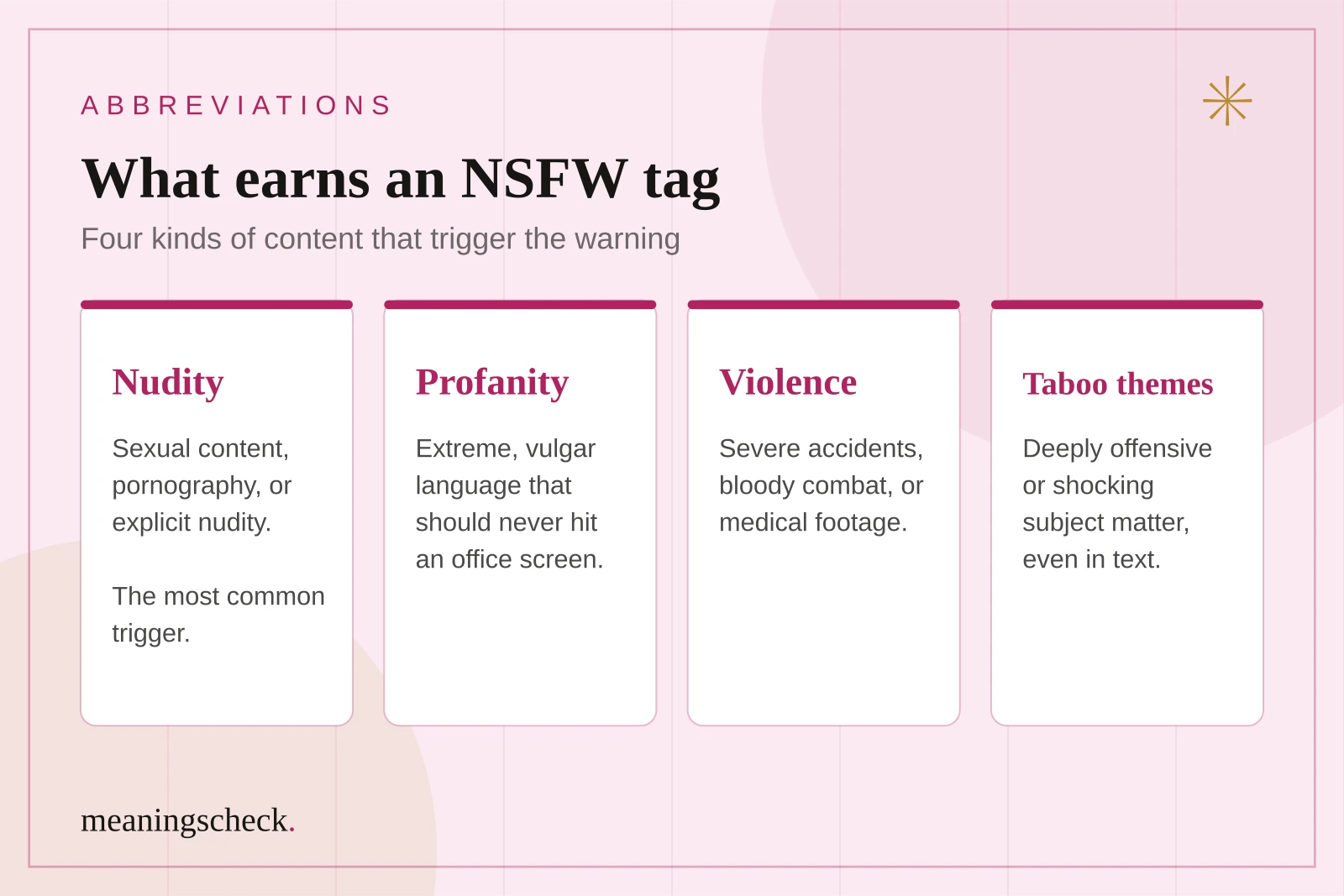
What exactly makes a piece of content trigger the NSFW meaning in text warning? The threshold for what is considered inappropriate varies slightly by platform, but it generally covers four main categories of explicit material.
- Nudity and Sexual Content: This is the most common trigger. Any imagery or text depicting sexual acts, pornography, or explicit nudity will immediately warrant the tag.
- Heavy Profanity: A text post that relies on extreme, aggressive, or excessive vulgar language can trigger the warning, ensuring it is not accidentally read aloud or displayed on a large office monitor. It is the same reason profane acronyms like the JFC meaning never belong in a work email.
- Graphic Violence: Videos or images showing severe accidents, bloody combat, or medical procedures are highly inappropriate for public viewing and require a warning.
- Highly Offensive Themes: Content that discusses taboo, deeply offensive, or shocking subject matter even without visual aids is often tagged to protect sensitive readers.
The Critical Danger of the NSFW Meaning in Text at Work
The Short Answer: Clicking on an NSFW link while connected to a corporate network or company Wi-Fi leaves a permanent digital footprint. Because IT departments actively monitor network traffic, engaging with this content is a direct violation of workplace policy and frequently results in termination.
The Digital Footprint of Corporate Wi-Fi
One of the most dangerous misconceptions about the NSFW meaning in text is that the warning only applies to physical visibility. People falsely assume that if they hide their phone under their desk or angle their laptop screen away from their boss, they are perfectly safe.
This is a catastrophic misunderstanding of modern cybersecurity. If you are connected to your company's Wi-Fi network, using a company-issued VPN, or operating a corporate smartphone, you have zero digital privacy. Every single domain name you request, every link you click, and every byte of data you download is logged by the IT department's firewall.
When you click a link clearly marked with an explicit warning, the company's network security software often flags the traffic automatically. You do not need an angry manager looking over your shoulder; the router has already reported your activity directly to human resources.
Why Ignoring the Tag Can Cost You Your Job
Why do corporations care so deeply about this? Beyond basic professionalism, it is a massive legal liability for the company.
If an employee is openly viewing NSFW pics in the middle of an office floor, it actively creates a hostile work environment. Under federal labor laws, if another employee sees that explicit content and feels uncomfortable or threatened, the company can be sued for sexual harassment or failing to provide a safe workplace.
Furthermore, sites hosting explicit material are notorious breeding grounds for malware, ransomware, and aggressive tracking cookies. By clicking that link on a corporate network, you are actively inviting severe cybersecurity threats past the company firewall. For these reasons, ignoring the tag is one of the fastest, most surefire ways to be immediately terminated with cause.
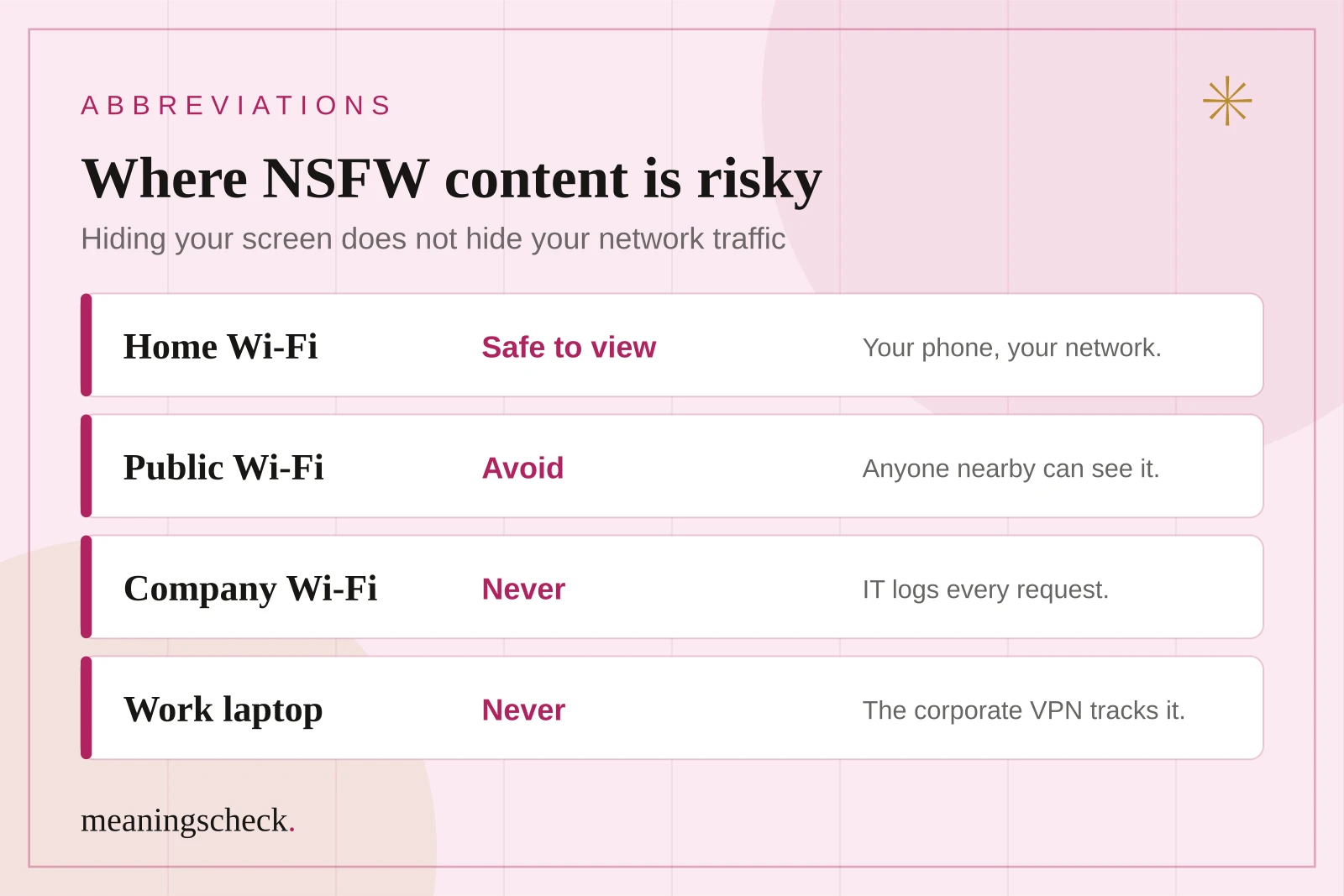
Comparison Table: Safe vs. Dangerous Browsing Environments
| Browsing Environment | Visibility Risk | Digital Tracking Risk | Action Required |
|---|---|---|---|
| Personal Phone on Home Wi-Fi | Zero | Zero (from employer) | Safe to view. |
| Personal Phone on Public Wi-Fi (Cafe) | High | Low | Avoid viewing; risk of public embarrassment. |
| Personal Phone on Company Wi-Fi | Medium | Extreme | Never view; IT logs all network traffic. |
| Company Laptop on Home Wi-Fi | Zero | Extreme | Never view; corporate VPNs track everything. |
Platform Mechanics: How the NSFW Pics Meaning Works on Reddit and Discord
The Short Answer: Major social platforms mechanize the warning. On Reddit and Discord, the platform algorithms actively blur the image thumbnail of an explicit post, forcing the user to physically click and un-blur the image as a form of digital consent.
The Digital Consent Form: Blurring the Thumbnail
If you spend any time on Reddit or massive community Discord servers, the NSFW pic meaning is not just a text warning; it is a built-in software feature.
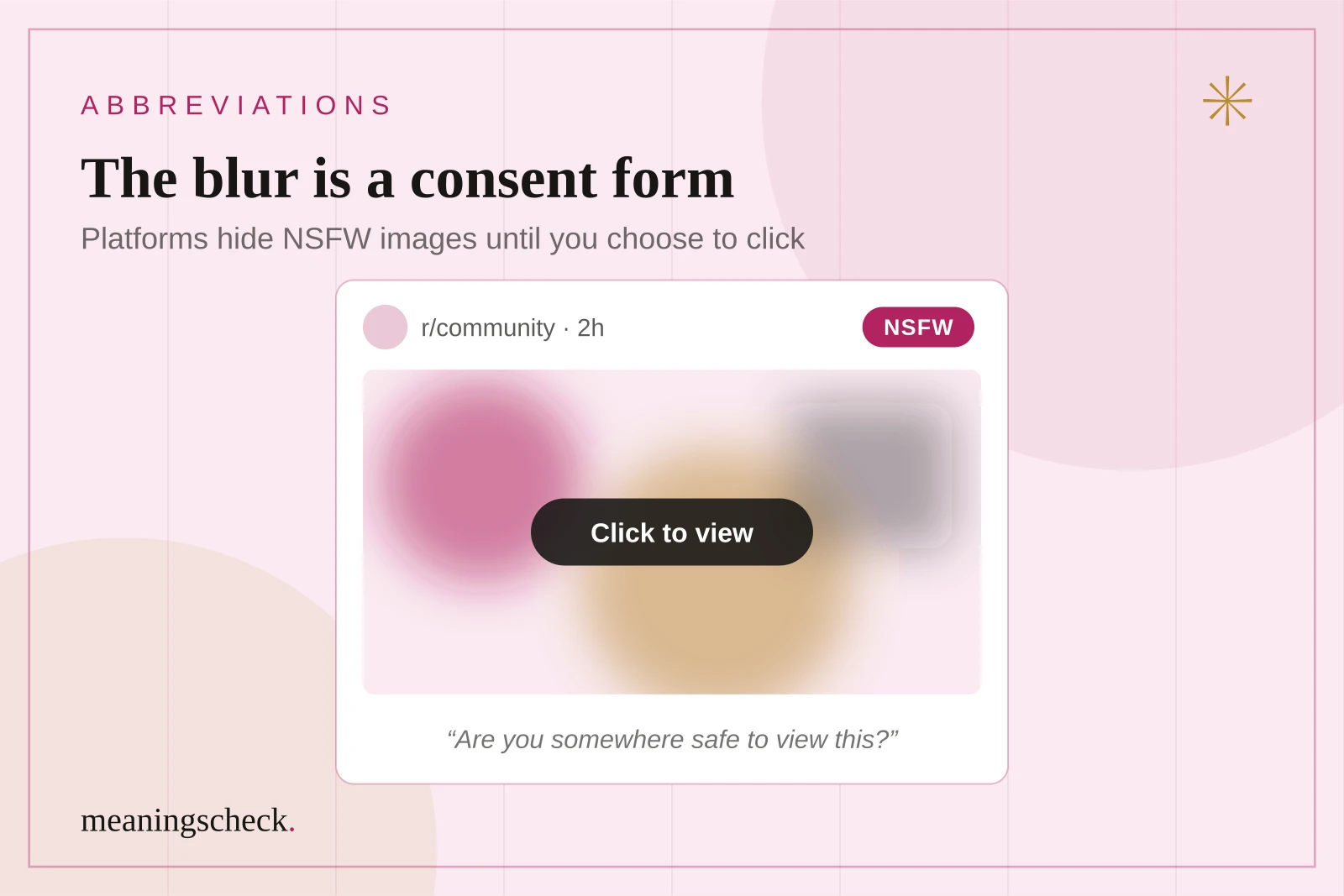
When a user uploads a photo to a specific subreddit and applies the explicit tag, the platform takes immediate action. The website's code algorithmically places a heavy blur or a solid red screen over the image thumbnail. As you scroll down your feed, you cannot see the underlying photo.
This mechanical blur acts as a digital consent form. The platform is explicitly asking you, "Are you sure you are in a safe environment to view this?" You must physically click on the blurred image to reveal the content. This prevents the nightmare scenario of an explicit photo suddenly occupying your entire screen while you are scrolling next to your grandmother.
The Settings Toggle: How to Turn Off the NSFW Filter
Because this tag is a foundational piece of platform architecture, it also serves as a robust age gate. By default, social media platforms hide all explicit content from new accounts and users registered as minors.
If you are an adult user who wants to view the unfiltered internet, you must actively opt in. On Reddit, for example, you have to navigate deep into your account settings and manually toggle a switch labeled "Show NSFW Content (I am over 18)."
This puts the legal and moral liability entirely on the user. If you toggle that switch and suddenly encounter the nsfw meaning in text while riding the bus, you cannot blame the platform. You actively opted in to see the uncensored reality of the internet.
The Darker Cousin: NSFW vs. NSFL (Not Safe For Life)
The Short Answer: While NSFW typically warns of nudity or heavy profanity, NSFL (Not Safe For Life) is a far more severe warning. NSFL implies extreme, graphic gore, fatal accidents, or deeply traumatic imagery that could permanently disturb the viewer.
Understanding the NSFL Designation
As an authoritative source on internet culture, we must address the most critical content gap that generic dictionaries miss. The explicit tag is actually part of a spectrum. If you do not understand the difference between the acronyms on this spectrum, you risk exposing yourself to severe psychological trauma.
The darker, much more dangerous cousin of our primary acronym is NSFL. This stands for Not Safe For Life.
If you see a link marked NSFL, do not click it out of morbid curiosity. This is the internet's most severe warning label. It is not used for standard pornography or a string of swear words. It is exclusively reserved for the absolute darkest corners of reality.
Profanity vs. Permanent Psychological Trauma
The distinction between the two tags is the difference between risking your job and risking your mental health.
If you click an NSFW link, you might see an inappropriate joke or a nude photograph. It is embarrassing if you get caught — the kind of moment that earns an instant SMH from every coworker who sees it — but it is ultimately harmless to your psyche.
If you click an NSFL link, you will likely see footage of a fatal car crash, severe surgical gore, industrial accidents, or extreme animal cruelty. This is content that cannot be unseen. It is imagery that can induce panic attacks, severe nausea, and long-lasting psychological distress. While the primary tag warns you to look around your physical environment, the NSFL tag warns you to protect your own mind.
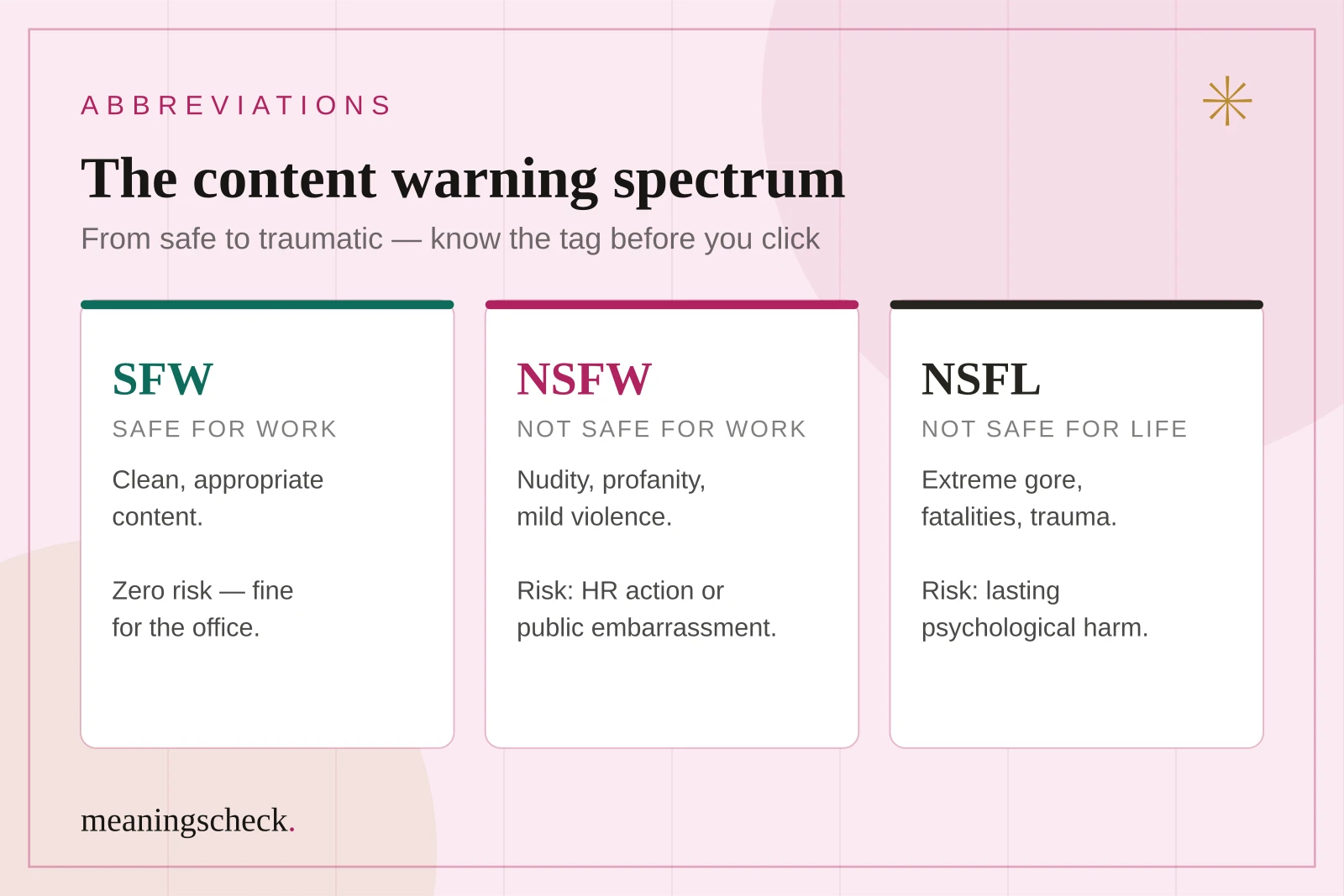
Comparison Table: The Explicit Content Warning Spectrum
| The Acronym | Stands For | What it Contains | The Ultimate Risk |
|---|---|---|---|
| SFW | Safe For Work | Clean, appropriate content. | Zero risk. Totally fine for the office. |
| NSFW | Not Safe For Work | Nudity, profanity, mild violence. | Risk of HR disciplinary action or public embarrassment. |
| NSFL | Not Safe For Life | Extreme gore, fatalities, deep trauma. | Risk of severe, lasting psychological distress. |
Real-World Examples: Clickbait and Marketing Tactics
The Short Answer: Content creators often weaponize the explicit tag as a clickbait tactic. Because human curiosity is overwhelmingly strong, slapping a blurred explicit tag on a perfectly mundane, safe video practically guarantees high click-through rates.
Weaponizing the Curiosity Gap
The internet is an attention economy. Content creators, marketers, and influencers live and die based on their click-through rates (CTR). Recently, savvy digital marketers realized they could weaponize the NSFW tag on pics to hack human psychology.
This is known as exploiting the "curiosity gap." If you are scrolling through a social media feed filled with standard, visible photos, and suddenly you hit a heavily blurred, red-tagged image, your brain instantly demands to know what is hidden behind the blur.
Creators will frequently slap the explicit tag on a perfectly innocent photo. They know that the sheer mystery of the blurred thumbnail will force thousands of people to click on it. Once you click, they get the algorithmic engagement metric they wanted, even if you just immediately close the photo of a harmless puppy.
Using the Tag for Mundane Spoilers and Jokes
Beyond malicious clickbait, the tag has also been adopted by the gaming and movie communities for a highly practical, non-explicit purpose.
Because platforms like Reddit use the tag to mechanically blur thumbnails, users have co-opted the feature to hide spoilers. If a highly anticipated movie is released on a Friday, and a fan wants to post a screenshot of the shocking ending on Saturday, they will tag the post as explicit.
In this specific scenario, the NSFW meaning in text has absolutely nothing to do with nudity or profanity. It is simply a polite way to blur the image so that fans scrolling through their feed do not accidentally have the movie ruined for them. It is an incredibly clever repurposing of a digital censorship tool, and a far kinder way to share an ending than dropping a one-line TLDR of the plot in the comments.
The Verdict: Respect the Warning
The internet is a vast, largely unregulated ocean of content. As we seamlessly transition between our personal lives and our professional environments using the exact same smartphones, the boundaries between public and private viewing constantly blur.
The NSFW meaning is the ultimate digital guardrail. It is a vital piece of internet etiquette designed to keep you safe, employed, and untraumatized — the same protective instinct behind answering a stranger's WYF meaning question vaguely.
The rules are incredibly simple. If you are on company Wi-Fi, using a corporate VPN, or sitting in a crowded coffee shop, treat the warning like a locked door and walk away. If you see its darker cousin, NSFL, turn around entirely. Respect the tag and understand the mechanics behind it, and you will navigate the digital world safely.
Frequently Asked Questions (FAQs)
What is the NSFW slang meaning?
The nsfw meaning slang stands for "Not Safe For Work" (or "Not Suitable For Work"). It is a universal internet warning used to label explicit content that should never be opened in a professional office or a crowded public space.
What is the NSFW pics meaning?
On modern social media platforms like Reddit and Discord, the NSFW pic meaning translates to a mechanical feature. The platform will algorithmically blur the image thumbnail or place a red screen over it, forcing the user to physically click the image to unblur it and view the explicit content.
What does the NSFW meaning in text refer to?
If a paragraph or a specific link carries the nsfw meaning in text warning, it means the content contains heavy profanity, vulgar language, erotic themes, or highly controversial subject matter that is inappropriate for a professional setting.
Is NSFW the same as NSFL?
No, they are vastly different. While NSFW implies nudity or profanity that might get you in trouble with HR, NSFL (Not Safe For Life) is a severe warning for extreme, highly graphic gore or fatal accidents that can cause lasting psychological trauma.
Can I get fired for clicking an NSFW link at work?
Yes, absolutely. Even if nobody is physically looking at your computer screen, your company's IT department logs all network traffic. Clicking explicit links on company Wi-Fi is a severe violation of workplace policy and often results in immediate termination.
Why do some safe posts use the explicit tag?
Content creators sometimes use the explicit tag as "clickbait." Because the tag blurs the thumbnail, it exploits human curiosity, practically forcing users to click the image just to see what is hidden, thereby driving up engagement metrics.
Related terms
Share: · Post on X
Written by MeaningsCheck Team · Published
The MeaningsCheck team researches and writes plain-language explanations of slang, abbreviations, and everyday words — checked for accuracy, updated as language changes.