
What Does TLDR Mean? Definition, Examples, and How to Use It
TLDR stands for "Too Long; Didn't Read" — both a helpful summary an author provides to save the reader's time, and a dismissive comment from a reader indicating content was too lengthy to read.
Have you ever stared at a massive wall of text in an email and immediately felt your energy drain? You are not alone. Enter TLDR, which stands for "Too Long; Didn't Read."
What started as sarcastic internet slang on video game forums has fundamentally reshaped how we communicate. Today, TLDR is an essential corporate communication tool used to provide quick, executive summaries for busy readers.
However, there is a fine line between efficiency and rudeness. Use it incorrectly, and you risk sounding unprofessional. In this complete guide — part of our plain-language meaning guides — we will break down exactly what the TLDR meaning is in text and business, the strict "Top vs. Bottom" placement rule, and the professional alternatives you should use when messaging your CEO.
The Short Answer: Decoding the TLDR Meaning
The Short Answer: The acronym TLDR stands for "Too Long; Didn't Read." It acts as both a helpful summary provided by an author to save the reader's time, and a dismissive comment used by a reader to indicate that a piece of content was too lengthy to bother reading.
Too Long; Didn't Read: The Core Definition
At its core, the TLDR meaning is exactly what it sounds like: Too Long; Didn't Read. It is an initialism — one of the most useful texting abbreviations in modern writing — meaning you pronounce each letter individually (Tee-El-Dee-Are), rather than reading it as a single word.
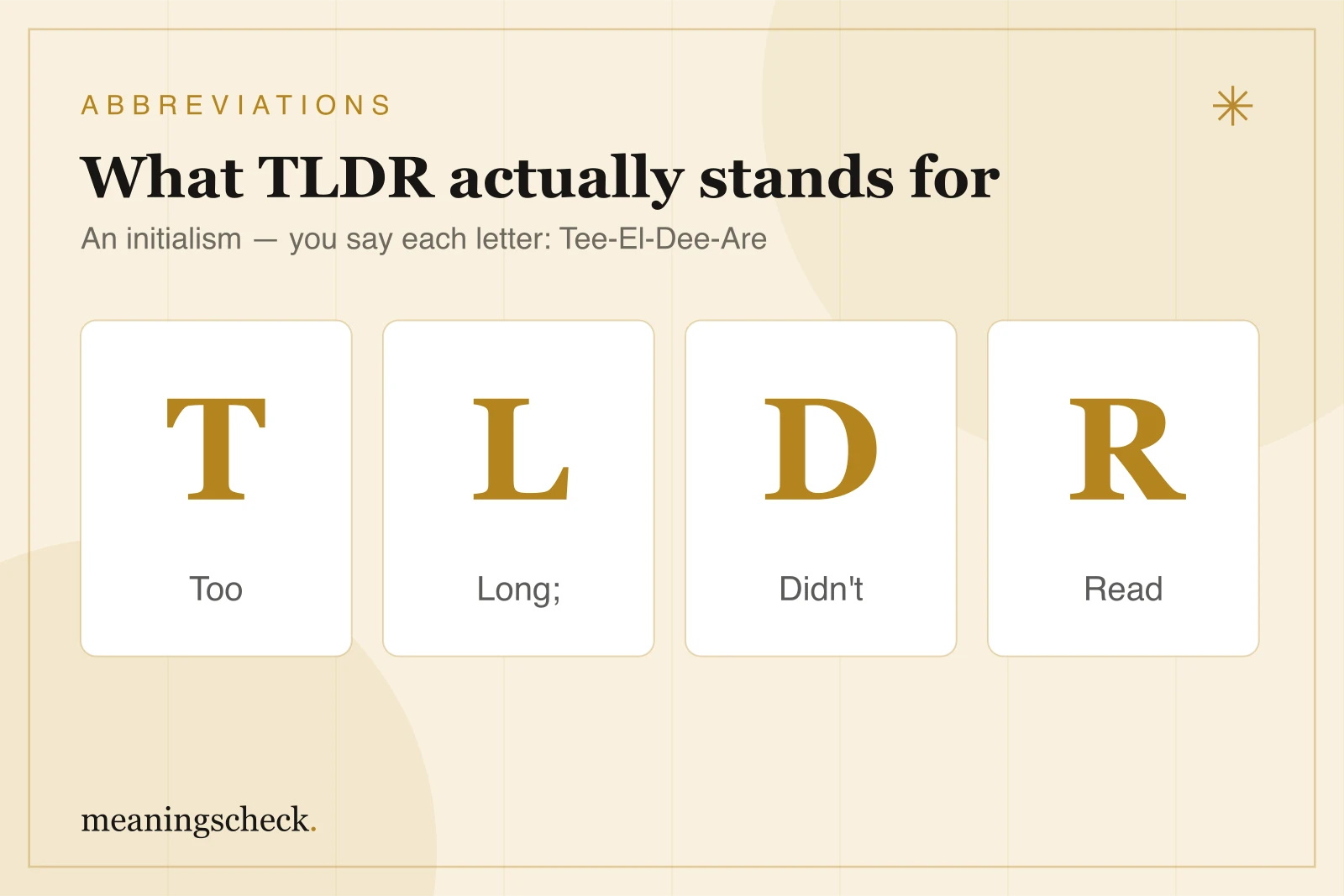
When an author uses it, they are doing you a massive favor. They acknowledge that their article, email, or post contains a lot of dense information. By providing a "TLDR" section, they are offering an executive summary or an abstract of the main points. They are giving you the bottom line up front so you can decide if the rest of the text is worth your time.
When a reader uses it, however, the dynamic changes entirely. If someone replies to your carefully crafted message with nothing but "TLDR," they are throwing up a stop sign. They are bluntly stating that your content exceeded their attention span limit.
Is it rude? Understanding the Intent Behind the Acronym
This brings us to a critical question: Is the TLDR meaning slang inherently rude? The answer depends entirely on who is using it. Context dictates intent.
If you are the author providing a summary, it is the height of digital politeness. You are respecting the reader's time. You are saying, "I know you are busy, so here are the key takeaways." It demonstrates high-level communication skills.
Conversely, if you reply to a colleague's message with a simple "TLDR," it is highly dismissive. It is the digital equivalent of interrupting someone mid-sentence to say, "Get to the point." It can come across as arrogant, snarky, and unprofessional. If someone sends you a massive block of text, a more polite response would be, "Could you give me a quick overview of the main action items?"
The Evolution of the TLDR Meaning Slang
The Short Answer: The phrase originated in the early 2000s on internet forums as a sarcastic insult directed at rambling posts. Over the next two decades, it transformed into a highly respected productivity tool utilized in corporate Slack threads and boardroom emails.
The Origins on Usenet and Message Boards
To truly understand the TLDR meaning in text, we have to go back to the early days of the internet. Before the era of 280-character tweets and 15-second TikTok videos, the internet was dominated by text-heavy forums and message boards.
According to the Merriam-Webster Dictionary, which officially added the term in 2018, the earliest recorded use traces back to 2002. It appeared on a Usenet newsgroup dedicated to Nintendo video games (rec.games.video.nintendo).
In those days, if a user posted a massive, rambling manifesto complaining about a game, other users would aggressively reply with "TLDR." It was a weaponized insult. It meant the original poster had failed to make their point engaging enough to warrant reading. It was a staple of internet troll culture on sites like Reddit and 4chan. Not every acronym from that era started as an attack, though — the IIRC meaning was born in the same forums as a polite way to hedge a memory.
How a Forum Insult Became a Respected Business Tool
How did a sarcastic forum insult infiltrate the corporate world? The answer lies in information overload.
As millennials and Gen Z entered the workforce, they brought their internet slang acronyms with them. Simultaneously, the volume of digital communication exploded. Employees began drowning in endless email chains and sprawling Slack channels. The need for rapid, concise summaries became a survival mechanism.
The tldr meaning slang organically shifted from an offensive weapon to a defensive shield. Writers realized that if they didn't summarize their own emails, nobody would read them. Today, it is widely accepted as a highly efficient way to communicate complex ideas in fast-paced corporate environments. It successfully transitioned from the basement to the boardroom.
How to Use the TLDR Meaning Abbreviation Properly
The Short Answer: The placement of your summary matters immensely. In professional emails and informational articles, always place the TLDR at the top to save time. For personal storytelling or Reddit posts, place it at the bottom to avoid ruining the narrative experience.
The Golden Rule of Placement: Top vs. Bottom
One of the most highly debated topics in modern writing is where to put the summary. Should it be the first thing a reader sees, or the last?
Many amateur writers make the mistake of placing it randomly. However, expert communicators follow a strict rule: your placement depends entirely on the genre of your content and the intent of your reader.
You have two choices: top or bottom. Choose wrong, and you either frustrate a busy executive or ruin a perfectly good story.
When to Put the Summary at the Top (Emails and Articles)
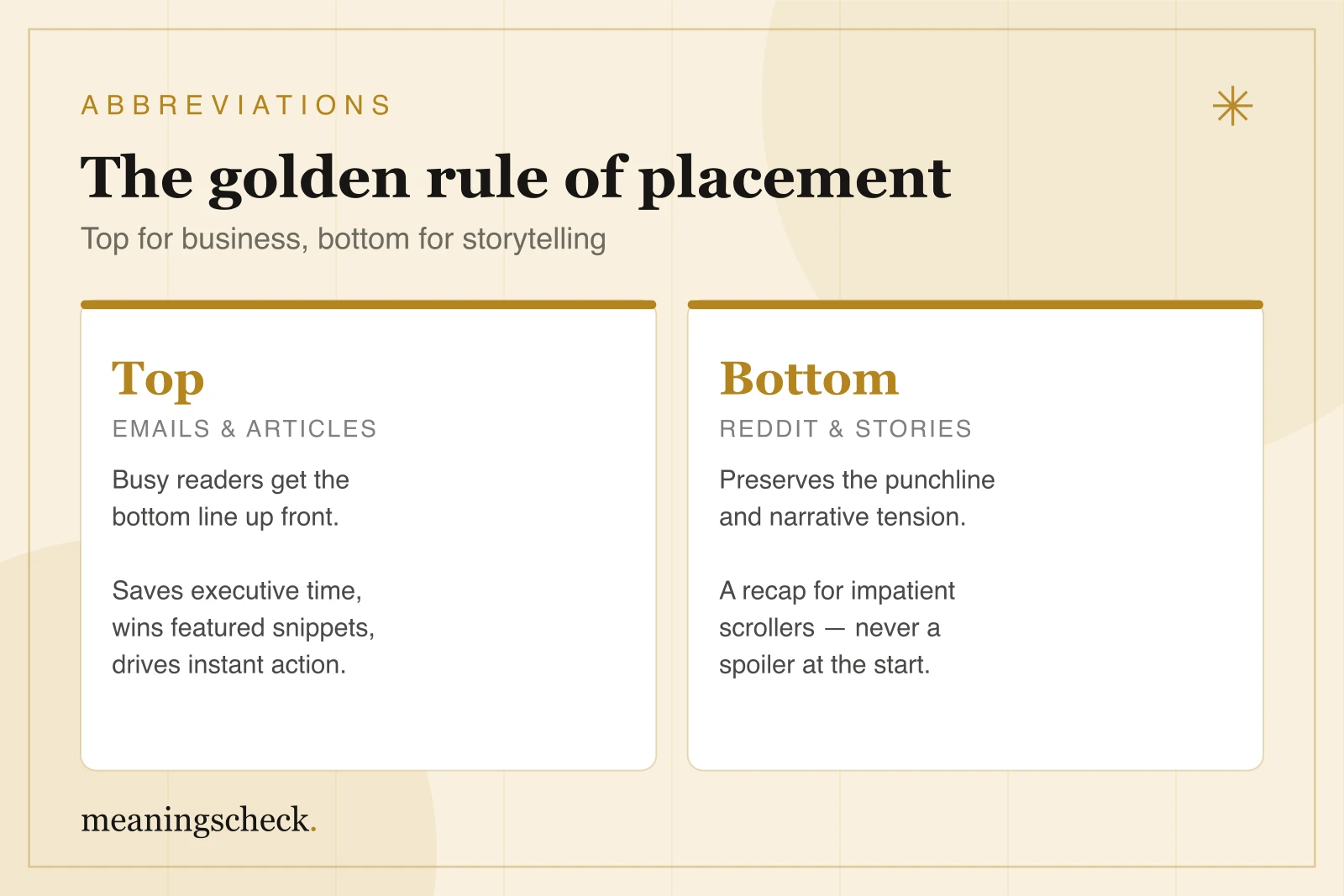
If you are writing a professional email, a project update, or an informational blog post, your TLDR must go at the very top.
In business, time is the most valuable currency. Your manager does not want to read a four-paragraph backstory before finding out the project is delayed. By placing the TLDR meaning abbreviation at the beginning, you provide immediate value.
This is known in journalism as the "inverted pyramid" style. You give them the heavy, crucial information first. If they need the granular details, they can choose to read further.
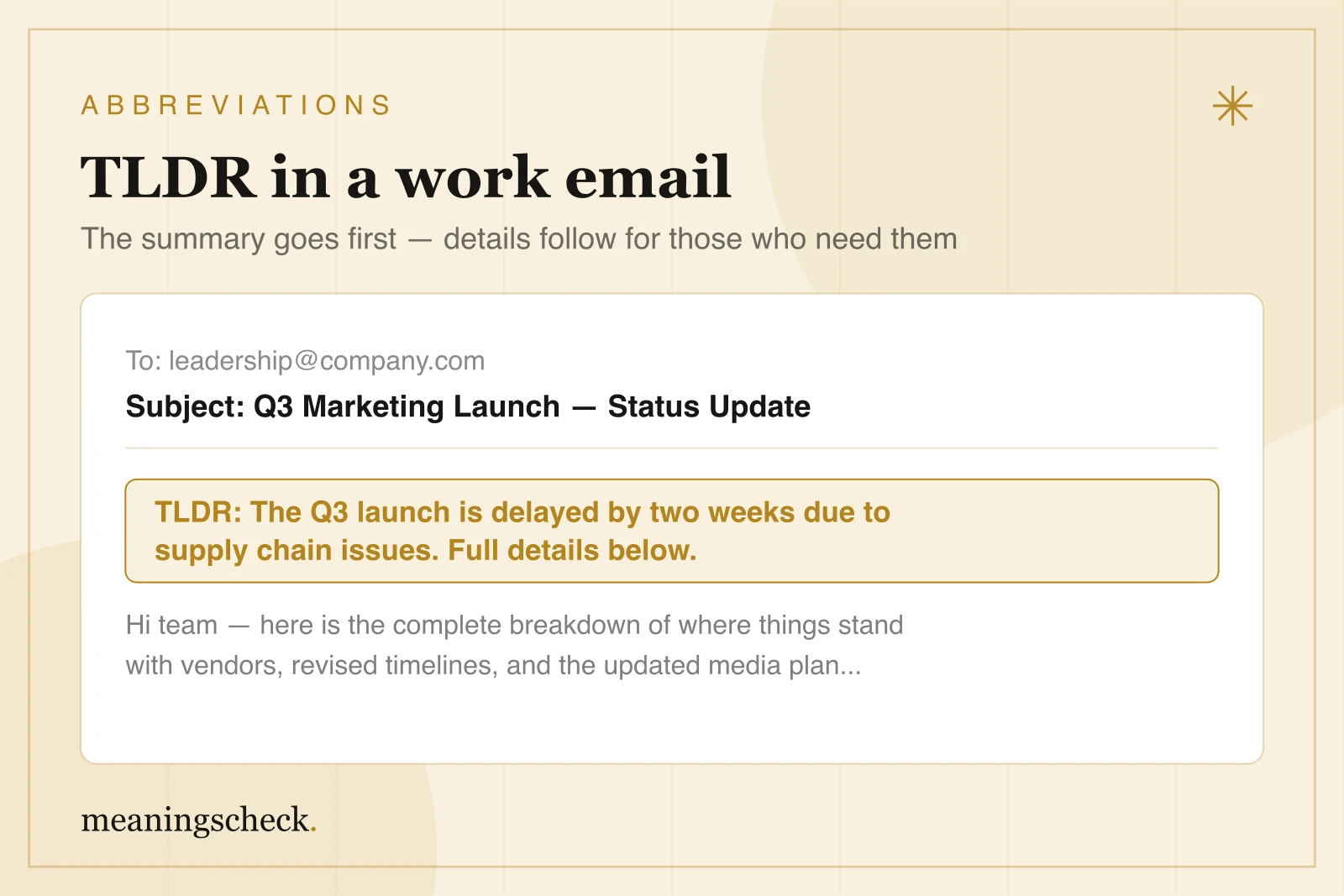
- Example: "TLDR: The Q3 marketing launch is delayed by two weeks due to supply chain issues. Full details below."
When to Put the Summary at the Bottom (Reddit and Storytelling)
Conversely, if you are writing a personal narrative, an entertaining story on Reddit, or a suspenseful social media post, the summary must go at the bottom.
Why? Because placing it at the top would ruin the punchline. It is a spoiler. If you are sharing a hilarious story about a disastrous first date, you want the reader to experience the rising action and the climax. You want them to enjoy the journey.
The TLDR meaning at the bottom of a story serves a different purpose. It acts as a safety net for impatient scrollers who skipped to the end or a humorous recap for those who read the whole thing.
Comparison Table: Top vs. Bottom Placement
| Use Case | Recommended Placement | Why This Works Best |
|---|---|---|
| Corporate Emails | Top | Immediately saves the recipient's time and drives action. |
| Informational Articles | Top | Satisfies search intent instantly; captures Featured Snippets. |
| Reddit Posts / Forums | Bottom | Preserves the narrative tension and prevents spoilers. |
| Personal Storytelling | Bottom | Acts as a comedic recap rather than an executive summary. |
Real-World Examples: The TLDR Meaning in Text and Online
The Short Answer: The acronym adapts to the platform. In text messages, it summarizes personal drama. On TikTok, it provides context for fast-scrolling viewers. In all cases, it condenses long-form thoughts into bite-sized, digestible facts.
The TLDR Meaning in Text Messages and Group Chats
Let us look at how the TLDR meaning in text operates in the wild. Group chats are notoriously fast-paced — conversations that open with a lazy WSP can spiral into essay-length storytelling within minutes. If you step away from your phone for an hour, you might return to fifty unread messages.
Imagine your friend went on a blind date. They send a massive, five-part text message detailing every single awkward moment, what they ordered for dinner, and how the valet lost their car keys.
Instead of forcing the group to read a novel, a savvy texter will follow up with a summary.
- Long Text Block...
- "TLDR: The date was a complete disaster, the guy was rude to the waiter, and I am never using a dating app again."
This is highly effective. It allows busy friends to grasp the emotional core of the story instantly, while those with more time can scroll back and read the hilarious details. It's the kind of recap that earns a sympathetic SMH from the group.
The TLDR Meaning TikTok and Social Media Usage
Language never stops evolving. Recently, there has been a massive spike in searches for the "tldr" meaning TikTok refers to. How does an acronym meant for reading apply to a video platform?
TikTok is the ultimate fast-consumption app. Users scroll at lightning speed. If a creator posts a "Storytime" video that is three minutes long, they risk losing viewers in the first ten seconds.
To combat this, creators will use the text-on-screen feature to place a "TLDR" right at the beginning of the video.
- On-Screen Text: "TLDR: How I accidentally joined a cult."
It acts as a powerful hook. It promises the viewer that the upcoming three-minute investment will be worth their time. It bridges the gap between text-based internet slang and modern video consumption.
Using the Acronym as an Author vs. a Replier
To truly master the TLDR meaning, you must understand the dichotomy between the author and the replier.
When you use it as an author, you are acting as a guide. You have done the hard work of synthesizing your own thoughts. You are providing clarity.
When you use it as a replier, you are acting as a critic. You are telling the author that their work was poorly structured or overly verbose.
Author Usage (Polite): "Here is the new 50-page employee handbook. TLDR: Casual Fridays are back, and PTO rollover is changing." Replier Usage (Rude): "You sent me four paragraphs about the new coffee machine. TLDR."
Professional Alternatives: When the TLDR Meaning is Too Casual
The Short Answer: If "TLDR" feels too informal for your company culture, use BLUF (Bottom Line Up Front) or a classic executive summary. These alternatives command respect while serving the same summarizing function.
Introducing BLUF (Bottom Line Up Front)
While the TLDR meaning abbreviation is widely accepted in tech startups and modern agencies, it might not fly at a traditional law firm or a conservative banking institution. You have to read the room. If you are emailing a strict CEO, internet slang might undermine your professionalism.
This is where the corporate content gap lies. What do you use instead? Enter BLUF.
BLUF stands for Bottom Line Up Front. It is a communication framework designed by the United States military. In high-stakes, high-stress environments, military leaders do not have time for pleasantries or background context. They need the critical facts immediately.
Using BLUF in an email is the ultimate power move. It shows you respect the recipient's time, but it utilizes professional terminology instead of internet slang.
- Example: "BLUF: We need an additional $5,000 in budget approval by 3:00 PM today to launch the ad campaign."
The Classic Executive Summary
If you are dealing with a massive document like a quarterly earnings report or a comprehensive business proposal, even BLUF might be too brief.
In these cases, you revert to the classic executive summary.
An executive summary is essentially a formal, heavily structured TLDR. It condenses a 100-page document into a single page of bullet points. It highlights the problem, the proposed solution, and the required action.
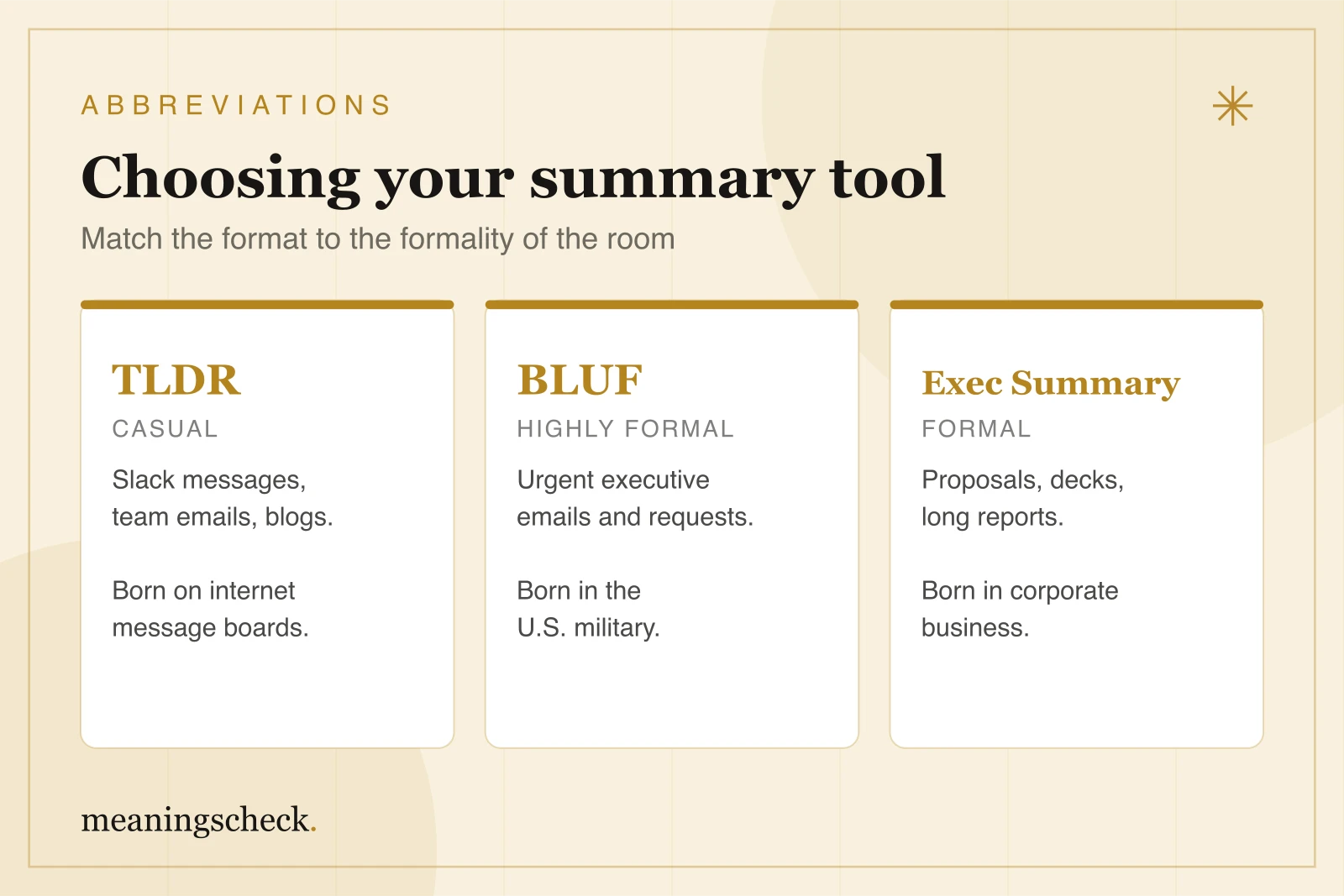
Comparison Table: Choosing Your Summary Tool
| Term | Formality Level | Best Used For | Origin |
|---|---|---|---|
| TLDR | Casual / Semi-Formal | Slack messages, internal team emails, blogs. | Internet Message Boards |
| BLUF | Highly Formal | Urgent emails to executives, direct requests. | U.S. Military |
| Executive Summary | Formal | Formal proposals, pitch decks, long reports. | Corporate Business |
Expert Insights: How the Acronym Changed the Internet
The Short Answer: The rise of TLDR perfectly illustrates society's shrinking attention span. Content creators and SEO experts now use TLDR sections at the top of articles to capture featured snippets and satisfy impatient readers instantly.
Shrinking Attention Spans and the Demand for Summaries
We cannot discuss the TLDR meaning text phenomenon without addressing the psychological shift it represents.
Humanity has never had access to more information. Yet, paradoxically, we have never had less time to consume it. The proliferation of the smartphone has trained our brains to skim, not read. We want the dopamine hit of the conclusion without the effort of the journey.
The widespread adoption of TLDR is a direct symptom of this cultural shift. We are demanding that writers do the cognitive heavy lifting for us. If an article cannot be summarized in three sentences, many modern readers will simply abandon it.
The SEO Angle: Why Content Creators Love a Good TLDR
If you work in digital marketing or Search Engine Optimization (SEO), you already know the secret power of the summary.
Google's algorithm is designed to answer a user's question as quickly as possible. This is why Google created "Featured Snippets," those highlighted boxes at the very top of the search results that directly answer your query.
Content creators have realized that by placing a clear, concise "TLDR" or "Key Takeaways" section at the top of their blog posts, they massively increase their chances of winning that featured snippet.
It caters to the "zero-click search." The user asks a question, reads the TLDR right on the Google results page, gets their answer, and moves on. By embracing the "tldr" meaning abbreviation, websites are actively training AI search engines to pull their content. It is a brilliant, necessary tactic for surviving in modern digital publishing.
The Verdict: Mastering the Summary
The TLDR meaning has traveled a long, strange road. It was born as a toxic insult on video game forums, utilized to mock anyone who dared to write more than three sentences. Today, it is a hallmark of efficient, empathetic communication. It's not alone in reinventing itself — the NFS meaning drifted from a 1980s computing term all the way to modern dating slang.
By mastering when to use it, where to place it, and when to swap it out for a professional alternative like BLUF, you elevate your writing. You prove that you understand the modern digital landscape. You prove that you respect your reader's time.
And honestly, in a world drowning in endless text, respect is the most valuable thing you can offer.
Frequently Asked Questions (FAQs)
What is the TLDR meaning of the text abbreviation?
The tldr meaning text abbreviation stands for "Too Long; Didn't Read." It is used to provide a quick summary of a lengthy message, or conversely, used as a dismissive reply to indicate a message was too long to bother reading.
What does the TLDR meaning "TikTok" refer to?
The tldr meaning TikTok users employ refers to a short, on-screen text summary placed at the beginning of a long video. It acts as a hook, giving fast-scrolling viewers the core premise of the story instantly so they decide to keep watching.
Is it okay to use TLDR in a professional email?
Yes, but it depends on your company culture. In modern startups and casual offices, it is highly encouraged as a time-saving tool. However, if you are emailing a conservative executive or a traditional client, it is safer to use "BLUF" (Bottom Line Up Front) or "Executive Summary."
How do you pronounce TLDR?
Because it is an initialism (like FBI or CIA) rather than a true acronym (like NASA), you pronounce each letter individually. It is spoken aloud as Tee-El-Dee-Are.
Where is the best place to put a TLDR?
If the goal is to save a professional colleague's time, put it at the very top of the email or document. If the goal is to summarize a funny or dramatic personal story without ruining the punchline, put it at the very bottom.
Related terms
Share: · Post on X
Written by MeaningsCheck Team · Published
The MeaningsCheck team researches and writes plain-language explanations of slang, abbreviations, and everyday words — checked for accuracy, updated as language changes.