
What Does FRL Mean? FRL Meaning in Text, FRL vs. FR and FRFR, and How to Reply (2026)
FRL means "for real" — a texting shortcut used to say "seriously," "I mean it," or "are you serious?" As a statement ("I'm tired frl"), it adds sincerity. As a question ("frl?"), it asks if something is true. It works like FR and FRFR.
FRL means "for real." It's a quick way to say "seriously," "I mean it," or "no joke." When a friend texts "that movie was amazing frl," they're telling you they genuinely loved it.
FRL can also be a question. A simple "frl?" means "Are you serious?" or "Is that true?" — the texting version of a raised eyebrow.
If you're wondering what does FRL mean, think of it as a close cousin of FR and FRFR. All three spell out "for real." FRL just keeps one more letter, which some people feel makes it look more like the full phrase.
This guide covers the FRL meaning in text, how it works as a statement and a question, how it compares to FR, FRFR, ONB, NGL, and BFFR, what it means on Snapchat and TikTok, how to reply, and the non-slang meanings of FRL you might see in schools and workshops.
Key takeaway: FRL = "for real." As a statement, it means "I'm serious." As a question, it means "Are you serious?"
Executive Summary: FRL at a Glance
Here's the quick version:
- Meaning: "For real."
- As a statement: Adds sincerity — "I'm proud of you frl."
- As a question: Checks if something's true — "frl??"
- Close cousins: FR ("for real"), FRFR ("for real, for real"), fr tho.
- Tone: Casual and sincere. Can show surprise, agreement, or doubt.
- Where you'll see it: Texts, Snapchat, TikTok, Instagram comments, and gaming chats.
- Other meanings: Free and reduced lunch in US schools, and filter-regulator-lubricator units in compressed-air systems.
What Does FRL Mean? The Core Definition
The Short Answer: FRL stands for "for real." It's used to show you're being sincere ("I needed that frl") or to ask if someone else is serious ("frl?"). It works just like FR and FRFR, with a slightly fuller spelling.
The Literal Translation
FRL is a shortened spelling of "for real":
- F — For
- R — Real
- L — the last letter of "real," kept for clarity
Unlike true acronyms, FRL isn't one letter per word. It's more of a clipped spelling — like "fr" with an extra letter that makes "real" more obvious.
"For Real" in Everyday English
"For real" means genuinely, seriously, or truly. You might hear:
- "Are you for real?" — "Are you serious?"
- "This time it's for real." — "This time it's genuine."
- "I love this, for real." — "I truly love this."
FRL brings that same meaning to fast texting.
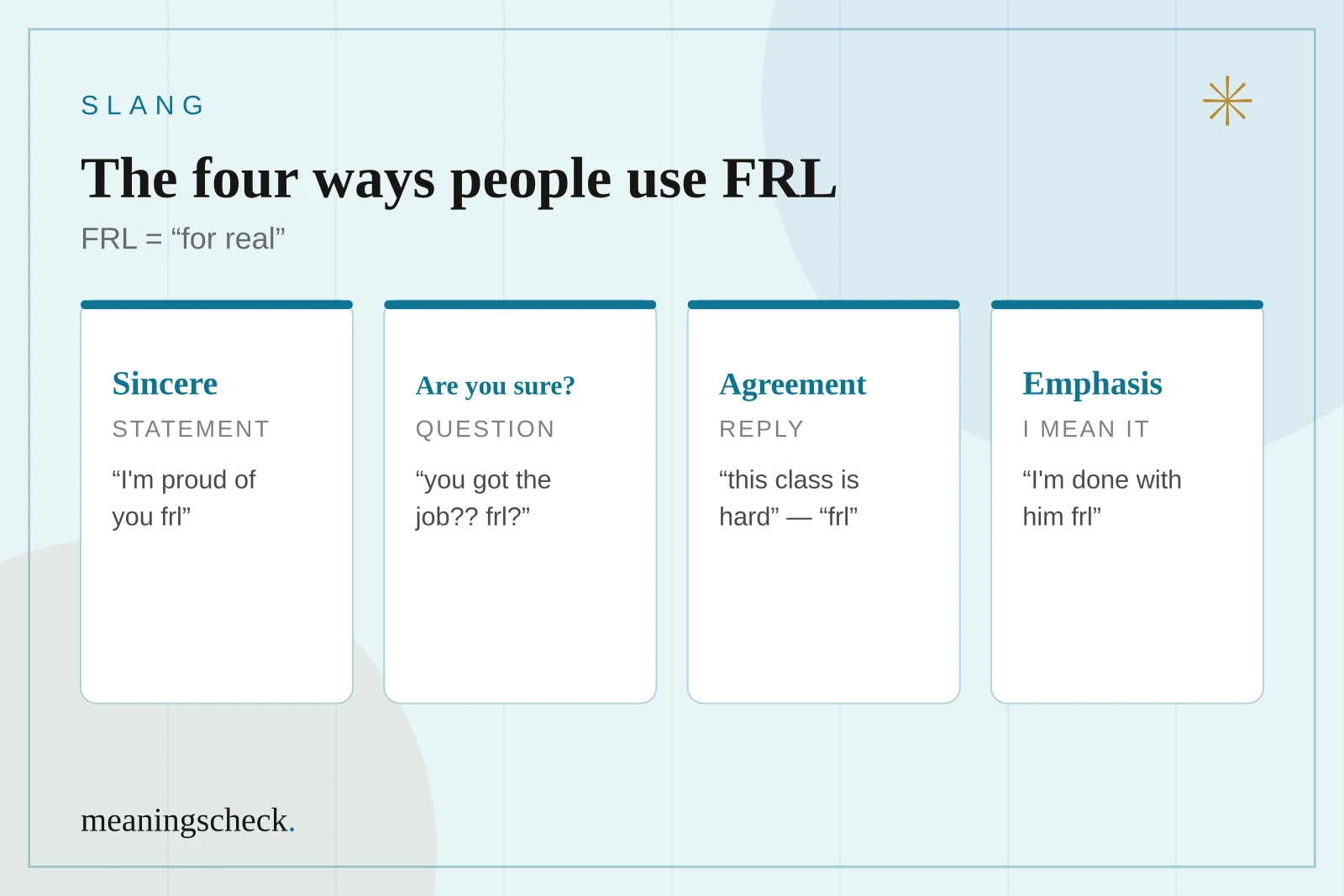
Two Main Uses
| Use | Example | What It Means |
|---|---|---|
| Statement | "that was so fun frl" | "I genuinely mean it." |
| Question | "you got the job?? frl?" | "Are you serious?" |
| Agreement | "this class is hard" — "frl" | "Seriously, I agree." |
| Emphasis | "I'm done with him frl" | "I mean it this time." |
| Doubt | "he said he'd pay you back? frl?" | "I find that hard to believe." |
Where Did FRL Come From?
The Short Answer: FRL comes from the phrase "for real," which has long been common in everyday English and especially in African American English and hip-hop. Texting shortened it to "fr," "frfr," and "frl." FRL is a less common spelling that keeps more of the word "real."
"For Real" Before Texting
"For real" was part of casual speech long before phones. It's especially common in African American English and hip-hop, where "for real" and "for real, for real" emphasize honesty and seriousness.
The Texting Shortcut
As texting grew, people shortened common phrases. "For real" became "fr." Doubling it became "frfr" ("for real, for real") for extra emphasis.
Why "FRL"?
Some people prefer FRL because "fr" can look like other words or typos. Adding the "L" makes it clearer that you mean "real." It's less common than "fr," but you'll see it in texts, captions, and comments.
| Form | Spelling | How Common |
|---|---|---|
| For real | Full phrase | Very common in speech |
| fr | Shortest | Very common in texts |
| frfr | Doubled for emphasis | Common |
| frl | Clearer clipped spelling | Less common |
| fr tho | "For real, though" | Common |
| 4real | Number style | Older, rarer |
FRL as a Statement: Adding Sincerity
The Short Answer: When FRL comes at the end of a statement, it means "I'm serious" or "I really mean this." It makes compliments warmer, complaints stronger, and confessions more honest.
Compliments
- "you did amazing today frl"
- "this is the best pizza ever frl"
Adding FRL makes the compliment sound genuine, not polite.
Complaints
- "I'm so tired frl"
- "this traffic is ridiculous frl"
Here FRL adds weight: "I'm not exaggerating."
Confessions
- "I miss hanging out frl"
- "I needed that talk frl"
FRL signals honesty — similar to "icl" ("I can't lie"), which our ICL meaning guide explains.
| Without FRL | With FRL |
|---|---|
| "That was fun." | "That was fun frl." (genuinely) |
| "I'm tired." | "I'm tired frl." (really tired) |
| "Thanks." | "Thanks frl." (deeply grateful) |
| "I'm proud of you." | "I'm proud of you frl." (sincerely) |
FRL as a Question: "Are You Serious?"
The Short Answer: "frl?" with a question mark means "Are you serious?" or "Is that true?" It can show excitement ("you got tickets?? frl?") or doubt ("he apologized? frl?"). The tone depends on the news.
A one-word "frl?" can carry very different feelings:
Excited Disbelief
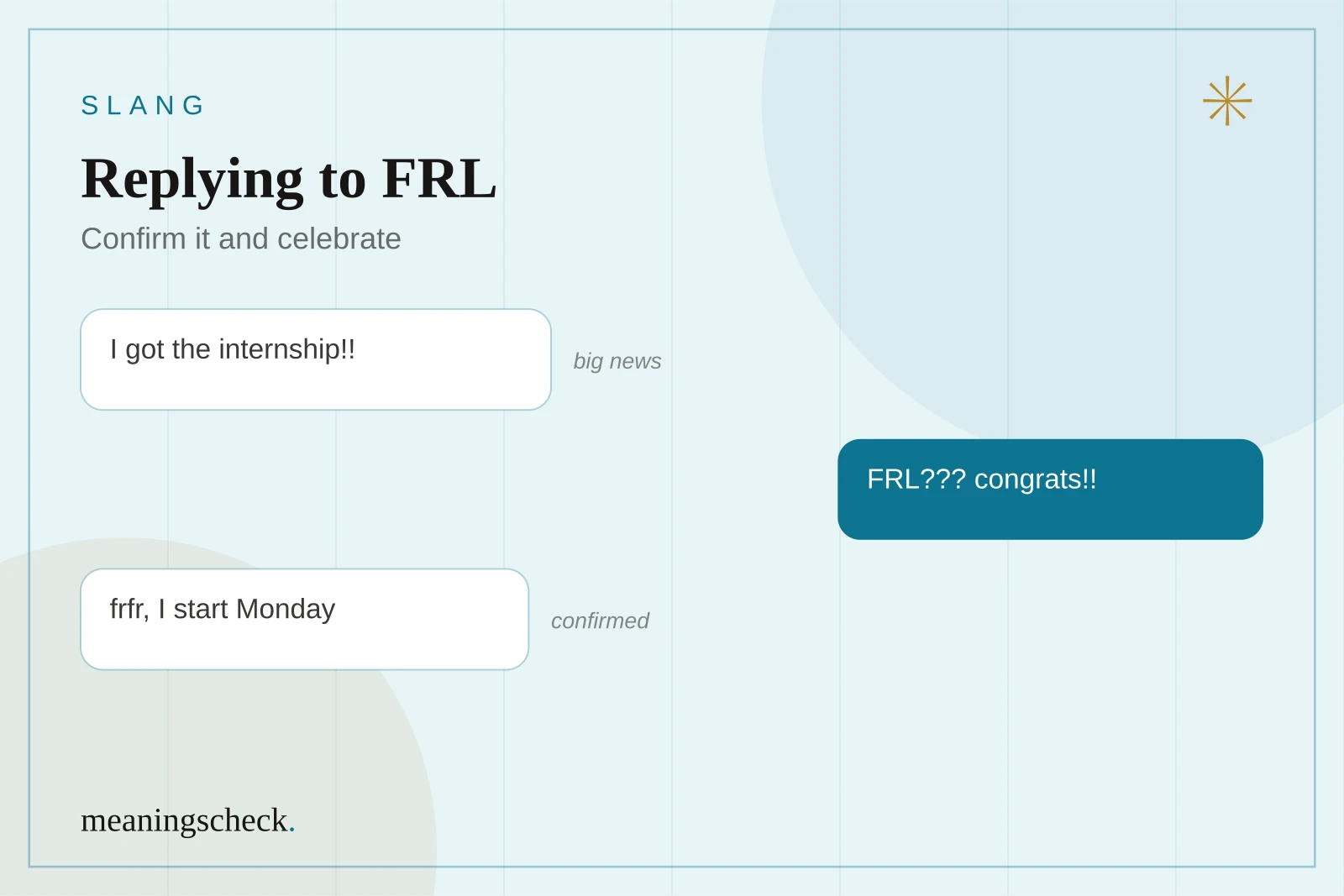
- "I got the internship!" — "FRL??? CONGRATS"
Skeptical Disbelief
- "He said he'll change." — "frl? 🤨"
Simple Confirmation
- "The test got moved to Monday." — "frl? thank god"
| Reply | Feeling |
|---|---|
| "FRL??" | Excited surprise |
| "frl?" | Genuine question |
| "frl? 🤨" | Doubtful |
| "frl? 😭" | Shocked, often by bad news |
| "frl…" | Let down or disappointed |
Key takeaway: "frl" with a period means "I mean it." "frl?" with a question mark means "Do you mean it?"
FRL vs. FR, FRFR, ONB, NGL, and BFFR
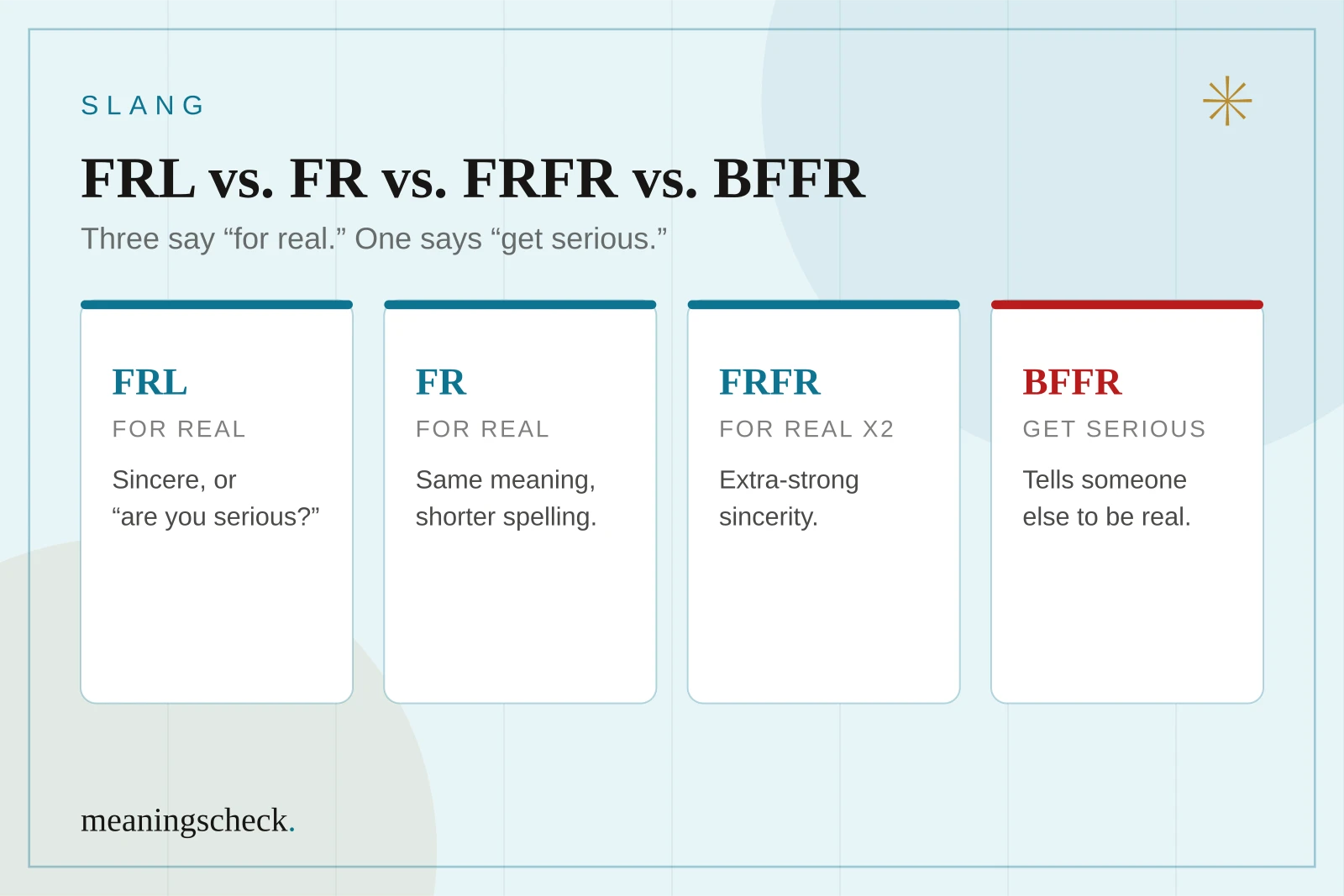
The Short Answer: FRL and FR mean the same thing: "for real." FRFR doubles it for extra emphasis. ONB ("on bro") swears something is true. NGL ("not gonna lie") adds honesty. BFFR tells someone else to get serious.
| Slang | Stands For | Job | Example |
|---|---|---|---|
| FRL | For real | Sincerity or "seriously?" | "I'm proud of you frl" |
| FR | For real | Same as FRL, shorter | "this is so good fr" |
| FRFR | For real, for real | Extra-strong sincerity | "I'm done frfr" |
| ONB | On bro | Swearing it's true | "I saw him there, onb" |
| NGL | Not gonna lie | Honest admission | "ngl I cried" |
| ICL | I can't lie | Honest admission | "icl that was fire" |
| BFFR | Be f***ing for real | Telling someone to get serious | "$9 fries? bffr" |
FRL vs. FR
They mean the same. FR is far more common. FRL is a bit clearer for readers who might not recognize "fr."
FRL vs. FRFR
FRFR is stronger. It's like saying "for real, for real" — "I really mean it."
FRL vs. BFFR
FRL describes your sincerity. BFFR demands sincerity from someone else — "be serious." Our BFFR meaning guide explains that difference in detail.
FRL vs. ONB
ONB ("on bro") is an oath — swearing something is true. It's stronger than FRL, as our ONB meaning guide explains.
FRL on Snapchat, TikTok, Instagram, and in Games
The Short Answer: On Snapchat, FRL shows up in quick replies and reactions. On TikTok and Instagram, it appears in comments like "this is so relatable frl." In gaming chats, it backs up claims or reacts to wild moments.
FRL on Snapchat
On Snapchat, FRL is a fast reply: "frl?" to news, or "miss you frl" in a chat.
FRL on TikTok
On TikTok, comments like "this is me frl" or "the way I needed this frl" add sincerity to reactions.
FRL on Instagram
In Instagram comments, FRL often warms up compliments: "you look amazing frl."
FRL in Gaming
In gaming chats, FRL reacts to wild plays or backs up claims: "that was the best clutch ever frl."
| Platform | Typical Use | Example |
|---|---|---|
| Snapchat | Quick replies | "frl?" |
| TikTok | Relatable comments | "this is so me frl" |
| Compliments | "stunning frl" | |
| X (Twitter) | Opinions | "this album is a classic frl" |
| Discord / games | Reactions | "that play was insane frl" |
| Texts | Everything | "I'm proud of you frl" |
FRL Meaning From a Girl or a Guy
The Short Answer: FRL means the same thing from anyone: "for real." From a crush, "I had fun frl" is a sincere compliment. "frl?" in response to your message usually means they're surprised or want confirmation.
When It's a Compliment
- "you're really funny frl"
- "I had a great time frl"
These are sincere. The FRL says "I'm not just being polite."
When It's a Question
- "you like that band too? frl?"
That's genuine interest. They're excited you have something in common.
When It's Doubt
- "you've never seen that movie? frl?? 😭"
Playful disbelief — often a setup for "we need to watch it together."
How to Reply to FRL (With Examples)
The Short Answer: If FRL is a statement, acknowledge it warmly ("thank you, that means a lot"). If it's a question ("frl?"), confirm ("fr fr," "yes for real") or clarify. Match their energy — excitement with excitement, doubt with reassurance.
When It's a Sincere Statement
- "Aww thank you, that means a lot."
- "Same frl."
- "Love you too 🥹"
When It's "frl?"
- "Yes for real!!"
- "Frfr, I'm not lying."
- "Swear on everything 😭"
When It's Doubtful
- "I know it sounds crazy. But yes!"
- "Okay, maybe I exaggerated a little 😅"
Is FRL Rude?
The Short Answer: No. FRL is friendly and casual. A skeptical "frl? 🙄" can come off as doubting someone, and it's too informal for work or school writing. Otherwise, it's a warm, everyday word.
| Situation | How FRL Lands |
|---|---|
| Complimenting a friend | Warm, sincere |
| Asking about good news | Excited |
| Questioning a story | Can feel doubtful |
| Work email | Too casual |
| School essay | Inappropriate |
If someone's sharing something personal and you reply with a doubtful "frl?", they might feel dismissed. A kinder version: "Wait, really? Tell me more."
Real-World Examples: FRL in Everyday Conversations
The Short Answer: FRL shows up when people celebrate good news, give compliments, vent, share surprising facts, and make plans. These examples show what it means each time — and how to answer.
These are typical patterns, not quotes from real people.
Good News
Message: "I passed my driving test!!"
Reply: "FRL??? Let's gooo"
What it means: Excited disbelief.
A Compliment
Message: "you were so good at the recital frl"
What it means: "I genuinely mean it."
Good reply: "Thank you!! I was so nervous."
Venting
Message: "I'm so over this week frl"
What it means: "I'm seriously done."
Good reply: "Weekend's almost here. Hang in there."
A Surprising Fact
Message: "octopuses have three hearts"
Reply: "frl?"
What it means: "Wait, is that true?"
Good reply: "Frfr, look it up 😂"
Plans
Message: "we should actually go this time frl"
What it means: "I'm serious about making it happen."
Good reply: "Okay, Saturday at 2. No canceling."
| Situation | FRL Signals | Good Reply |
|---|---|---|
| Good news | Excited surprise | Celebrate |
| Compliment | Sincerity | Say thanks |
| Venting | Frustration | Encourage |
| Surprising fact | "Is that true?" | Confirm |
| Plans | Commitment | Lock it in |
FRL Variations and Spellings
The Short Answer: You'll see frl, FRL, fr, frfr, "frl tho," "frl?" and "FRL???" They all mean "for real." Caps and extra question marks add excitement or disbelief.
| Variation | Meaning | Example |
|---|---|---|
| frl | For real | "miss you frl" |
| FRL | For real (louder) | "FRL best day ever" |
| frl? | Are you serious? | "frl?" |
| FRL??? | Excited disbelief | "FRL??? no way" |
| frl tho | For real, though | "that was hard frl tho" |
| fr | Shorter version | "same fr" |
| frfr | Extra emphasis | "I mean it frfr" |
How Do You Pronounce FRL?
The Short Answer: Most people don't say "F-R-L" out loud. They read it as the full phrase "for real." A few people spell out the letters as a joke. In normal speech, FRL is just "for real."
FRL is a written shortcut. When people read it aloud, they almost always say the phrase it stands for:
- "For real" — the normal way.
- "Fr-real" — a quick, blended version.
- "F-R-L" — spelling the letters, usually to be funny.
The same goes for FR and FRFR. Nobody says "eff-are-eff-are" in a real conversation. They say "for real, for real."
| Written | Spoken |
|---|---|
| frl | "for real" |
| fr | "for real" |
| frfr | "for real, for real" |
| frl? | "for real?" (rising tone) |
| FRL??? | "FOR REAL?!" |
Where Does FRL Go in a Sentence?
The Short Answer: FRL usually goes at the end of a sentence to add sincerity ("I miss you frl"). It can also stand alone as a reply ("frl") or a question ("frl?"). Less often, it opens a sentence ("frl, that was amazing").
FRL is flexible. Still, each position changes the feel a little:
At the End
This is the most common spot. It works like a period that says "and I mean it."
- "you're a good friend frl"
- "that test was brutal frl"
Standing Alone
As a one-word reply, FRL either agrees or asks.
- "This weather is perfect." — "frl" (agreeing)
- "They cancelled the concert." — "frl?" (asking)
At the Start
Opening with FRL sets a sincere tone for what comes next.
- "frl, thank you for coming"
- "frl tho, are you okay?"
| Position | Example | Effect |
|---|---|---|
| End | "I needed that frl" | Adds sincerity |
| Alone (statement) | "frl" | Agrees strongly |
| Alone (question) | "frl?" | Asks if it's true |
| Start | "frl, I'm proud of you" | Sets a serious tone |
| With "tho" | "frl tho" | Adds a turn or emphasis |
FRL With Emojis
The Short Answer: Emojis change how FRL feels. "frl 😭" is often overwhelmed or laughing. "frl 🥹" is touched. "frl? 🤨" is suspicious. "FRL 🎉" is celebrating. The emoji tells you which kind of "for real" it is.
Because FRL can mean several things, emojis help pin down the mood:
| Combo | Mood | Example |
|---|---|---|
| frl 😭 | Overwhelmed or laughing hard | "this video got me frl 😭" |
| frl 🥹 | Touched, emotional | "thank you frl 🥹" |
| frl? 🤨 | Suspicious | "he's 'busy'? frl? 🤨" |
| FRL 🎉 | Celebrating | "FRL we won 🎉" |
| frl 💯 | Strong agreement | "this is facts frl 💯" |
| frl 🙏 | Grateful | "needed that frl 🙏" |
| frl 😩 | Exhausted | "so tired frl 😩" |
If you're unsure whether someone is happy or doubtful, the emoji is usually the clue.
Expert Insights: Why "For Real" Never Goes Out of Style
The Short Answer: Online communication makes sincerity hard to read. Phrases like "for real," "ngl," and "icl" act as honesty markers that tell readers to take a message at face value. Shortening them keeps texting fast without losing that signal.
Sincerity Is Hard to Read in Text
In person, tone of voice and facial expressions show whether someone is joking. In text, those cues disappear. Sarcasm and sincerity can look identical. "That was great" might be praise — or an eye roll.
Honesty markers like "for real," "ngl," and "icl" solve that problem. They tell the reader: "Take this at face value."
Emphasis Through Repetition
"For real, for real" — and its texting form FRFR — uses repetition to intensify meaning. English does this all the time — think "very, very" or "really, really good." Repeating a word signals that you really mean it.
Credit to African American English
"For real" and "for real, for real" have deep roots in African American English and hip-hop. Many popular honesty markers — "on God," "no cap," "deadass" — come from Black and urban speech communities. Knowing that history is part of using the slang respectfully.
Shorter Isn't Always Clearer
"fr" is fast. But very short abbreviations can confuse readers who don't know them. FRL's extra letter is a small trade-off. It's slightly longer. It's also easier to read as "real."
Real-World Patterns of FRL
- Celebrations: "FRL??? congrats!!"
- Sincere thanks: "thank you frl, I needed that."
- Venting: "I'm exhausted frl."
- Fact-checking: "frl? that's crazy."
FRL in Group Chats
The Short Answer: In group chats, FRL reacts to news, backs up opinions, and confirms plans. A wave of "frl??" replies usually means someone just shared something surprising.
Group chats run on reactions:
- "I'm moving to Japan for a year" — "FRL??" — "WAIT WHAT"
- "this is the best group chat ever frl"
- "we need a beach trip frl" — "frfr" — "I'm in"
FRL keeps the energy real. It's a quick way to say "I'm serious about this" without a long message. Sometimes that sincerity comes with a little hedge, like "lowkey miss y'all frl" — the soft opener covered in our LWK meaning guide.
FRL for Parents and Teachers
The Short Answer: If a kid texts "frl," they mean "for real" — "seriously" or "I mean it." It's harmless. If they write "frl?", they're asking if something is true. In school contexts, FRL can also mean free and reduced lunch.
Parents may see "frl" in their kids' messages:
- "I cleaned my room frl" — "I really did."
- "we have a test tomorrow? frl?" — "Is that true?"
None of that is a concern. Teachers might also see "FRL" in a very different context: school data about free and reduced lunch eligibility. Context makes the meaning obvious.
Is FRL Professional?
The Short Answer: No. In work emails or with clients, say "seriously," "truly," or "I mean it." Among close coworkers in a casual chat, "frl" is usually fine.
| Casual | Professional |
|---|---|
| "great work frl" | "Truly great work." |
| "frl?" | "Is that confirmed?" |
| "I'm swamped frl" | "I'm at capacity this week." |
| "thanks frl" | "Thank you — I really appreciate it." |
When to Use FRL (and When to Skip It)
The Short Answer: Use FRL with friends, family, and anyone you text casually. Skip it in formal writing, with people who might not know slang, and in serious moments where a full sentence shows more care.
FRL is easy to use. Knowing when to use it is what makes you sound natural.
Good Times to Use FRL
- Celebrating a friend's news. "FRL??? so proud of you."
- Giving a sincere compliment. "you were amazing tonight frl."
- Agreeing in a group chat. "frl, we need a break."
- Checking surprising info. "the store closes at 6 now? frl?"
Times to Skip It
- Job applications and emails. Use full words.
- Texting someone who doesn't use slang. A grandparent may not know it.
- Serious or sad moments. If a friend shares bad news, "I'm so sorry. I'm here for you" says more than "frl."
- Arguments. A doubtful "frl?" can make a tense chat worse.
| Situation | Use FRL? | Better Option |
|---|---|---|
| Friend's good news | Yes | "FRL??? congrats!" |
| Group chat banter | Yes | "frl lol" |
| Work email | No | "That's great news." |
| Text to a grandparent | Maybe not | "Really? That's wonderful." |
| Friend's bad news | No | "I'm so sorry. I'm here." |
| Heated argument | No | "Can we talk about this?" |
Key takeaway: FRL is for relaxed, friendly chats. When the moment is formal or emotional, full words show more care.
Other Meanings of FRL
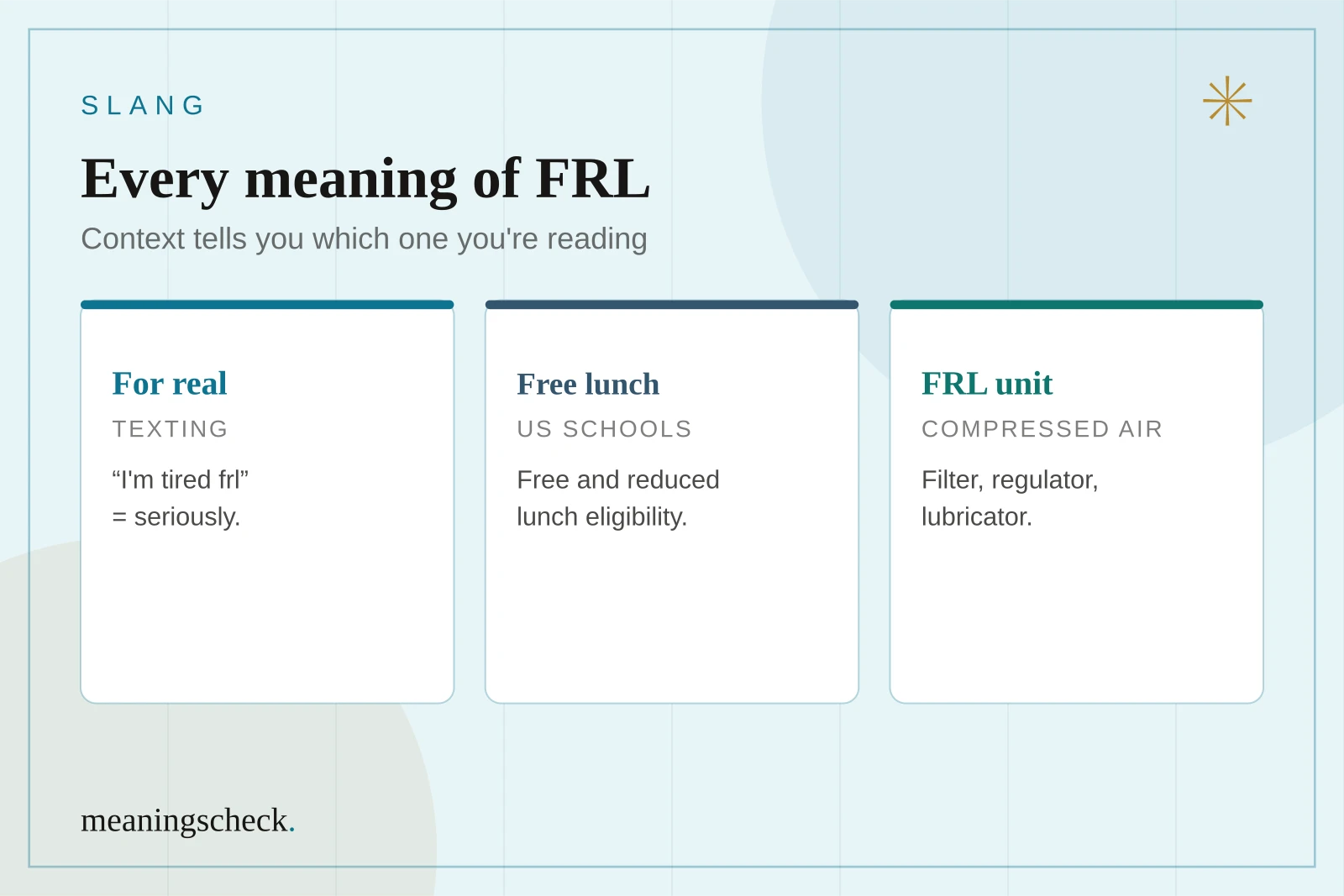
The Short Answer: Outside texting, FRL often means "free and reduced lunch" in US education — students eligible for free or reduced-price school meals. In manufacturing and maintenance, an FRL is a filter-regulator-lubricator unit for compressed air.
Free and Reduced Lunch (Education)
In US schools, FRL commonly stands for free and reduced lunch — students eligible for free or reduced-price meals through the National School Lunch Program. Schools and researchers often use FRL rates as a rough measure of student economic need: "This school has a 60% FRL population."
Filter-Regulator-Lubricator (Compressed Air)
In workshops and factories, an FRL unit is a filter-regulator-lubricator — a device that cleans, controls the pressure of, and lubricates compressed air before it reaches tools and machines.
| Context | FRL Means | Example |
|---|---|---|
| Texting | For real | "I'm proud of you frl" |
| US education | Free and reduced lunch | "FRL students" |
| Compressed air systems | Filter-regulator-lubricator | "Install an FRL before the tool." |
How to Explain FRL to Someone Who Doesn't Get It
The Short Answer: Say: "It means 'for real.' If it ends a sentence, it means 'I'm serious.' If it has a question mark, it means 'Are you serious?'"
If a parent, coworker, or friend is confused:
- "FRL means 'for real.'"
- "At the end of a sentence, it means 'I mean it.'"
- "With a question mark, it means 'Are you serious?'"
- "FR and FRFR mean the same thing."
That's all there is to it — and once people know, they start using it too.
FRL Across Generations
The Short Answer: Older generations say "seriously" or "really?" Millennials often say "for real" or "srsly." Gen Z and Gen Alpha use "fr," "frfr," and "frl" constantly in texts and comments.
| Group | How They Say It | Example |
|---|---|---|
| Gen X and older | "Seriously?" / "Really?" | "Really? That's great!" |
| Millennials | "For real?" / "srsly" | "srsly?? congrats" |
| Gen Z | "fr" / "frfr" / "frl" | "frl? no way" |
| Gen Alpha | "fr" / "frfr" with emojis | "frfr 😭" |
These are tendencies, not rules. Many people mix styles depending on who they're texting.
20 Example Sentences Using FRL
The Short Answer: FRL fits almost any casual sentence where you want to sound sincere or check that something is true. These 20 examples show it in compliments, complaints, questions, plans, and thank-yous.
Here's FRL in action, grouped by what the sender is doing:
Giving Compliments
- "your hair looks so good frl"
- "you're the funniest person I know frl"
- "that cake was amazing frl"
- "you killed that presentation frl"
Venting or Complaining
- "I'm running on 3 hours of sleep frl"
- "this homework is never-ending frl"
- "my phone battery is ruining my life frl"
- "I can't deal with this heat frl"
Asking If Something Is True
- "you're moving?? frl?"
- "school's closed tomorrow? frl?"
- "she said yes? FRL??"
- "they're making a sequel? frl?"
Making Plans
- "we need to hang out this week frl"
- "let's actually start the gym Monday frl"
- "I'm saving money this month frl"
- "next summer we're doing a road trip frl"
Saying Thanks or Showing Feelings
- "thank you for listening frl"
- "I appreciate you frl"
- "I miss you guys frl"
- "you made my whole day frl"
Why People Pick FRL Over "Seriously"
The Short Answer: "Seriously" can sound stiff or even annoyed. FRL feels lighter and friendlier. It also matches the fast, lowercase style of texting, which makes the message feel relaxed instead of formal.
Words carry a feel beyond their meaning. Compare these:
- "Seriously, thank you." — polite, a bit formal.
- "thank you frl" — warm and casual.
"Seriously?" on its own can even sound irritated. "frl?" feels curious instead. That's why many people reach for slang when they want sincerity without sounding heavy.
| Phrase | How It Can Feel |
|---|---|
| "Seriously?" | Annoyed or shocked |
| "Really?" | Neutral question |
| "Are you sure?" | Doubtful |
| "frl?" | Curious, friendly |
| "no way" | Excited disbelief |
Common Mistakes People Make With FRL
The Short Answer: The biggest mistakes are reading FRL as an unknown acronym, confusing it with BFFR, using a doubtful "frl?" when someone shares something personal, and using it at work.
- Treating it as a mystery acronym. It's just "for real."
- Confusing it with BFFR. BFFR tells someone else to be serious.
- Doubting someone's personal news. "frl?" can sting.
- Using it at work. Choose "truly" or "seriously."
- Overusing it. If everything is "frl," nothing stands out.
Slang Related to FRL
The Short Answer: FRL belongs to a family of "honesty markers" — words that tell people you mean it. Others include FR, FRFR, NGL, ICL, ONB, deadass, no cap, and LWK. Each adds sincerity in a slightly different way.
If you know FRL, these will feel familiar:
| Slang | Meaning | Feel |
|---|---|---|
| FR / FRFR | For real / for real, for real | Same family as FRL |
| NGL | Not gonna lie | Honest confession |
| ICL | I can't lie | Honest admission |
| ONB | On bro | Swearing it's true |
| No cap | No lie | Strong honesty |
| Deadass | Seriously | Very blunt sincerity |
| LWK | Lowkey | Soft, quiet honesty |
| BFFR | Be f***ing for real | "Get serious" |
Some of these are stronger than others. ONB and deadass feel like promises. NGL and ICL feel like confessions. LWK feels like a whisper. FRL sits in the middle: clear, friendly, and sincere. When someone you just met adds "frl" to their compliments, it often reads as genuine interest — the kind of energy our WYLL meaning guide describes in getting-to-know-you chats.
Quick Quiz: What Does FRL Mean Here?
The Short Answer: Read each message and decide if FRL is a statement ("I mean it") or a question ("Are you serious?"). The punctuation and context usually make it clear.
Test yourself. Answers are in the last column.
| Message | Statement or Question? | Meaning |
|---|---|---|
| "best day ever frl" | Statement | "I truly mean it." |
| "you won?? frl?" | Question | "Are you serious?" |
| "frl tho, are you okay?" | Statement opener | "Seriously, are you okay?" |
| "frl" (after "this is hard") | Statement | "I agree." |
| "frl? 🤨" | Question | "I doubt that." |
| "thank you frl 🥹" | Statement | "I'm truly grateful." |
If you got all six, you read FRL like a pro.
Frequently Asked Questions (FAQs)
What does FRL mean in text?
FRL means "for real." It can mean "I'm serious" or, with a question mark, "Are you serious?"
Is FRL the same as FR?
Yes. Both mean "for real." FR is more common, while FRL spells out a bit more of "real."
What does "frl?" mean?
"frl?" means "Are you serious?" or "Is that true?" It can show excitement or doubt.
What's the difference between FRL and FRFR?
FRFR means "for real, for real" — a stronger, doubled version of FRL.
What does FRL mean on Snapchat?
On Snapchat, FRL means "for real." People use it in quick replies and reactions.
Is FRL rude?
No. It's casual and friendly. A doubtful "frl?" can feel dismissive in sensitive conversations.
What does FRL mean in schools?
In US schools, FRL usually means "free and reduced lunch" — students eligible for free or reduced-price meals.
How do you respond to FRL?
If it's a compliment, say thanks. If it's "frl?", confirm with "yes for real" or "frfr."
What does "frl tho" mean?
"frl tho" means "for real, though" — adding emphasis to a point.
Final Thoughts
FRL is a small word with a big job: making sure people know you mean it. In a world of sarcasm and inside jokes, "for real" cuts through. It turns a compliment into a heartfelt one and a question into genuine curiosity.
Use it with friends, in comments, and in group chats. Swap it for "seriously" at work. And when someone shares great news, a loud "FRL???" is one of the best replies there is.
For more slang decoded the same way, explore our internet slang guides.
Related terms
Share: · Post on X
Written by MeaningsCheck Team · Published
The MeaningsCheck team researches and writes plain-language explanations of slang, abbreviations, and everyday words — checked for accuracy, updated as language changes.