
What Does MO Mean? MO Meaning in Text, Slang, and Modus Operandi Explained (2026)
MO most often stands for "modus operandi" — Latin for "way of operating," meaning someone's usual method or habit, as in "Showing up late is his MO." In casual texts, lowercase "mo" can mean "moment" ("wait a mo"), "month" ("$10/mo"), or "more" ("no mo"). MO is also the postal code for Missouri.
MO usually means "modus operandi" — a Latin phrase for someone's usual way of doing things. When a friend says "Canceling last minute is so her MO," they mean it's her typical pattern. You'll also hear it in crime shows: "The suspect's MO matches three other break-ins."
That's the big one. But "mo" is a busy little word.
In a casual text, lowercase "mo" can mean "moment" ("wait a mo"), "month" ("$15/mo"), or "more" ("no mo drama"). In Australia and the UK, a "mo" is a moustache — which is why November is Movember. And on an envelope, MO is Missouri.
So if you're asking what does MO mean, the honest answer is: it depends on the capitals, the punctuation, and the sentence around it. This guide covers every meaning, how to tell them apart, and how to use MO correctly.
Key takeaway: Uppercase "MO" usually means modus operandi. Lowercase "mo" in texts usually means moment, month, or more. Context decides.
Executive Summary: MO at a Glance
Here's the quick version:
- Main meaning: MO = modus operandi — someone's typical method or habit.
- Literal Latin: "Mode of operating." Merriam-Webster dates the phrase in English to 1654.
- Crime use: A criminal's MO is their recognizable method.
- Text meanings: "mo" = moment, month, or more.
- Australian and British slang: "mo" = moustache (hence Movember).
- Places: MO = Missouri (postal code). AP style abbreviates it "Mo."
- Other abbreviations: Medical Officer, money order, mail order, and Mo for the element molybdenum.
What Does MO Mean? The Core Definition
The Short Answer: MO stands for "modus operandi," Latin for "way of operating." It describes someone's usual method or habit. People use it about criminals ("the burglar's MO"), coworkers ("over-preparing is her MO"), and friends ("ghosting is his MO").
The Literal Translation
Modus operandi comes from Latin:
- Modus — mode, manner, or way
- Operandi — of operating or working
Put together, it means "way of operating." Merriam-Webster defines it as "a method of procedure" — especially a distinct pattern of operation that suggests the work of a single criminal in more than one crime. It lists the phrase's first known use in English as 1654.
The plural is modi operandi, though most people simply say "MOs."
How People Use It
You'll see MO in two main ways:
- Crime and investigation. "The arsonist's MO was always the same."
- Everyday habits. "Bringing snacks to every meeting is totally his MO."
| Sentence | What MO Means |
|---|---|
| "The thief's MO never changed." | The thief's usual method |
| "Being early is her MO." | Her typical habit |
| "That's not really my MO." | That's not how I usually do things |
| "What's your MO for studying?" | What's your usual approach? |
| "Classic MO — he disappeared again." | His familiar pattern |
How to Write and Say It
You'll see MO, M.O., and m.o. Dictionary.com lists all three. It's pronounced as two letters: "em-oh."
MO Meaning in Text: Moment, Month, or More?
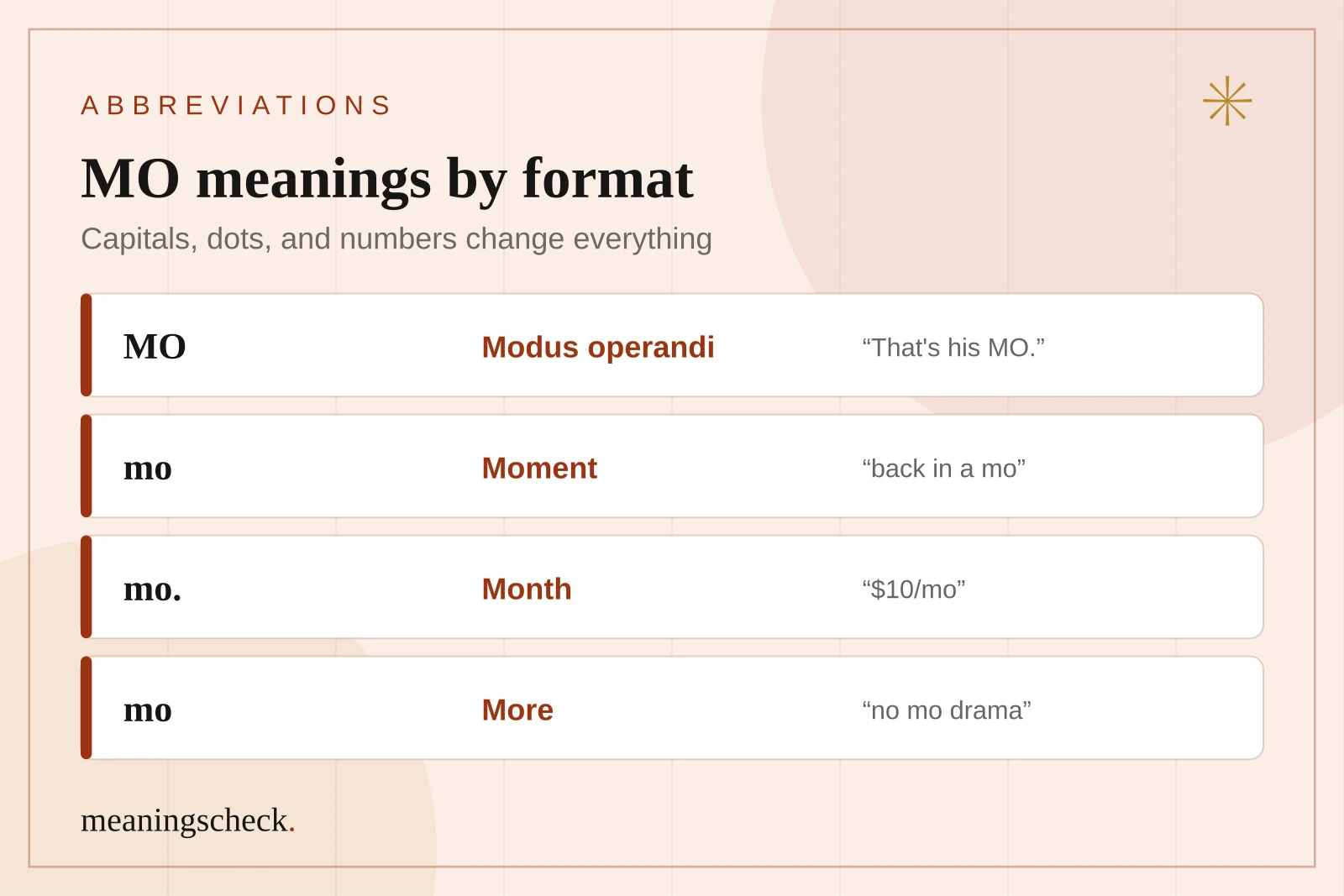
The Short Answer: In texts, lowercase "mo" usually means "moment" ("be there in a mo"), "month" ("$20/mo," "6 mo old"), or "more" ("no mo"). Look at the words around it: numbers point to month, "wait" or "in a" points to moment, and "no" or "mo money" points to more.
"Mo" = Moment
"Hang on a mo" and "be there in a mo" mean "in a moment." Dictionary.com labels this an informal, especially British, shortening of "moment." You'll also hear "half a mo," which means "just a second."
- "wait a mo, grabbing my keys"
- "back in a mo"
- "half a mo!"
The same clipping shows up in "slow-mo," short for slow motion.
"Mo" = Month
With numbers and prices, mo means month. Dictionary.com lists "mo." as an abbreviation for month.
- "$12/mo" — twelve dollars per month
- "my baby is 6 mo" — six months old
- "3 mo free trial"
Parents often write ages like "4mo" or "18mo." Subscriptions and rentals use "/mo" constantly.
"Mo" = More
In some dialects and in song lyrics, "mo" means "more." Dictionary.com notes this dialect pronunciation. The most famous example is The Notorious B.I.G.'s 1997 hit "Mo Money Mo Problems."
- "no mo excuses"
- "mo money, mo problems"
- "need mo sleep"
| Message | "Mo" Means | Clue |
|---|---|---|
| "be there in a mo" | Moment | "in a" |
| "$9.99/mo" | Month | Price + slash |
| "she's 8 mo now" | Month | Age |
| "no mo drama" | More | "no" |
| "watch it in slow-mo" | Motion | "slow" |
| "that's his MO" | Modus operandi | Capitals + "his" |
Key takeaway: Numbers mean month. "In a" means moment. "No" usually means more. Capitals usually mean modus operandi.
Real-World Examples: MO in Everyday Conversations
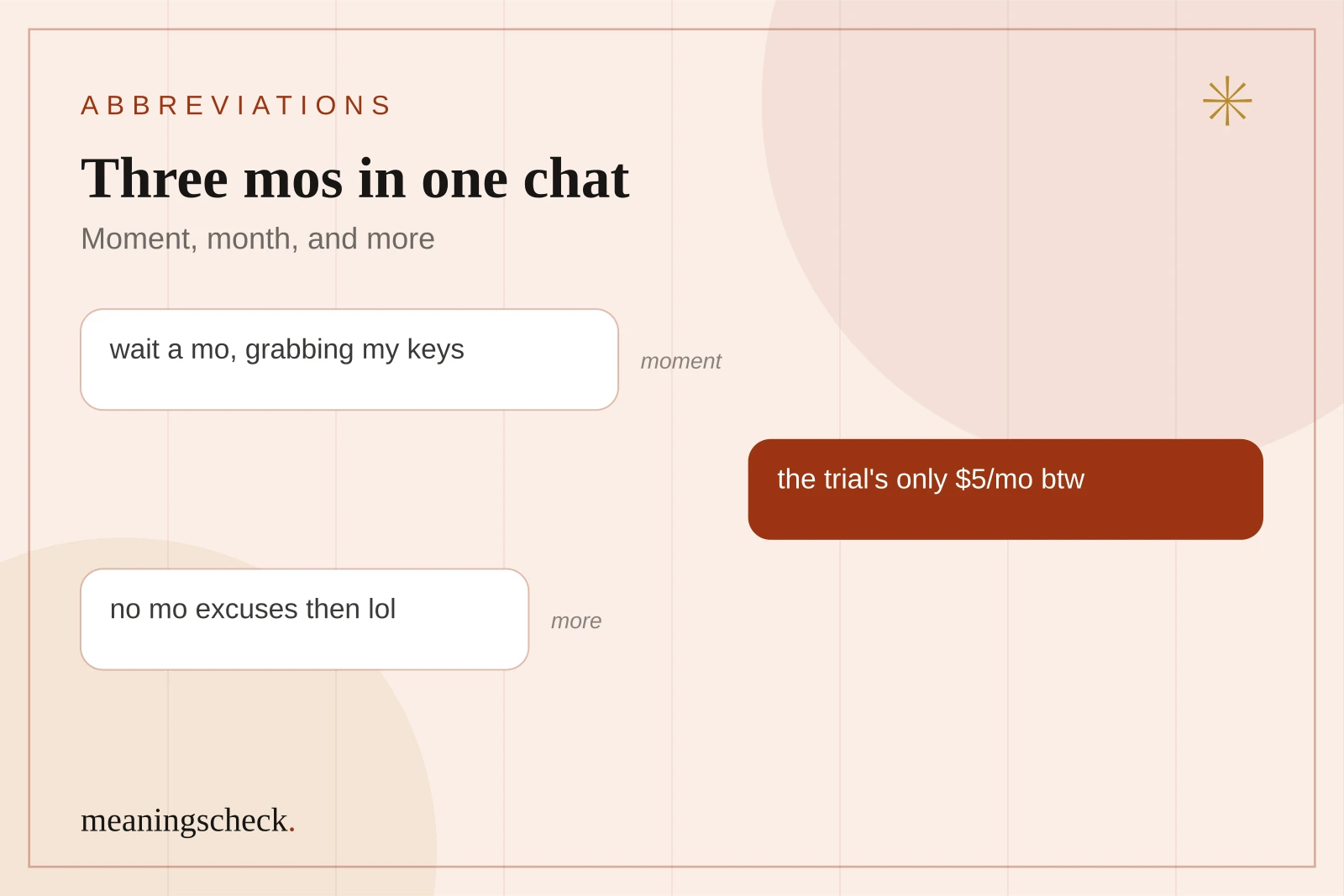
The Short Answer: You'll see MO in work chats, friend roasts, parenting texts, subscription pricing, and true-crime discussions. Each one uses a different meaning. These examples show how to read them.
These are typical patterns, not quotes from real people.
At Work
Message: "Classic Jordan MO — sends the deck at 11:59 pm"
What it means: "Jordan always sends things at the last minute."
Good reply: "Lol at least it's consistent."
A Friend Roast
Message: "ordering fries and then eating everyone else's is your MO"
What it means: "You always do this."
Good reply: "Guilty. It's a lifestyle."
A Parenting Text
Message: "she's 9 mo and already pulling up on the couch"
What it means: "She's nine months old."
Good reply: "Already?! She's growing so fast."
Subscription Pricing
Message: "it's only $6/mo if you pay yearly"
What it means: "Six dollars per month."
Good reply: "Ok that's actually worth it."
True Crime Chat
Message: "the MO in episode 3 matches the first case"
What it means: "The method is the same — it might be the same person."
Good reply: "Wait. Copycat or the same guy??"
| Situation | MO Means | Clue |
|---|---|---|
| Work chat | Habit (modus operandi) | "Classic … MO" |
| Friend roast | Habit (modus operandi) | "is your MO" |
| Parenting | Month | A number before it |
| Pricing | Month | "$" and "/" |
| True crime | Method (modus operandi) | "matches the case" |
MO in Crime and Criminal Profiling
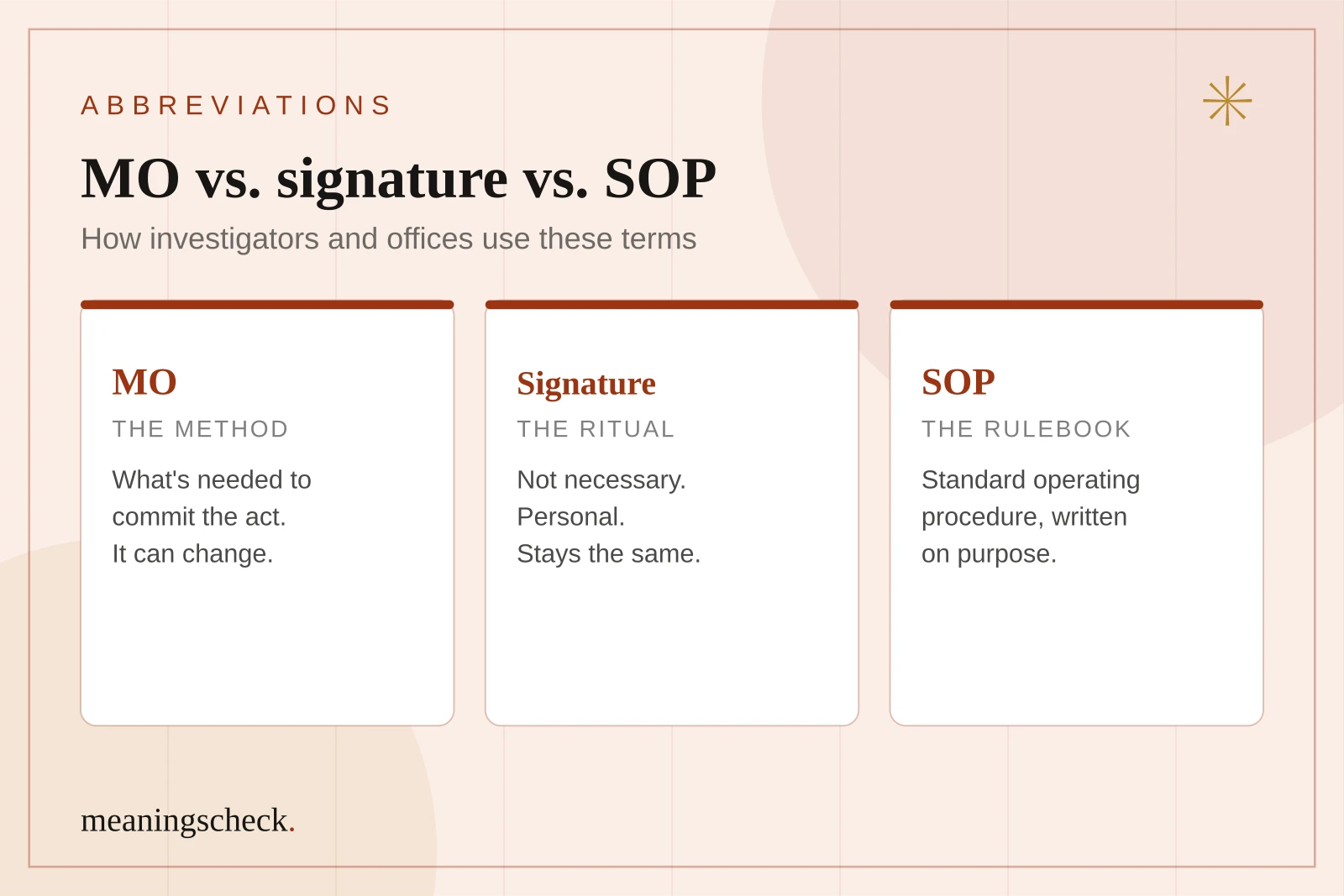
The Short Answer: In criminal investigations, MO means the method an offender uses to commit a crime — how they get in, what tools they use, and how they escape. Investigators compare MOs to link crimes. Profilers also distinguish MO from a "signature," a personal ritual that isn't needed to commit the crime.
MO is a standard term in law enforcement and true crime. Detectives look at an offender's methods to spot patterns:
- How did they enter — a forced lock or an unlocked window?
- What time did they strike?
- What tools did they use?
- How did they leave?
If two crimes share an unusual MO, investigators may suspect the same person.
MO vs. Signature
Former FBI profiler John Douglas, whose work inspired the Netflix series Mindhunter (2017), helped popularize an important distinction:
- MO is what an offender does to commit the crime. It's practical. It can change as they learn.
- Signature is something they do that isn't necessary to commit the crime — a personal ritual. It tends to stay the same.
| Term | What It Is | Does It Change? | Example |
|---|---|---|---|
| MO | The method needed to commit the act | Yes — it evolves | Picking locks instead of breaking windows |
| Signature | A personal, unnecessary ritual | Usually not | Leaving a specific object behind |
| SOP | Standard operating procedure | Updated deliberately | A company's written process |
That's why crime shows love the term. "The MO changed. The signature didn't." It's a classic plot twist.
A Short History of "Modus Operandi"
The Short Answer: "Modus operandi" entered English from Latin by the 1600s. Police forces later built formal "MO systems" to classify criminals by method — an approach often credited to a British chief constable in the early 1900s. From there, the phrase moved into crime fiction and everyday speech.
From Latin to English
Merriam-Webster dates "modus operandi" in English to 1654. For centuries, it was a scholarly and legal phrase — the kind of Latin that educated writers sprinkled into formal prose.
Police Records and the "MO System"
In the early 20th century, police began tracking criminals by method as well as by name and appearance. Llewelyn Atcherley, a chief constable in Yorkshire, England, is often credited with developing an influential "modus operandi" system around 1913. The idea was simple: criminals tend to repeat what works. Catalog the methods, and you can link the crimes.
Into Pop Culture
Detective fiction and, later, TV crime dramas picked up the phrase. By the late 20th century, "MO" was common enough that people used it jokingly about friends, coworkers, and themselves. Today, it's as likely to describe someone's coffee order as a criminal's method.
| Period | What Happened |
|---|---|
| 1654 | "Modus operandi" appears in English (Merriam-Webster) |
| Early 1900s | Police develop "MO systems" to classify offenders |
| 20th century | Detective fiction and TV popularize "MO" |
| 1990s–2000s | FBI profiling and true crime make "MO vs. signature" famous |
| Today | "That's my MO" is everyday slang for a habit |
MO in Everyday Conversation
The Short Answer: Outside crime, MO just means someone's habit or usual approach. "Overthinking is my MO" or "Late replies are his MO." It can be neutral, playful, or a little critical depending on the habit.
People borrow MO from crime language because it sounds a bit dramatic — and a bit funny:
- "Showing up with coffee for everyone is her MO." (positive)
- "Leaving dishes in the sink is his MO." (critical)
- "Starting projects at midnight is my MO." (self-deprecating)
| Tone | Example |
|---|---|
| Admiring | "Making everyone feel welcome is her MO." |
| Teasing | "Ordering the same pizza every time is his MO." |
| Critical | "Making promises and not following through is their MO." |
| Self-aware | "Panic, then productivity — that's my MO." |
MO at Work
In professional settings, "MO" is fine in casual conversation: "Her MO is to overprepare." In formal writing, people often write "approach," "method," or the full "modus operandi."
MO Meaning From a Girl or a Guy
The Short Answer: From anyone, "that's your MO" means "that's your usual pattern." It can be teasing, affectionate, or a callout. On dating apps, "what's your MO?" asks about your style — how you usually approach dates, weekends, or relationships.
When It's Teasing
- "Falling asleep during movies is so your MO 😂"
- "Texting back 3 days later is his MO lol"
This kind of MO is playful. They've noticed a habit and they're poking fun.
When It's a Callout
- "Disappearing when things get serious is kind of your MO."
This one has weight. It's pointing out a pattern that hurts. It's worth taking seriously — and maybe talking about.
On Dating Apps
"What's your MO?" on a dating app means "What's your usual style?" It might be about first dates ("coffee or drinks?"), weekends, or how you approach relationships. A fun, specific answer works best: "Taco tour, then a long walk. Every time."
How to Reply When Someone Says "That's Your MO"
The Short Answer: Match the tone. If it's a joke, own it ("guilty"). If it's a compliment, say thanks. If it's a criticism, take a breath — and ask what they mean if it stings.
| They Say… | Tone | Try Replying… |
|---|---|---|
| "Bringing snacks is so your MO" | Compliment | "Someone has to keep us alive 😌" |
| "Being late is your MO lol" | Teasing | "Guilty. Working on it!" |
| "Canceling is kinda your MO" | Criticism | "Oof. Fair. I'll do better." |
| "What's your MO?" | Curious | "Plan everything, then improvise." |
When the comment stings, a calm reply helps more than a defensive one. "Is that how it feels to you?" opens a real conversation.
Mo = Moustache: Australian and British Slang (and Movember)
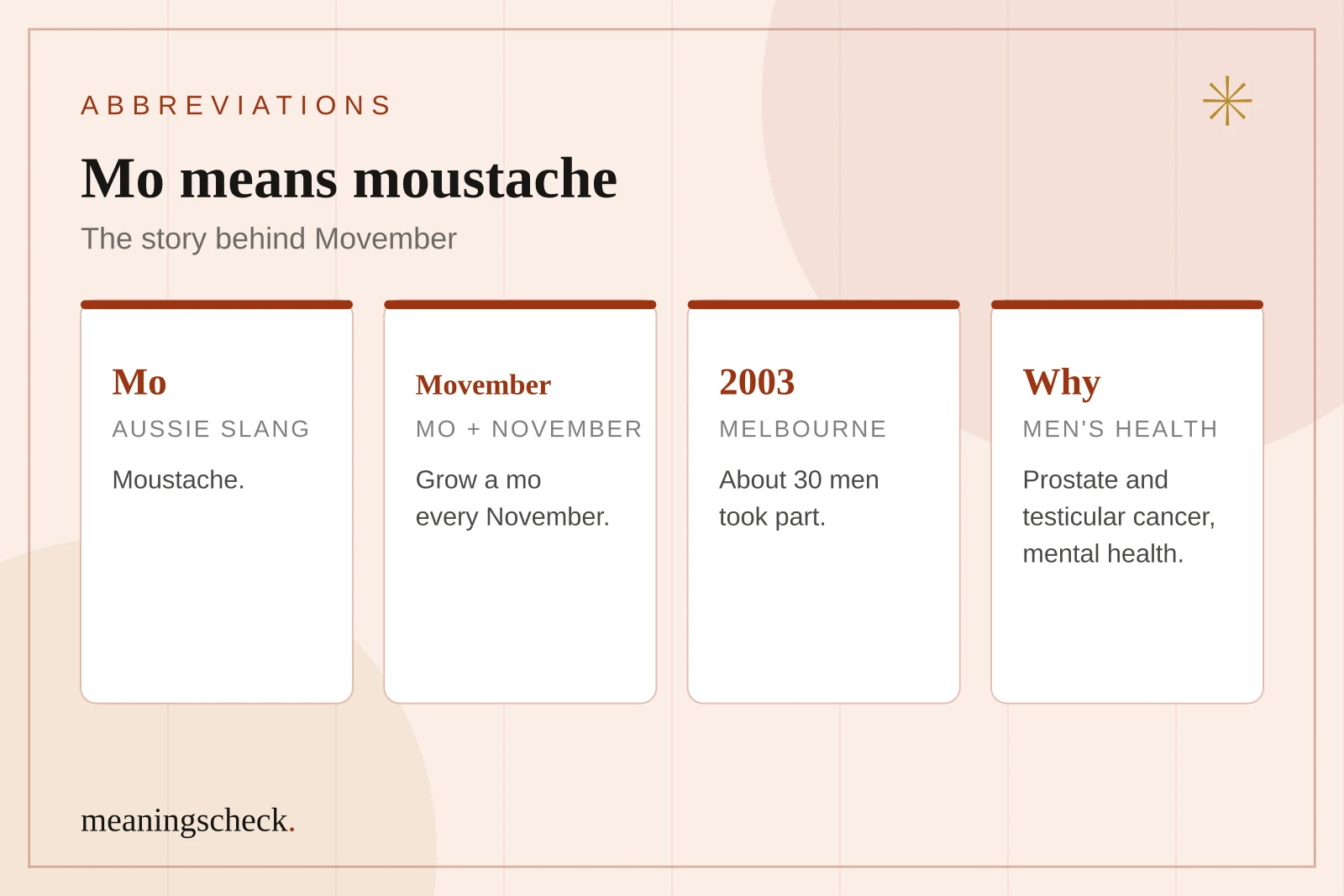
The Short Answer: In Australia, New Zealand, and the UK, "mo" is slang for moustache. That's where "Movember" comes from — "mo" plus "November." The men's health campaign started in Melbourne, Australia, in 2003.
In Australian and British English, a "mo" is a moustache. Dictionary.com lists it as British slang. "Nice mo, mate" is a compliment on someone's facial hair.
Movember
Movember blends "mo" and "November." Each November, participants grow moustaches to raise awareness and money for men's health — including prostate cancer, testicular cancer, and mental health and suicide prevention.
The campaign began in Melbourne in 2003. Its founders — Adam Garone, Travis Garone, Luke Slattery, and Justin Coghlan — started it half as a joke, with about 30 men taking part that first year. It has since grown into a worldwide charity movement.
Participants are often called "Mo Bros," and supporters "Mo Sistas." So if you see "growing my mo for Movember" this month, now you know.
| Term | Meaning |
|---|---|
| mo | Moustache (Australian and British slang) |
| Movember | Mo + November — a men's health campaign |
| Mo Bro | A man growing a moustache for Movember |
| Mo Sista | A supporter of Movember |
MO = Missouri and Other Abbreviations
The Short Answer: MO is the official US postal code for Missouri. AP style abbreviates the state as "Mo." in datelines. MO can also mean Medical Officer, money order, or mail order, and "Mo" is the chemical symbol for molybdenum.
Missouri
MO is the USPS two-letter code for Missouri. You'll see it in addresses: "Kansas City, MO 64105." News writers following AP style use "Mo." instead: "St. Louis, Mo."
Medical Officer
In the UK, militaries, and some health systems, MO means Medical Officer — a doctor in charge of medical care for a unit or organization.
Money Order and Mail Order
Dictionary.com lists m.o. for money order and mail order. You'll see "pay by MO" on older forms and listings.
Molybdenum
In chemistry, Mo (capital M, lowercase o) is the symbol for molybdenum, a metal used to strengthen steel.
Mo as a Name
"Mo" is also a nickname for names like Mohamed, Maurice, and Morris — think footballer Mo Salah or runner Mo Farah.
| Context | MO Means | Example |
|---|---|---|
| Everyday or crime | Modus operandi | "That's his MO." |
| Texting | Moment | "back in a mo" |
| Prices and ages | Month | "$10/mo," "6 mo old" |
| Dialect and lyrics | More | "no mo drama" |
| Australia and UK | Moustache | "growing a mo" |
| Addresses | Missouri | "Springfield, MO" |
| UK and military | Medical Officer | "See the MO." |
| Payments | Money order | "Pay by MO." |
| Chemistry | Molybdenum (Mo) | "Mo has atomic number 42." |
MO in Group Chats
The Short Answer: In group chats, MO usually shows up as a friendly roast — "classic Sam MO" — or as "a mo" when someone needs a second. Prices with "/mo" pop up when friends split subscriptions.
Group chats love calling out patterns:
- "Classic Priya MO, 20 minutes early and judging us"
- "brb, give me a mo"
- "if we split it 4 ways it's like $4/mo each"
The roasts are usually affectionate. If a running joke about someone's "MO" starts to feel mean, it's worth easing off. Everyone has habits. Not everyone wants them announced to the whole chat.
MO Around the World
The Short Answer: Americans mostly use MO for modus operandi, months, and Missouri. In the UK, "half a mo" means a moment, and an MO can be a Medical Officer. In Australia and New Zealand, a "mo" is a moustache.
| Region | Most Common Meanings | Example |
|---|---|---|
| United States | Modus operandi, month, Missouri | "That's his MO." / "$10/mo" / "St. Louis, MO" |
| United Kingdom | Moment, moustache, Medical Officer | "Half a mo!" / "Nice mo." |
| Australia and New Zealand | Moustache, moment | "Growing a mo for Movember." |
| Online everywhere | Month (prices), modus operandi | "$4.99/mo" |
If you're chatting with someone from another country, keep these differences in mind. A British friend's "back in a mo" isn't about a month. An Aussie's "check out my mo" isn't about their habits.
Latin Abbreviations Like MO You'll See Every Day
The Short Answer: MO is one of many Latin-based abbreviations in everyday English. Others include "etc." (et cetera), "e.g." (exempli gratia), "i.e." (id est), "vs." (versus), "a.m." and "p.m.," "P.S." (post scriptum), and "N.B." (nota bene).
English borrows a lot from Latin, and many of those borrowings survive as abbreviations:
| Abbreviation | Latin | Meaning |
|---|---|---|
| MO | Modus operandi | Way of operating |
| etc. | Et cetera | And so on |
| e.g. | Exempli gratia | For example |
| i.e. | Id est | That is |
| vs. | Versus | Against |
| a.m. / p.m. | Ante meridiem / post meridiem | Before noon / after noon |
| P.S. | Post scriptum | Written after |
| N.B. | Nota bene | Note well |
| et al. | Et alii | And others |
Quick Tip: e.g. vs. i.e.
These two get mixed up constantly. "e.g." introduces examples ("fruit, e.g., apples"). "i.e." introduces a clarification ("my favorite fruit, i.e., mango"). Think "e.g. = example given" and "i.e. = in essence."
How to Tell Which MO Someone Means
The Short Answer: Check capitals, numbers, and nearby words. "His MO" means modus operandi. "In a mo" means moment. "$10/mo" means month. "No mo" means more. A city name before MO means Missouri.
Use this quick decision guide:
- Capital letters plus "his," "her," "my," or "their"? → Modus operandi.
- A number or price right before it? → Month.
- "In a," "wait a," or "half a" before it? → Moment.
- "No" or a repeated phrase like "mo money"? → More.
- A city name before it? → Missouri.
- Facial hair or November? → Moustache.
If you're still unsure, ask. "Wait, MO like month or modus operandi?" is a perfectly normal question.
Expert Insights: Why "Mo" Means So Many Things
The Short Answer: "Mo" is a classic case of "clipping" — shortening a longer word to its first syllable. Moment, month, more, moustache, and motion all start with "mo," so they all clip to the same form. Context, not spelling, does the work.
Clipping: How Words Get Shortened
Linguists call it clipping when a word gets cut down: "laboratory" becomes "lab," "photograph" becomes "photo," "influenza" becomes "flu." "Mo" is a clipping of several different words:
- moment → mo
- month → mo
- moustache → mo
- slow-motion → slow-mo
Because these words share the same first sound, their clippings collide. That's why "mo" can mean so many things.
Acronyms vs. Clippings
MO for modus operandi is different. It's an initialism — the first letters of two words, said as letters ("em-oh"). Texting is full of initialisms like this — "TMI," for example, which our TMI meaning guide explains. Lowercase "mo" for moment is a clipping, said as one syllable ("moh").
| Type | How It's Formed | MO Example | Other Examples |
|---|---|---|---|
| Initialism | First letters, said as letters | MO (modus operandi) | FBI, TMI |
| Clipping | A shortened word | mo (moment) | lab, photo, flu |
| Dialect spelling | Written as pronounced | mo (more) | gonna, finna |
| Symbol | Official scientific code | Mo (molybdenum) | Fe, Au |
Latin in Everyday English
Modus operandi is one of many Latin phrases that live in everyday English — like "et cetera" (etc.), "per se," "bona fide," and "vice versa." Many survive as abbreviations, which is why MO feels as natural as "etc."
Real-World Patterns of MO
- True crime: "The killer's MO" is a staple of podcasts and documentaries.
- Office talk: "Overpromising is that vendor's MO."
- Subscriptions: "$4.99/mo" appears on nearly every streaming and app price page.
- Movember: "Growing a mo for Movember" fills social feeds every November.
MO in Business, Marketing, and Pricing
The Short Answer: In business, "/mo" means "per month" on pricing pages and subscriptions. "MO" can also describe a company's approach: "Fast shipping is their MO." In contracts and invoices, spell out "per month" to avoid confusion.
"/mo" on Pricing Pages
Look at almost any subscription — streaming, software, gyms, phone plans — and you'll see "/mo." It's short, clear, and fits neatly on a price tag: "$9.99/mo." You'll also see "/yr" for yearly plans.
A quick tip: when a price says "$8/mo, billed annually," you usually pay the full year upfront. The "/mo" figure just shows the monthly equivalent.
MO as a Company's Approach
People also use MO to describe how a company operates:
- "Undercutting competitors on price is their MO."
- "Great customer service is that brand's MO."
- "Their MO is to launch fast and fix later."
In Formal Documents
Contracts, invoices, and legal documents usually avoid "mo." They write "per month" or "monthly" instead. Clarity matters more than saving space when money is involved.
| Context | Best Format | Example |
|---|---|---|
| Pricing page | /mo | "$12/mo" |
| Ad or social post | /mo | "Only $5/mo!" |
| Invoice | per month | "$12 per month" |
| Contract | monthly | "a monthly fee of $12" |
| Casual team chat | MO (approach) | "Shipping fast is our MO." |
Mo vs. Moe vs. Mow: Don't Mix Them Up
The Short Answer: "Mo" is the clipping or abbreviation covered in this guide. "Moe" is a name. "Mow" means to cut grass. They sound alike but mean very different things.
Homophones trip people up, especially in fast texting:
| Word | Meaning | Example |
|---|---|---|
| mo | Moment, month, more, moustache (casual) | "back in a mo" |
| MO | Modus operandi, Missouri | "That's his MO." |
| Moe | A first name or nickname | "Moe is coming too." |
| mow | To cut grass | "I need to mow the lawn." |
If autocorrect turns your "mo" into "mow," your friend might think you're doing yard work instead of being right back.
MO in Pop Culture
The Short Answer: MO is a staple of crime fiction and TV, from detective novels to shows like Mindhunter. "Mo Money Mo Problems" made "mo" for "more" famous. And Movember made "mo" a global word for moustache.
MO shows up all over pop culture:
- Crime shows and true crime: Detectives analyze an offender's MO. Mindhunter (Netflix, 2017) dramatized early FBI work on criminal profiling.
- Music: The Notorious B.I.G.'s "Mo Money Mo Problems" (1997) made "mo" for "more" unforgettable.
- Charity: Movember turns "mo" into a global men's health campaign every November.
- Everyday jokes: "That's my MO" has become a playful way to own your habits.
How to Use MO Correctly: A Quick Style Guide
The Short Answer: Use "MO" (caps) for modus operandi, "mo" (lowercase) for moment or month in casual writing, and spell things out in formal contexts. In contracts and pricing, write "per month" when clarity matters.
- Capitalize MO for modus operandi. "That's her MO."
- Use lowercase "mo" for moment in casual chats: "back in a mo."
- Use "/mo" for prices in casual or marketing copy: "$10/mo."
- Spell out "per month" in contracts and invoices.
- Use "Missouri" or "MO" correctly — "MO" in addresses, "Mo." in AP-style news.
- Avoid "mo" for "more" in formal writing. It's dialect and song-lyric territory.
| Do | Don't |
|---|---|
| "Her MO is to overprepare." | "Her mo is to overprepare." (looks like moment) |
| "$15/mo" on a pricing page | "$15/mo" in a legal contract |
| "Back in a mo!" with friends | "Back in a mo" in a client email |
| "Kansas City, MO" on an envelope | "Kansas City, Mo" on an envelope |
MO for English Learners and Students
The Short Answer: For English learners, remember three rules: capital "MO" means a habit or method, "/mo" means per month, and "in a mo" means in a moment. In essays, write "modus operandi" or "method" rather than "MO."
"Mo" is tricky for English learners because one short form covers so many words. A few rules make it manageable:
- "MO" in capitals = a habit or method. "Her MO is to study early."
- A number plus "mo" = months. "6 mo" = six months.
- "A mo" or "in a mo" = a moment. "Back in a mo."
- "No mo" in songs = no more.
In Essays and Academic Writing
In school writing, avoid "MO." Write "modus operandi" (in italics in many style guides, since it's a foreign phrase) or a plain word like "method," "approach," or "pattern." Teachers generally prefer the plain English version.
| Casual | Academic |
|---|---|
| "The villain's MO" | "The villain's method" |
| "Her MO was persuasion" | "Her approach relied on persuasion" |
| "6 mo later" | "Six months later" |
Common Mistakes People Make With MO
The Short Answer: The biggest mistakes are mixing up "MO" and "mo," using "mo" in formal writing, confusing MO with SOP, and forgetting that MO means Missouri in addresses.
- Mixing up capitals. "His MO" and "in a mo" mean very different things.
- Using "mo" in contracts. Write "per month."
- Confusing MO with SOP. MO is a habit or method. SOP is a written procedure.
- Assuming MO is always negative. It can describe good habits too.
- Forgetting the plural. "MOs" in casual use, "modi operandi" in formal writing.
If someone fires a dozen abbreviations at you at once, a quick "tldr?" might be the right reply — our TLDR meaning guide explains when that's helpful and when it's rude. And if you're not sure you've remembered a meaning right, "iirc" is the polite hedge, as our IIRC meaning guide explains.
Frequently Asked Questions (FAQs)
What does MO stand for?
MO most often stands for "modus operandi," Latin for "way of operating." It describes someone's usual method or habit.
What does "that's his MO" mean?
It means "that's his usual way of doing things" — his typical pattern or habit.
What does mo mean in texting?
In texting, "mo" usually means "moment" ("back in a mo"), "month" ("$10/mo"), or "more" ("no mo"). Context tells you which.
What does /mo mean on a price?
"/mo" means "per month." For example, "$12/mo" means twelve dollars each month.
What does mo mean in Australian slang?
In Australia, "mo" means moustache. That's where "Movember" — mo plus November — comes from.
What is the difference between MO and signature?
In criminal profiling, MO is the method needed to commit a crime and can change. A signature is a personal ritual that isn't necessary and tends to stay the same.
What does MO mean in an address?
In an address, MO is the postal code for Missouri.
What does MO mean in a crime show?
In crime shows, MO is the method a criminal uses — how they commit the crime. Detectives use it to connect cases.
Is MO the same as habit?
In everyday speech, mostly yes. Saying "it's his MO" means it's his usual habit or approach.
What does Movember mean?
Movember combines "mo" (moustache) and "November." It's a men's health campaign that started in Melbourne in 2003.
What is the plural of modus operandi?
The formal plural is "modi operandi." In casual speech, people say "MOs."
What does "half a mo" mean?
"Half a mo" means "just a moment" or "one second." It's common in British English.
Final Thoughts
MO is two letters with a surprising number of jobs. In a detective story, it's a criminal's method. In a group chat, it's a friend's predictable habit. On a price tag, it's a month. In Melbourne, it's a moustache. And on an envelope, it's Missouri.
The trick is reading the clues — capitals, numbers, and the words around it. Once you know them, every MO makes sense.
And since it's November, you might spot a few new mos around. Now you know what they're for. For more abbreviations explained the same way, explore our abbreviation guides, or see how "smth" softens plans in our SMTH meaning guide.
Related terms
Share: · Post on X
Written by MeaningsCheck Team · Published
The MeaningsCheck team researches and writes plain-language explanations of slang, abbreviations, and everyday words — checked for accuracy, updated as language changes.