
What Does YFM Mean? YFM Meaning in Text, Slang, and How to Reply (2026)
YFM stands for "you feel me?" — a casual way to ask "do you understand what I mean?" or "do you agree?" It usually follows an opinion, explanation, or feeling, as in "I just need a break, yfm?"
YFM means "you feel me?" It's a casual way of asking "Do you understand what I mean?" or "Do you agree?" When someone texts "I just need some space this week, yfm?" they're checking that you get where they're coming from.
That's the simple version. But YFM is rarely a pure question.
Most of the time, it's a little conversational nudge — closer to "right?" or "you know?" than to a real request for an answer. And it carries a long history in Black American English and hip-hop culture, where "you feel me?" has been part of everyday speech for decades. So if you're wondering what does YFM mean, there's more under the surface than three letters suggest.
This guide covers the YFM meaning in text, what "feel" really means here, the three jobs YFM does, its roots and its family tree — from the jazz-era "dig?" to "you know what I'm saying?" — how it compares to YKWIM and IYKYK, and exactly how to reply.
Key takeaway: YFM is a connection check. The sender wants to know you're with them — in understanding, agreement, or feeling.
Executive Summary: YFM at a Glance
Here's what you need:
- Definition: YFM stands for "you feel me?" — "do you understand?" or "do you agree?"
- What "feel" means: Here, "feel" means understand or relate to — as in "I feel you."
- Three jobs: Checking understanding, seeking agreement, and asking for empathy.
- Roots: "You feel me?" comes from Black American English and hip-hop culture; the abbreviation spread with texting in the 2000s and beyond.
- Best replies: "I feel you," "fr," "100%," or an honest "not sure I see it."
- Rare alternate meaning: In heated messages, a few people use YFM for "you f***ing me?" — an angry "are you kidding me?" Context makes it obvious.
What Does YFM Mean? The Core Definition
The Short Answer: YFM stands for "you feel me?" It's a casual way to ask whether someone understands or agrees with what you just said. It usually comes after an opinion, an explanation, or a feeling, like "I'm done with that job, yfm?"
The Literal Translation: "You Feel Me?"
The YFM meaning in slang is a direct abbreviation of "you feel me?" — You Feel Me. It almost always ends a sentence, often with a question mark:
- "This city is too expensive, yfm?"
- "I'm not trying to go out tonight, yfm"
- "He's talented but lazy, yfm?"
In each case, YFM asks for the same thing: a sign that the listener is on the same wavelength.
"Feel" Means "Understand"
In this phrase, "feel" doesn't mean physical touch. It means to understand, relate to, or empathize with someone. You've probably heard the reply "I feel you," which means "I get it" or "I understand where you're coming from."
That's why "you feel me?" works so well. It asks for more than intellectual understanding. It asks, "Do you get how I feel about this?"
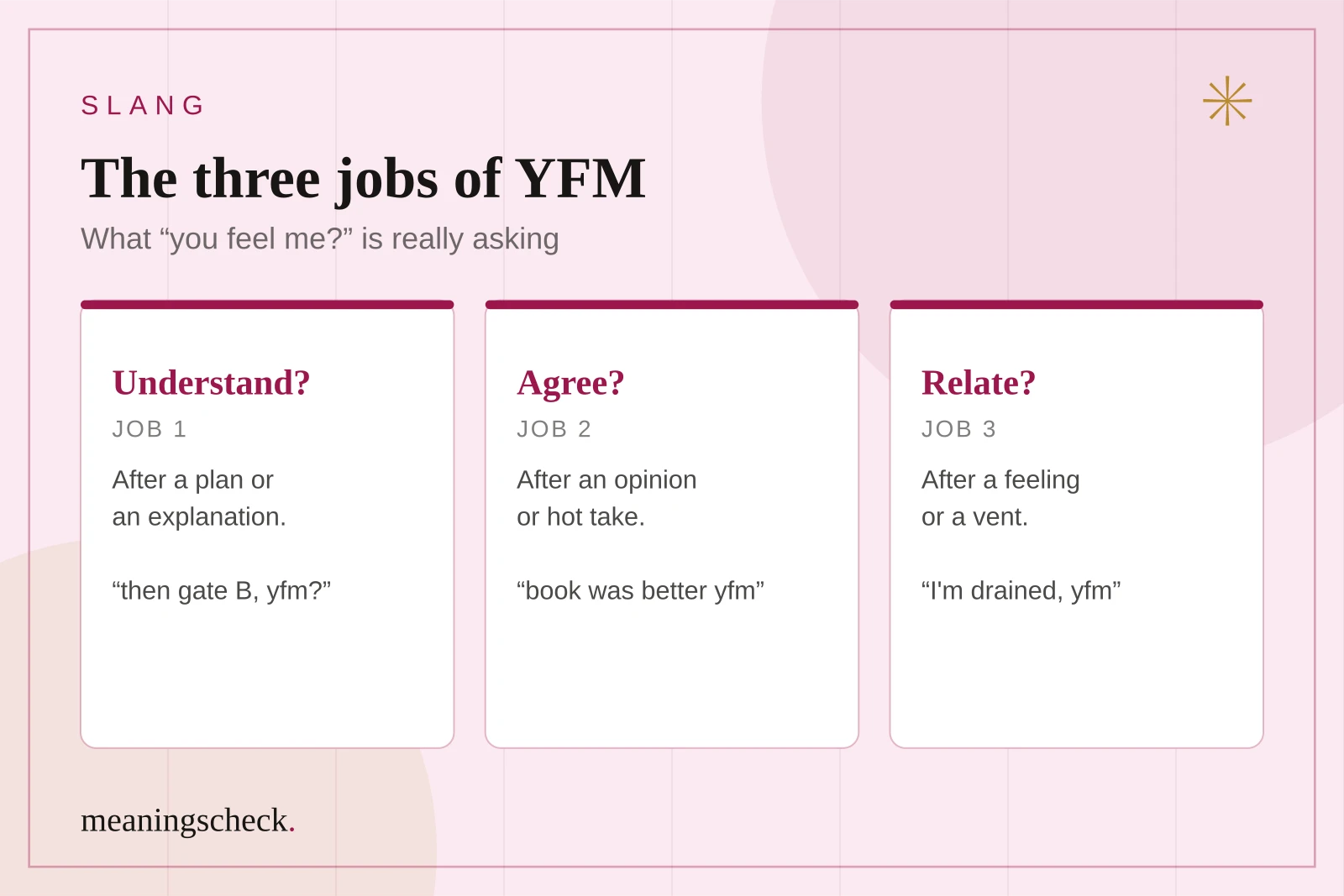
The Three Jobs of YFM
Depending on the conversation, YFM does one of three jobs:
| Job | Example | What It Really Means |
|---|---|---|
| Check understanding | "You plug it in, then hold the button, yfm?" | "Does that make sense?" |
| Seek agreement | "That movie was overrated, yfm?" | "You agree, right?" |
| Ask for empathy | "I'm just tired of always being the one who plans, yfm" | "Do you understand how I feel?" |
The third job is the most personal. When YFM follows a feeling, the sender is often looking for validation — a sign that their frustration or hope makes sense to you.
Where YFM Came From
"You feel me?" has deep roots in Black American English (also called African American Vernacular English, or AAVE) and hip-hop culture, where it has long been a natural way to check that a listener is following along. It shows up constantly in rap lyrics, interviews, and everyday conversation.
As texting took off in the 2000s, the phrase got the abbreviation treatment. YFM now appears across texts, Snapchat, TikTok comments, and X posts — often among people who've never thought about where it came from.
How "Feel" Came to Mean "Understand"
Using "feel" for emotional understanding isn't new. English speakers have said "I feel for you" to mean "I sympathize" for a very long time. What Black American speech added was a shorter, punchier version: "I feel you" — not "I feel sorry for you," but "I get you. I'm with you."
From there, the question form followed naturally. If "I feel you" means "I understand you," then "you feel me?" means "do you understand me?" It's the same idea flipped around.
That emotional flavor is why the phrase stuck. You can understand a math problem. But you feel someone when you get the experience behind their words. YFM asks for that deeper kind of understanding.
The same sense of "feel" shows up all over social media today:
- "I felt that" — "that's so relatable."
- "Felt" (one word, in a comment) — "same, this is me."
- "I feel that" — "I agree" or "fair point."
So if you see a TikTok comment that just says "felt," it's the same family as YFM. It's a short way of saying "I relate."
That history matters. A huge share of modern internet slang — including phrases like "no cap," "on God," and "you feel me" — comes from Black American speech. Recognizing those roots is part of using the language respectfully.
The "Understand?" Family Tree
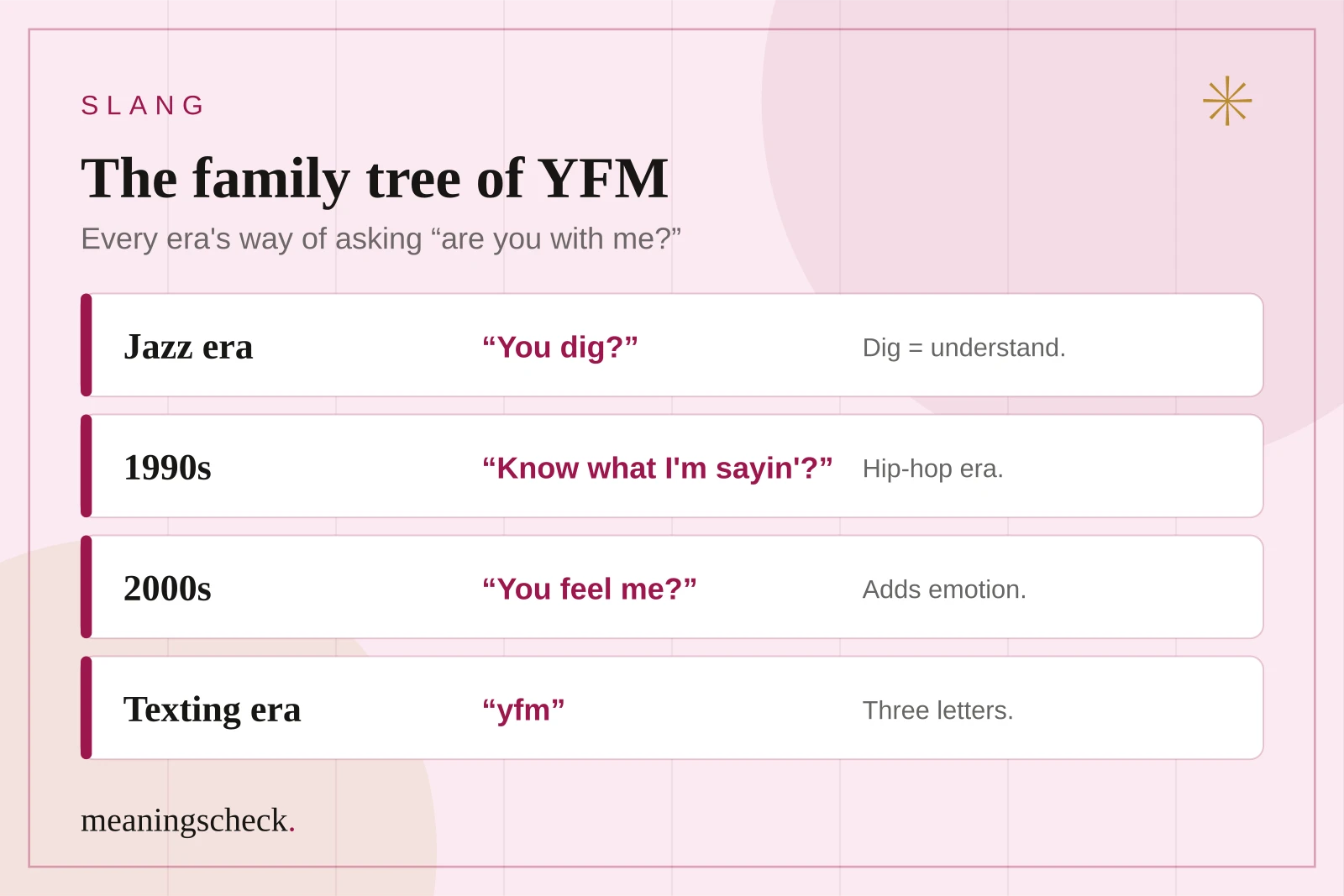
Every era has its own way of asking "you get it?" YFM is the latest branch of a long family:
| Era | Phrase | Example |
|---|---|---|
| 1930s–1950s jazz era | "Dig?" / "You dig?" | "It's a cool scene, you dig?" |
| 1960s–1970s | "Can you dig it?" | "We're gonna make it, can you dig it?" |
| 1990s | "You know what I'm sayin'?" | "It's about respect, you know what I'm sayin'?" |
| 2000s | "You feel me?" / "Ya feel me?" | "I'm just being real, you feel me?" |
| Texting era | "yfm" / "ykwim" | "need a break, yfm" |
Notice the pattern. Each phrase asks the same thing — "are you with me?" — in the voice of its generation. "Dig" came from jazz slang meaning "understand" or "appreciate." "You feel me" adds emotion to the question.
YFM Meaning in Text: How to Read It
The Short Answer: In a text, YFM usually signals that the sender wants you to nod along. After an explanation, it means "make sense?" After an opinion, it means "agree?" After a feeling, it means "do you get me?" It's often rhetorical — a reply like "fr" or "I feel you" is all they need.
After an Explanation
When YFM follows instructions or a plan, it's a comprehension check:
- "We meet at 7, then drive to the venue together, yfm?"
- "You add the sauce last so it doesn't burn, yfm?"
A quick "got it" or "makes sense" is the perfect reply.
After an Opinion
When YFM follows an opinion, it's fishing for agreement:
- "Season 2 was way better than season 3, yfm?"
- "Breakfast for dinner is elite, yfm"
Here you can agree, disagree, or add your own take. It's an invitation to discuss.
After a Feeling
When YFM follows something emotional, it's asking for empathy:
- "I just feel like nobody checks on me, yfm"
- "I love my job but I'm so drained, yfm?"
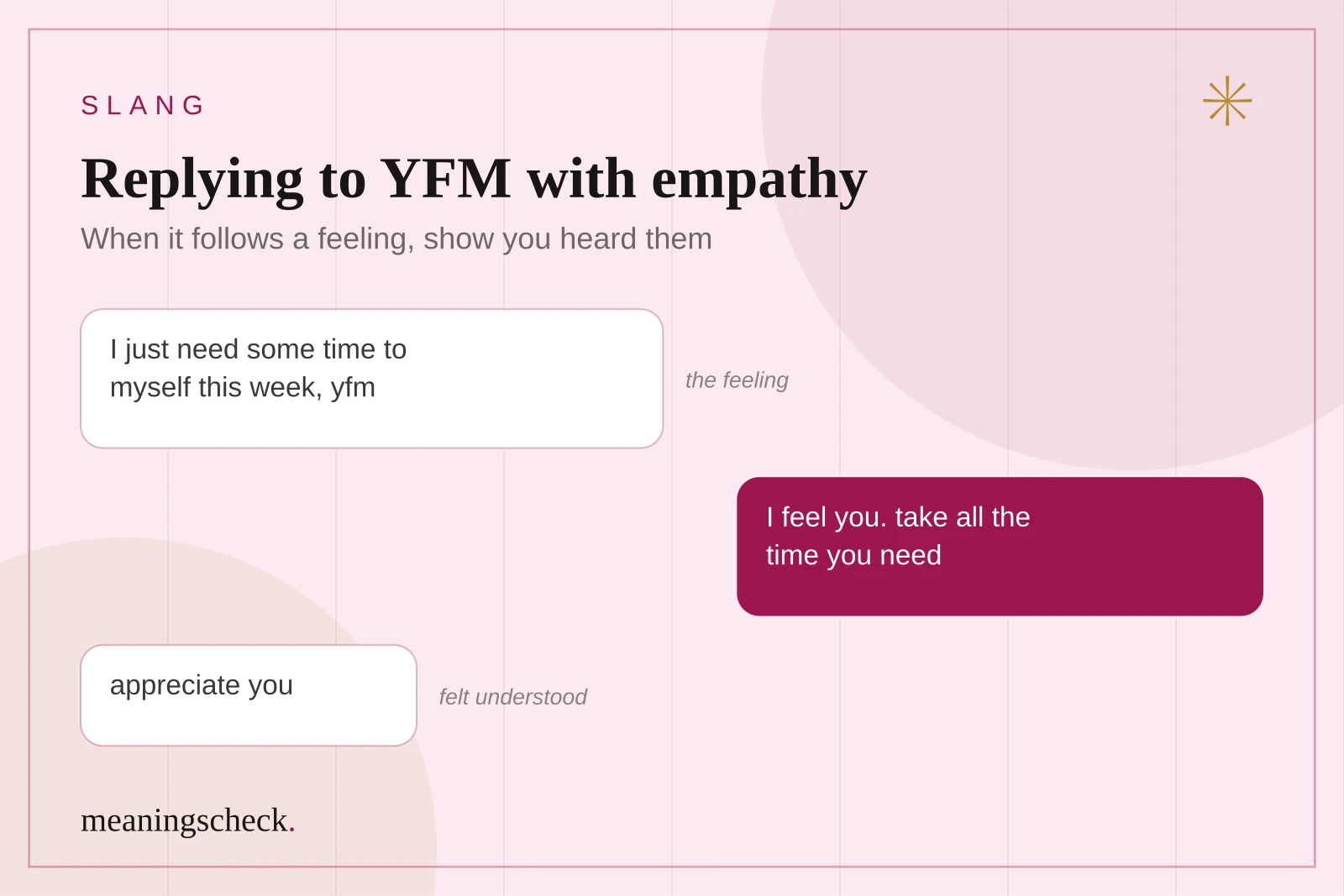
These are the moments to slow down. "I feel you" — or a genuine question about how they're doing — shows you heard them.
Is YFM a Real Question?
Often, no. YFM usually works like "right?" or "you know?" — a little conversational tag that invites agreement without demanding a full answer. That's why many people add it without a question mark: "need a nap yfm."
| Message | What the Sender Wants |
|---|---|
| "...then we split the bill, yfm?" | Confirmation you understood |
| "that song is overrated yfm" | Agreement (or a friendly debate) |
| "I'm just tired of it all, yfm" | Empathy and support |
| "yfm?" (alone, after a long message) | "Did that land? Are you with me?" |
| "YFM??" | Frustrated — they feel unheard |
Key takeaway: Match your reply to the job. Understanding needs "got it." Agreement needs your opinion. Feelings need "I feel you."
YFM Variants and Spellings: Ya Feel Me, Feel Me, and More
The Short Answer: YFM has a few common spellings — "ya feel me," "u feel me," "feel me," and plain "yfm." They all mean the same thing. What changes the tone is punctuation and caps: "yfm" is relaxed, "yfm?" is a real check, and "YFM??" sounds frustrated.
You'll see the phrase written several ways. Each one carries a slightly different feel:
| Spelling | How It Reads | Example |
|---|---|---|
| yfm | Relaxed, almost a verbal shrug | "need a nap yfm" |
| yfm? | A genuine check-in | "we leave at 6, yfm?" |
| YFM | A bit more emphasis | "I'm DONE, YFM" |
| YFM?? | Frustration or feeling unheard | "I've said this three times YFM??" |
| ya feel me | Spoken, playful rhythm | "it's a vibe, ya feel me" |
| u feel me | Quick and casual | "that's just how it is u feel me" |
| feel me? | Short spoken tag | "we good, feel me?" |
What Punctuation Tells You
In texting, punctuation does the job your voice would do out loud. Here's a quick way to read it:
- No punctuation ("yfm") means the sender is chill. They don't expect a big answer.
- One question mark ("yfm?") means they'd like a real response. A thumbs-up or "got it" works.
- Several question marks or all caps ("YFM??") means they feel like you're not hearing them. Slow down and respond with care.
Why People Shorten "You Feel Me"
Texting rewards speed. Three letters do the work of three words, and the abbreviation keeps the rhythm of spoken conversation. It also looks casual on purpose. Typing out "Do you understand what I mean?" can sound stiff or even cold in a text. "yfm" sounds like you're talking with a friend.
Key takeaway: The spelling matters less than the punctuation. Watch the question marks and caps to read the sender's mood.
YFM vs. YKWIM, IYKYK, "Feel Me," and "You Get Me"
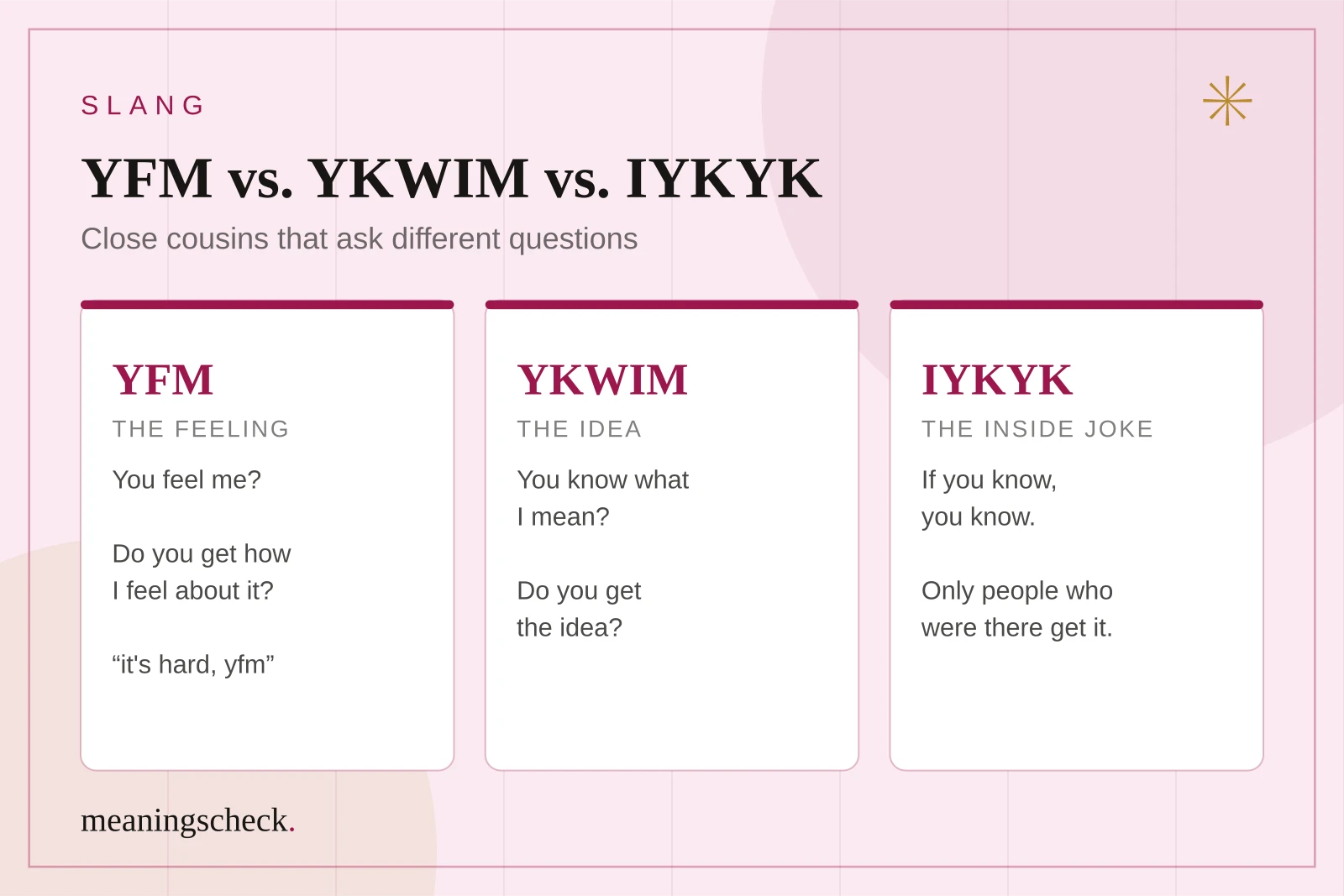
The Short Answer: YFM and YKWIM ("you know what I mean") are near-twins. YFM just leans more emotional. IYKYK ("if you know, you know") is about insider knowledge, not understanding. "You get me?" is the British equivalent you'll hear in London slang.
| Phrase | Meaning | Main Use | Example |
|---|---|---|---|
| YFM | You feel me? | Understanding with emotion | "it's hard, yfm" |
| YKWIM | You know what I mean? | Understanding an idea | "it's complicated, ykwim" |
| IYKYK | If you know, you know | Inside jokes and shared experiences | "that one teacher… iykyk" |
| Feel me? | Short spoken version | Casual agreement | "we good, feel me?" |
| You get me? | British equivalent | Understanding, London slang | "it's long, you get me?" |
| Right? | Classic tag question | Agreement | "it's cold, right?" |
The key difference is emotional weight. YKWIM asks if you understand the idea. YFM asks if you understand the feeling behind it. That's why YFM shows up more often in venting, relationships, and personal stories.
If you want to flag honesty before an opinion instead of checking for agreement after it, people reach for a different tool — "icl," the honesty marker explained in our ICL meaning guide.
YFM on TikTok, Snapchat, Instagram, and X
The Short Answer: On TikTok, YFM shows up in captions and comments that share opinions or relatable feelings. On Snapchat and in texts, it's common in personal conversations and venting. On X, it caps hot takes. Across platforms, it asks the audience to agree or relate.
YFM on TikTok
On TikTok, YFM often appears in captions on relatable content:
- "some days you just need to be alone, yfm"
- "not everyone deserves access to you, yfm?"
It invites viewers to relate. Comment sections often respond with "I feel you" or "this is so real."
YFM on Snapchat and in Texts
In private messages, YFM shows up during real conversations — especially venting:
- "I love them but I need my space, yfm"
- "just tired of being the planner every time, yfm"
These are moments when the sender wants to feel understood.
YFM on Instagram
On Instagram, YFM appears in captions with a reflective or motivational tone: "growth looks quiet sometimes, yfm." It's an invitation to nod along.
YFM on X (Twitter)
On X, YFM caps opinions: "best pizza in the city is the corner spot, yfm." It's a playful nudge toward agreement — or a friendly debate.
| Platform | Typical Use | Example | Usual Job |
|---|---|---|---|
| TikTok | Relatable captions | "some days you need quiet, yfm" | Empathy |
| Snapchat / texts | Venting and personal talk | "I'm drained, yfm" | Empathy |
| Reflective captions | "growth is quiet, yfm" | Agreement | |
| X (Twitter) | Hot takes | "that album is a classic, yfm" | Agreement |
| Group chats | Plans and opinions | "let's keep it low-key, yfm?" | Understanding |
YFM From a Girl or a Guy: Is It Flirty?
The Short Answer: YFM isn't flirty on its own. But when someone uses it while sharing feelings or personal thoughts with you, it shows trust — they want you, specifically, to understand them. That's a sign of closeness.
People sometimes wonder what YFM means from a girl or from a guy they like. The honest answer: YFM is about understanding, not romance.
But understanding is a big deal in relationships. When someone shares something personal and adds "yfm," they're inviting you into their inner world:
- "I don't open up to a lot of people, yfm"
- "I just want something real, yfm?"
Those messages are worth answering thoughtfully. "I feel you — I'm the same way" builds connection. A dry "ok" can shut it down.
Key takeaway: YFM after a personal feeling is a trust signal. Answer it with care.
How to Reply to YFM (With Examples)
The Short Answer: Reply based on what the sender needs. If they explained something, confirm you got it. If they shared an opinion, agree or disagree honestly. If they shared a feeling, show empathy with "I feel you" or a caring question.
When You Understand or Agree
- "I feel you."
- "fr fr"
- "100%."
- "facts."
- "say less" (meaning "I understand completely")
When You Want to Show Empathy
- "I feel you. That sounds exhausting."
- "Totally get it. Want to talk about it?"
- "That's valid. You deserve a break."
When You Don't Agree
You can disagree without killing the vibe:
- "I see what you mean. I liked season 3 more though lol."
- "Kinda? I think it's more complicated."
- "Not sure I feel that one. I hear you, though."
When You Don't Understand
YFM is technically a question. That means it's okay to say no:
- "Not fully — can you explain the second part?"
- "Wait, run that by me again."
Is YFM Professional? Using It at Work
The Short Answer: YFM is too casual for most professional settings. In meetings, emails, or client chats, use "Does that make sense?" or "Do you see what I mean?" instead. It can work in very relaxed team chats with close coworkers.
YFM is friendly. It's also informal. In a meeting with a manager or in an email to a client, it can sound out of place.
| Casual | Professional Alternative |
|---|---|
| "We ship Friday, then review Monday, yfm?" | "We'll ship Friday and review Monday. Does that work?" |
| "The budget's too tight, yfm" | "I'm concerned the budget may be too tight." |
| "I need more time on this, yfm?" | "Could I have a few more days on this?" |
| "That plan won't scale, yfm" | "Do you see the scaling risk I'm seeing?" |
One more tip: in professional settings, "Does that make sense?" can sometimes sound like you're doubting the listener. "Let me know if anything's unclear" puts the responsibility on you instead.
Other Meanings of YFM
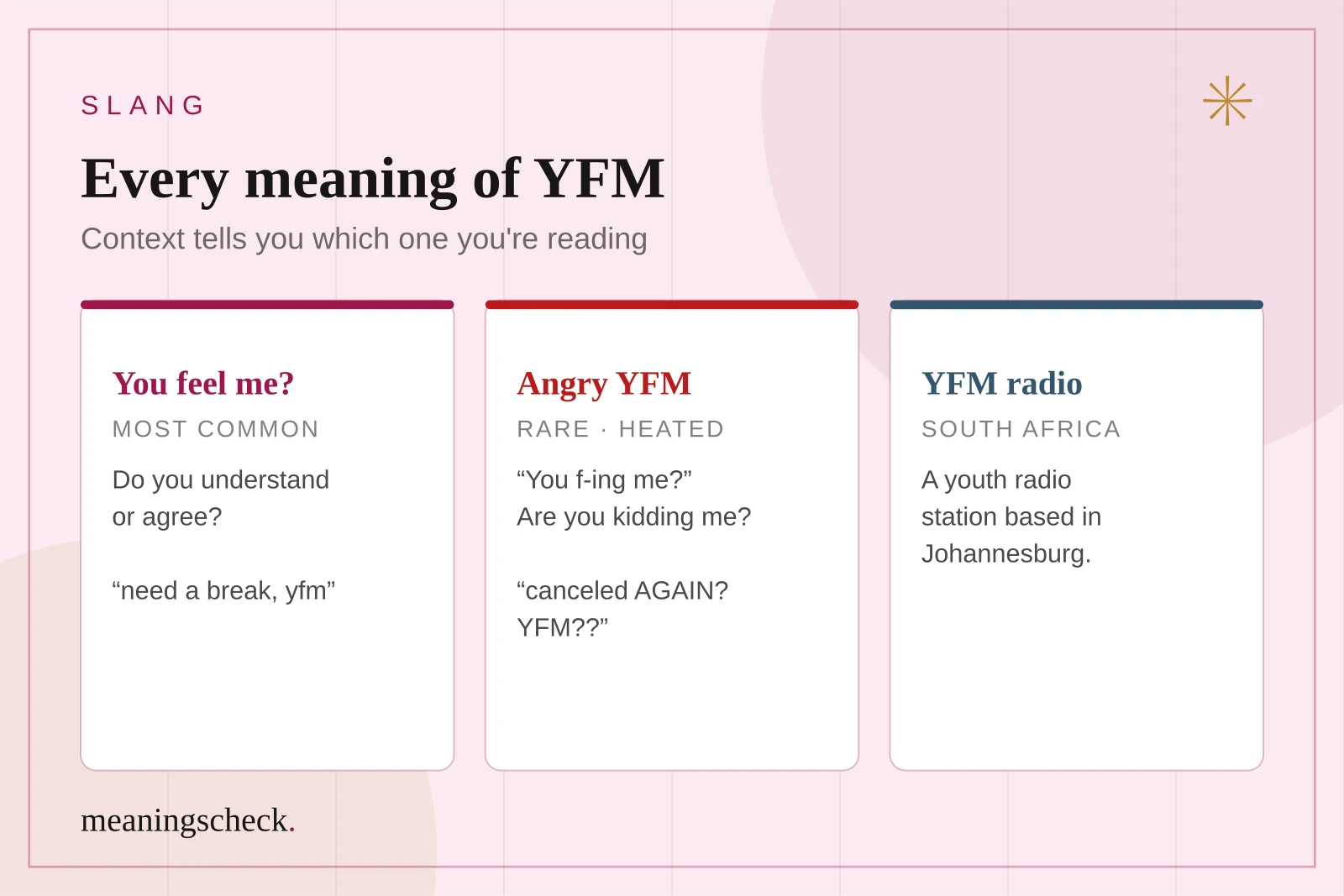
The Short Answer: Almost always, YFM means "you feel me?" Rarely, in angry messages, it stands for "you f***ing me?" — an exasperated "are you kidding me?" Outside slang, YFM is also the name of a youth radio station in Johannesburg, South Africa.
The Rare Angry Meaning
A few sources list YFM as "you f***ing me?" — as in "are you kidding me?" or "you're messing with me." It's uncommon, and context makes it easy to spot:
- "You canceled AGAIN? yfm?" → angry disbelief.
- "I need a break, yfm" → "you feel me?"
If YFM follows something frustrating and comes with all caps or multiple question marks, it might be the angry version. Otherwise, read it as "you feel me?" Exasperated disbelief has its own more common shorthand, too — the blunt reality check behind the BFFR meaning.
YFM the Radio Station
In South Africa, YFM is a well-known youth radio station based in Johannesburg. If YFM appears next to "radio," "DJ," "station," or "Gauteng," that's the meaning.
| Context | YFM Means | Example |
|---|---|---|
| Texting and social media | You feel me? | "need a break, yfm" |
| Angry messages (rare) | You f***ing me? | "you canceled AGAIN? yfm?" |
| South African media | A youth radio station | "I heard it on YFM." |
Expert Insights: Why We Ask "You Feel Me?"
The Short Answer: YFM is a "tag question" — like "right?" or "innit?" — that invites agreement and keeps a conversation collaborative. It reflects a deep human need to feel understood, which research links to closer, more satisfying relationships.
YFM Is a Tag Question
Linguists call phrases like "right?", "you know?", "isn't it?", and "innit?" tag questions — little questions attached to the end of a statement. They rarely ask for new information. Instead, they invite the listener in.
YFM is a modern tag question with an emotional twist. "This is hard, right?" asks you to agree. "This is hard, yfm?" asks you to relate.
That's why YFM often doesn't need a full answer. A quick "fr" or "I feel you" completes the exchange, like a nod in a face-to-face conversation.
Feeling Understood Is a Core Need
Psychologists have long studied how much it matters to feel understood. Research on perceived partner responsiveness, associated with psychologist Harry Reis and colleagues, finds that people feel closer and more satisfied in relationships when they believe the other person understands, values, and cares for them.
YFM is a tiny request for exactly that. Each "yfm?" asks, "Do you understand me?" And each "I feel you" answers, "Yes, I do." Over time, those small exchanges add up to trust.
The Rhetorical Nudge
Here's a counterintuitive insight: YFM can make disagreement slightly harder. Ending a statement with "yfm?" frames it as something any reasonable person would feel — so disagreeing can feel like breaking the vibe.
That's not manipulative most of the time. It's just how tag questions work. But it's worth knowing that you're allowed to say "I hear you. I just see it differently." A good friend will respect that.
Honesty, Oaths, and Agreement
YFM belongs to a broader family of conversation tools. Some phrases share honesty ("icl"). Some swear to it — like the oath slang behind the ONB meaning. Some soften a statement — like the quiet hedge of the LWK meaning. YFM does something different: it checks for connection after you've spoken.
Credit Where It's Due
Much of today's most popular slang — including "you feel me?" — comes from Black American English. As phrases spread across the internet, their origins often get lost. Knowing where YFM comes from doesn't mean you can't use it. It means using it with awareness and respect for the culture that created it.
Real-World Patterns of YFM
- Venting messages: "I'm just drained, yfm" is one of the most common YFM patterns in personal chats.
- Relatable captions: TikTok and Instagram captions use YFM to invite viewers to relate.
- Instruction checks: Group plans and how-to messages end with "yfm?" to confirm everyone's on the same page.
- Hot takes: X posts use YFM to dare readers to disagree.
Real-World Examples: YFM in Everyday Conversations
The Short Answer: In real life, YFM shows up when people vent, set boundaries, explain plans, share opinions, or open up in relationships. Each situation calls for a slightly different reply. The examples below show what the sender means and how to answer well.
These are typical patterns, not quotes from real people. They show how YFM works in context.
Venting After a Long Day
Message: "work was a lot today, I just want to lie down and not talk to anyone, yfm"
What it means: "I'm drained. Please understand that I need quiet."
Good reply: "I feel you. Rest up. I'll text you tomorrow."
Notice the reply doesn't try to fix anything. It just shows understanding and gives space.
Setting a Boundary
Message: "I love hanging out but I can't do every weekend anymore, yfm?"
What it means: "This isn't about you. I need more balance."
Good reply: "Totally get it. Let's do every other weekend?"
Here the "yfm?" softens a boundary. Respecting it — and suggesting a middle ground — builds trust.
Explaining a Plan
Message: "we park at the north lot, walk in through gate B, then meet by the merch stand, yfm?"
What it means: "Does everyone understand the plan?"
Good reply: "Got it. North lot, gate B, merch stand."
Repeating the key details back is the clearest way to confirm.
Sharing a Hot Take
Message: "the book was way better than the movie, yfm"
What it means: "Agree with me — or argue with me."
Good reply: "Facts" — or "Hard disagree, the movie fixed the ending lol."
Either answer works. Opinions plus YFM are invitations to talk.
Opening Up in a Relationship
Message: "I'm not great at saying this stuff. I really like where this is going though, yfm?"
What it means: "I'm being vulnerable. Do you feel the same?"
Good reply: "I feel you. I like where this is going too."
This is where YFM matters most. A warm, honest reply means a lot here.
| Situation | What YFM Asks | Best Reply Style |
|---|---|---|
| Venting | "Understand my mood" | Empathy plus space |
| Boundary | "Respect my need" | Acceptance plus a middle ground |
| Plan | "Confirm the details" | Repeat the key points |
| Hot take | "Agree or debate" | Your honest opinion |
| Opening up | "Do you feel the same?" | Warm, honest answer |
YFM in Group Chats
The Short Answer: In group chats, YFM checks that everyone understands a plan or agrees with an opinion. One "yfm?" often draws a quick round of "fr" and "facts" — or a lively debate.
Group chats use YFM for coordination and opinions:
- "Let's keep it cheap this time, yfm?"
- "We leave at 6 sharp, yfm?"
- "The first movie is still the best, yfm"
For plans, YFM is a polite way to confirm everyone's on board. For opinions, it starts conversations. Expect replies like "fr," "facts," or "nah, the sequel clears."
A useful habit: if your "yfm?" is about a plan, ask for a clear response. "Thumbs up if you're in" turns a vague nod into a real commitment — much like turning a hedged "or smth" into an actual plan, a pattern explained in our SMTH meaning guide.
How to Use YFM Correctly: A Quick Style Guide
The Short Answer: Put YFM at the end of a statement, use it with people you're comfortable with, keep it out of formal writing, and genuinely listen to the reply — especially when it follows a feeling.
- Put it at the end. "I need a break, yfm?" reads naturally.
- Use it for real connection. It works best after opinions and feelings.
- Don't overuse it. Ending every message with yfm gets repetitive.
- Skip it at work. Use "Does that make sense?" instead.
- Listen to the answer. If someone says "not really," take it seriously.
| Do | Don't |
|---|---|
| "I'm just tired lately, yfm" | "yfm" after every single text |
| "We meet at 7, yfm?" | "yfm" in an email to a client |
| "I feel you" (as a reply) | Ignoring a "yfm" after someone opens up |
| "Does that make sense?" (at work) | Using it to pressure someone into agreeing |
YFM for Parents and Teachers
The Short Answer: If a teen texts "yfm," there's nothing to worry about. It simply means "you feel me?" — they're checking that you understand. Pay attention when it follows a feeling. That's often a teen trying to explain something that matters to them.
Parents sometimes see "yfm" in a child's messages and wonder if it's code for something risky. It isn't. It's an everyday phrase for "do you understand me?"
What's worth noticing is when it shows up. A teen who writes "I just feel left out at school, yfm" is telling you something real. A short "I hear you. Want to talk about it?" can open a much bigger conversation.
Teachers will hear the spoken version, "you feel me?", in class discussions too. It's usually a student checking that their point landed. Treating it as a genuine question — "Yes, and here's what I think" — keeps the discussion going.
Common Mistakes People Make With YFM
The Short Answer: The most common YFM mistakes are taking it too literally, ignoring an emotional "yfm," using it in professional settings, and confusing it with IYKYK or the rare angry meaning.
- Reading "feel" literally. It means understand, not touch.
- Ignoring the emotion. A "yfm" after venting deserves more than "lol."
- Using it at work. It reads as too casual.
- Confusing it with IYKYK. IYKYK is about insider knowledge, not empathy.
- Missing the angry version. In heated messages with all caps, it might mean something harsher.
Frequently Asked Questions (FAQs)
What does YFM mean in text?
YFM means "you feel me?" — a casual way to ask "do you understand?" or "do you agree?" It usually follows an opinion, explanation, or feeling, like "I need a break, yfm?"
What does "I feel you" mean?
"I feel you" means "I understand" or "I relate to what you're saying." It's one of the most common replies to YFM.
Is YFM rude?
No. YFM is friendly and casual. It's only out of place in formal settings, like work emails, where "Does that make sense?" sounds more professional.
What's the difference between YFM and YKWIM?
Both ask if you understand. YKWIM ("you know what I mean") is about understanding an idea. YFM ("you feel me") leans more emotional — understanding a feeling.
Where does "you feel me" come from?
"You feel me?" comes from Black American English and hip-hop culture, where it has long been used to check that a listener understands. The abbreviation YFM spread with texting.
How do you reply to YFM?
Match what they need. Confirm understanding ("got it"), share your opinion ("facts" or "I see it differently"), or show empathy ("I feel you, that sounds hard").
Can YFM mean something rude?
Rarely. In angry messages, a few people use it for "you f***ing me?" — an exasperated "are you kidding me?" Context, like all caps or frustration, makes that clear.
What does YFM mean from a girl or a guy?
It means the same thing from anyone — "you feel me?" If they use it while sharing something personal with you, it's a sign of trust.
Is YFM a question?
Technically, yes. In practice, it's often rhetorical — like "right?" or "you know?" A short reply like "fr" or "I feel you" usually completes the exchange.
What does "ya feel me" mean?
"Ya feel me" is a spoken-style spelling of "you feel me?" It means the same thing: "do you understand?" or "do you agree?"
What does "felt" mean in a comment?
"Felt" in a comment means "I relate to this." It comes from the same use of "feel" as YFM — understanding something on an emotional level.
What's the British version of YFM?
In London slang, "you get me?" does the same job. You'll also hear "innit?" used as a tag question to invite agreement.
Should I use YFM in an email?
Not in a professional email. Use "Does that make sense?" or "Let me know if you have questions" instead. Save YFM for friends and casual chats.
Final Thoughts
YFM is three letters that ask a very human question: "Are you with me?" It checks understanding, invites agreement, and — most importantly — asks to be understood.
It also carries history. From the jazz-era "dig?" to "you know what I'm saying?" to "you feel me?", every generation has found its own way to reach across a conversation. YFM is simply the texting-era version, rooted in Black American speech and now shared across the internet.
So the next time someone ends a message with "yfm," take a second to really answer. Sometimes it's just a nod. Sometimes it's someone hoping you'll say, "I feel you." For more slang decoded the same way, explore our internet slang guides.
Related terms
Share: · Post on X
Written by MeaningsCheck Team · Published
The MeaningsCheck team researches and writes plain-language explanations of slang, abbreviations, and everyday words — checked for accuracy, updated as language changes.