
What Does TMI Mean? TMI Meaning in Text, Oversharing, and How to Respond (2026)
TMI stands for "too much information" — a reaction to someone sharing details that are too personal, gross, or unnecessary. People also use it as a warning before oversharing, as in "TMI, but I haven't slept in two days."
TMI means "too much information." It's what you say when someone shares more than you wanted to know — a gross detail, a private story, or a medical update you didn't ask for. It's also a warning label people put on their own overshares: "TMI, but I haven't showered in two days."
Simple enough. But TMI is more interesting than it looks.
Depending on who says it and how, TMI can be playful teasing, a polite boundary, or a self-aware joke. And in Korean pop culture, "TMI" means something surprisingly different — harmless fun facts that fans actively want to hear. So if you're asking what does TMI mean, the context matters.
This guide covers the TMI meaning in text, the two very different ways people use it, what counts as "too much," where the phrase came from, the K-pop meaning of TMI, how to respond to an overshare kindly, and what TMI means outside slang.
Key takeaway: TMI flags an overshare. Said to someone else, it's a gentle "that's a lot." Said about yourself, it's a heads-up before you share something personal.
Executive Summary: TMI at a Glance
Here's everything you need in thirty seconds:
- Definition: TMI stands for "too much information."
- Two uses: A reaction ("ok, TMI 😭") or a warning label ("tmi but I'm so sick today").
- What triggers it: Body and health details, romantic specifics, money, family drama, and gross stories.
- Origin: The phrase spread in 1990s American speech. The abbreviation appeared on Urban Dictionary by 2002 and was already in the Oxford English Dictionary by 2011.
- K-pop twist: In Korean slang, TMI means harmless trivia — idols share "TMIs" like what they ate for breakfast.
- Tone: Usually playful. Said coldly, it can feel like a shutdown.
What Does TMI Mean? The Core Definition
The Short Answer: TMI stands for "too much information." People say it when someone shares details that are too personal, too gross, or simply unnecessary — and they use it on themselves as a warning before oversharing.
The Literal Translation
The TMI meaning in slang is a direct abbreviation of "too much information." It's an initialism. People say it letter by letter: "T-M-I."
Unlike a lot of slang, TMI is just as common out loud as it is in texts. "Okay, TMI!" is something you'll hear at the dinner table, in the office kitchen, and on reality TV.
At its heart, TMI is about boundaries. Every conversation has an invisible line between what's normal to share and what's private. TMI is the word for crossing that line.
Two Ways People Use TMI
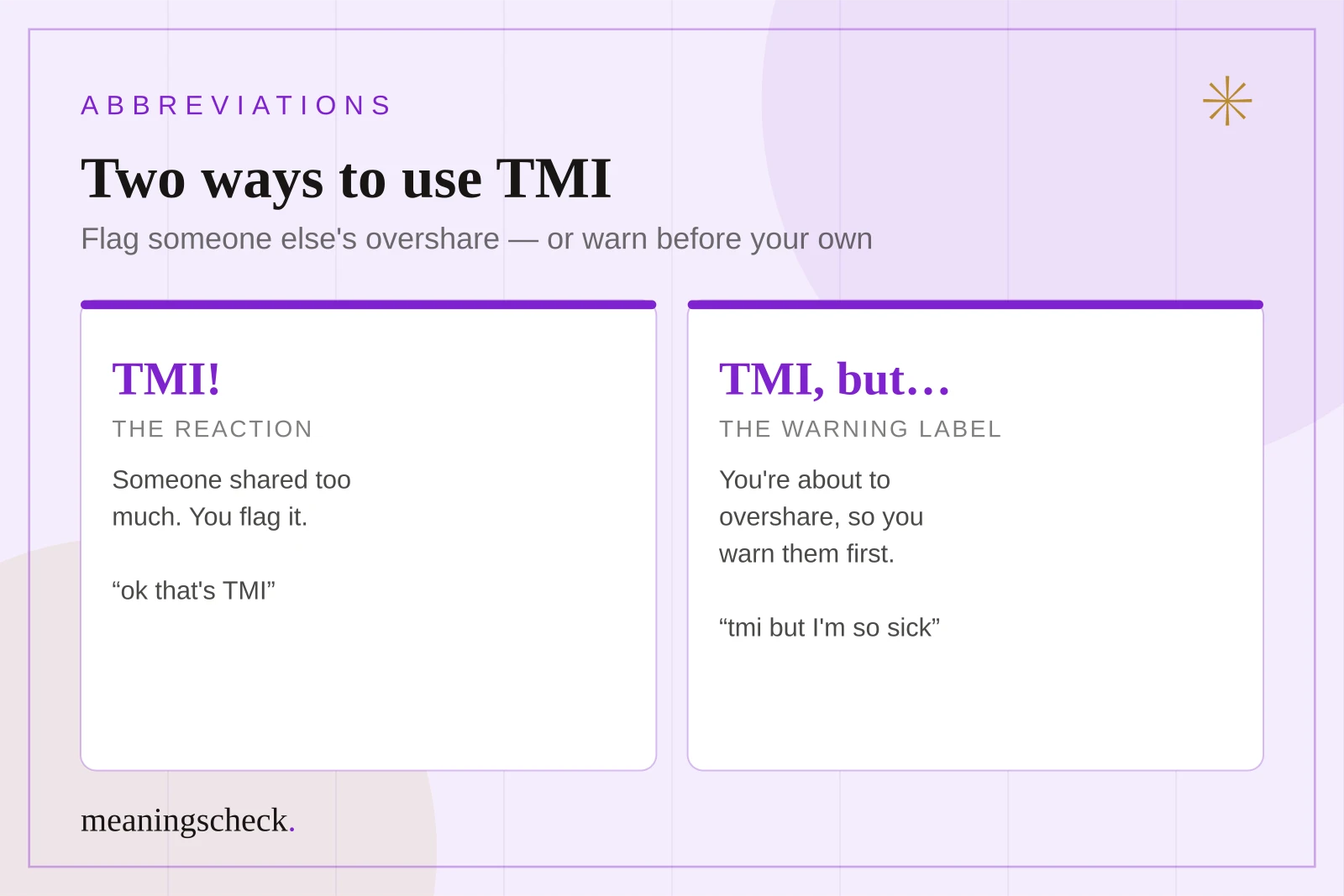
Here's the part most explanations miss: TMI works in two opposite directions.
| Use | Who Says It | Example | What It Means |
|---|---|---|---|
| The reaction | The listener | "Okay, TMI 😭" | "You've shared more than I needed to know." |
| The warning label | The sharer | "TMI, but I haven't slept in two days." | "Heads up — personal detail incoming." |
| The check-in | The sharer | "Is that TMI?" | "Did I overshare just now?" |
The reaction is the classic use. Someone describes their stomach bug in detail, and a friend replies "TMI!"
The warning label is just as common now. People open with "tmi but…" to signal that a personal detail is coming. It's a polite way to overshare — you're giving the listener fair warning.
What Counts as "Too Much"?
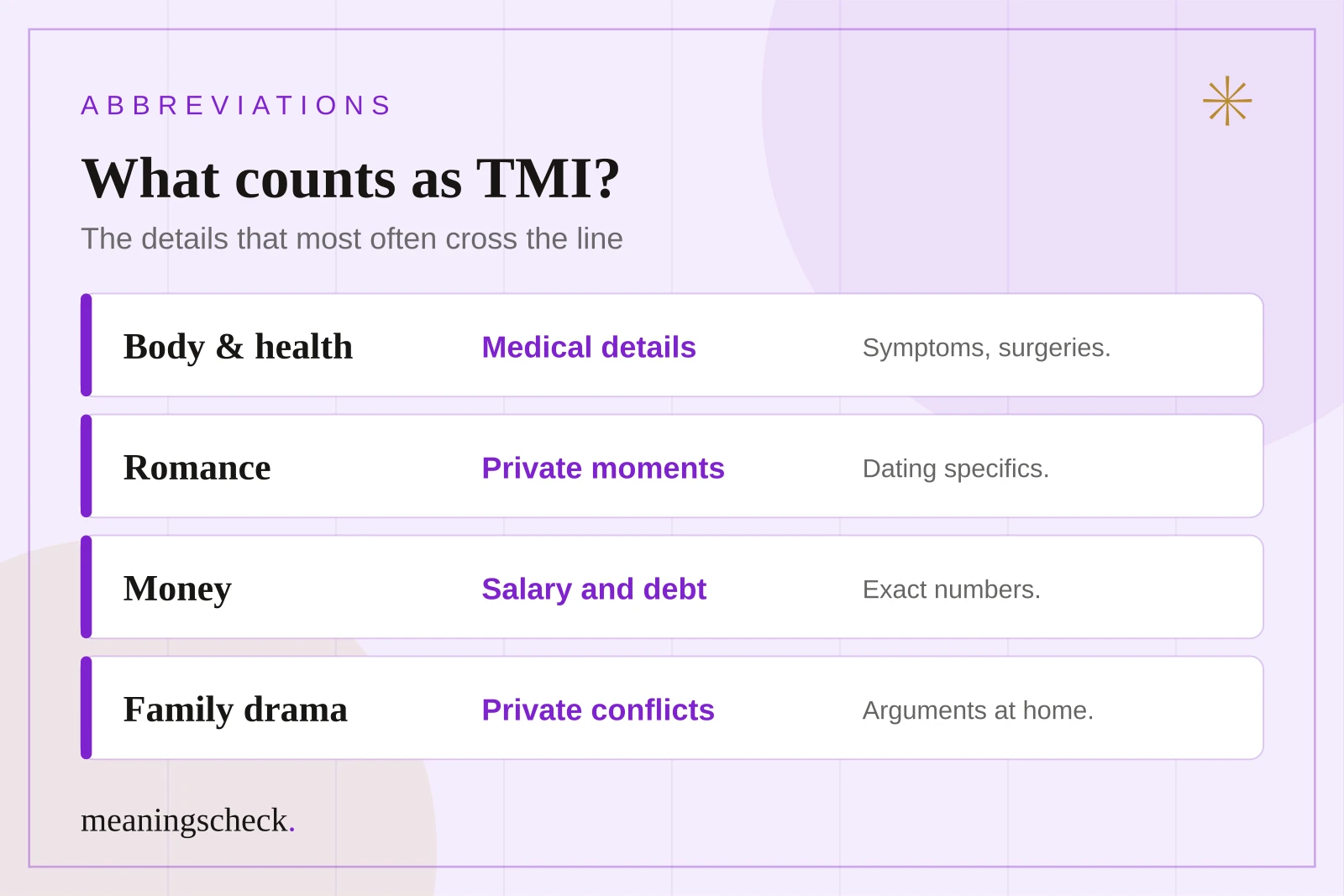
There's no official list. Still, most TMI moments fall into a few categories:
| Category | Examples | Why It Feels Like TMI |
|---|---|---|
| Body and health | Symptoms, bathroom details, surgery recovery | Graphic or private |
| Romance and intimacy | Specifics about dates or relationships | Too personal for the audience |
| Money | Exact salary, debt, what someone earns | Socially sensitive |
| Family drama | Private arguments, relatives' secrets | Puts listeners in an awkward spot |
| Gross stories | Food mishaps, pet accidents, injuries | Hard to "unhear" |
Context changes everything. A health detail that's TMI at work might be completely normal with your best friend. The same story can be perfectly fine in one room and way too much in another.
Timing matters as well. A gross story right before dinner lands differently than the same story an hour later. Part of avoiding TMI is simply picking the right moment.
Where TMI Came From
"Too much information" spread through American speech in the 1990s. Online forum discussions from the early 2000s recall hearing it on TV — sketch comedy and sitcoms — where it worked as a quick punchline after an awkward overshare.
You'll sometimes see a claim that the abbreviation was first used in 1988. Know Your Meme notes, however, that the claim is uncited. What's better documented:
- 2002: Urban Dictionary published an early definition of TMI as "way more than you need/want to know about someone."
- 2007: NetLingo listed TMI as text-message shorthand.
- 2011: When the Oxford English Dictionary added LOL and OMG, NPR noted that TMI was already in the dictionary.
From there, social media took over. Celebrities tweeted "#TMI" alongside personal updates. The abbreviation soon became one of the most recognizable texting abbreviations in English.
Timeline: How TMI Went Mainstream
| Era | What Happened | Why It Matters |
|---|---|---|
| 1990s | "Too much information" spreads in American speech and TV comedy. | The phrase becomes a common reaction to oversharing. |
| 2002 | Urban Dictionary publishes an early TMI definition. | The abbreviation is documented online. |
| 2007 | NetLingo lists TMI as text-message shorthand. | TMI becomes standard texting slang. |
| By 2011 | TMI is already in the Oxford English Dictionary (per NPR). | Formal dictionaries recognize it. |
| 2010s | Celebrities use #TMI on Twitter. | The abbreviation goes fully mainstream. |
| Today | TMI is everyday slang — and a K-pop staple with its own meaning. | It's global, with regional twists. |
TMI Meaning in Text: How to Read It
The Short Answer: In a text, "TMI" alone is a reaction to an overshare. "TMI but…" at the start of a message is a warning label. "Is that TMI?" is a check-in. Emojis and tone tell you whether it's playful or genuinely uncomfortable.
"TMI" as a Reaction
When someone replies "TMI" to your message, they're saying you shared more than they expected. Most of the time, it's playful:
- "TMI 😭"
- "ok TMI lmao"
- "nooo TMI"
These are teasing, not scolding. The laughing emojis make it clear they're not upset.
A flat "TMI." with a period is different. That can mean the person is genuinely uncomfortable and wants you to stop.
"TMI But…" as a Warning Label
"TMI but" is one of the most common ways to start a personal message:
- "tmi but I've had a migraine all day."
- "tmi but I cried at my desk earlier."
- "tmi but my dog ate my sock and we're at the vet."
This version is considerate. You're acknowledging that what follows is personal. You're also giving the reader a moment to brace. It's a lot like opening with "icl" before an honest confession — a softener explained in our ICL meaning guide.
"Is That TMI?" as a Check-In
Some people ask after they share: "sorry, was that TMI?" It shows social awareness. The best response is usually reassurance — "not at all!" — unless it really was too much.
Reading the Tone
| Message | Likely Tone |
|---|---|
| "TMI 😭" | Playful teasing |
| "ok TMI lmao" | Amused, not bothered |
| "TMI." | Genuinely uncomfortable |
| "tmi but…" | Polite warning before sharing |
| "was that TMI?" | Self-aware check-in |
| "WAY TMI" | Strong reaction — maybe dial it back |
Key takeaway: "TMI" with a laughing emoji is teasing. "TMI." with a period is a boundary. "tmi but" is a courtesy.
TMI on TikTok, Instagram, Snapchat, and X
The Short Answer: On TikTok, TMI shows up in "get ready with me" confessions and storytimes. On Instagram and Snapchat, it labels personal close-friends stories. On X, it tags candid updates — a habit celebrities helped popularize.
TMI on TikTok
TikTok runs on candid, personal content. TMI is everywhere:
- "Get ready with me" (GRWM) videos, where creators chat about their lives while doing makeup: "tmi but my skin has been terrible this week."
- Storytimes that get very detailed, very fast.
- Comment sections, where viewers react: "this is so TMI and I love it."
On TikTok, TMI is often a feature, not a bug. Oversharing creates intimacy with viewers, which is part of the platform's appeal.
That comes with a trade-off. A detail shared with "just my followers" can be stitched, screenshotted, and reshared to millions. Many creators now keep a mental line between relatable TMI — messy rooms, bad hair days — and private TMI they'll never post.
TMI on Instagram and Snapchat
On Instagram, people often save their TMI moments for Close Friends stories — a smaller audience for more personal updates. On Snapchat, "tmi but…" is common in private chats with best friends.
TMI on X (Twitter)
X has a long history with #TMI. Know Your Meme documents celebrities tweeting the hashtag in the 2010s alongside candid updates — proof of how quickly the abbreviation moved from text messages into public social media.
Comparison Table: TMI Across Platforms
| Platform | Typical Use | Example | Tone |
|---|---|---|---|
| TikTok | GRWM and storytimes | "tmi but my skin is breaking out" | Candid, intimate |
| TikTok comments | Reactions | "so TMI and I'm obsessed" | Playful |
| Close Friends stories | "tmi: rough week, staying in" | Personal | |
| Snapchat | Best-friend chats | "tmi but I'm so sick" | Private |
| X (Twitter) | Candid updates | "#TMI" | Self-aware |
TMI in K-pop and Korean Slang
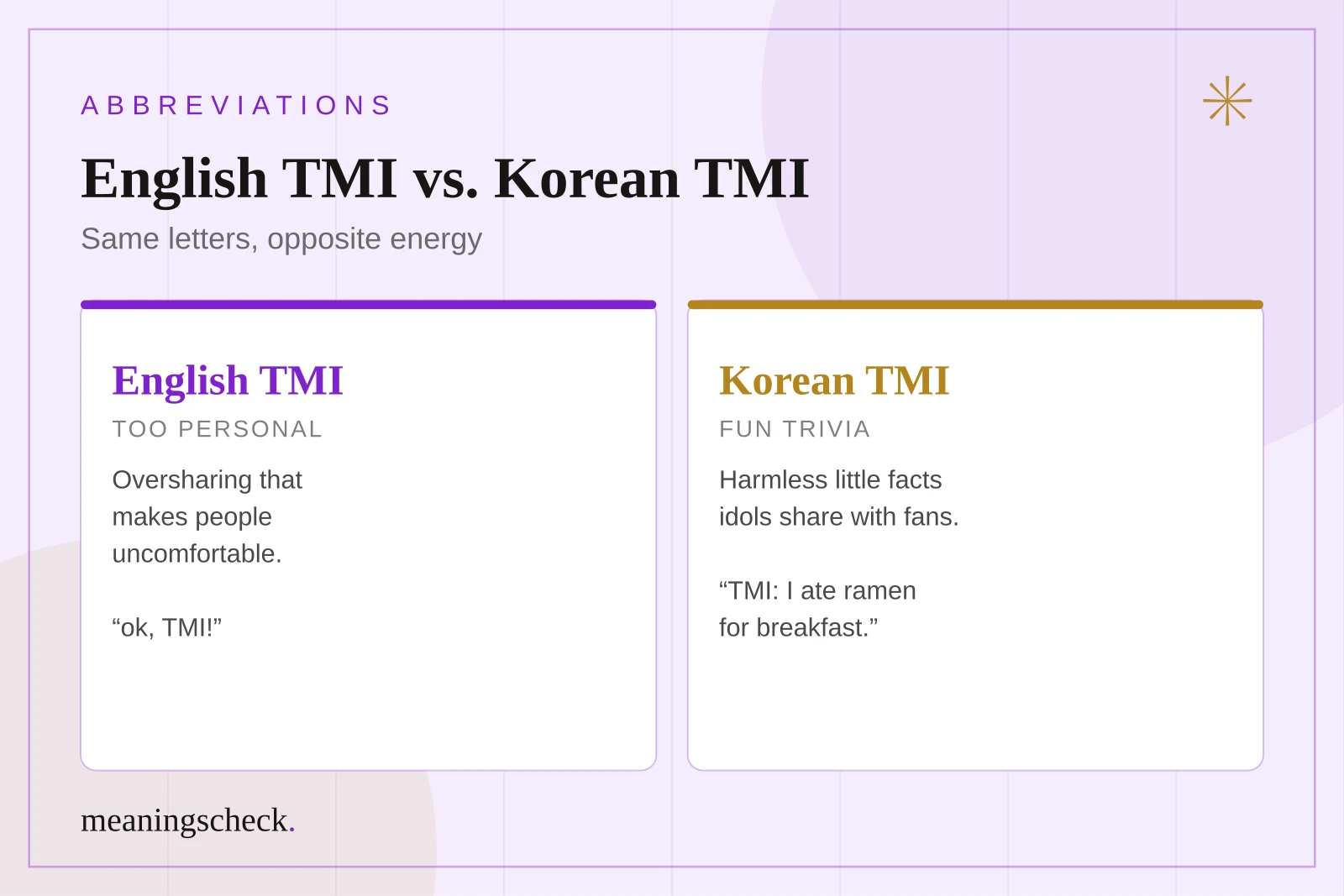
The Short Answer: In Korean slang, TMI usually means harmless, trivial facts rather than embarrassing overshares. K-pop idols share "TMIs" — like what they ate or their favorite snack — and fans love hearing them.
Here's a twist many English speakers don't expect. In Korean internet culture, "TMI" took on a softer, friendlier meaning.
Wiktionary notes that in Korean usage, TMI refers to unnecessary information you don't need to know — and that it isn't taboo the way it can be in English. An allkpop roundup listed TMI among the slang words Koreans used most in 2018, describing it as information that isn't necessarily helpful but that people want to know anyway, especially about their favorite idols.
That's why K-pop fans constantly ask idols for "TMIs." On livestreams, fan meetings, and variety shows, idols share tiny personal facts:
- "TMI: I had ramen for breakfast."
- "TMI: my favorite color changed this year."
- "TMI: I sleep with three pillows."
Soompi has even compiled lists of idols' funniest TMIs. And members of BTS were filmed in 2019 explaining TMI to international audiences as one of several popular Korean slang terms.
| English TMI | Korean / K-pop TMI | |
|---|---|---|
| Meaning | Too personal or gross | Harmless trivia |
| Tone | "Please stop" (often playfully) | "Tell me more!" |
| Who asks for it | Nobody | Fans |
| Example | "Okay, TMI!" | "Idol shares a TMI about their snack habit" |
This difference causes real confusion. An international fan might expect a shocking confession and get "TMI: I like strawberry milk." In Korean usage, that's exactly the point.
TMI in Dating: Too Much, Too Soon?
The Short Answer: In early dating, TMI usually means sharing something heavy too soon — exes, health details, or family drama on a first date. A small "tmi but…" can build trust, while a big overshare can overwhelm someone who barely knows you.
Dating is where TMI gets tricky. You want to be open and authentic. You also don't want to unload your whole life story on a first date.
When a Crush Says "TMI but…"
If someone you're getting to know opens with "tmi but…" and shares something small — they're nervous, they cried at a movie, they're a bit of a mess this week — that's often a trust signal. They're letting you see a less polished side of them.
A warm reply rewards that openness: "honestly that's cute," or "same, don't worry about it."
When You Say Too Much
Everyone overshares sometimes. If you catch yourself mid-TMI on a date, a light "okay, that was a lot for a first date 😂" usually defuses it. Self-awareness is attractive. Spiraling into apologies isn't.
| Usually Fine Early On | Usually TMI Early On |
|---|---|
| Hobbies, jobs, favorite foods | Detailed stories about exes |
| Light, funny embarrassing moments | Graphic health details |
| Family in general terms | Serious family conflicts |
| Hopes and plans | Finances in exact numbers |
Key takeaway: A small "tmi but" builds closeness. A big unprompted overshare can feel like too much, too soon.
TMI in Family Group Chats
The Short Answer: Family group chats are TMI hotspots — parents sharing medical updates, relatives posting private drama, and teens replying "TMI MOM." Different generations often have very different ideas about what's okay to share.
If you're in a family group chat, you've probably seen it: a detailed update about someone's colonoscopy, a long rant about a cousin, or a photo nobody needed to see.
Generational norms play a big role. Many older relatives grew up sharing health updates openly with family. Younger people often see those same updates as TMI — especially in a group chat with twenty members.
A few tips for peaceful family chats:
- Use private messages for personal details. Not everything needs the whole family.
- Lead with the headline. "Surgery went well!" is perfect. The full medical report can stay offline.
- Teens: be kind. "TMI mom 😭" works as teasing. A cold "TMI." can hurt a parent who was just excited to share.
How to Respond to TMI
The Short Answer: If a friend overshares, a light "lol TMI" or a gentle subject change works. If it's genuinely too much, set a kind boundary. And if someone tells you "TMI," don't panic — a quick "haha sorry" is all you need.
When a Friend Overshares
Most overshares are harmless. A light touch keeps the friendship easy:
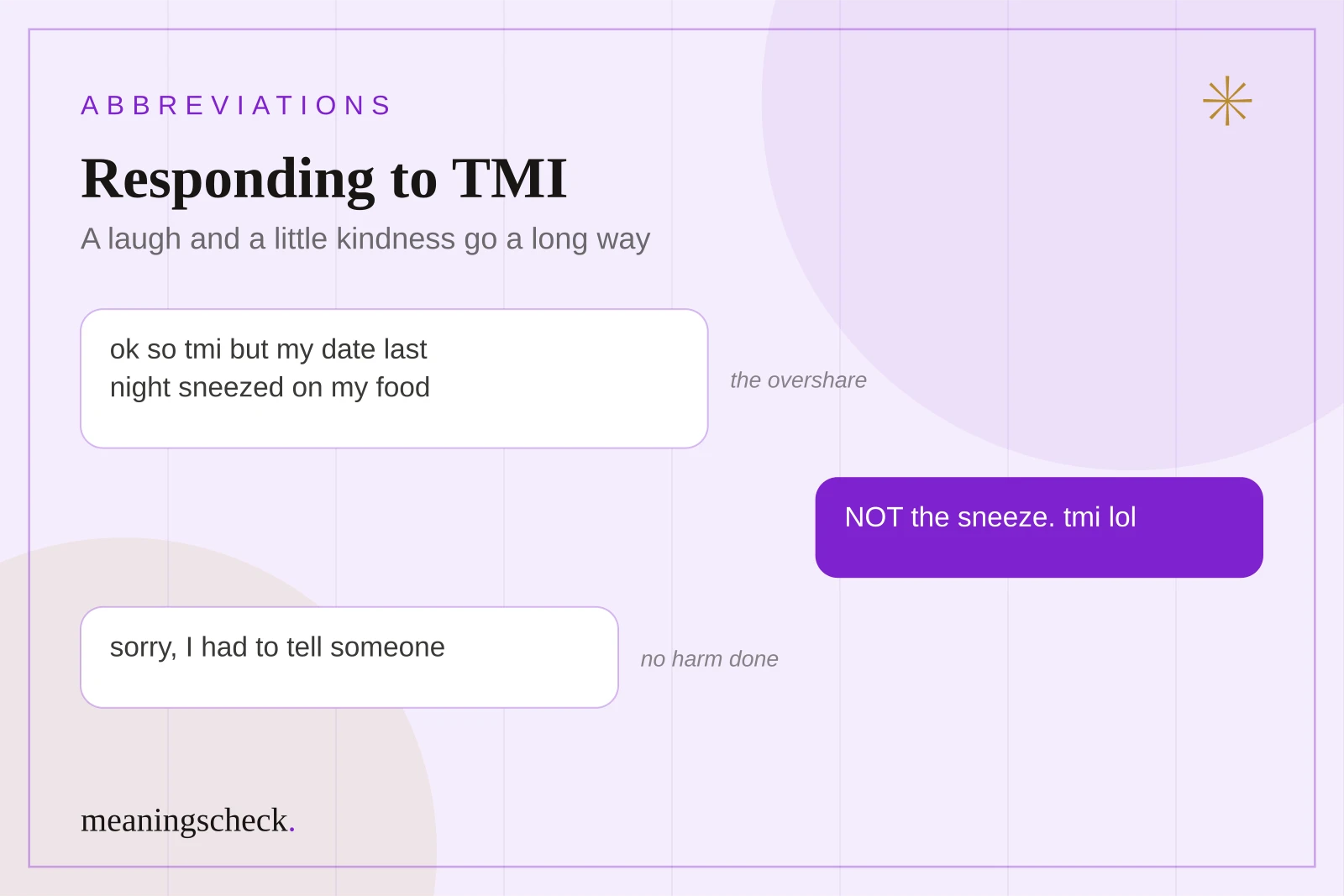
- "lol TMI but I hope you feel better!"
- "ok that's a lot 😭 but are you okay?"
- "TMI but valid."
Notice the pattern: acknowledge it with humor, then show you care about the person.
When It's Genuinely Too Much
Sometimes oversharing makes you truly uncomfortable — especially with graphic details, or with coworkers and acquaintances. You can set a boundary without being harsh:
- "I'm glad you're feeling better! That's a bit more detail than I need, though 😅"
- "Let's maybe save that one for your doctor lol."
- "Okay, changing the subject — how was the weekend?"
When Someone Says "TMI" to You
Don't overthink it. Most people say TMI with a smile. A quick acknowledgment is enough:
- "haha sorry"
- "fair, fair 😂"
- "noted, TMI quota reached"
If they seemed genuinely uncomfortable, a short apology and a subject change show respect.
And don't let one TMI moment make you stop sharing altogether. Being open is how friendships deepen. The goal isn't to share less — it's to share the right things with the right people.
Venting vs. "Trauma Dumping"
There's an important difference between sharing something hard and overwhelming someone. Online, people use the term "trauma dumping" for unloading heavy personal pain on someone without checking if they have the capacity to hear it.
The fix is simple: ask first. "Can I vent for a sec?" or "Do you have the energy for something heavy?" turns an overshare into a conversation the other person agreed to.
TMI vs. Oversharing, Trauma Dumping, FYI, and NSFW
The Short Answer: TMI is the reaction to oversharing. "Trauma dumping" is a heavier kind of oversharing. FYI is information someone actually needs. NSFW warns about explicit content. They overlap. Each one still describes something different.
TMI lives in a neighborhood of related terms. Here's how they compare:
| Term | Meaning | When It Fits |
|---|---|---|
| TMI | Too much information | A personal detail went too far |
| Oversharing | Revealing more than fits the setting | The behavior TMI reacts to |
| Trauma dumping | Unloading heavy pain without checking in | Serious emotional overload |
| FYI | For your information | Useful info someone should know |
| NSFW | Not safe for work | Explicit or graphic content |
| TLDR | Too long; didn't read | A message is simply too long |
The interesting contrast is FYI vs. TMI. Both are about sharing information. FYI says "you'll want to know this." TMI says "I really didn't need to know that."
When an overshare crosses from awkward into explicit, it's no longer just TMI — it's the kind of content the NSFW meaning warning exists for.
Is TMI Rude? Workplace and Polite Alternatives
The Short Answer: Saying "TMI" is usually friendly, not rude. It can sting if said coldly or in front of others. At work, both oversharing and blunt "TMI!" reactions can feel awkward. Softer phrasing works better.
TMI itself isn't rude. It's one of the gentlest ways to signal a boundary. But context matters.
In a group setting, a loud "TMI!" can embarrass the person who shared. In a work setting, oversharing and calling it out can both create awkwardness — especially around health details, which many people consider private.
| Situation | Instead of… | Try… |
|---|---|---|
| Coworker overshares health details | "TMI!" | "I hope you're feeling better soon." |
| You're about to share something personal at work | "TMI, but…" | "Quick personal note — I'll be out Friday for an appointment." |
| A meeting drifts into personal territory | "Way TMI." | "Let's get back to the agenda." |
| A manager overshares | "Lol TMI" | A neutral "Thanks for letting us know." |
A good workplace rule of thumb: share the outcome, not the details. "I'm out for a medical appointment" is enough. Nobody needs the diagnosis.
Expert Insights: The Psychology of Oversharing
The Short Answer: Sharing personal details builds closeness — but only when it happens gradually and both people take turns. TMI moments usually happen when someone skips steps, shares too much too soon, or shares with the wrong audience.
Self-Disclosure Builds Closeness
Psychologists have long studied how sharing personal information affects relationships. Social penetration theory, developed by Irwin Altman and Dalmas Taylor in 1973, describes relationships deepening in layers: people start with surface-level details and gradually share more personal ones.
The key words are gradually and mutually. Closeness grows when both people take turns opening up, a little at a time.
Why TMI Happens: Skipping Steps
Through that lens, a TMI moment is often a sequencing problem. Someone jumps several layers ahead — sharing deeply personal information with a coworker they've met twice, or on a first date.
The information itself might be perfectly fine between close friends. The problem is timing and audience. That's why the same story can be charming with your best friend and TMI with a stranger.
Why People Overshare Online
Online spaces make oversharing even more common. Psychologist John Suler described the online disinhibition effect in 2004: behind a screen, people feel less restrained and share things they'd never say face to face.
A TikTok might also reach thousands of strangers. That's a recipe for TMI. Something that feels like a chat with friends is actually a public broadcast. That's also why it's smart to protect private details online — including where you live, a lesson covered in our guide to the WYF meaning.
Oversharing as Connection
Here's a counterintuitive insight: a little TMI can actually help. Admitting something slightly embarrassing signals trust and authenticity. That's why "tmi but…" posts often get warm responses. Viewers feel let in.
The trick is calibration. A small, relatable overshare builds connection. A graphic or heavy one, dropped without warning, pushes people away.
The Spotlight Effect: Your TMI Moment Is Smaller Than You Think
Ever replay an overshare in your head for days? Psychology has good news. In a well-known 2000 study, Thomas Gilovich and colleagues described the spotlight effect: people consistently overestimate how much others notice and remember their behavior.
In other words, the TMI moment you can't stop thinking about probably faded from everyone else's memory quickly. A quick "haha sorry, TMI" and moving on is almost always enough.
Cultural Differences
The Korean meaning of TMI shows how much culture shapes what counts as "too much." In K-pop fandom, small personal facts are a gift. In many English-speaking workplaces, the same facts might feel oddly personal. Neither is wrong — they're different norms about sharing.
Real-World Examples of TMI
- Know Your Meme documents celebrity #TMI tweets in the 2010s, from candid updates to bathroom jokes.
- NPR's 2011 coverage of the OED adding LOL and OMG noted that TMI was already in the dictionary.
- Soompi and allkpop chronicle K-pop idols' favorite TMIs, showing the Korean, trivia-style meaning in action.
Other Meanings of TMI
The Short Answer: Outside slang, TMI is famously associated with Three Mile Island, the Pennsylvania nuclear plant where a partial meltdown occurred in 1979. "Too Much Information" is also the title of songs by The Police (1981) and Duran Duran (1993).
Three Mile Island
In energy and history contexts, TMI stands for Three Mile Island, a nuclear power plant near Harrisburg, Pennsylvania. In March 1979, one of its reactors suffered a partial meltdown — the most serious accident in U.S. commercial nuclear power history. The accident reshaped how the United States regulates nuclear power, and "TMI" remains shorthand for it in engineering and policy circles. If TMI appears next to "nuclear," "reactor," or "1979," that's the meaning.
Songs Called "Too Much Information"
Music fans may know "Too Much Information" as a song by The Police from the 1981 album Ghost in the Machine, and as a 1993 single by Duran Duran. Both use the phrase in its everyday sense: a world overloaded with information.
Information Overload
In media and psychology, "too much information" also describes information overload — the stress of processing more news, notifications, and data than we can handle. It's a cousin of the slang meaning: same words, bigger scale.
| Context | TMI Means | Example |
|---|---|---|
| Texting and social media | Too much information (oversharing) | "ok TMI 😭" |
| K-pop and Korean slang | Harmless personal trivia | "TMI: I love strawberry milk" |
| Energy and history | Three Mile Island | "The TMI accident happened in 1979." |
| Music | Song titles | The Police (1981), Duran Duran (1993) |
| Media studies | Information overload | "We're drowning in too much information." |
How to Share Personal Things Without It Becoming TMI
The Short Answer: Lead with the headline, match the details to your audience, ask before going deep, and use a "tmi but" when you're unsure. Short, honest updates rarely feel like TMI — long, graphic ones often do.
Being open is good. Here's how to share personal things without making people squirm:
- Lead with the headline. "I'm sick and staying home" says enough. Details can come if someone asks.
- Match the audience. Best friends, family, coworkers, and followers all have different comfort levels.
- Ask before going deep. "Want the full story?" lets people opt in.
- Use humor carefully. A light joke can make a personal detail land softly. Graphic humor usually doesn't.
- Keep it short. The longer an overshare runs, the more likely it tips into TMI.
- Watch the reaction. If someone goes quiet or changes the subject, that's your cue.
A simple test: would this detail make sense to share out loud, in the same room, with the same people? If not, it probably reads as TMI in text, too.
How to Use TMI Correctly: A Quick Style Guide
The Short Answer: Use "TMI" playfully as a reaction, "tmi but" as a courtesy before sharing, and soften it with emojis. Skip it in formal settings, and never use it to shame someone for sharing something painful.
Follow these rules:
- Add warmth. "TMI 😭" teases. "TMI." can feel cold.
- Warn before you overshare. "tmi but" is a kindness to your reader.
- Read the audience. Best friends can handle more than coworkers.
- Don't shame painful shares. If someone opens up about something hard, "TMI" can feel dismissive. Respond with care instead.
- Ask before venting. "Can I vent?" prevents accidental trauma dumping.
| Do | Don't |
|---|---|
| "lol TMI but feel better!" | "TMI." to someone sharing grief |
| "tmi but I'm so tired today" | Graphic details with coworkers |
| "Can I vent for a sec?" | Dropping heavy news without warning |
| "Was that TMI? Sorry!" | Making someone feel bad for a small overshare |
Common Mistakes People Make With TMI
The Short Answer: The most common TMI mistakes are using it to shut down someone who's struggling, saying it loudly in front of others, oversharing at work, and misunderstanding the K-pop meaning.
- Calling grief TMI. When someone shares something painful, "TMI" can feel like rejection.
- Calling it out publicly. A loud "TMI!" in a group can embarrass the sharer.
- Oversharing at work. Share outcomes, not details.
- Expecting K-pop TMIs to be scandalous. In Korean usage, they're usually tiny, wholesome facts.
- Over-warning. If every message starts with "tmi but," people stop taking the warning seriously.
Frequently Asked Questions (FAQs)
What does TMI mean in text?
TMI means "too much information." In texts, it's a reaction to someone oversharing ("ok TMI 😭") or a warning before you share something personal ("tmi but I'm sick").
What does "TMI but" mean?
"TMI but" is a warning label before a personal detail. It means "heads up, this might be more than you want to know" — a polite way to overshare.
What does TMI mean in K-pop?
In K-pop and Korean slang, TMI usually means harmless trivia. Idols share "TMIs" like their favorite snacks or what they ate for breakfast, and fans enjoy hearing them.
Is it rude to say TMI?
Usually not. It's a light, often playful way to signal a boundary. It can feel rude if said coldly, in front of others, or in response to someone sharing something painful.
How do you respond when someone says TMI?
A quick "haha sorry" or "fair 😂" is enough. If they seemed genuinely uncomfortable, apologize briefly and change the subject.
When did people start saying TMI?
"Too much information" spread in American speech in the 1990s. Urban Dictionary had a TMI definition by 2002, and NPR noted the Oxford English Dictionary already included it by 2011.
What does TMI stand for in history?
In history and energy contexts, TMI stands for Three Mile Island, the Pennsylvania nuclear plant where a partial meltdown occurred in 1979.
What does TMI mean from a girl or a guy?
It means the same thing from anyone — too much information. If a crush opens with "tmi but…" and shares something small and personal, it's often a sign they trust you.
Is TMI a bad word?
No. TMI contains no profanity. It's a friendly, widely understood abbreviation that's fine in almost any casual conversation.
Can TMI be a good thing?
Sometimes. A small, relatable overshare can build trust and make people feel closer to you. It only becomes a problem when it's too graphic, too heavy, or shared with the wrong audience.
What is oversharing?
Oversharing means revealing more personal information than fits the relationship or setting. It often happens when someone shares too much, too soon, or with the wrong audience.
What's the difference between TMI and TLDR?
TMI means a message has too much personal information. TLDR ("too long; didn't read") means a message is simply too long — the summary habit explained in our TLDR meaning guide.
Final Thoughts
TMI is three letters that police one of the oldest social lines: how much is too much to share. Used playfully, it keeps conversations light. Used as "tmi but," it's a small courtesy before getting personal.
It also shows how slang travels and changes. In English, TMI is a gentle "please stop." In K-pop fandom, it's an eager "tell me more." Same letters, opposite energy.
So the next time someone hits you with a TMI, take it in stride — and if you're the one about to overshare, a quick "tmi but" goes a long way. For reactions that run even stronger, explore the SMH meaning and keep an eye on content that crosses into NSFW territory.
Related terms
Share: · Post on X
Written by MeaningsCheck Team · Published
The MeaningsCheck team researches and writes plain-language explanations of slang, abbreviations, and everyday words — checked for accuracy, updated as language changes.