
What Does GFYS Mean? GFYS Meaning in Text, Gaming, and How to Respond (2026)
GFYS is an abbreviation of "go f*** yourself" — a vulgar, hostile insult used to angrily dismiss someone. It's a variant of GFY, which can also mean "good for you" when used sarcastically or sincerely.
GFYS means "go f*** yourself." It's one of the harshest insults in online slang — a vulgar way to tell someone to get lost, delivered in four letters. If you received it, the sender was almost certainly angry, dismissive, or trying to provoke you.
Content note: this guide explains a profane insult. We censor the swear word throughout and focus on what it means, why people use it, and how to handle it safely.
If you're asking what does GFYS mean, you probably saw it in a heated DM, a gaming lobby, or a comment section that turned ugly. Maybe a friend sent it as a joke and you're not sure how to read it. Either way, the context matters a lot.
This guide covers the GFYS meaning in text, the difference between GFY and GFYS, the surprising "good for you" twist, how the insult shows up in gaming and online communities, how to respond, block, or report it, and why people type insults online that they'd never say face to face.
Key takeaway: GFYS is an attack, not a joke — unless it comes from a close friend who's clearly kidding. When in doubt, don't engage.
Executive Summary: GFYS at a Glance
Here's what you need to know:
- Definition: GFYS stands for "go f*** yourself" — a vulgar, hostile dismissal.
- Family: It's a variant of GFY, which dictionaries like Wiktionary also list as "good for you" (often sarcastic).
- Severity: Very high. It's a direct personal insult, far harsher than "smh" or "whatever."
- Where it shows up: Heated arguments, toxic gaming lobbies, comment sections, and harassing DMs.
- Best response: Don't escalate. Step back, block, or report — or, if it's a friend joking, read the room.
- Never use it: At work, at school, with family, or toward strangers. It can count as harassment.
What Does GFYS Mean? The Core Definition
The Short Answer: GFYS is an abbreviation of "go f*** yourself," a vulgar insult that tells someone to go away in the most dismissive way possible. It's used in anger, during arguments, and in toxic online spaces.
The Literal Translation
The GFYS meaning in slang breaks down letter by letter: Go F*** YourSelf. The S comes from splitting "yourself" into "your self," which gives the abbreviation four letters instead of three.
The phrase itself is old, common, and deeply offensive. It's not a casual swear like an exclamation after stubbing your toe. It's directed at a person. That's what makes it an insult rather than just strong language.
Online, the abbreviation does two things at once. It delivers the full force of the phrase. It also lets the sender skip typing the swear word. Everyone who sees "GFYS" still reads the original sentence in their head.
GFY vs. GFYS: What the Extra S Adds
GFY is the more established abbreviation. Wikipedia lists GFY as an initialism for "go f*** yourself," and Wiktionary documents it as internet slang. GFYS is a less common variant, and dictionaries rarely list it separately.
So what does the extra S add? Mostly emphasis and rhythm. "GFYS" spells out "yourself" more completely, which some people feel lands harder. In practice, the two mean the same thing when used as insults.
| Abbreviation | Usual Meaning | How Common | Notes |
|---|---|---|---|
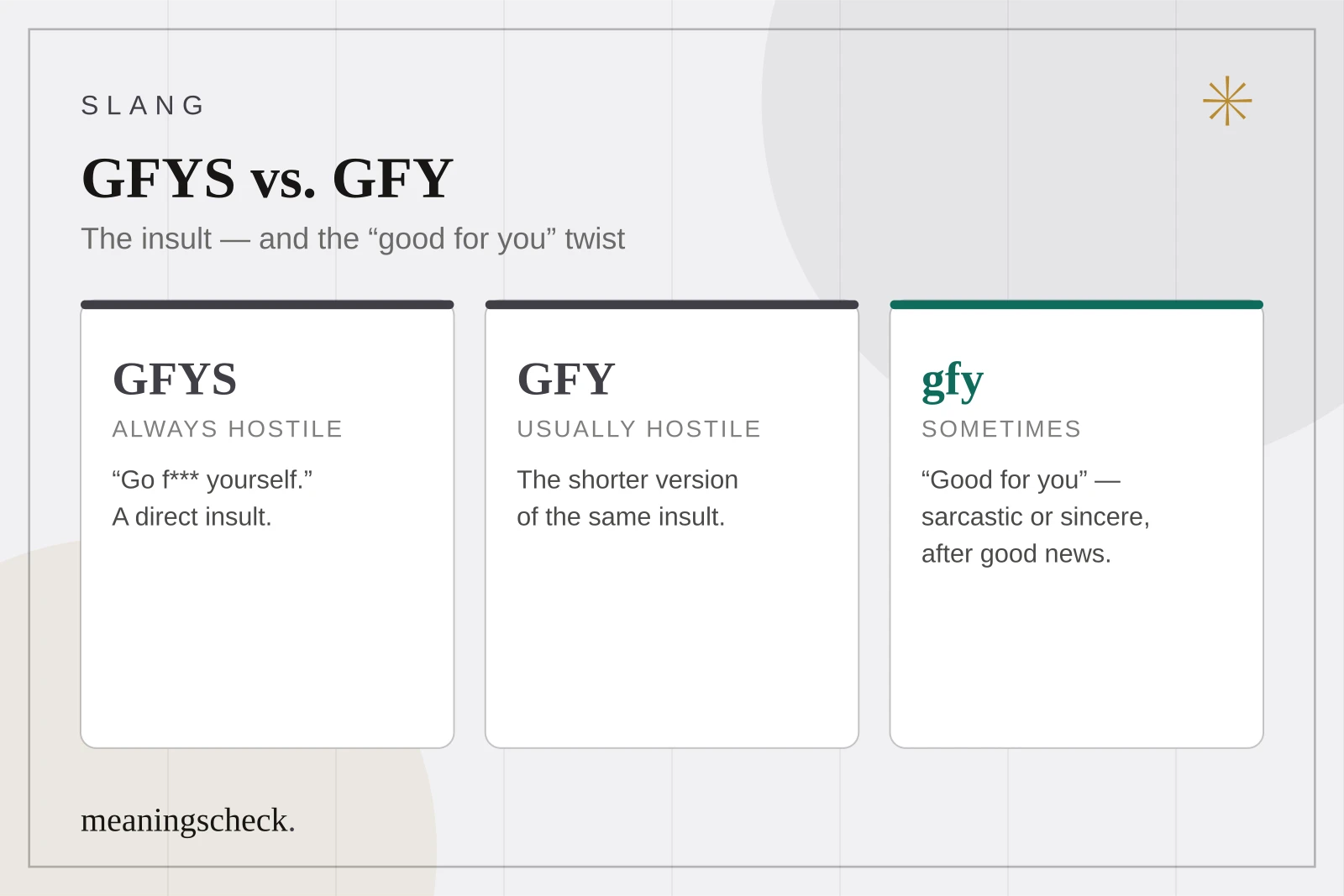
| GFY | Go f*** yourself — or good for you | More common | Can be ambiguous |
| GFYS | Go f*** yourself | Less common | Almost always an insult |
| gfy (lowercase, after good news) | Good for you | Occasional | Sincere or sarcastic |
That last row matters. GFYS is almost never friendly. GFY, on the other hand, has a split personality.
The "Good For You" Twist
Here's the part most explainers skip. According to Wiktionary, GFY can also mean "good for you" — often used ironically.
That creates a strange situation. The same three letters can be an insult or a (sarcastic) congratulation:
- "I just got promoted!" — "gfy 🎉" → probably "good for you."
- "I'm not coming to your party." — "GFY." → almost certainly the insult.
- "I ran a marathon this weekend." — "gfy." → could be sarcastic "good for you," with a cold period.
GFYS rarely has this ambiguity. The extra S tilts it firmly toward the insult. If you see GFYS, read it as hostile.
How Offensive Is GFYS?
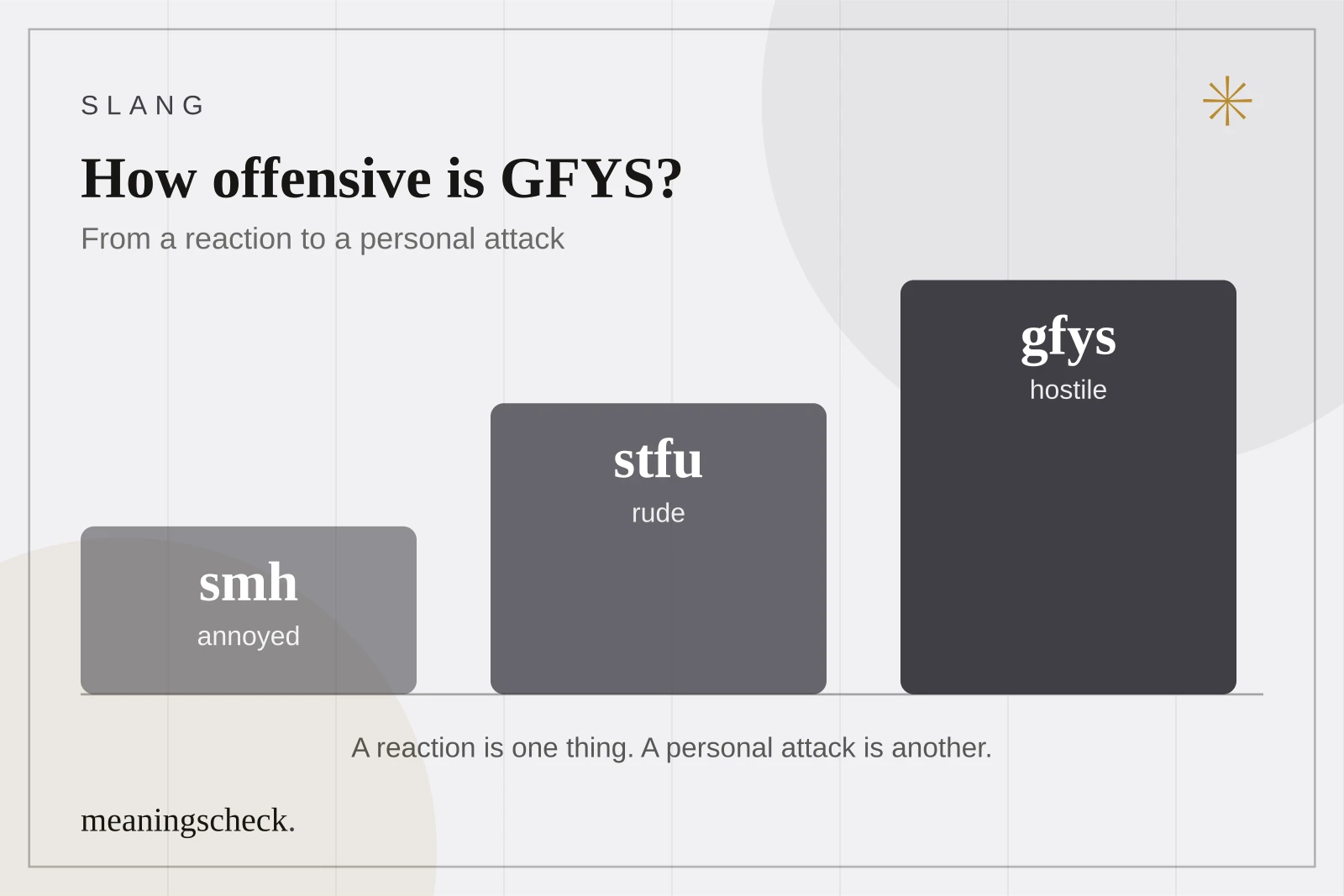
Not all rude texts are equal. Here's where GFYS sits:
| Message | Meaning | Severity | What It Signals |
|---|---|---|---|
| "smh" | Shaking my head | Low | Disappointment |
| "whatever" | Dismissal | Low–medium | Annoyance |
| "bffr" | Be f***ing for real | Medium | Exasperated disbelief |
| "stfu" | Shut the f*** up | High | Anger, telling you to stop |
| "gfys" | Go f*** yourself | Very high | Hostile, personal attack |
GFYS is near the top because it's personal, profane, and dismissive all at once. A disappointed headshake — the energy behind the SMH meaning — is a reaction. GFYS is an attack on you.
Where GFYS Came From
The phrase "go f*** yourself" has been part of English profanity for generations. It shows up in films, music, and arguments everywhere. Its abbreviations grew with online chat, where people wanted to swear fast — or hide the swear word from simple filters.
The phrase has also made headlines when public figures used it. In 2004, Vice President Dick Cheney was widely reported to have used it toward Senator Patrick Leahy on the Senate floor. In November 2023, Elon Musk used it about advertisers at the New York Times DealBook Summit. Both moments drew attention precisely because the phrase is so far outside polite public speech.
Timeline: How the Insult Went Online
| Era | What Happened | Why It Matters |
|---|---|---|
| 20th century | "Go f*** yourself" becomes a common profane insult in English. | The phrase behind GFYS is established. |
| 1990s–2000s | Chat rooms, forums, and online games popularize fast abbreviations. | Insults get compressed into initials like GFY. |
| 2004 | A widely reported Senate-floor exchange puts the phrase in headlines. | The insult's shock value becomes national news. |
| 2010s–2020s | Gaming chats and social media spread GFY and GFYS. | The abbreviations become common in toxic spaces. |
| 2023 | A tech CEO uses the phrase at a major business conference. | The phrase remains a headline-grabbing taboo. |
GFYS Meaning in Text: Reading the Situation
The Short Answer: In a text, GFYS is almost always a sign of real anger or hostility. The only common exception is close friends joking with each other — and even then, emojis and context make the joke obvious.
Genuine Anger
Most of the time, GFYS shows up when someone is furious:
- In the middle of an argument.
- After a breakup or betrayal.
- In response to a comment they found offensive.
In these cases, GFYS is an exit slam. The sender wants to end the conversation and wound you on the way out. You don't have to answer.
Joking Between Friends
Some close friends trade insults as a sign of comfort. In that context, GFYS might be playful:
- "I beat your high score lol" — "gfys 😂"
- "Told you the ending would be sad" — "gfys 😭"
The clues are clear: laughing emojis, a light topic, and a long friendship. Even so, plenty of people don't enjoy this kind of humor. If a friend jokes this way and it bothers you, it's fair to say so.
Is GFYS Ever Funny? The Friend-Banter Question
Some friendships run on insults. "Banter" — trading playful jabs — can be a sign of closeness, especially in long friendships where everyone knows the jokes aren't serious.
But banter has an unwritten rule: it only works when everyone involved enjoys it. The moment one person stops laughing, it's no longer banter. It's just insults.
A few signs that crude joking is still fine:
- It goes both ways, not always at one person.
- Nobody has asked for it to stop.
- It never touches sensitive topics like looks, family, or insecurities.
- It stays private, not in front of people who might misread it.
If you're unsure, ask. "Is the joking too much?" is a sign of a good friend, not a weak one.
Sarcastic "gfy" — Good For You
As covered above, lowercase "gfy" after someone shares good news can mean "good for you." It's usually sarcastic — a way of saying "nobody asked" — but occasionally it's genuinely congratulatory. GFYS with an S almost never means this.
Reading the Clues
| Clue | Likely Meaning |
|---|---|
| Sent during an argument | Genuine insult |
| From a stranger or troll | Hostile harassment |
| From a close friend with 😂 or 💀 | Joking (but still crude) |
| "gfy" after good news | Sarcastic or sincere "good for you" |
| All caps "GFYS" | Furious |
| Repeated, or with other insults | Harassment — consider blocking and reporting |
Key takeaway: Treat GFYS from anyone outside your closest friends as genuine hostility. You're never obligated to reply.
GFYS vs. Other Hostile Acronyms
The Short Answer: GFYS belongs to a group of hostile acronyms like STFU ("shut the f*** up") and GTFO ("get the f*** out"). One acronym is far more serious than the rest: KYS, which tells someone to kill themselves. Treat KYS as an emergency-level harassment message, never as a joke.
Hostile acronyms aren't all equal. Here's how GFYS compares:
| Acronym | Meaning | What It Does | Seriousness |
|---|---|---|---|
| STFU | Shut the f*** up | Tells you to stop talking | High |
| GTFO | Get the f*** out | Tells you to leave (or shows disbelief) | High |
| GFYS | Go f*** yourself | Dismisses you with contempt | Very high |
| KYS | Kill yourself | Encourages self-harm | Extremely serious |
KYS deserves special attention. Telling someone to kill themselves is not an insult like the others — it's a form of harassment that can cause real harm, especially to someone who's already struggling. Report it every time. If you or someone you know is in crisis, contact local emergency services or a crisis line; in the US, you can call or text 988, the Suicide & Crisis Lifeline.
GFYS in Gaming, Comment Sections, and DMs
The Short Answer: GFYS is common in toxic gaming lobbies, heated comment sections, and harassing DMs. Most platforms treat targeted insults like this as harassment, and gaming companies increasingly use moderation tools to catch abusive chat.
Toxic Gaming Lobbies
Competitive games can bring out the worst in people. In text and voice chat, losing streaks and frustration often turn into insults — and GFYS is a common one.
Game companies have noticed. In 2023, Activision announced it was using ToxMod, an AI voice-moderation tool from the company Modulate, to detect toxic speech in Call of Duty voice chat. Many games also let you mute players, report them, and limit chat to friends only.
If you're getting GFYS messages in a game:
- Mute or block the player immediately.
- Use the in-game report tool — many games review reports for chat abuse.
- Adjust your chat settings so only friends can message you.
Comment Sections and Pile-Ons
In comment sections, GFYS often appears during arguments or pile-ons. One heated reply leads to another, and soon a whole thread is hurling insults.
Pile-ons are especially harmful when they target a real person for their looks or a single post — the same dynamic that turned the chopped meaning from a joke into a form of bullying. The best move is not to join in, even when a target seems to "deserve" it.
DMs and Harassment
A GFYS in your DMs from someone you don't know is harassment, plain and simple. It's not a debate to win. Screenshot it if you think you'll need a record, then block and report.
Platform Rules
Major platforms — including Instagram, TikTok, X, Snapchat, Discord, and most game networks — have community rules against harassment and bullying. Targeted insults like GFYS can violate those rules, especially when repeated or combined with threats.
| Platform Type | What GFYS Usually Means There | What You Can Do |
|---|---|---|
| Online games | Rage after a loss | Mute, block, report in-game |
| Comment sections | Heated argument or pile-on | Don't reply; report abusive comments |
| DMs from strangers | Harassment | Screenshot, block, report |
| Group chats | Argument or rough joke | Step away; address it later privately |
| Close-friend chats | Crude joking (with emojis) | Laugh it off — or say it bothers you |
How to Respond to GFYS
The Short Answer: Your best response depends on who sent it. Laugh it off with a close friend who's clearly joking. De-escalate with someone you care about who's genuinely upset. Don't engage at all with strangers — block, report, and move on.
If a Friend Says It as a Joke
If it's obviously playful, you can play along — or set a boundary:
- "lol rude 😂"
- "you're just mad I won"
- "ok but actually don't say that to me" (if it bothers you)
There's no rule that says you have to accept crude jokes. Friends who care about you will adjust.
If Someone You Care About Is Genuinely Angry
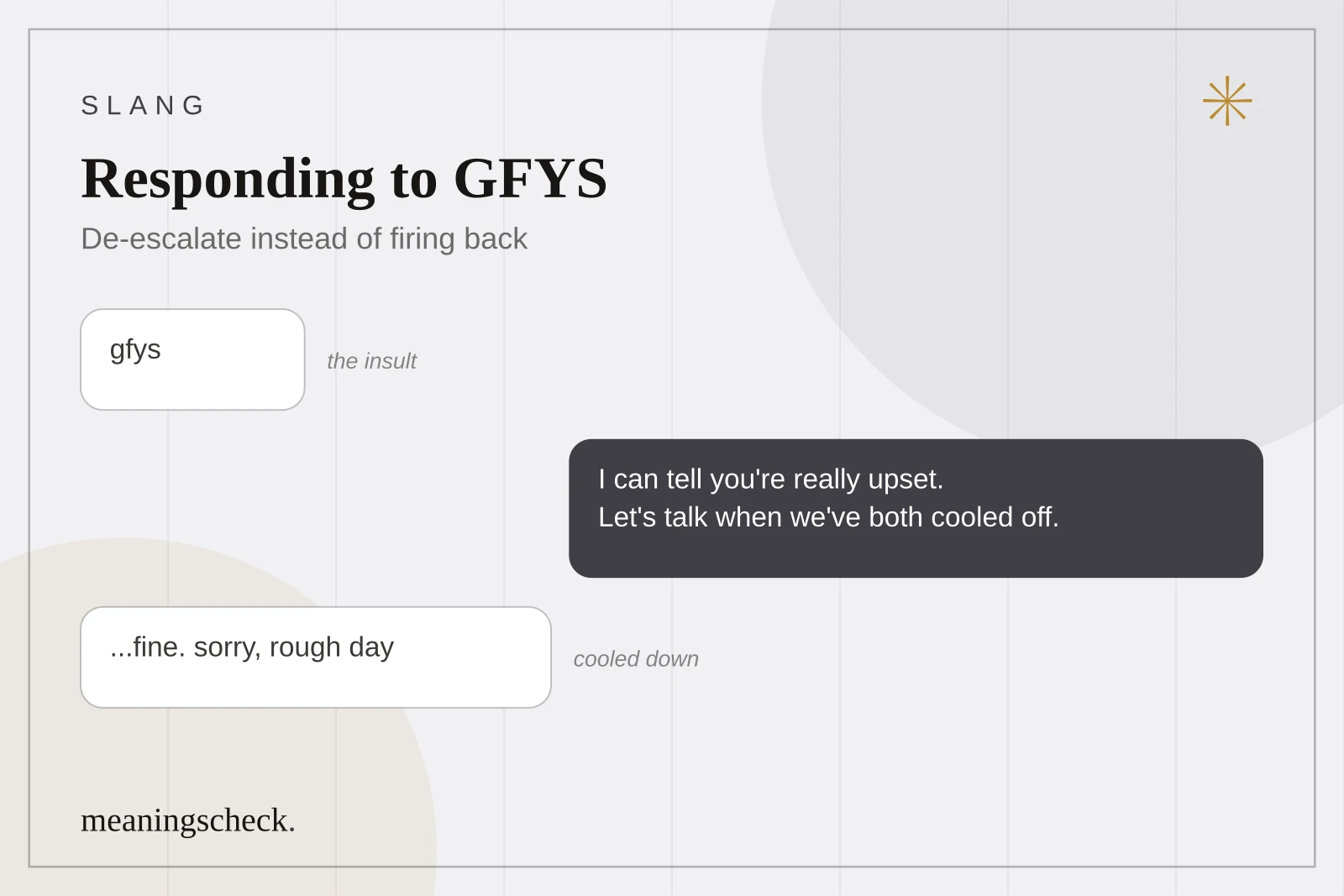
When a partner, friend, or family member sends GFYS in anger, matching their energy almost always makes things worse. Try to cool things down:
- "I can tell you're really upset. Let's talk when we've both calmed down."
- "I don't want to fight over text. Can we call later?"
- "That hurt. I'm going to step away for a bit."
You can acknowledge their feelings without accepting the insult. Stepping away is not losing — it's choosing not to escalate.
If It's a Stranger or Harassment
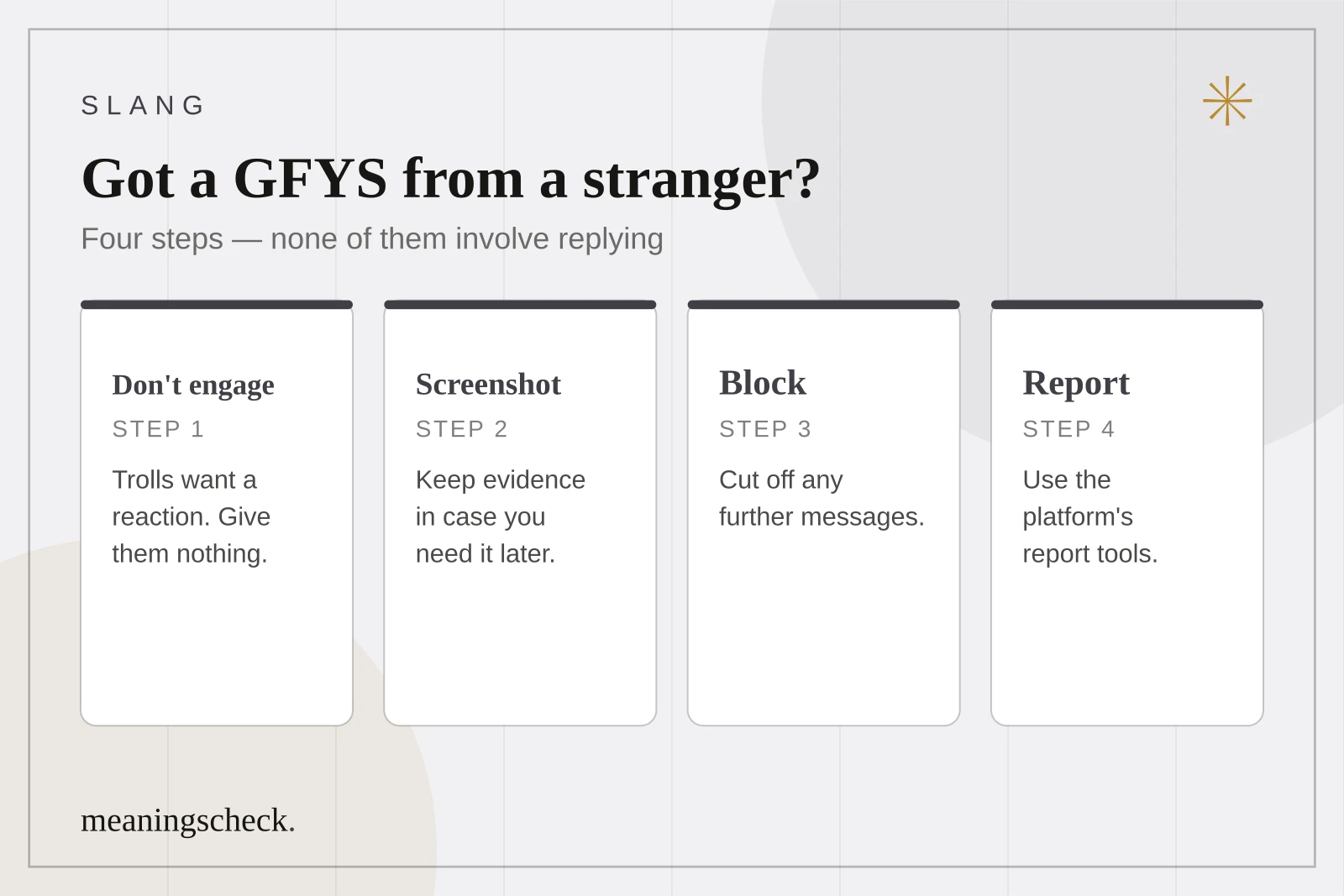
With strangers, don't engage. Trolls want a reaction. Silence takes away their reward.
- Don't reply. Not even to argue back.
- Screenshot if you might need evidence later.
- Block the account.
- Report it using the platform's tools.
One more reason not to fire back: when moderators review a heated exchange, they see both sides. Replying with your own insults can get your account flagged too. Staying silent keeps your record clean — and leaves the troll with nothing to screenshot.
If It Keeps Happening
Repeated insults, threats, or messages from multiple accounts are a bigger problem. Save evidence, report every account, and talk to someone you trust. If you're a young person, tell a parent, teacher, or counselor. If messages include threats of violence, contact local authorities.
GFYS in Relationships and Breakups
The Short Answer: A GFYS from a partner or ex usually comes from a moment of intense anger. One heated message after a breakup is painful but common. Repeated insults, especially alongside control or fear, are a warning sign worth taking seriously.
Breakups and fights bring out raw emotions, and GFYS often shows up at the worst moments: after an argument, after being blocked and unblocked, or at 2 a.m. after a breakup.
If you receive one in a single heated moment, you don't have to respond. Space usually helps more than a reply.
If it's part of a pattern — frequent insults, threats, monitoring your phone, or making you afraid — that's different. Verbal abuse is a real form of harm, not just "fighting." In the US, organizations like loveisrespect and the National Domestic Violence Hotline offer free, confidential support, and similar services exist in many countries.
Key takeaway: One angry GFYS is a bad moment. A pattern of insults is a red flag. You deserve to be spoken to with respect.
Where GFYS Crosses the Line
The Short Answer: GFYS crosses the line almost everywhere outside close-friend banter. At work it can be grounds for discipline. At school it can count as bullying. Online, repeated use can violate harassment rules — and screenshots make it permanent.
At Work
Saying or texting GFYS to a coworker, manager, or client is a fast way into an HR meeting. Workplace conduct policies generally prohibit abusive language, and directing profanity at a colleague can lead to formal discipline or termination. Even in casual work chats, it's off-limits — the same reason profane acronyms like the JFC meaning don't belong in a work email.
At School
Schools typically treat targeted profanity as disrespectful conduct, and repeated insults can fall under anti-bullying policies. A GFYS in a class group chat can follow a student into a principal's office.
With Family
Insults said in anger are hard to take back. With family, GFYS can do lasting damage to relationships, even if it was sent in a moment of frustration.
Online
Online, the line is repetition and targeting. One heated reply in an argument is ugly. Repeatedly sending GFYS to the same person, or joining a pile-on, can violate harassment policies and get accounts suspended.
| Setting | Is GFYS Okay? | Why |
|---|---|---|
| Close-friend joking | Sometimes | Only if you both find it funny |
| Arguments with loved ones | No | Escalates and wounds |
| Work | No | Conduct policies and harassment risk |
| School | No | Treated as disrespect or bullying |
| Strangers online | No | Can count as harassment |
| Public posts | No | Screenshots make it permanent |
Expert Insights: Why People Type Insults They'd Never Say
The Short Answer: Psychologists describe an "online disinhibition effect" — people feel less restrained behind screens. Abbreviations make profanity feel lighter to type. The impact on the person receiving it is just as heavy.
The Online Disinhibition Effect
In 2004, psychologist John Suler described the online disinhibition effect: people often say things online they would never say in person. Anonymity, distance, and the lack of facial feedback all lower our normal social brakes.
GFYS is a textbook example. Someone who would never say "go f*** yourself" to a stranger's face might type it in a game lobby without a second thought. The screen removes the immediate consequence of seeing the other person's reaction.
Abbreviations as a Mask
Abbreviated profanity has a pattern. WTF, FFS, JFC, BFFR, GFYS — many of the internet's strongest reactions hide a swear word inside initials.
Abbreviating makes swearing feel lighter on the screen. That's useful for exclamations like "wtf" that aren't aimed at anyone. It's also how hidden swear words sneak into everyday messages — the same trick behind the BFFR meaning. But with GFYS, the mask doesn't soften the blow. The insult is aimed at a person. They know exactly what it says.
Not All Swearing Is the Same
Here's a nuance worth knowing. Research suggests swearing isn't always negative. In a well-known 2009 study, psychologist Richard Stephens and colleagues at Keele University found that people who swore could keep their hands in ice water longer than people who used neutral words — swearing seemed to boost pain tolerance.
That kind of swearing is cathartic — directed at a situation, like stubbing your toe. GFYS is different. It's directed at a person. Cathartic swearing releases frustration. Abusive swearing transfers it onto someone else.
Why Messages Feel Harsher in Text
Text strips away tone of voice, facial expressions, and body language. That makes it easy to misread intent — and easy to escalate.
In a 2005 study, researchers Justin Kruger and Nicholas Epley found that people consistently overestimated how well their tone came across over email. Senders thought their sarcasm or humor would be obvious. Readers often missed it.
That gap explains a lot about GFYS. A friend might type it as a joke and assume you'll "hear" the laugh. You might read it as pure hostility. When tone can't be heard, harsh words land at full strength.
The Screenshot Problem
Text lasts. A GFYS sent in anger can be screenshotted, shared, and resurfaced months later — in a school dispute, a breakup, or even a job background check. What feels like a moment of venting becomes a permanent record.
That's the simplest reason to avoid it: anything you type in anger can outlive the anger.
Real-World Examples
- Senate floor, 2004: A widely reported exchange in which Vice President Dick Cheney used the phrase toward Senator Patrick Leahy became national news.
- DealBook Summit, 2023: Elon Musk's use of the phrase about advertisers drew global headlines.
- Music: Wikipedia lists songs titled "GFY," including a 2022 track by Blackbear and Machine Gun Kelly and a 2019 song by Amyl and the Sniffers.
- Gaming moderation, 2023: Activision's adoption of AI voice moderation for Call of Duty shows how seriously platforms now treat abusive chat.
What to Do If You Sent GFYS (and Regret It)
The Short Answer: Apologize soon, keep it short, and don't add excuses. "I'm sorry I said that — it was out of line" works better than a long explanation. Then give the other person space to respond in their own time.
Most people who send GFYS regret it once they've cooled down. If that's you, a sincere apology can repair a lot of damage.
Follow these steps:
- Wait until you're calm. An apology sent while you're still angry often restarts the fight.
- Own it directly. "I'm sorry I told you to go f*** yourself. That was out of line."
- Skip the "but." "I'm sorry, but you started it" isn't an apology.
- Don't demand forgiveness. Give them time to respond — or not.
- Change the pattern. If it keeps happening, think about what's triggering it.
| Weak Apology | Strong Apology |
|---|---|
| "sorry if you were offended" | "I'm sorry. What I said was hurtful." |
| "sorry but you were being annoying" | "I was angry. That's no excuse. I'm sorry." |
| "it was just a joke" | "It wasn't funny. I shouldn't have said it." |
| "ok sorry, can we move on now?" | "I'm sorry. Take whatever time you need." |
A good apology doesn't erase what you said. It does show the other person that you know where the line is — and that you won't cross it lightly again.
Calmer Alternatives When You're Angry
The Short Answer: If you're angry enough to type GFYS, try a firm boundary instead: "I'm done with this conversation," "That's not okay," or simply logging off. These protect your point without giving the other person ammunition.
Anger is normal. How you express it is a choice. Here are stronger, smarter alternatives:
| Instead of GFYS | Try | Why It Works |
|---|---|---|
| Ending an argument | "I'm done with this conversation." | Clear, final, and screenshot-safe |
| Responding to an insult | "That's not okay." | Sets a boundary without escalating |
| Dealing with a troll | (No reply) + block | Removes their reward |
| Feeling disrespected | "Don't talk to me like that." | Direct and firm |
| Needing space | "I need a break. Talk later." | Protects the relationship |
You're allowed to be angry. You don't have to hand someone a screenshot that makes you look worse than them.
GFYS for Parents and Teachers
The Short Answer: If you find GFYS in a child's messages, find out whether it was sent or received, and in what context. Sent in anger or as a crude joke, it's a chance to talk about respect. Received from others, it may be a sign of bullying.
Finding GFYS on a child's phone can be alarming. Before reacting, figure out the context:
- Was it sent or received? Receiving GFYS repeatedly can be a sign of bullying.
- Who was involved? A close friend joking is different from a classmate attacking.
- Was there a pattern? One heated moment is different from ongoing harassment.
If your child sent it, talk calmly about how words land and what to do with anger instead. Ask what happened right before they sent it. Often there's a conflict underneath that matters more than the word itself — and helping with that conflict prevents the next GFYS better than any punishment. If your child received it, make sure they know how to block and report — and that they can always come to you.
Teachers can treat GFYS in class chats like any other targeted profanity: address it privately first, and escalate under anti-bullying policies if it's part of a pattern.
Other Meanings of GFY and GFYS
The Short Answer: GFY can also mean "good for you," and it's the title of songs by Blackbear and Machine Gun Kelly (2022) and Amyl and the Sniffers (2019). As a code, GFY is also the IATA identifier for Grootfontein Air Force Base in Namibia and the name of a human gene.
Outside the insult, GFY has a surprising range of meanings:
- Good for you: documented by Wiktionary, often sarcastic.
- Music: Wikipedia lists "GFY" as a 2022 song by Blackbear and Machine Gun Kelly and a 2019 song by Amyl and the Sniffers.
- Aviation: GFY is the IATA code for Grootfontein Air Force Base in Namibia.
- Genetics: GFY is the name of a human gene, short for "Golgi-associated olfactory signaling regulator."
GFYS, with the S, doesn't share these alternate meanings in common use. When you see GFYS, it's the insult.
| Term | Context | Meaning |
|---|---|---|
| GFYS | Texting, gaming, comments | Go f*** yourself |
| GFY | Texting (hostile) | Go f*** yourself |
| gfy | Texting (after good news) | Good for you (often sarcastic) |
| "GFY" | Music | Song titles (2019, 2022) |
| GFY | Aviation | Grootfontein Air Force Base code |
| GFY | Genetics | A human gene name |
Frequently Asked Questions (FAQs)
What does GFYS mean in text?
GFYS means "go f*** yourself" — a vulgar, hostile insult. In a text, it usually signals real anger and an attempt to end the conversation on a hurtful note.
What's the difference between GFY and GFYS?
Both usually mean "go f*** yourself." GFY is more common and can also mean "good for you" in some contexts. GFYS spells out "yourself" more fully and is almost always an insult.
Can GFY mean "good for you"?
Yes. Wiktionary lists "good for you" as a meaning of GFY, often used sarcastically. Context — like a reply to good news — tells you which meaning is intended.
Is GFYS a swear word?
Yes. It abbreviates a phrase containing the F-word. That makes it profanity. It's also a direct insult, which makes it more offensive than general swearing.
How should I respond to GFYS?
With a close friend who's clearly joking, laugh it off or set a boundary. With someone genuinely angry, de-escalate and step away. With a stranger, don't reply — block and report.
Can you get banned for saying GFYS?
You can. Many platforms and games treat targeted insults as harassment, especially when repeated. Accounts that send abusive messages can be muted, suspended, or banned.
What does GFYS mean on Snapchat?
On Snapchat, GFYS means the same thing: "go f*** yourself." It usually appears in heated private chats or replies to stories. If a stranger sends it, block and report the account.
What does GFYS mean from a girl or a guy?
It means the same thing from anyone — a hostile insult. From a close friend with laughing emojis, it might be crude teasing. From anyone else, read it as genuine anger.
Is it okay to say GFYS as a joke?
Only with close friends who find it funny — and even then, it's crude. If anyone seems hurt, drop it. Never use it at work, at school, or with strangers.
What should parents do if their child receives GFYS?
Find out the context, help them block and report the sender, and keep communication open. Repeated messages can be a sign of bullying worth addressing with the school.
Why do people send GFYS online?
Psychologists point to the online disinhibition effect: screens make people less restrained. Abbreviations also make profanity feel lighter to type, even though the impact is just as harsh.
Final Thoughts
GFYS is four letters of pure hostility. It hides a swear word. It doesn't hide the intent. When it shows up in your messages, someone is trying to end a conversation by hurting you.
The good news is that you control what happens next. You don't have to argue, defend yourself, or fire back. You can step away, block, report, or — with a close friend who's clearly joking — laugh it off.
And if you ever feel tempted to send it yourself, remember that words typed in anger outlast the anger. A firm "I'm done with this conversation" protects your point and your reputation. For more about mature slang and how to handle it, see our guides to the NSFW meaning and other internet slang.
Related terms
Share: · Post on X
Written by MeaningsCheck Team · Published
The MeaningsCheck team researches and writes plain-language explanations of slang, abbreviations, and everyday words — checked for accuracy, updated as language changes.