
What Does FUPA Mean? FUPA Meaning in Slang, What Causes It, and Is It Offensive? (2026)
FUPA stands for "fat upper pubic area" (sometimes "pelvic area") — slang for extra fat or skin on the lower belly, just above the pubic bone. The medical name for that area is the mons pubis. It's often used jokingly about yourself, but it can be hurtful when aimed at someone else.
FUPA stands for "fat upper pubic area." Some people say "fat upper pelvic area" instead. It's slang for extra fat or loose skin on the lowest part of your belly — the soft area just above the pubic bone and below the belly button.
You'll hear it in jokes, fitness videos, fashion tips, and, unfortunately, insults. So if you're wondering what does FUPA mean, the definition is simple. How it lands depends a lot on who's saying it and why.
This guide covers the FUPA meaning in slang, where the term came from, the real medical terms for the area, what causes it, how it compares to "muffin top" and "mom pooch," whether it's offensive, and how to reply when someone uses it.
Key takeaway: FUPA is casual slang for lower-belly fat above the pubic bone. The area itself is a normal part of the body. The word can be a lighthearted self-joke or a hurtful jab — context decides.
This article explains a slang term. It isn't medical advice. Talk to a doctor about any health concern.
Executive Summary: FUPA at a Glance
Here's the quick version:
- Stands for: "Fat upper pubic area" (or "fat upper pelvic area").
- Pronunciation: "FOO-puh." Plural: FUPAs.
- What it describes: Fat or loose skin on the lower belly, just above the pubic bone.
- Medical terms: The area is the mons pubis. A hanging fold of lower-belly skin and fat is a pannus or panniculus.
- Common causes: Genetics, aging, hormone changes, pregnancy, and weight gain or loss.
- Tone: Often self-deprecating. Used about someone else, it's usually body-shaming.
- Who has one: Anyone — any gender, any body size.
What Does FUPA Mean? The Core Definition
The Short Answer: FUPA is an acronym for "fat upper pubic area." It's slang for the fatty area on the lower belly just above the pubic bone. People use it to joke about their own bodies, talk about fitness, or — less kindly — tease others.
The Literal Translation
The FUPA meaning comes straight from its letters:
- F — Fat
- U — Upper
- P — Pubic (or Pelvic)
- A — Area
Dictionary.com defines FUPA as slang for "a wide area of protruding fat in the upper pubic region." It's pronounced "FOO-puh," and you'll see it written as FUPA, Fupa, or fupa.
Where Exactly Is It?
The FUPA sits below the belly button and above the pubic bone. It's the lowest part of the stomach — the area that might fold over the waistband when you sit down or press against tight jeans.
Everyone has some fatty tissue there. The term usually describes when that area looks fuller or rounder than the rest of the belly.
The Medical Name: Mons Pubis
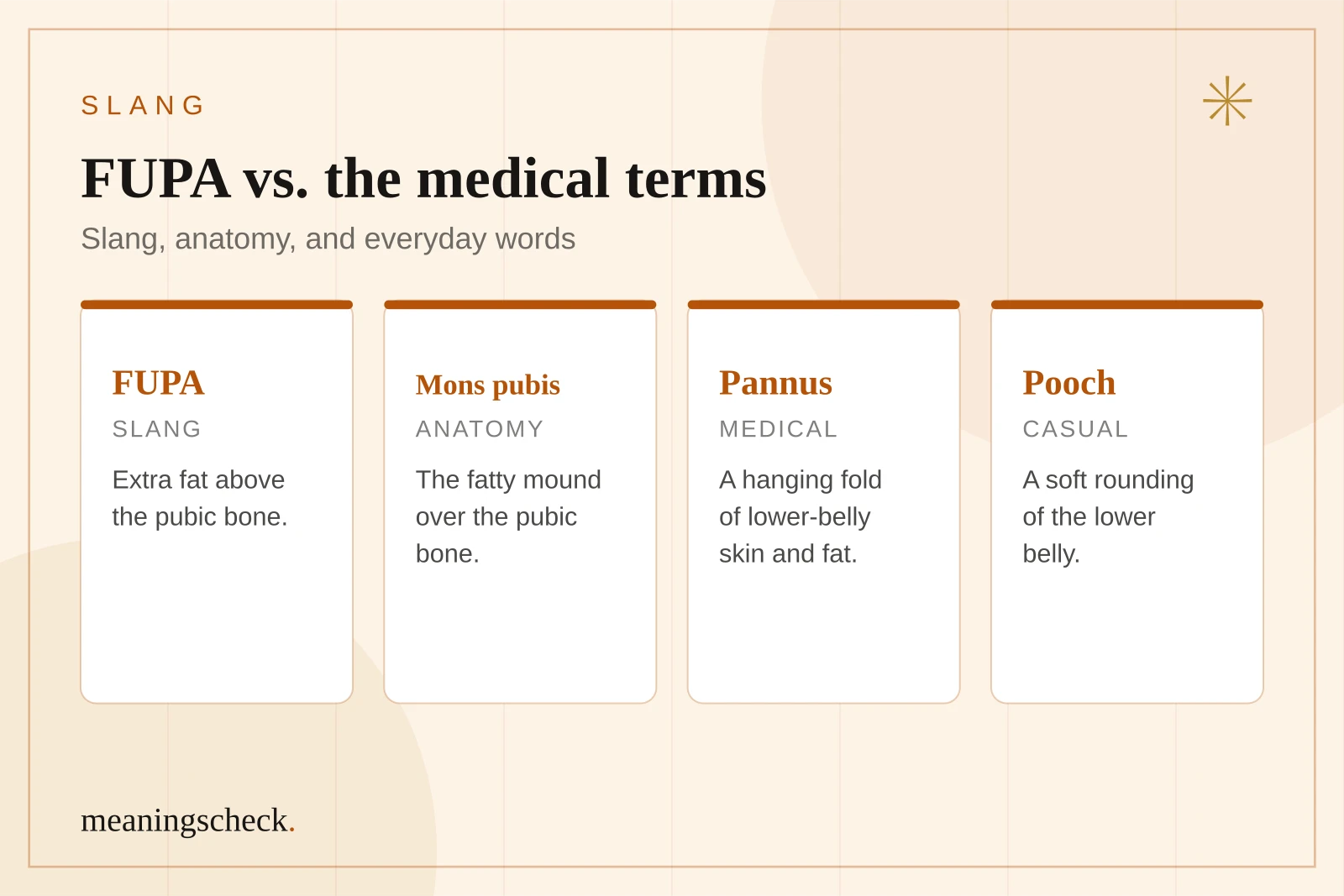
Doctors don't say FUPA. The medical name for the area is the mons pubis — the mound of tissue in front of the pubic bones, according to the Cleveland Clinic. It naturally contains a layer of fat that cushions the pubic bone.
When the lower belly develops a hanging fold of skin and fat, doctors call that a pannus or panniculus. People sometimes call that an "apron belly."
| Term | Type | What It Means |
|---|---|---|
| FUPA | Slang | Extra fat above the pubic bone |
| Mons pubis | Medical (anatomy) | The fatty mound over the pubic bone |
| Pannus / panniculus | Medical | A hanging fold of lower-belly skin and fat |
| Apron belly | Casual | Everyday name for a pannus |
| Lower belly pooch | Casual | A gentle rounding of the lower stomach |
Where Did FUPA Come From?
The Short Answer: FUPA is American slang built from the first letters of "fat upper pubic area." It circulated online for years before dictionaries documented it. Dictionary.com's examples show it trending on social media between 2016 and 2018, often in jokes about public figures.
Nobody knows exactly who coined FUPA. Like many body-slang acronyms, it spread through casual conversation and early internet culture before anyone wrote it down.
Dictionary.com treats it as American slang and published a slang entry for it in 2018. The examples it collected came from social media posts between 2016 and 2018 — many of them jokes about politicians' bodies, tagged #FUPA.
That history says a lot. From the start, FUPA has often been used to mock someone's body. Over time, people also started using it about themselves — in a joking, self-aware way.
| Period | What Happened | Why It Matters |
|---|---|---|
| Before 2016 | FUPA circulates in casual and online slang | The term spreads by word of mouth |
| 2016–2018 | Social posts use #FUPA, often about public figures | Its teasing tone takes hold |
| July 2018 | Dictionary.com publishes a FUPA slang entry | The term becomes documented |
| 2020s | Fitness, fashion, and body-image content use it widely | It moves into mainstream social media |
FUPA Meaning in Text and on Social Media
The Short Answer: In texts and posts, FUPA shows up in four main ways: joking about your own body, talking about workouts, giving fashion tips, and — less kindly — mocking someone else. The tone changes completely depending on which one it is.
Self-Deprecating Jokes
Most casual uses are about the speaker's own body:
- "Thanksgiving dinner gave me a FUPA lol"
- "these jeans and my fupa are not friends"
- "me and my fupa are going to bed"
These jokes are usually lighthearted. People poke fun at themselves to sound relatable.
Fitness Talk
Fitness content uses FUPA constantly — "FUPA workout," "how to lose your FUPA," "lower belly routine." As you'll see below, a lot of that content oversells what targeted exercises can do.
Fashion Tips
Fashion creators talk about outfits that feel comfortable with a fuller lower belly. You'll see captions like "high-waisted jeans for a FUPA" or "best leggings if you have a fupa."
Insults and Body-Shaming
The harshest use is aimed at someone else: "look at his FUPA 💀." That's body-shaming, plain and simple. Comment sections can pile onto strangers this way — the same pattern you see with appearance insults like "chopped," which our chopped meaning guide breaks down.
| Context | Example | Tone |
|---|---|---|
| Self-joke | "my fupa after pizza night 😭" | Lighthearted, relatable |
| Fitness | "10-minute FUPA workout" | Motivational (sometimes misleading) |
| Fashion | "jeans that don't dig into your fupa" | Practical |
| About someone else | "his FUPA is crazy" | Mocking, body-shaming |
| Body positivity | "my fupa and I are at peace" | Reclaiming, confident |
FUPA on TikTok, Instagram, and X
- TikTok: Workout routines, "outfit hacks," and self-deprecating comedy skits.
- Instagram: Before-and-after posts, fitness captions, and body-positive selfies.
- X (Twitter): Jokes, including jokes about celebrities and politicians.
- Reddit: Honest questions about causes, clothing, and medical options.
Is FUPA Offensive?
The Short Answer: It depends on who you're talking about. Using FUPA about your own body is usually harmless self-humor. Using it about someone else's body — especially a stranger's — is body-shaming and can genuinely hurt.
FUPA isn't a swear word. You won't get bleeped for saying it on TV. But it's a word about bodies, and words about bodies carry weight.
When It's Usually Fine
- Joking about your own body with friends.
- Talking about fitness or clothing in a neutral way.
- Using it among close friends who all joke this way.
When It Hurts
- Commenting on someone else's body without being asked.
- Mocking a stranger's photo or a public figure's appearance.
- Teasing someone who's already self-conscious about their weight.
- Talking about a partner's body in front of others.
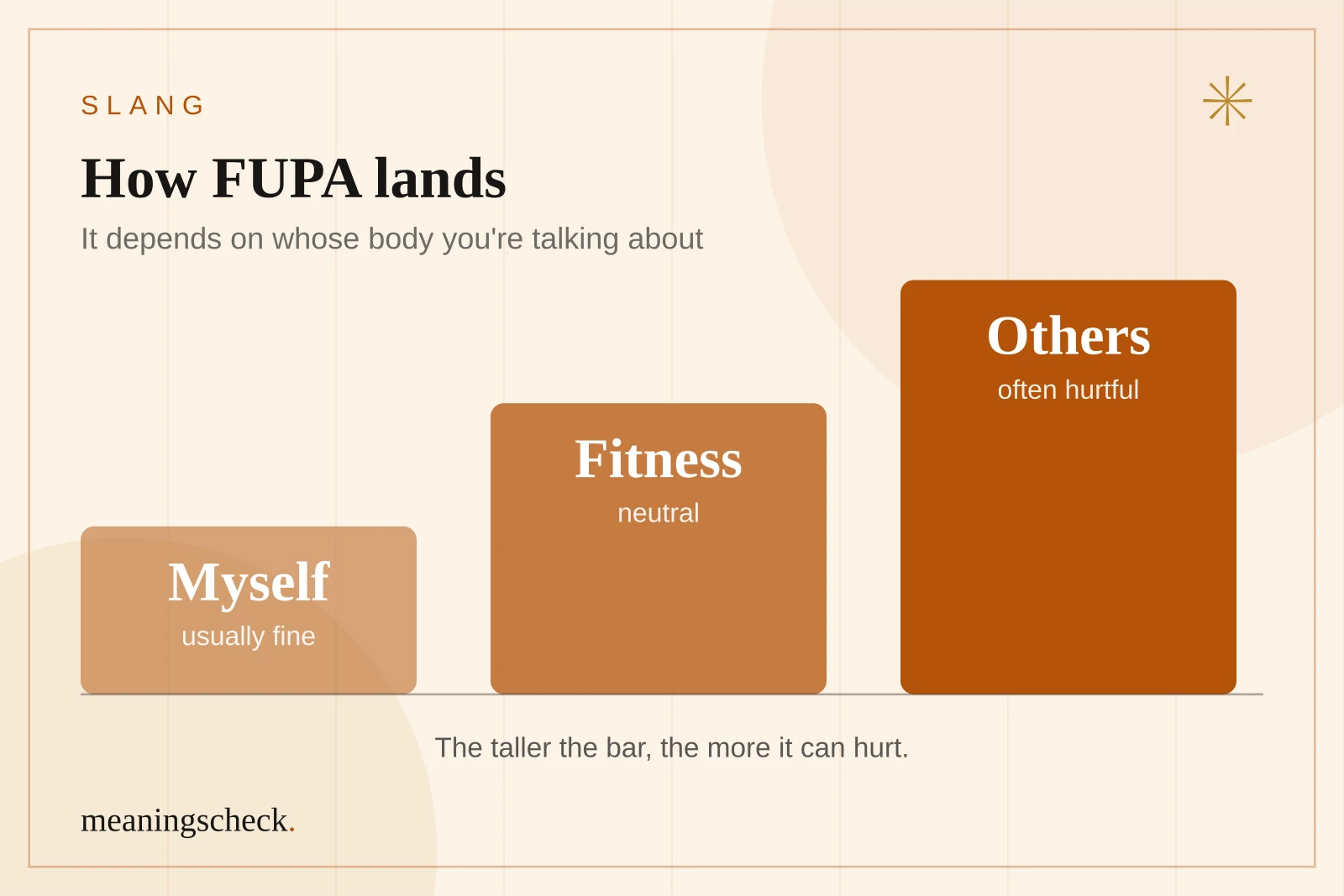
Key takeaway: A simple rule works best. Use FUPA about yourself if you like. Don't use it about anyone else.
FUPA vs. Muffin Top, Love Handles, and Mom Pooch
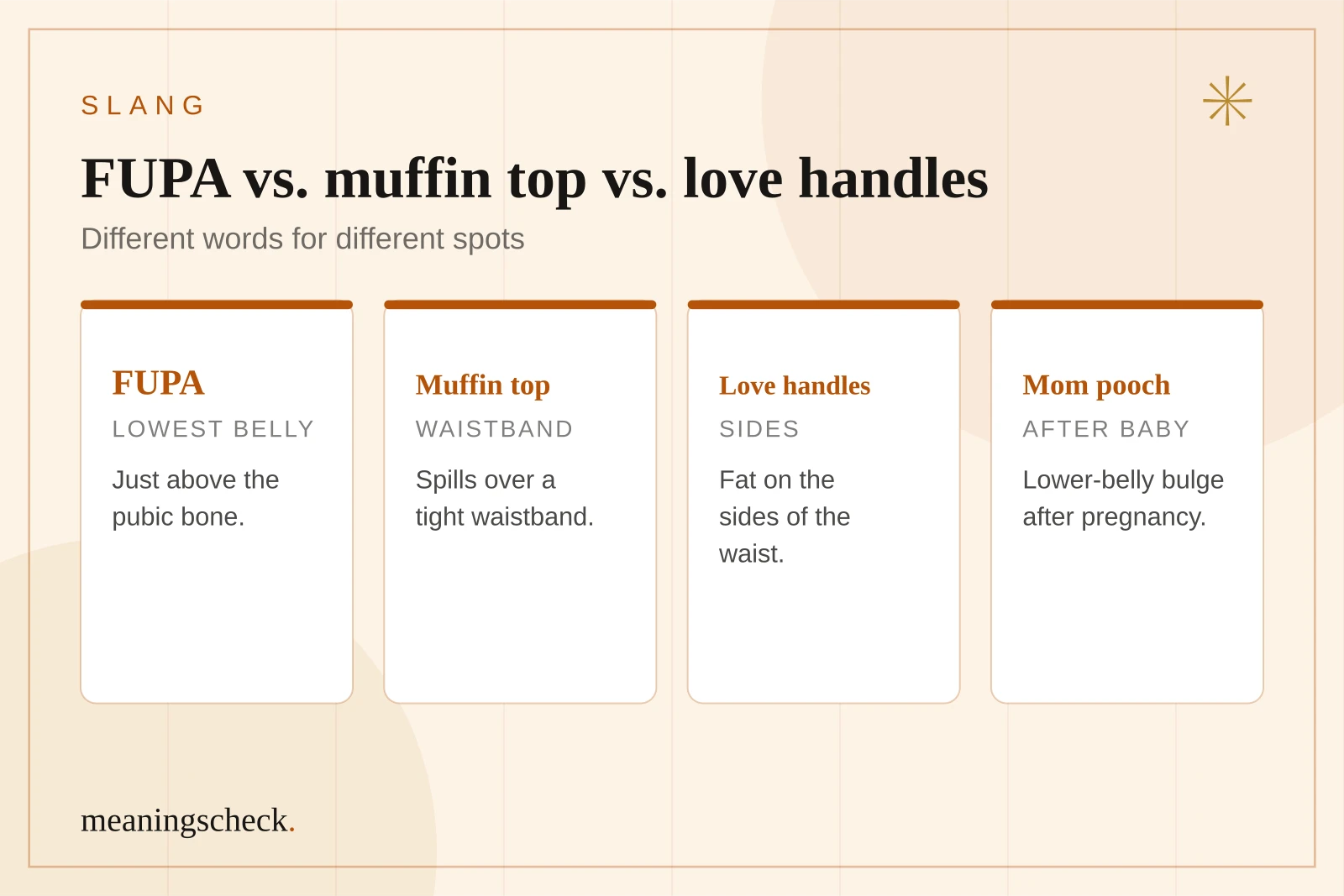
The Short Answer: FUPA is fat directly above the pubic bone. A muffin top spills over the waistband, love handles sit on the sides, a beer belly is the upper stomach, and a "mom pooch" is a lower-belly bulge after pregnancy. They describe different areas.
People mix these terms up all the time. Here's the difference:
| Term | Where It Is | Common Cause | Tone |
|---|---|---|---|
| FUPA | Just above the pubic bone | Genetics, hormones, weight changes | Casual, can be mocking |
| Muffin top | Spilling over a tight waistband | Clothing fit plus belly fat | Playful, can be mocking |
| Love handles | Sides of the waist | Fat stored on the hips and flanks | Mild, often affectionate |
| Beer belly | Upper and middle stomach | Overall weight gain | Teasing |
| Mom pooch | Lower belly after pregnancy | Stretched muscles and skin | Casual |
| Apron belly (pannus) | A hanging fold of lower-belly skin | Major weight gain or loss | Casual or medical |
| C-section shelf | A ledge above a C-section scar | Scar tissue pulling inward | Casual |
FUPA vs. Diastasis Recti
A "mom pooch" is sometimes caused by diastasis recti — a separation of the abdominal muscles that can happen during pregnancy. That's a muscle issue, not a fat issue. A doctor or a pelvic-floor physical therapist can check for it. It's worth asking about if your lower belly bulges after pregnancy and doesn't change with weight loss.
FUPA vs. C-Section Shelf
After a C-section, scar tissue can pull the skin inward. The tissue above it can then hang over the scar in a "shelf." It looks similar to a FUPA. The cause is the scar, not just fat.
What Causes a FUPA?
The Short Answer: Common causes include genetics, aging, hormone changes, pregnancy, and weight gain or loss. Your genes largely decide where your body stores fat. That's why two people with the same weight can have very different lower bellies.
This section is general information, not medical advice.
Genetics
Your genes play a big role in where your body stores fat. Some people naturally store more fat on the lower belly and hips. Others store it on the upper stomach, arms, or thighs. You can't choose your pattern.
Aging and Skin Changes
As you age, skin loses some elasticity. Fat can also shift. The Cleveland Clinic lists aging as one cause of extra skin and fat on the mons pubis.
Hormone Changes
Hormones — especially estrogen — influence where the body stores fat. After menopause, many women notice more fat around the abdomen as estrogen levels drop.
Pregnancy
Pregnancy stretches the abdominal skin and muscles. The Cleveland Clinic lists it as a common cause of excess skin and fat in the area. Some changes ease over time. Others don't.
Weight Gain and Weight Loss
Weight gain adds fat to the area and stretches the skin. Significant weight loss can leave loose skin behind. The Cleveland Clinic notes both can contribute.
| Cause | What Happens | Can You Change It? |
|---|---|---|
| Genetics | Your body stores fat there first | No — it's your natural pattern |
| Aging | Skin loosens and fat shifts | Partly — through overall health habits |
| Hormones | Fat moves toward the abdomen | Partly — talk to a doctor about options |
| Pregnancy | Skin and muscles stretch | Partly — some changes ease with time |
| Weight changes | More fat or loose skin | Partly — overall weight affects it |
Is a FUPA Normal?
The Short Answer: Yes. Everyone has fatty tissue over the pubic bone. Its size varies from person to person. A fuller lower belly is common and usually isn't a medical problem on its own.
The mons pubis naturally contains fat. That fat cushions the pubic bone. How much fat sits there depends on genes, age, hormones, and overall body size.
Many people who are at a healthy weight still have a rounded lower belly. Athletes have them. Models have them. It's one of the most common body areas people feel self-conscious about.
When to Talk to a Doctor
Most of the time, a FUPA is purely a cosmetic concern. The Cleveland Clinic notes that some people seek treatment when a large or hanging mons pubis causes real problems, such as:
- Skin rashes or infections in the fold.
- Trouble with hygiene.
- Discomfort during daily activities.
If any of those apply to you, a doctor can talk you through your options.
Can You Get Rid of a FUPA?
The Short Answer: You can't target fat in one spot with exercise alone. Overall fat loss through diet and activity can shrink the area, though genetics still play a role. Medical options like a monsplasty (pubic lift) exist for people who want them.
Not medical or fitness advice. Talk to a professional before making changes.
The Spot-Reduction Myth
Lots of videos promise to "burn your FUPA in 7 days." Unfortunately, spot reduction — losing fat in one area by exercising that area — doesn't work the way those videos suggest.
For example, a 2011 study in the Journal of Strength and Conditioning Research found that six weeks of abdominal exercises alone didn't reduce belly fat. Ab exercises strengthen the muscles underneath. They don't burn the fat sitting on top.
What Actually Helps
- Overall fat loss through balanced eating and regular activity.
- Strength training to build muscle across the body.
- Core work to strengthen the abdominal wall (helpful — not a fat burner).
- Patience — the lower belly is often one of the last places fat leaves.
Medical Options
Some people choose cosmetic procedures. These are personal decisions, best made with a board-certified provider:
| Option | What It Does | Good to Know |
|---|---|---|
| Monsplasty (pubic lift) | Removes extra skin and fat from the mons pubis | Often paired with a tummy tuck |
| Abdominoplasty (tummy tuck) | Tightens the abdomen and removes extra skin | Doesn't lift the pubic area on its own |
| Liposuction | Removes fat from targeted areas | Doesn't fix loose skin |
| Cryolipolysis | Freezes fat cells non-surgically | Best for small, pinchable areas |
The Cleveland Clinic notes that a tummy tuck or liposuction alone can sometimes make the mons pubis look more noticeable. That's why surgeons may recommend a monsplasty at the same time. It also notes that anyone — including men — can have a monsplasty.
FUPA Meaning From a Girl or a Guy
The Short Answer: When a girl or a guy says "my FUPA," they're usually making a self-deprecating joke about their lower belly. If someone says it about your body, it's a comment on your looks — and you're allowed to tell them it's not okay.
When a Girl Says It
Women use FUPA most often about themselves — especially when talking about clothing, periods, bloating, or post-pregnancy bodies. "My FUPA is not cooperating with these jeans" is a relatable joke, not a cry for help.
When a Guy Says It
Men have FUPAs too. Guys use the term about themselves in gym talk or jokes: "gotta lose the fupa before summer." Lower-belly fat in men is just as common. It often shows up with overall weight gain.
When Someone Says It About You
That's different. A partner, friend, or stranger commenting on your FUPA is commenting on your body. Even if they say it as a joke, you're allowed to say it bothers you.
How to Reply When Someone Says FUPA
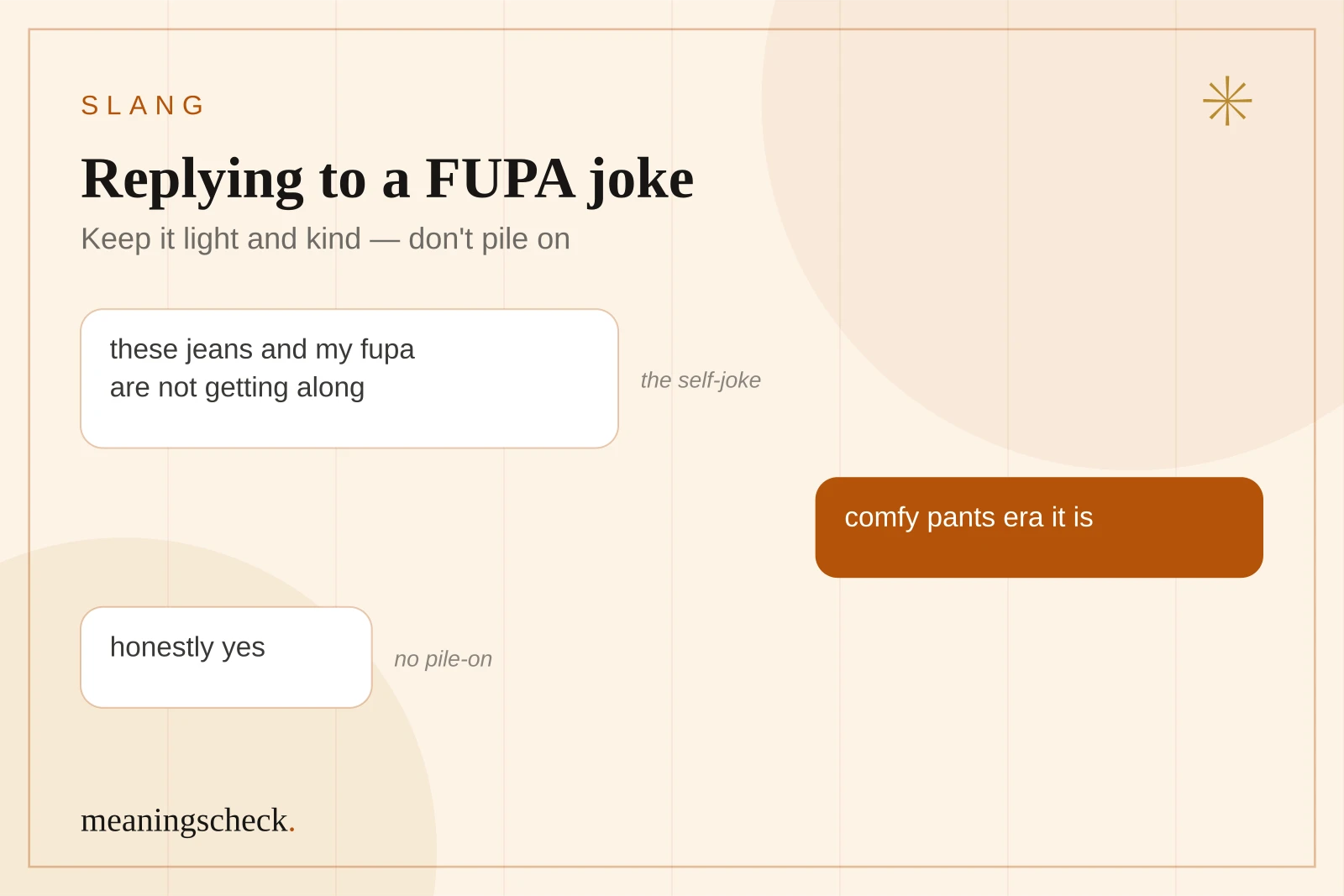
The Short Answer: If a friend jokes about their own FUPA, keep it light and kind — don't pile on. If someone uses it about you, set a clear boundary. If someone mocks a stranger's body, you don't have to laugh along.
When a Friend Jokes About Their Own
- "Lol same. Comfy pants era."
- "You look great. Those jeans are just mean."
- "Pizza night was worth it."
Avoid agreeing too hard ("yeah, it's big"). They're joking. They're not asking for a review.
When Someone Says It About You
- "Not a fan of comments about my body."
- "Let's leave my FUPA out of this."
- "That's a weird thing to say about someone."
When Someone Mocks Someone Else
- "Kinda harsh, no?"
- "We don't need to roast people's bodies."
- Or just don't react. Silence can be its own message.
FUPA and Clothing: What Actually Feels Comfortable
The Short Answer: There's no "right" way to dress a lower belly. Many people find high-rise or mid-rise waistbands, stretchy fabrics, and flowy tops more comfortable. The goal is clothes that fit your body — not hiding it.
A lot of FUPA content is really about clothing. Tight, low-rise waistbands tend to press into the lower belly. That pressure is what creates a visible fold, even on people with very little body fat.
Here's what many people find comfortable:
- High-rise jeans and trousers sit above the lower belly instead of cutting across it.
- Mid-rise styles with stretch move with you when you sit down.
- Wide, soft waistbands — like on many leggings — don't dig in.
- Wrap dresses and A-line skirts skim the area instead of clinging to it.
- Flowy or tucked-out tops feel relaxed over any waistband.
- Sizing up when a waistband pinches. Sizes vary wildly between brands. A bigger number isn't a failure.
Shapewear is optional. Some people like the smooth feel. Others find it uncomfortable. Either choice is fine.
| Clothing Choice | Why People Like It | Watch Out For |
|---|---|---|
| High-rise jeans | Sits above the lower belly | Can feel snug when sitting |
| Stretch leggings | Wide, soft waistband | Thin fabric may roll down |
| Wrap dresses | Adjustable and forgiving | Needs a secure tie |
| Mid-rise trousers | Classic, comfortable fit | Rigid fabric may dig in |
| Shapewear | Smooth look under clothes | Can feel tight or hot |
Key takeaway: If your jeans make you feel bad about your FUPA, the jeans are probably the problem.
Is FUPA NSFW?
The Short Answer: No, FUPA isn't explicit. It describes an area near the pubic bone, though. Some people find it a little crude. It's fine in most casual chats but best avoided at school, at work, and around people you don't know well.
The word refers to anatomy — not to anything sexual. You'll hear it on talk shows, in fitness videos, and in everyday conversation.
Still, it names a body area right next to the genitals. That makes some people uncomfortable. Some school and work filters may also flag it. Treat it like other body slang: fine with friends, awkward in a meeting.
If you're not sure whether something counts as safe for a shared screen, our NSFW meaning guide explains what typically gets that label.
How to Talk About Your Body Without Putting Yourself Down
The Short Answer: You can joke about your FUPA and still be kind to yourself. Try neutral words, notice when jokes turn into criticism, and talk about what your body does rather than only how it looks.
Self-deprecating humor is everywhere online. A little of it can be healthy. Constant put-downs, though, can shape how you feel about yourself.
Here are a few small shifts that help:
- Use neutral words. "My lower belly" sounds different from "my disgusting FUPA."
- Notice the pattern. One joke is fine. Ten a day might be worth a second look.
- Focus on function. Your core helps you stand, lift, carry, and move.
- Skip the comparison. Edited photos aren't a fair benchmark.
- Talk to someone. If body worries take up a lot of your day, a doctor or counselor can help.
People often soften body talk with hedge words, too. "lwk hate how these jeans fit" is gentler than a flat statement. That quiet hedge is explained in our LWK meaning guide.
FUPA Across Different Communities
| Community | How FUPA Is Used | Typical Tone |
|---|---|---|
| Fitness | "Lower belly routine" or "FUPA workout" | Motivational, sometimes misleading |
| New parents | Post-pregnancy body talk | Honest, supportive |
| Fashion | Fit and comfort tips | Practical |
| Body positivity | Reclaiming the word | Confident, neutral |
| Comment sections | Mocking strangers | Harsh, body-shaming |
Real-World Examples: FUPA in Everyday Conversations
The Short Answer: FUPA comes up in shopping trips, gym chats, post-pregnancy talk, and group-chat roasts. Each situation calls for a different response. These examples show what the speaker usually means and how to answer kindly.
These are typical patterns, not quotes from real people.
Shopping for Jeans
Message: "tried on 6 pairs of jeans and every single one hates my fupa"
What it means: "Shopping was frustrating. I feel a bit self-conscious."
Good reply: "Jeans are the worst. Want to try that high-rise brand together?"
The reply blames the jeans — not the body — and offers help.
At the Gym
Message: "doing ab workouts every day to get rid of my fupa"
What it means: "I want my lower belly to look flatter."
Good reply: "Strong core is great! Just know ab work alone won't shrink one spot."
You're sharing useful info without judging their goal.
After Having a Baby
Message: "still have the postpartum fupa and it's been a year"
What it means: "I'm frustrated with how my body changed."
Good reply: "Your body did something huge. If it bugs you, a doctor can check for muscle separation too."
This is a sensitive moment. Warmth matters more than tips.
In a Group-Chat Roast
Message: "look at the fupa on this guy 💀" (with a stranger's photo)
What it means: "Let's laugh at this person's body."
Good reply: "Nah, leave him alone lol." Or simply don't join in.
Roasting strangers' bodies can spread fast. Not adding fuel is a quiet way to push back.
| Situation | What the Speaker Feels | Best Reply Style |
|---|---|---|
| Jeans shopping | Frustrated, self-conscious | Blame the clothes, offer help |
| Gym goals | Motivated | Support plus accurate info |
| After pregnancy | Frustrated or sad | Warmth first, tips second |
| Roasting a stranger | Looking for laughs | Don't join in |
Expert Insights: Why Body Slang Like FUPA Sticks
The Short Answer: Acronyms like FUPA make an awkward body part easy and funny to talk about. That's useful for self-jokes. It also makes mocking others feel casual. Research on weight stigma shows that teasing about bodies can have real costs.
Acronyms Soften Awkward Topics
Talking about the area above the pubic bone feels awkward. "Mons pubis" sounds clinical. Describing it in full sounds clumsy. An acronym fixes both problems. FUPA sounds short, silly, and almost cute.
That's a classic language pattern. People invent playful or abbreviated words for topics that feel taboo — bodies, bathrooms, money, death. The playful form makes the topic easier to say out loud.
The Downside: Easy Words Make Easy Insults
The same quality that makes FUPA easy to joke about makes it easy to aim at others. A short, funny word lowers the bar for commenting on someone's body. That's why FUPA appears so often in comment-section pile-ons.
Weight Stigma Has Real Effects
Researchers who study weight stigma — including Rebecca Puhl of the UConn Rudd Center for Food Policy and Health — have found that weight-based teasing and shaming are linked to stress, lower self-esteem, and avoiding exercise or medical care. In other words, mocking someone's body rarely motivates them. It often does the opposite.
Self-Deprecation as Armor
Why do people joke about their own FUPA? Often, it's a way to beat others to the punch. If you make the joke first, nobody else can use it against you. It can also be a genuine bonding move — "we all have one."
There's nothing wrong with that. But if your self-jokes start to feel more like self-criticism, it might be worth noticing.
Body Neutrality and Reclaiming the Word
Some creators now use FUPA in a body-neutral or body-positive way: "my FUPA and I are fine, thanks." Body neutrality focuses on what your body does rather than how it looks. In that framing, FUPA becomes just another word — not an insult.
Real-World Patterns of FUPA
- Holiday jokes: "Post-Thanksgiving FUPA" posts appear every November.
- Fitness marketing: "FUPA-burning" workouts promise more than exercise science supports.
- Fashion content: Creators share jeans and leggings that feel comfortable with a fuller lower belly.
- Celebrity mockery: Public figures' bodies get labeled with #FUPA, continuing the term's earliest pattern.
Is FUPA Appropriate at Work or in Professional Settings?
The Short Answer: No. FUPA is casual slang about bodies. It doesn't belong in work conversations, emails, or professional content. In medical or fitness settings, use "lower abdomen," "mons pubis," or "lower belly" instead.
Bodies aren't a workplace topic, and slang about bodies even less so. Commenting on a coworker's body can create real HR problems.
| Casual | Professional Alternative |
|---|---|
| "FUPA workout" | "Lower-abdominal strength routine" |
| "my fupa" | "my lower belly" (if you must mention it at all) |
| "FUPA fat" | "Lower abdominal fat" |
| "FUPA surgery" | "Monsplasty" or "pubic lift" |
If you're a fitness coach, writer, or health professional, stick to neutral terms. They're clearer and more respectful.
Other Meanings of FUPA
The Short Answer: Almost every time you see FUPA, it means "fat upper pubic area." The name has also been borrowed for a small meme cryptocurrency. That use is rare. Context makes the meaning obvious.
| Context | FUPA Means | Example |
|---|---|---|
| Slang | Fat upper pubic area | "my fupa after brunch" |
| Fitness | Lower-belly fat | "lower belly / FUPA routine" |
| Crypto (rare) | FupaCoin, a meme coin | "anyone holding FupaCoin?" |
Common Mistakes People Make With FUPA
The Short Answer: The most common mistakes are using it about other people, believing spot-reduction workouts will erase it, thinking it means you're unhealthy, and using it in professional settings.
- Using it about someone else. That's body-shaming, even as a "joke."
- Believing "FUPA-burning" workouts. Spot reduction doesn't work like that.
- Assuming it means you're unhealthy. It's a normal area of the body.
- Confusing it with diastasis recti. A post-pregnancy bulge might be a muscle issue.
- Using it at work. Stick to neutral terms.
- Oversharing. Detailed body talk can be a lot for some people — the kind of moment covered in our TMI meaning guide.
Frequently Asked Questions (FAQs)
What does FUPA stand for?
FUPA stands for "fat upper pubic area." Some people say "fat upper pelvic area." It's slang for extra fat just above the pubic bone.
What is the medical term for FUPA?
The area is called the mons pubis. A hanging fold of lower-belly skin and fat is called a pannus or panniculus.
Is FUPA a bad word?
It's not a swear word. But it can be hurtful when used about someone else's body. Using it about yourself is usually harmless.
What causes a FUPA?
Common causes include genetics, aging, hormone changes, pregnancy, and weight gain or loss. Your genes largely decide where you store fat.
Can exercise get rid of a FUPA?
Not by targeting that spot alone. Overall fat loss can shrink the area, while ab exercises strengthen the muscles underneath. Genetics still matter.
Do men have FUPAs?
Yes. Anyone can have extra fat above the pubic bone. The Cleveland Clinic notes that men can also have a monsplasty.
Is a FUPA normal?
Yes. Everyone has some fatty tissue over the pubic bone. Its size varies and it's usually not a medical issue on its own.
What is the difference between a FUPA and a muffin top?
A FUPA sits just above the pubic bone. A muffin top is fat that spills over a tight waistband, usually at the sides and front.
Is FUPA NSFW?
No. FUPA isn't explicit, though it names an area near the pubic bone. It's fine in casual chats but best avoided at school and work.
How do you pronounce FUPA?
It's pronounced "FOO-puh." The plural is FUPAs.
Final Thoughts
FUPA is four letters for a body part almost everyone has. It can be a relatable joke about pizza night, a fitness buzzword, or a careless insult — and the difference comes down to who it's aimed at.
The area itself is normal. The mons pubis holds fat by design. Genes, age, hormones, and life changes like pregnancy all shape how it looks. And no workout video can rewrite your genes in seven days.
So use the word with care. Joke about yourself if it helps. Skip the comments about everyone else. For more slang explained the same way, explore our internet slang guides.
Related terms
Share: · Post on X
Written by MeaningsCheck Team · Published
The MeaningsCheck team researches and writes plain-language explanations of slang, abbreviations, and everyday words — checked for accuracy, updated as language changes.