
What Does TTC Mean? TTC Meaning in Text, Fertility Forums, and Toronto (2026)
TTC most often stands for "trying to conceive" — actively trying to get pregnant. You'll see it on fertility forums, Instagram, TikTok, and in texts, as in "We've been TTC for six months." In Toronto, TTC also means the Toronto Transit Commission, the city's public transit system.
TTC usually means "trying to conceive." It's shorthand for actively trying to get pregnant. When a friend says "we're TTC" or a post is tagged #TTC, they're talking about their journey toward having a baby.
That's the meaning you'll see most in texts, forums, and social media. But if you're in Toronto, TTC almost always means something else entirely: the Toronto Transit Commission, the city's subway, streetcar, and bus system.
So if you're wondering what does TTC mean, context is everything. This guide covers the TTC meaning in text, the fertility acronyms that travel with it (like BFP, AF, and TWW), how to respond when someone tells you they're TTC, when doctors suggest getting checked, and every other meaning of TTC.
Key takeaway: In personal messages and fertility communities, TTC means "trying to conceive." In Toronto, it means the transit system. Rarely, it means something else.
This article explains an abbreviation. It isn't medical advice. Talk to a doctor about fertility questions.
Executive Summary: TTC at a Glance
Here's the quick version:
- Main meaning: "Trying to conceive" — actively trying to get pregnant.
- Where you'll see it: Fertility forums, Reddit, Instagram, TikTok, Facebook groups, and fertility-tracking apps.
- Common companions: BFP (positive test), BFN (negative test), AF (period), TWW (two-week wait), DPO (days past ovulation).
- Other big meaning: The Toronto Transit Commission, which has run Toronto's public transit since 1921.
- Rare meaning: Dictionary.com also lists "text the cell" as a textspeak use.
- Tone: Personal and often emotional. Respond with care.
What Does TTC Mean? The Core Definition
The Short Answer: TTC stands for "trying to conceive." People use it when they're actively trying to get pregnant, whether naturally or with fertility treatment. It's common in fertility communities and personal conversations, like "We've been TTC for a year."
The Literal Translation
The TTC meaning comes straight from its letters:
- T — Trying
- T — To
- C — Conceive
"Conceive" means to become pregnant. So "TTC" describes the whole stage of trying for a baby — from tracking cycles to taking pregnancy tests to, for some people, fertility treatment.
How People Use It
TTC works as a noun, an adjective, and a status:
- "We're TTC." (a status)
- "Day 40 of my TTC journey." (a noun phrase)
- "Any TTC friends want to swap tips?" (an adjective)
- "TTC #2" means trying for a second child.
Who Uses TTC?
You'll see TTC most often from:
- People and couples trying to get pregnant.
- Fertility communities on Reddit, Facebook, Instagram, and TikTok.
- Fertility-tracking apps and clinic blogs.
- Friends and family sharing updates with each other.
Dictionary.com notes that the trying-to-conceive meaning is especially common in fertility discussion spaces. Outside those spaces, the transit meaning often wins.
Where Did TTC Come From?
The Short Answer: TTC grew out of online pregnancy and fertility message boards, where people needed quick, discreet ways to talk about cycles, tests, and treatment. A whole vocabulary of acronyms formed around it. Today it's standard on social media and fertility apps.
Online fertility communities have existed almost as long as message boards themselves. People going through the same thing found each other online — often because they didn't feel comfortable discussing it in person.
Those forums developed their own shorthand. Typing "trying to conceive" over and over got old. So did spelling out sensitive topics. Acronyms solved both problems. They were faster. They were also more discreet.
TTC became the umbrella term. Around it grew dozens of related acronyms — some medical (IVF, IUI), some playful (AF, for "Aunt Flo"), and some emotional (BFP, the long-hoped-for "big fat positive").
As fertility conversations moved to Instagram, TikTok, and Reddit communities like r/TryingForABaby, the vocabulary moved with them. Today you'll see #TTC and #ttccommunity on thousands of posts.
The TTC Glossary: Acronyms You'll See With TTC
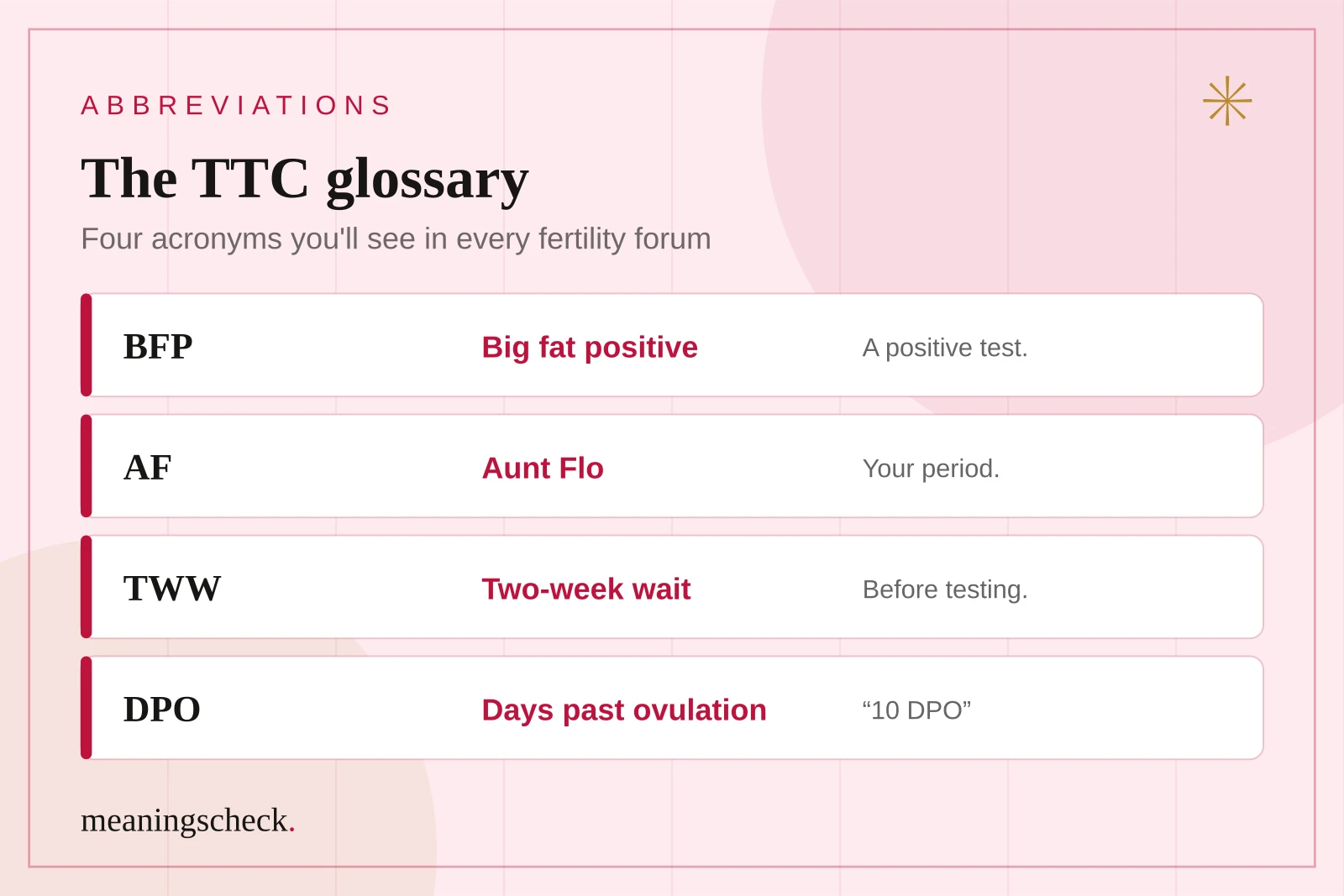
The Short Answer: TTC comes with its own vocabulary. The most common terms are BFP (positive pregnancy test), BFN (negative test), AF (period), TWW (the two-week wait before testing), DPO (days past ovulation), and OPK (ovulation test).
If you've joined a fertility group, you've probably felt like you needed a dictionary. Here are the terms you'll see most:
| Acronym | Stands For | What It Means |
|---|---|---|
| BFP | Big fat positive | A positive pregnancy test |
| BFN | Big fat negative | A negative pregnancy test |
| AF | Aunt Flo | Your period |
| TWW / 2WW | Two-week wait | The time between ovulation and testing |
| DPO | Days past ovulation | "10 DPO" = 10 days after ovulating |
| CD | Cycle day | CD1 is the first day of your period |
| O | Ovulation | "Just O'd" = just ovulated |
| OPK | Ovulation predictor kit | A test that detects the hormone surge before ovulation |
| HPT | Home pregnancy test | A urine test that detects hCG |
| POAS | Pee on a stick | Taking a home pregnancy test |
| BBT | Basal body temperature | Your resting temperature, tracked to spot ovulation |
| BD / DTD | Baby dance / doing the deed | Sex during the fertile window |
Treatment Terms
| Acronym | Stands For | What It Means |
|---|---|---|
| IVF | In vitro fertilization | Eggs are fertilized in a lab, then an embryo is transferred |
| IUI | Intrauterine insemination | Washed sperm is placed directly into the uterus |
| RE | Reproductive endocrinologist | A fertility specialist doctor |
| ET | Embryo transfer | Placing an embryo into the uterus during IVF |
| Beta | Beta hCG blood test | A blood pregnancy test, often after IVF |
| Frostie | Frozen embryo | An embryo frozen for a later cycle |
Community and Emotional Terms
- Baby dust: A good-luck wish — "sending baby dust your way!"
- Rainbow baby: A baby born after a pregnancy or infant loss.
- TTCAL: Trying to conceive after loss.
- TTCAR: Trying to conceive after a reversal procedure.
- NTNP: Not trying, not preventing — a relaxed "if it happens, it happens" stage.
- BOB: Baby on the brain.
- MC: Miscarriage.
- CB: Cycle buddy — someone on a similar cycle timeline.
A Typical TTC Cycle, Explained in Acronyms
The Short Answer: A TTC cycle usually runs from CD1 (the first day of a period) through ovulation, the two-week wait, and a pregnancy test. Each stage has its own acronym, which is why TTC posts can look like code to outsiders.
General information only. Every body is different, and cycle lengths vary.
Once you know the stages, posts like "CD14, +OPK, 12 DPO, BFN" start to make sense. Here's how a cycle is often described in TTC communities:
- CD1 — AF arrives. The first day of a period is cycle day 1. Many people "reset" their tracking here.
- Tracking begins. Some people chart BBT each morning. Others use OPKs to watch for the hormone surge that comes before ovulation.
- O — Ovulation. A positive OPK often comes a day or so before ovulation. People call the days around it the fertile window.
- TWW — The wait. After ovulation comes the two-week wait. Posts start counting DPO.
- POAS — Testing. Around the expected period, people take a home pregnancy test.
- BFP or BFN. A positive means pregnancy. A negative — or AF arriving — starts a new cycle.
| Stage | Acronyms You'll See | Example Post |
|---|---|---|
| Period starts | CD1, AF | "AF showed up. CD1 again." |
| Tracking | BBT, OPK, CM | "CD12, OPK getting darker" |
| Ovulation | O, +OPK, BD | "Positive OPK today!" |
| Waiting | TWW, DPO | "8 DPO and going crazy" |
| Testing | POAS, HPT | "POAS this morning…" |
| Result | BFP, BFN | "BFN at 14 DPO 😞" |
Cycle lengths and ovulation timing differ from person to person. That's why fertility apps and doctors focus on your pattern, not an average.
TTC Meaning in Text: How to Read It
The Short Answer: In a text, TTC almost always means someone is trying to get pregnant. It's personal news. If a friend shares it, they're trusting you. Respond with warmth, not advice or pressure.
When a Friend Tells You
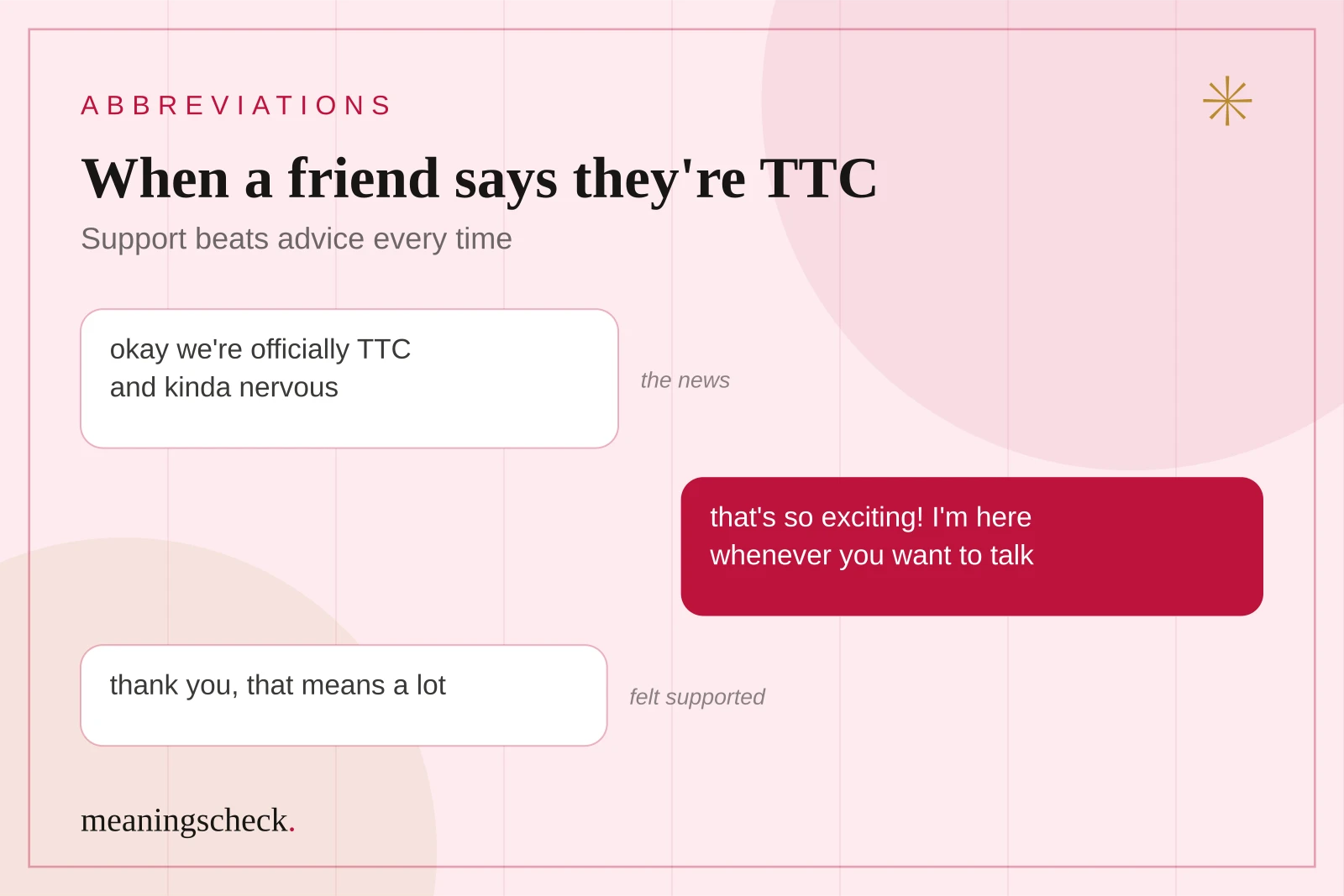
Message: "Okay, don't tell anyone. We're officially TTC 🤞"
What it means: "We're trying for a baby, and I wanted you to know."
This is big, personal news. A warm reply works best: "That's so exciting! I'm rooting for you."
When Someone Shares a Hard Update
Message: "TTC is wearing me down. Another BFN this month."
What it means: "We're still trying. This month's test was negative. I'm sad."
This isn't a moment for tips. "I'm so sorry. That's really hard. I'm here" goes a long way.
When It's a Status in a Bio
On Instagram or TikTok, "TTC" or "TTC #2" in a bio means the person is open about their fertility journey. They often share updates, tips, and emotions with a community.
| Message | What It Means | Good Response |
|---|---|---|
| "We're TTC!" | Excited news | "So happy for you!" |
| "TTC month 8, still BFN" | Discouraged | "I'm sorry. I'm here for you." |
| "Finally a BFP after a year TTC" | A positive test | "Oh my gosh, congratulations!" |
| "TTCAL, trying again" | Trying after a loss | "Thinking of you. Wishing you the best." |
| "We're NTNP for now" | Relaxed, not actively trying | "Love that. No pressure." |
Key takeaway: When someone shares that they're TTC, they're sharing something personal. Support beats advice every time.
TTC on Instagram, TikTok, Reddit, and Apps
The Short Answer: On Instagram and TikTok, #TTC connects people sharing their fertility journeys. On Reddit, communities like r/TryingForABaby offer support and practical tips. Fertility-tracking apps use TTC to describe their "trying to conceive" modes.
TTC on Instagram
On Instagram, TTC appears in bios, captions, and hashtags. Accounts share cycle updates, treatment milestones, and encouragement. "TTC sisters" and "TTC community" are common phrases.
TTC on TikTok
On TikTok, #ttc and #ttccommunity videos cover everything from test-day reactions to IVF diaries. Pregnancy announcements after long journeys often go viral.
TTC on Reddit
On Reddit, communities such as r/TryingForABaby are known for detailed discussions — charts, symptoms, and support threads. The acronym-heavy posts there are a big reason many people search "what does TTC mean" in the first place.
TTC in Fertility Apps
Many cycle- and fertility-tracking apps offer a "trying to conceive" or "TTC" mode. These modes focus on predicting fertile days rather than avoiding pregnancy.
| Platform | How TTC Shows Up | Example |
|---|---|---|
| Bios, captions, hashtags | "TTC #2 🌈" | |
| TikTok | Hashtags and video diaries | "#ttc test day reaction" |
| Community threads | "12 DPO, BFN, still hopeful?" | |
| Facebook groups | Private support groups | "New here, TTC for 6 months" |
| Fertility apps | A tracking mode | "Switch to TTC mode" |
| Texts | Personal news | "We're TTC 🤞" |
How to Reply When Someone Says They're TTC
The Short Answer: Be warm, be private, and skip the advice. Say something like "I'm rooting for you" or "I'm here if you ever want to talk." Avoid "just relax," pregnancy questions, or sharing their news without permission.
Supportive Replies
- "I'm so happy for you. Rooting for you!"
- "Thanks for trusting me with this. I'm here anytime."
- "Want to talk about it, or should I just send good vibes?"
- "Baby dust your way! ✨"
Things to Avoid Saying
- "Just relax and it'll happen." It can feel dismissive.
- "Have you tried…?" Unless they ask, skip the tips.
- "Are you pregnant yet?" Let them share news when they're ready.
- "At least you can…" Comparisons rarely help.
- Telling others. Their news is theirs to share.
If They Share Bad News
Fertility journeys can include negative tests, losses, and treatment setbacks. If someone shares something painful, simple words work:
- "I'm so sorry. That's really hard."
- "No need to reply. Just know I'm thinking of you."
- "Do you want company, or space?"
Sometimes people overshare when they're overwhelmed — and that's okay. A close friend is exactly who they should feel safe sharing with, even if it feels like TMI. Our TMI meaning guide covers how to respond to big personal disclosures with kindness.
TTC Meaning From a Girl or a Guy
The Short Answer: TTC means the same thing from anyone: they're trying to have a baby. Women post about it most visibly. Partners and men are TTC too. "We're TTC" from a guy usually means he and his partner are trying together.
When a Woman Says TTC
Women are the most visible voices in TTC communities. They often share cycle tracking, test results, and treatment updates. If a female friend says she's TTC, she's sharing something personal — and possibly something she's been thinking about for a long time.
When a Man Says TTC
Men use TTC too, usually as "we": "We've been TTC for a year." Fertility is a two-person story for many couples. Male fertility testing — often a semen analysis (SA) — is a standard part of a fertility workup.
Some men say they feel left out of TTC conversations. A friend asking "How are you doing with all of it?" can mean a lot.
When It Comes Up in Dating
On dating apps or early dates, TTC rarely comes up directly. When someone mentions "I want kids someday," they're describing a goal — not that they're TTC. Being TTC usually describes a committed partnership or a solo parenting plan.
TTC for LGBTQ+ Couples and Solo Parents
The Short Answer: TTC isn't only for heterosexual couples. LGBTQ+ couples and single people who choose solo parenthood use TTC too — often with donor sperm, IUI, IVF, or surrogacy. Their journeys come with extra steps and their own vocabulary.
Many people building families use the same TTC language:
- Same-sex female couples may use donor sperm with IUI or IVF. Some do reciprocal IVF, where one partner's egg is carried by the other.
- Same-sex male couples may build families through surrogacy with an egg donor.
- Solo parents by choice often use donor sperm or donor eggs.
- Trans and nonbinary people may also be TTC, with medical guidance tailored to them.
Their communities share many of the same acronyms — BFP, TWW, beta — plus terms like known donor and gestational carrier. The emotional ups and downs are just as real.
How to Support a Friend or Partner Who's TTC
The Short Answer: Listen more than you advise, remember important dates gently, follow their lead on how much they want to talk, and keep their news private. Small, steady support matters more than perfect words.
Knowing someone is TTC can leave you unsure what to say. Here's what people in fertility communities often say helps most:
- Listen first. "Do you want advice, or do you just want to vent?" is a great question.
- Follow their lead. Some people love updates. Others want TTC to be a no-go topic.
- Remember the hard days. A quiet "thinking of you" around a test day or appointment means a lot.
- Be thoughtful with your own news. If you're pregnant, consider telling them privately first. A text lets them react on their own time, away from an audience.
- Offer practical help. A ride to an appointment or a distraction night out can be more useful than words.
- Keep it private. Never share their journey without permission.
Many TTC posts are full of careful hope — "lwk feeling good about this cycle" — the kind of quiet hedge our LWK meaning guide explains. Match that energy. Be hopeful with them, without adding pressure.
| If They Say… | Try Saying… |
|---|---|
| "Another BFN." | "I'm so sorry. Want to talk or want a distraction?" |
| "We're starting IVF." | "That's a big step. I'm cheering for you." |
| "I don't want to talk about it." | "Totally okay. I'm here whenever." |
| "We got a BFP!" | "I'm so happy for you!" |
TTC vs. NTNP, TTCAL, and Other Stages
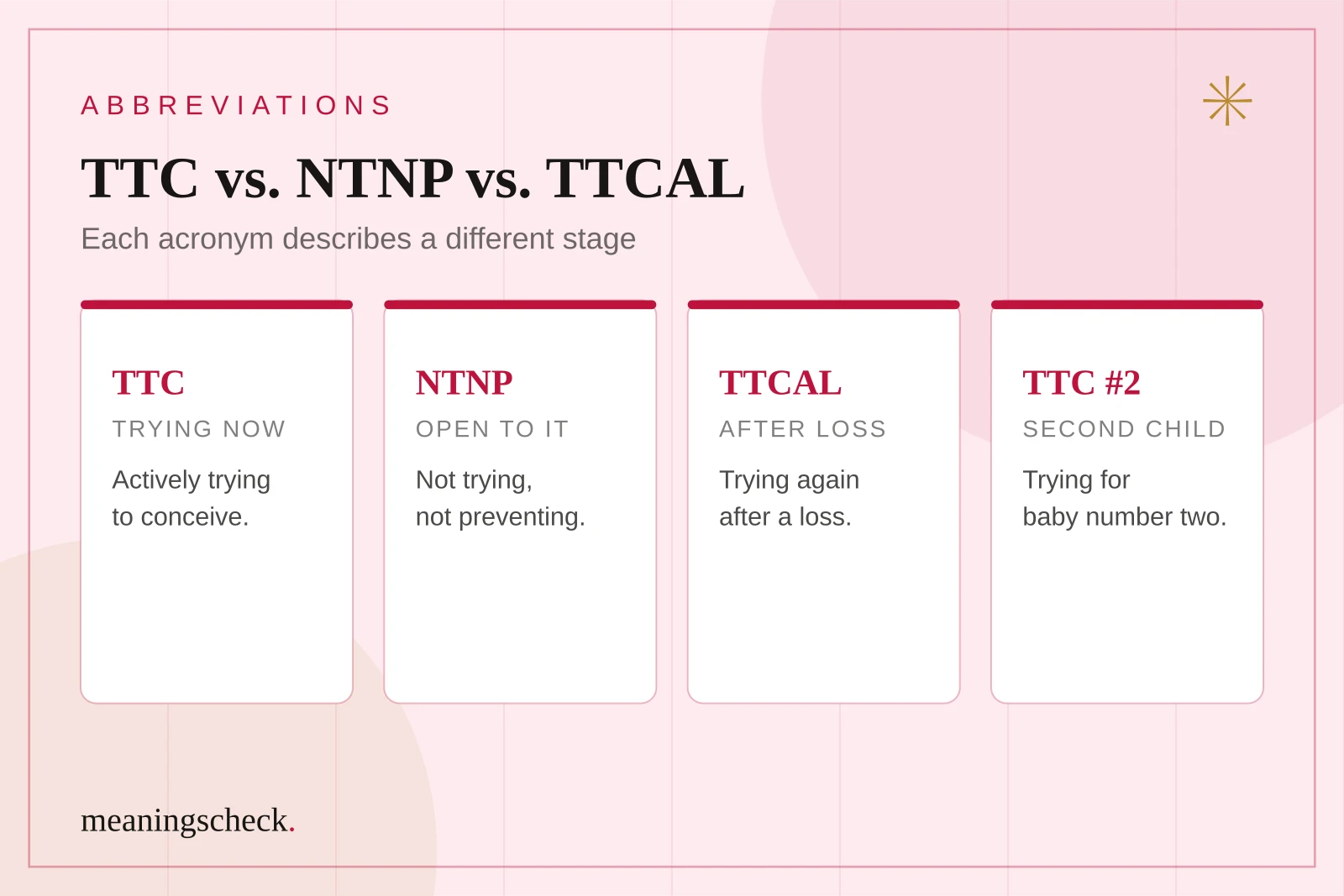
The Short Answer: TTC means actively trying. NTNP means "not trying, not preventing" — open to pregnancy without actively planning. TTCAL means trying after a loss, and TTCAR means trying after a reversal procedure.
People use slightly different acronyms to describe exactly where they are:
| Term | Stands For | What It Means |
|---|---|---|
| TTC | Trying to conceive | Actively trying to get pregnant |
| NTNP | Not trying, not preventing | Open to it, not actively planning |
| TTCAL | Trying to conceive after loss | Trying again after a miscarriage or loss |
| TTCAR | Trying to conceive after reversal | Trying after reversing a sterilization procedure |
| TTC #2 | Trying for a second child | Expanding the family |
| BOB | Baby on the brain | Thinking about a baby constantly |
These distinctions matter in communities. Someone who's NTNP may not want detailed ovulation tips. Someone who's TTCAL may need extra sensitivity.
How Long Does TTC Take, and When Should You See a Doctor?
The Short Answer: Many people conceive within a year of trying. The American Society for Reproductive Medicine (ASRM) suggests seeing a doctor after 12 months of trying if you're under 35, or after 6 months if you're 35 or older — sooner if you have known risk factors.
This section is general information, not medical advice.
General Guidelines
According to the American Society for Reproductive Medicine (ASRM), infertility is generally defined as not achieving pregnancy after 12 months of regular unprotected sex. For women 35 and older, ASRM says evaluation is warranted after 6 months.
ASRM's patient materials also suggest seeing a specialist sooner if there are known factors such as:
- Irregular or absent periods.
- A history of PCOS or endometriosis.
- Possible fallopian tube problems, such as a history of pelvic inflammatory disease.
- A known issue with sperm in a male partner.
How Common Is Infertility?
Fertility struggles are more common than many people realize. In 2023, the World Health Organization reported that about 1 in 6 people worldwide experience infertility at some point in their lives.
That's one reason TTC communities matter. Many people feel alone until they find others going through the same thing.
Who to See
| Situation | Who Can Help |
|---|---|
| Just starting to try | A primary care doctor or OB/GYN |
| Trying for 12 months (under 35) | OB/GYN or a reproductive endocrinologist (RE) |
| Trying for 6 months (35+) | OB/GYN or a reproductive endocrinologist (RE) |
| Concerns about sperm | A reproductive urologist |
| Emotional strain | A counselor who specializes in fertility |
The Emotional Side of TTC
The Short Answer: TTC can be exciting and exhausting at the same time. The two-week wait, negative tests, and pressure from others can take a toll. Fertility communities, counseling, and supportive friends make a real difference.
TTC isn't just a medical process. It's an emotional one.
The Two-Week Wait
The TWW — the days between ovulation and a reliable pregnancy test — is famously stressful. Many people analyze every twinge. Communities are full of "symptom spotting" posts during this time.
Clinic guides often note that testing too early can give a false negative. Many suggest waiting until at least the day of a missed period for the most reliable result.
Comparison Fatigue
Social media can make TTC harder. Feeds fill up with pregnancy announcements, gender reveals, and baby photos. Many people in TTC communities say they mute certain words or accounts for a while. That's not jealousy. It's self-protection — and it's completely okay.
Hope and Disappointment
Each cycle brings hope. Each BFN can bring disappointment. Over months, that cycle can wear people down — which is why so many turn to online communities for support.
The Pressure From Others
Questions like "So when are you having kids?" can sting for someone who's TTC. Many people in fertility communities say they wish others would simply stop asking.
Key takeaway: You never know who's TTC. Skip the "when are you having kids?" questions.
TTC Etiquette in Online Communities
The Short Answer: TTC groups have unwritten rules: read the group guidelines, use content warnings for pregnancy announcements and loss, don't diagnose others, and keep tests and symptoms in the right threads. Kindness comes first.
Online TTC communities can be wonderful. They also have norms that keep everyone feeling safe:
- Read the rules first. Many groups have specific threads for test photos, announcements, or loss.
- Use content warnings. Pregnancy announcements can be painful for people who've been trying for years. Many groups ask members to label them — similar to how NSFW tags warn people about sensitive content, as our NSFW meaning guide explains.
- Don't diagnose. "That sounds like PCOS" from a stranger can cause real worry. Point people to a doctor instead.
- Celebrate carefully. A BFP is joyful. It's also hard news for someone on their twentieth BFN. Sensitive groups often have separate "graduation" spaces.
- Respect privacy. Don't screenshot or share others' posts.
| Do | Don't |
|---|---|
| Use the group's acronyms and threads | Post test photos in the wrong thread |
| Add content warnings for loss and announcements | Spring pregnancy news without warning |
| Encourage people to see a doctor | Diagnose strangers |
| Share your own experience | Tell others what they "should" do |
Expert Insights: Why Fertility Communities Speak in Acronyms
The Short Answer: TTC acronyms do three jobs: they save time, protect privacy, and soften sensitive topics. Words like "Aunt Flo" and "baby dance" turn clinical or awkward subjects into gentle, shared language — a classic way communities build belonging.
Speed
Fertility conversations repeat the same concepts constantly — cycle days, tests, ovulation, treatment. Acronyms like DPO, CD, and OPK make detailed updates fast to type and easy to scan: "CD14, positive OPK, BD'd today."
Discretion
Many people aren't ready to share their fertility journey with everyone. Acronyms offer privacy in plain sight. A coworker glancing at a screen won't know what "12 DPO, BFN" means.
Softening the Sensitive
Fertility involves periods, sex, loss, and medical procedures — topics many people find awkward. Euphemisms like "Aunt Flo" (period) and "baby dance" (sex) make those topics easier to discuss. They add warmth to clinical subjects.
In-Group Language Builds Belonging
Like any specialized vocabulary, TTC lingo marks members of a community. Learning what BFP means is almost a rite of passage. It signals, "I'm one of you. I understand."
Real-World Patterns of TTC
- Update posts: "CD 21, 7 DPO, trying not to symptom spot!"
- Test-day posts: Photos of tests with "BFP?? Do you see a line?"
- Milestone posts: "One year TTC today. Still hopeful."
- Announcements: "After 2 years TTC, our rainbow baby is coming 🌈."
Is TTC Appropriate at Work?
The Short Answer: TTC is a personal topic. Most people don't share it at work. If you need time off for appointments, you can keep it general. In professional or medical writing, spell it out: "trying to conceive."
Fertility is private. You don't owe anyone at work an explanation. If you need flexibility for appointments, "I have some medical appointments coming up" is enough.
If you choose to share, that's your call. Some people find support from coworkers who've been through it too.
| Casual | Professional |
|---|---|
| "We're TTC" | "We're trying to start a family" (only if you want to share) |
| "IVF appointment" | "A medical appointment" |
| "TTC journey" | "Fertility treatment" (in medical or HR contexts) |
Other Meanings of TTC
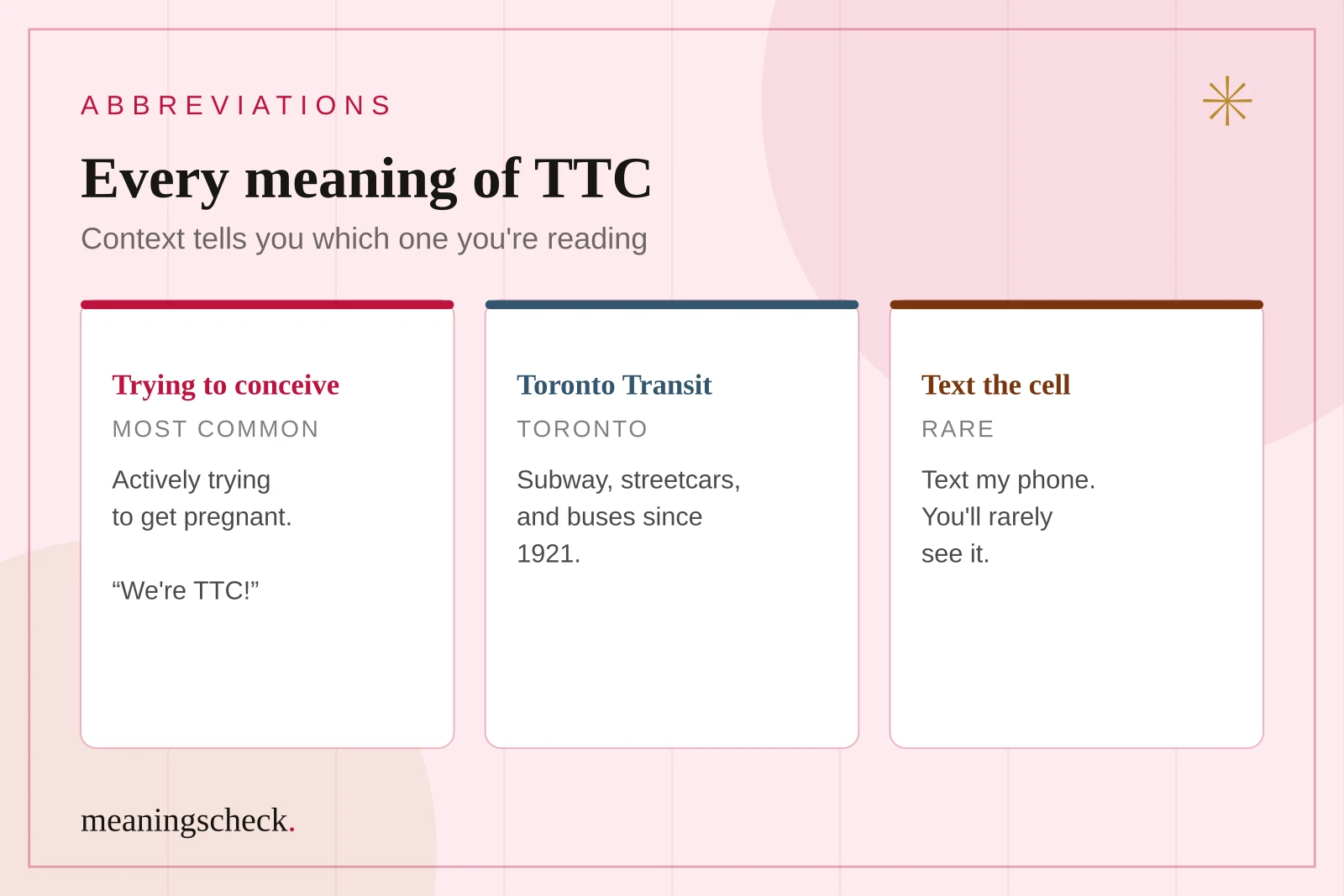
The Short Answer: Besides "trying to conceive," TTC most often means the Toronto Transit Commission — Toronto's public transit system. Dictionary.com also lists a rare textspeak meaning, "text the cell." Context almost always makes the meaning clear.
TTC: The Toronto Transit Commission
In Toronto, TTC means the Toronto Transit Commission, which runs the city's subway, streetcars, and buses. It began as the Toronto Transportation Commission on September 1, 1921, and took its current name in 1954.
If you see "TTC delays," "TTC fare," "took the TTC," or "TTC subway," it's about transit. Toronto locals use it constantly.
TTC: "Text the Cell"
Dictionary.com also lists a rare textspeak meaning: "text the cell" — as in, text my cell phone. It even calls this usage "kind of weird." You'll rarely see it.
| Context | TTC Means | Example |
|---|---|---|
| Fertility and personal texts | Trying to conceive | "We've been TTC for 6 months." |
| Toronto | Toronto Transit Commission | "The TTC is delayed again." |
| Rare textspeak | Text the cell | "ttc later" |
How to Tell Which TTC Someone Means
The Short Answer: Look at the words around it. Pregnancy, cycles, or tests point to "trying to conceive." Subway, bus, streetcar, or Toronto point to the transit system. A plain "ttc me" from a friend might be the rare "text the cell."
Here's a quick decision guide:
- Mentions of babies, cycles, tests, or months of trying? It's "trying to conceive."
- Mentions of Toronto, subways, buses, fares, or delays? It's the transit commission.
- Sounds like a request to message someone? It might be "text the cell."
- Still unsure? Ask. "Do you mean the transit TTC?" is a perfectly normal question.
If you're curious how other abbreviations shift meaning by context, our abbreviation guides cover plenty more.
Common Mistakes People Make With TTC
The Short Answer: The biggest mistakes are confusing TTC with the Toronto transit system, asking intrusive questions, offering unsolicited advice, and sharing someone's TTC news without permission.
- Mixing up the meanings. "TTC delays" isn't about fertility.
- Asking for updates. Let them share when they're ready.
- Offering unsolicited advice. "Just relax" rarely helps.
- Sharing their news. Keep it private unless they say otherwise.
- Assuming it's quick. For many people, it takes time.
If someone shares their TTC news and you want to thank them for trusting you, a warm "tysm for telling me" can be the perfect start. Our TYSM meaning guide covers how warm that little thank-you reads.
Frequently Asked Questions (FAQs)
What does TTC mean in text?
In texts, TTC usually means "trying to conceive" — actively trying to get pregnant. In Toronto, it often refers to the Toronto Transit Commission.
What does BFP mean in TTC?
BFP means "big fat positive" — a positive pregnancy test. Its opposite is BFN, "big fat negative."
What does AF mean in TTC?
AF stands for "Aunt Flo," a playful euphemism for your period. "AF arrived" means a period started.
What is the TWW?
TWW means "two-week wait" — the time between ovulation and when a pregnancy test is reliable. It's often called the most stressful part of each cycle.
What does DPO mean?
DPO means "days past ovulation." "10 DPO" means 10 days after ovulation.
What does NTNP mean?
NTNP means "not trying, not preventing." The person is open to pregnancy but isn't actively trying.
What does TTCAL mean?
TTCAL means "trying to conceive after loss." It's used by people trying again after a miscarriage or other loss.
When should you see a doctor about TTC?
ASRM suggests seeing a doctor after 12 months of trying if you're under 35, or after 6 months if you're 35 or older. See someone sooner if you have known risk factors like irregular periods.
What does TTC #2 mean?
TTC #2 means trying to conceive a second child. You'll often see it in Instagram bios and community posts.
What does POAS mean?
POAS means "pee on a stick" — taking a home pregnancy test. People often post "POAS this morning" before sharing results.
What does baby dust mean?
"Baby dust" is a good-luck wish in TTC communities. Sending baby dust means you're hoping someone gets their BFP soon.
What does TTC mean in Toronto?
In Toronto, TTC means the Toronto Transit Commission, which runs the city's subway, streetcars, and buses.
Final Thoughts
TTC is three letters that carry a lot of hope. For some people, it's a short status update. For others, it's a journey that lasts months or years — full of acronyms, test lines, and waiting.
If you see it in a friend's message, take it as trust. Respond with warmth. Skip the advice. And if you see it on a Toronto subway sign, relax — it's just the train.
Want to decode more abbreviations like this? Explore our abbreviation guides, or check out how people ask friends to reach out anytime with the HMU meaning.
Related terms
Share: · Post on X
Written by MeaningsCheck Team · Published
The MeaningsCheck team researches and writes plain-language explanations of slang, abbreviations, and everyday words — checked for accuracy, updated as language changes.