
What Does Ion Mean in Text? Ion Meaning in Slang, Snapchat, and How to Use It (2026)
In texting and slang, "ion" means "I don't." It's a spelling of how "I don't" sounds when said quickly, as in "ion know" (I don't know) or "ion care" (I don't care). In all caps, ION can occasionally mean "in other news."
In texting, "ion" means "I don't." It's how "I don't" sounds when you say it fast and casually. So "ion know" means "I don't know," "ion care" means "I don't care," and "ion think so" means "I don't think so."
If you've been wondering what does ion mean in text, you're not alone. Plenty of people read it as the chemistry word and get very confused.
Here's the thing: slang "ion" isn't an acronym. It's a phonetic spelling — a way of writing speech exactly as it sounds. Dictionary.com describes it as a spelling of "I don't" based on casual pronunciation, especially in Black English.
This guide covers the ion meaning in text, where it came from, how it compares to "ian," IDK, and IDC, what it means on Snapchat, TikTok, and Instagram, how to reply, and the other meanings of ion — from chemistry class to "in other news."
Key takeaway: In slang, "ion" = "I don't." Swap it in and the sentence makes sense: "ion know" = "I don't know."
Executive Summary: Ion at a Glance
Here's the quick version:
- Meaning: "I don't."
- Pronunciation: "EYE-on" — like saying "I don't" quickly.
- Type: A phonetic spelling, not an acronym.
- Most common phrases: "ion know," "ion care," "ion think so," "ion wanna."
- Roots: Black English (also called African American English or AAVE), according to Dictionary.com.
- Online since: At least 2007, based on early posts Dictionary.com collected.
- Other meanings: The chemistry term, "in other news" (ION), and ION Television.
- Tone: Casual. Fine with friends. Not for work emails.
What Does Ion Mean in Text? The Core Definition
The Short Answer: "Ion" means "I don't." It's a spelling of how the words sound in fast, casual speech. You'll see it before a verb: "ion know," "ion care," "ion want to go." Replace "ion" with "I don't" and the meaning is clear.
A Phonetic Spelling, Not an Acronym
Many texting terms are acronyms. IDK is "I don't know." IDC is "I don't care." Slang "ion" works differently. It's not a set of first letters. It's the sound of "I don't" written down.
Say "I don't know" fast and relaxed. The "d" and "t" in "don't" almost disappear. What's left sounds like "eye-on know." Spell that out. You get "ion know."
How People Use It
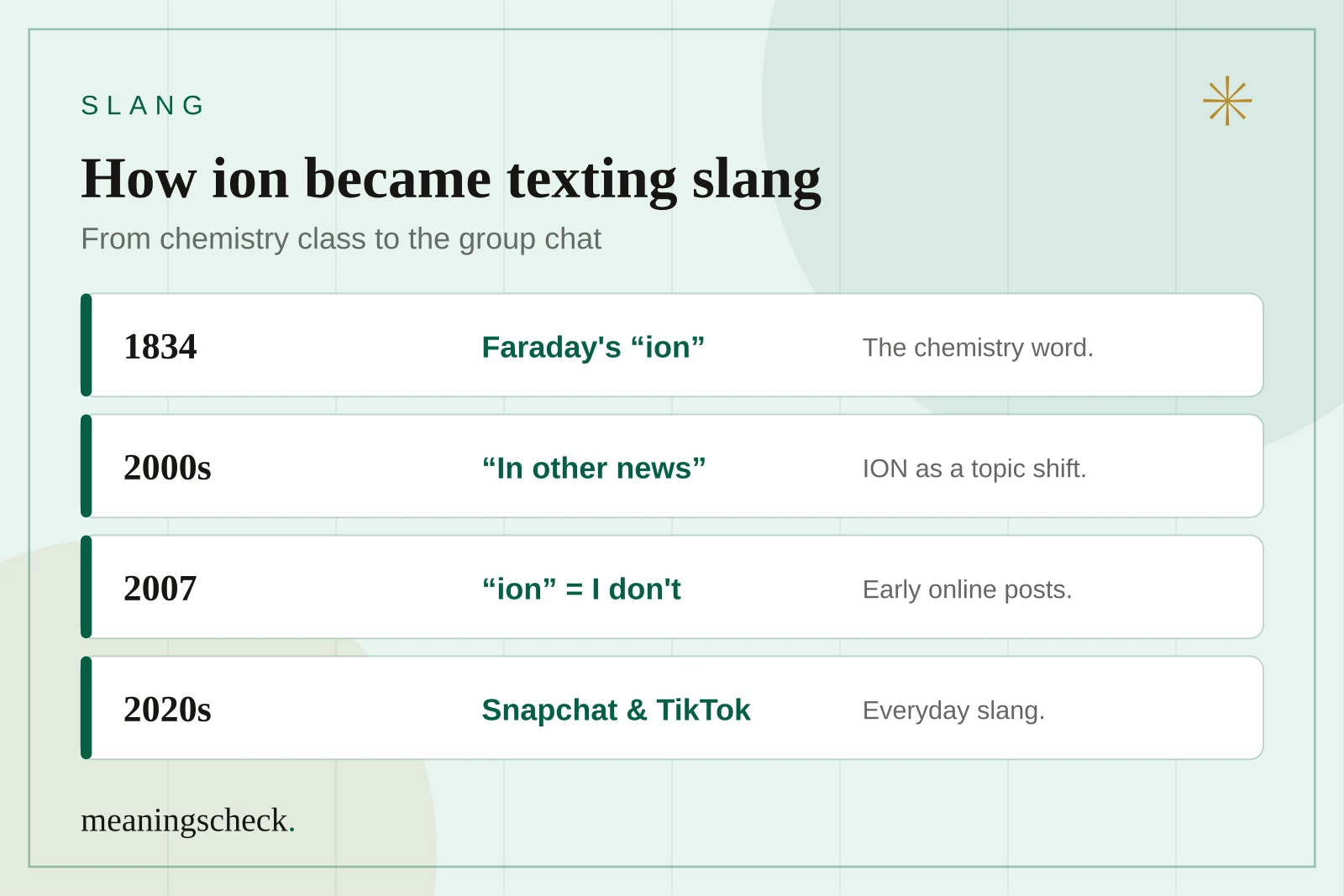
"Ion" almost always comes right before a verb:
| Phrase | Means | Example |
|---|---|---|
| ion know | I don't know | "ion know what time it starts" |
| ion care | I don't care | "ion care where we eat" |
| ion think so | I don't think so | "ion think so lol" |
| ion wanna | I don't want to | "ion wanna go out tonight" |
| ion like | I don't like | "ion like horror movies" |
| ion even know | I don't even know | "ion even know what happened" |
| ion get it | I don't get it | "ion get the hype" |
| ion mind | I don't mind | "ion mind driving" |
Pronunciation and Spelling
Slang ion sounds like "EYE-on." You'll see it written as ion, Ion (at the start of a sentence), I'on, or occasionally ION. Lowercase is most common in texts.
The all-caps ION can be confusing, though. In older internet writing, ION also meant "in other news." We'll cover that below.
Where Did "Ion" Come From?
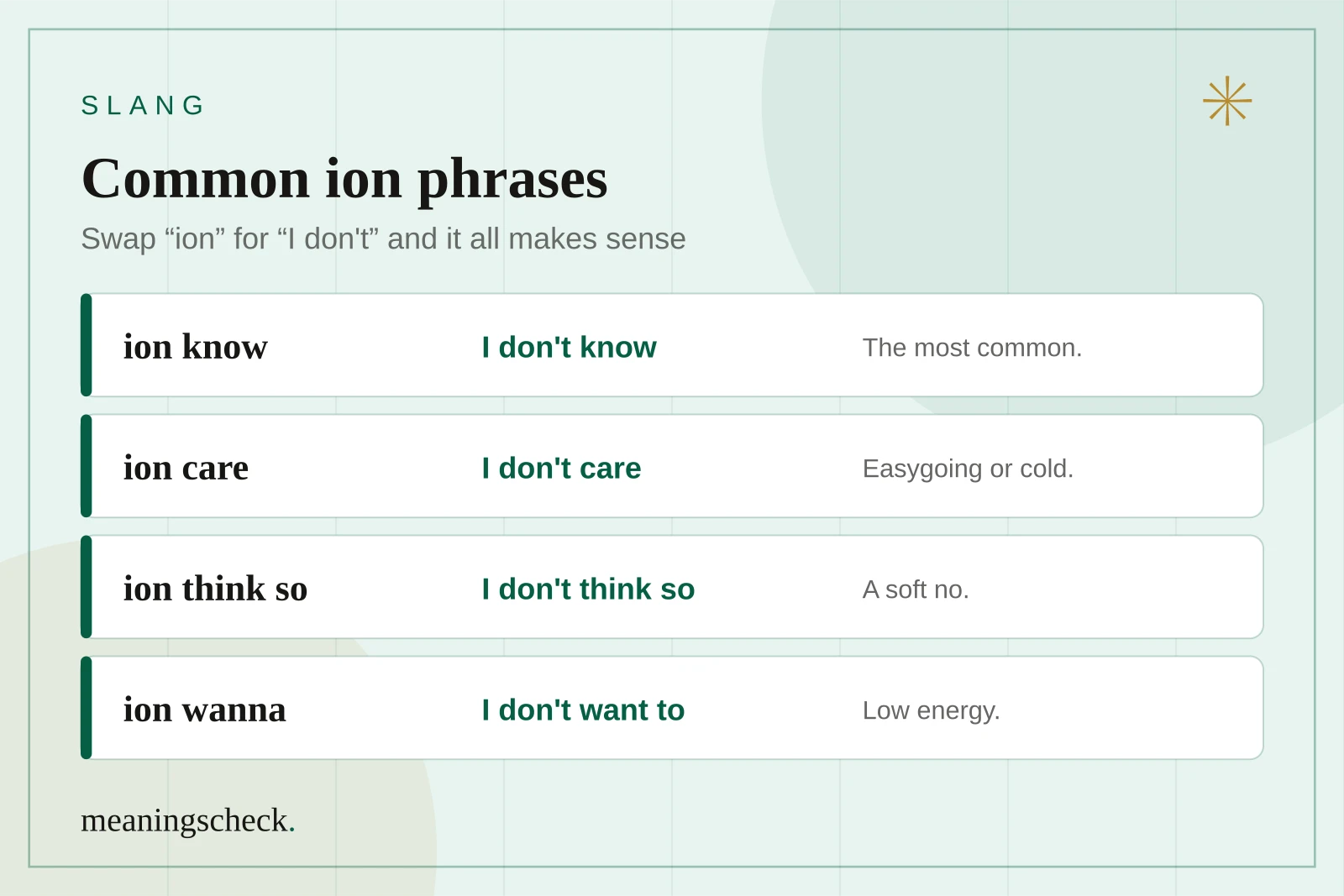
The Short Answer: "Ion" comes from the casual pronunciation of "I don't," especially in Black English. Dictionary.com found it in online writing by 2007. It spread through Twitter, rap, and later Snapchat and TikTok to become everyday texting slang.
Rooted in Black English
Dictionary.com describes "ion" as a spelling based on the colloquial pronunciation of "I don't," especially in Black English. Many other popular slang terms share those roots — including "you feel me," explained in our YFM meaning guide.
Fast, relaxed speech compresses words in every English dialect. "I don't know" becomes "I dunno" for many speakers. In Black English and many Southern varieties, it often sounds closer to "I'on know." Writing it as "ion" captures that sound.
Early Online Use
Dictionary.com's examples show "ion" in casual online writing by 2007. As Twitter grew in the late 2000s and early 2010s, the spelling became more visible. It saved characters and matched how people actually talked.
Music and Social Media
Hip-hop helped spread it further. Dictionary.com points to a 2018 song by Memphis rapper Moneybagg Yo that uses "ion" in its title. By the 2020s, "ion" was everywhere on Snapchat, TikTok, and Instagram — used by people of all backgrounds, many of whom didn't know its roots.
| Year | What Happened | Why It Matters |
|---|---|---|
| 1834 | Michael Faraday introduces the scientific word "ion" | The chemistry meaning arrives first |
| 2000s | "ION" means "in other news" in early internet slang | A second, unrelated meaning |
| 2007 | Early online posts use "ion" for "I don't" | The slang appears in writing |
| 2010s | Twitter and Instagram spread the spelling | It becomes widely recognizable |
| 2018 | A Moneybagg Yo track uses "ion" in its title | Music boosts visibility |
| 2020s | Snapchat and TikTok make it everyday slang | Mainstream adoption |
Ion Variations and Related Phrases
The Short Answer: "Ion" shows up in dozens of combinations — "ion even know," "ion play like that," "ion got time," and the stronger "ion f*** with it." They all start with the same meaning: "I don't."
Once you know "ion" = "I don't," every combination decodes itself. Here are the ones you'll see most:
| Phrase | Means | Tone |
|---|---|---|
| ion even know | I don't even know | Overwhelmed or confused |
| ion play like that | I don't joke about that / I don't tolerate that | Serious, firm |
| ion got time | I don't have time | Busy or dismissive |
| ion do drama | I don't do drama | Setting a boundary |
| ion see it | I don't see it | Disagreeing politely |
| ion trust it | I don't trust it | Suspicious |
| ion f*** with it | I don't like or support it | Strong, crude |
| ion remember | I don't remember | Neutral |
"Ion F*** With It"
You'll sometimes see "ion fw" or "ion f*** with it." It means "I don't like it" or "I don't support it." It's crude. It's common in casual chats among friends. It's not something to send to your boss — or your grandma.
"Ion Play Like That"
"Ion play like that" is firmer than it looks. It means "I don't joke about that" or "I don't put up with that." If someone says it, they're setting a boundary.
Ion vs. Ian, IDK, IDC, and "Dunno"
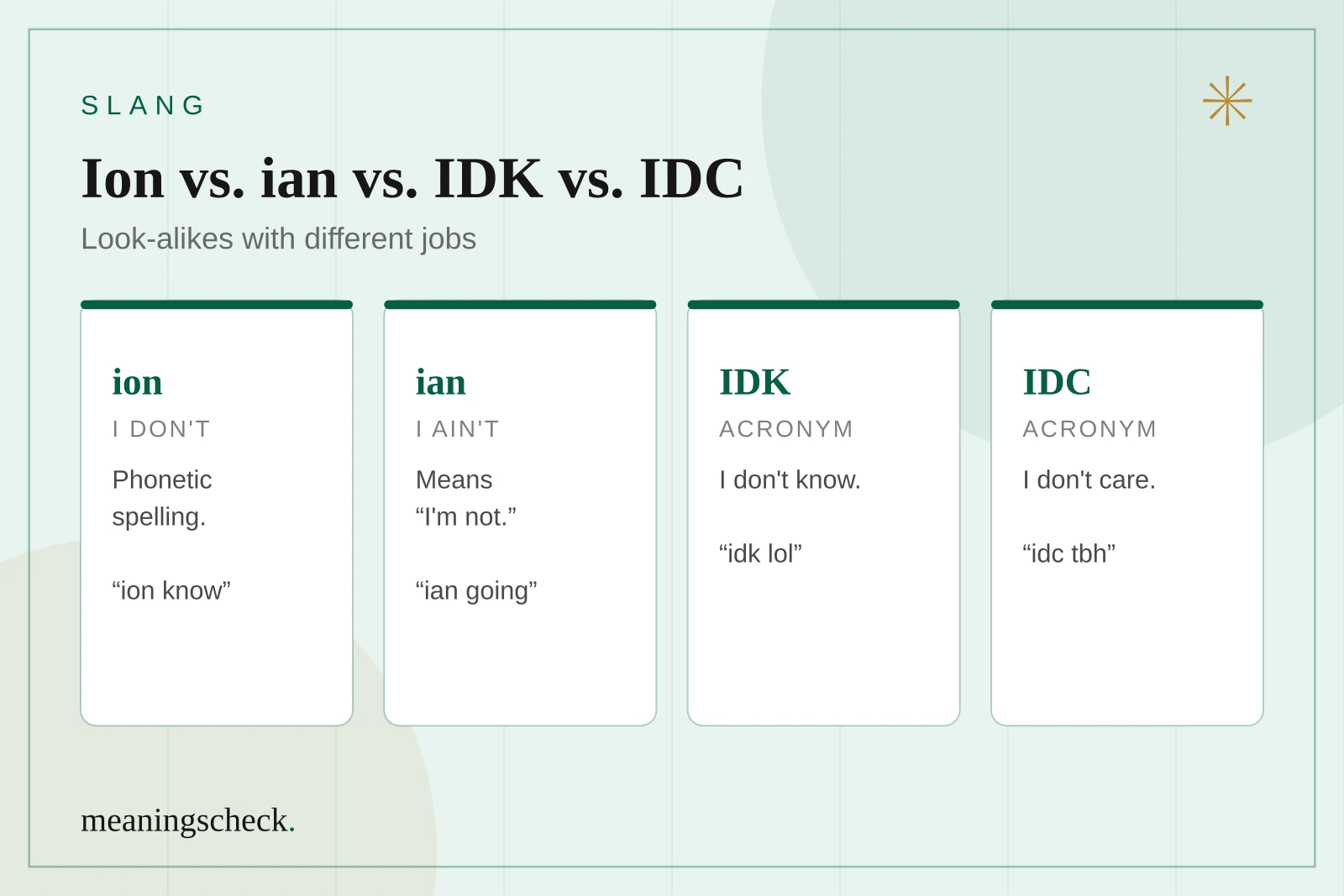
The Short Answer: "Ion" means "I don't." "Ian" means "I ain't." IDK means "I don't know," and IDC means "I don't care." "Ion know" and IDK mean the same thing — "ion know" just sounds more like speech.
These terms get mixed up a lot. Here's how they compare:
| Term | Means | Type | Example |
|---|---|---|---|
| ion | I don't | Phonetic spelling | "ion know" |
| ian | I ain't | Phonetic spelling | "ian going" |
| IDK | I don't know | Acronym | "idk where it is" |
| IDC | I don't care | Acronym | "idc what we watch" |
| dunno | Don't know | Phonetic spelling | "dunno, maybe" |
| ight | Alright | Phonetic spelling | "ight bet" |
Ion vs. Ian
These two look similar. They're different words:
- "ion going" = "I don't go" (or "I don't wanna go").
- "ian going" = "I ain't going" — "I'm not going."
In practice, both often express refusal. "ian doing all that" and "ion wanna do all that" land in the same place.
"Ion Know" vs. IDK
They mean the same thing. The difference is voice. IDK reads like a quick abbreviation. "ion know" reads like someone talking — relaxed and a little more personal.
Ion Meaning on Snapchat, TikTok, Instagram, and X
The Short Answer: On Snapchat, "ion" shows up in quick replies like "ion know" or a flat "ion" meaning "I don't want to." On TikTok and Instagram, it's common in captions and comments. Across platforms, it always means "I don't."
Ion on Snapchat
On Snapchat, "ion" is a fast reply. "ion know" answers a question. A bare "ion" after an invitation usually means "I don't want to" — a low-energy no.
Ion on TikTok
On TikTok, "ion" appears in captions and comments: "ion know who needs to hear this," "ion care what anyone says, this song slaps." It adds a casual, spoken feel.
Ion on Instagram
On Instagram, you'll see it in captions ("ion do drama") and story replies ("ion even know what to say 😭").
Ion on X (Twitter)
On X, "ion" helps save characters and keeps posts conversational: "ion think people realize how hard this is."
| Platform | Typical Use | Example |
|---|---|---|
| Snapchat | Quick replies | "ion know" / "ion" |
| TikTok | Captions and comments | "ion care, this slaps" |
| Captions and story replies | "ion do drama" | |
| X (Twitter) | Opinions and reactions | "ion think that's fair" |
| Texts | Everyday chat | "ion wanna cook tonight" |
| Gaming chats | Quick answers | "ion have mic rn" |
Key takeaway: Ion means "I don't" on every platform. Only the tone changes.
Ion Meaning From a Girl or a Guy
The Short Answer: "Ion" means "I don't" no matter who sends it. What matters is the context. A playful "ion know 🙈" can be flirty. A flat "ion" after an invitation usually means they're not interested — at least not right now.
When It's Playful
- "ion even know why I'm telling you this 🙈"
- "ion usually text first lol"
Messages like these can be flirty. They show a little vulnerability.
When It's a Polite No
- "wanna hang?" — "ion think I can today"
- "you coming?" — "ion feel like it"
These are soft refusals. They're not necessarily rude. The person just doesn't want to.
When It's Dry
A one-word "ion" with no follow-up can feel like a dry text — low effort and hard to respond to. It's the same low-energy vibe people complain about with "wsp," as our WSP meaning guide explains.
Ion on Dating Apps
The Short Answer: On dating apps, "ion" keeps the conversation casual. "ion usually do this" or "ion know what to say lol" can be cute and a little nervous. A one-word "ion" in reply to a question can signal low interest.
Dating-app chats move between playful and practical fast. "Ion" fits both:
- Nervous and cute: "ion usually message first lol"
- Honest preferences: "ion drink. Down for coffee though!"
- Gentle no: "ion think we're a match. Good luck though!"
- Low effort: "ion" (and nothing else)
If someone answers your question with just "ion," try one more open question. If the next reply is just as short, they may not be very invested. That's useful information too.
| Message | What It Suggests |
|---|---|
| "ion usually do this 🙈" | Nervous, interested |
| "ion know, what do you like to do?" | Engaged — they asked back |
| "ion drink but coffee works" | Clear and friendly |
| "ion" | Low effort or low interest |
How to Reply to Ion (With Examples)
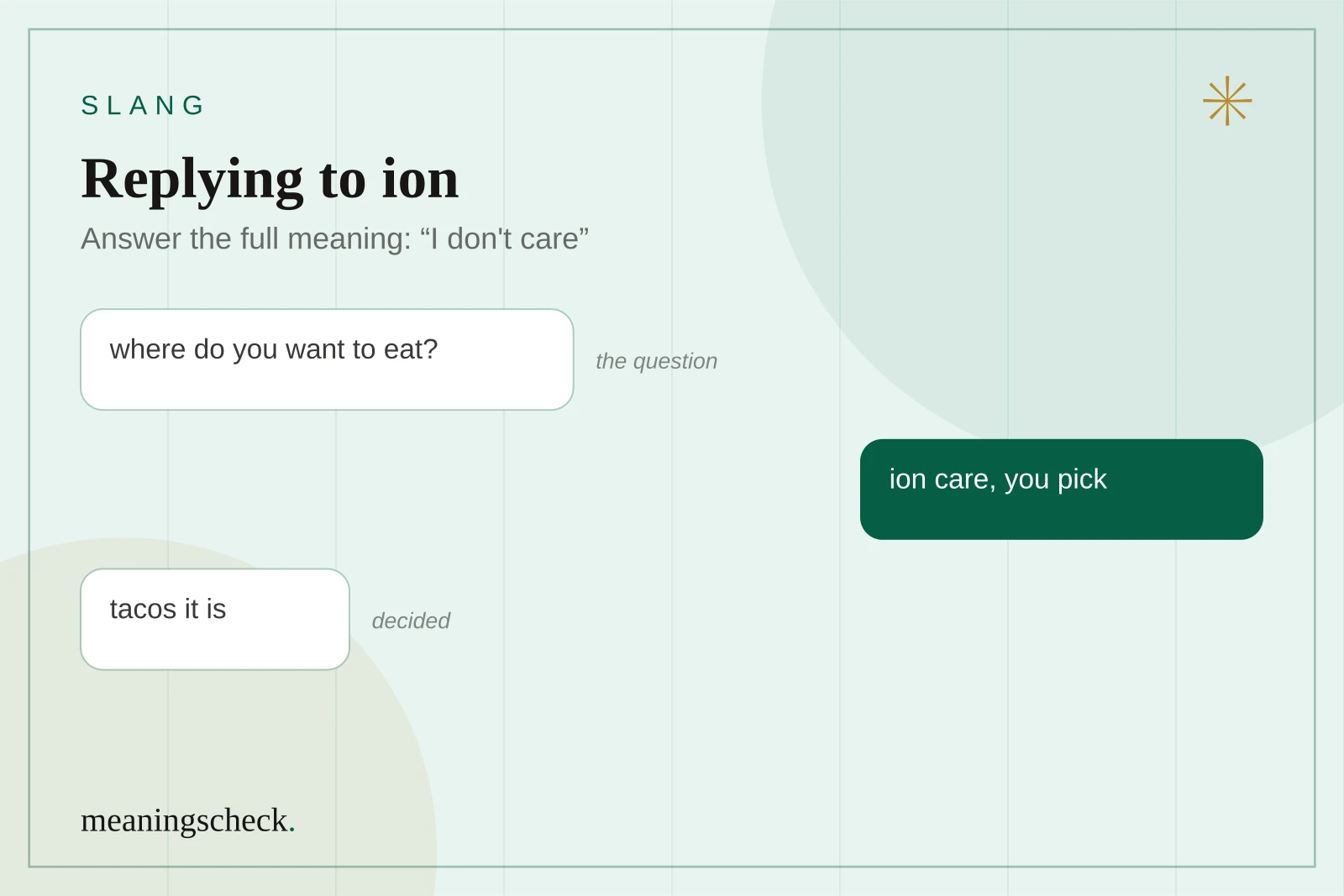
The Short Answer: Reply to the full meaning. If they say "ion know," help them figure it out. If they say "ion care," check whether they're relaxed or upset. If they send just "ion," respect the no or ask a lighter follow-up question.
When They Say "Ion Know"
- "No worries, I'll check."
- "Want me to pick?"
- "Same honestly lol."
When They Say "Ion Care"
"Ion care" can mean "I'm easygoing" or "I'm annoyed." Read the context:
- Easygoing: "ion care where we eat" → "Tacos it is!"
- Annoyed: "ion care anymore" → "You okay? Want to talk?"
When They Just Say "Ion"
- "All good, maybe next time!"
- "Fair. What would you rather do?"
Is "Ion" Rude or Lazy?
The Short Answer: No. "Ion" is just casual. It reflects a real way people speak. It can sound dismissive in phrases like "ion care," and it's too informal for school or work writing. With friends, it's perfectly normal.
Some people see spellings like "ion" as lazy. Linguists see it differently. Spellings that capture speech are a natural part of informal writing. "Gonna," "wanna," and "dunno" work the same way.
That said, tone matters:
| Phrase | How It Can Land |
|---|---|
| "ion know" | Neutral |
| "ion mind" | Friendly, easygoing |
| "ion care" | Easygoing or dismissive, depending on context |
| "ion care what you think" | Defiant or rude |
| "ion" (alone) | Can feel dry |
How to Use Ion Correctly: A Quick Style Guide
The Short Answer: Use "ion" in place of "I don't," right before a verb. Keep it to casual chats. Don't use it for "I'm not" or "I own," and don't use it in essays, emails, or anything professional.
- Put it before a verb. "ion know," "ion want," "ion like."
- Keep it casual. Texts, DMs, captions, and comments.
- Don't use it for "I'm not." "ion tired" is wrong. Use "ian tired" or "I'm not tired."
- Don't confuse it with "I own." "ion a car" doesn't work.
- Skip it at work and school. Write "I don't."
| Correct | Incorrect |
|---|---|
| "ion know" | "ion knowing" |
| "ion wanna go" | "ion going to go" (use "ian going") |
| "ion think so" | "ion tired" (use "I'm not tired") |
| "ion like it" | Using "ion" in a cover letter |
If you're about to share a strong opinion casually, slang has other tools too — like "icl," the honesty opener explained in our ICL meaning guide.
Ion vs. "I Don't": Which Should You Use?
The Short Answer: Use "ion" in casual chats with people who know the slang. Use "I don't" everywhere else — work, school, older relatives, and anyone who might be confused. When in doubt, spell it out.
Slang works best when everyone's in on it. Here's a simple guide:
| Situation | Best Choice | Why |
|---|---|---|
| Texting close friends | "ion" | Casual and natural |
| Group chat with mixed ages | "I don't" or "idk" | Clearer for everyone |
| Social media captions | "ion" | Matches the casual tone |
| Work Slack or Teams | "I don't" | Professional and clear |
| Emails and essays | "I don't" | Formal writing |
| Texting a grandparent | "I don't" | Avoids confusion |
| A science class chat | "I don't" | Avoids the chemistry mix-up |
Why Clarity Matters
Slang is a shortcut. Shortcuts only help if the other person knows the route. If your reader has to stop and search "what does ion mean," the shortcut took longer than spelling it out.
When Autocorrect Gets in the Way
Phone keyboards don't always know slang. Some autocorrect "ion" into something else, or capitalize it as if it were a name. If your message looks wrong after sending, that's probably why. Many people add "ion" to their phone's personal dictionary so it stops getting changed.
How Tone Changes "Ion"
The Short Answer: Punctuation and emojis change how "ion" feels. "ion know 😭" is playful, "ion know." is flat, and "ION KNOW" is frustrated. Read the extras, not just the word.
The letters stay the same. The mood doesn't.
- "ion know lol" — relaxed, no big deal.
- "ion know 😭" — dramatic, playful confusion.
- "ion know." — flat, maybe a little annoyed.
- "ION KNOW" — frustrated: "stop asking me!"
- "ion knowww" — teasing or flirty.
| Message | Mood |
|---|---|
| "ion know lol" | Relaxed |
| "ion know 😭" | Playful drama |
| "ion know." | Flat or annoyed |
| "ION KNOW" | Frustrated |
| "ion knowww 🙈" | Teasing or flirty |
Key takeaway: If "ion" ever feels confusing, look at the emoji and punctuation. They tell you how the sender feels.
Other Meanings of Ion
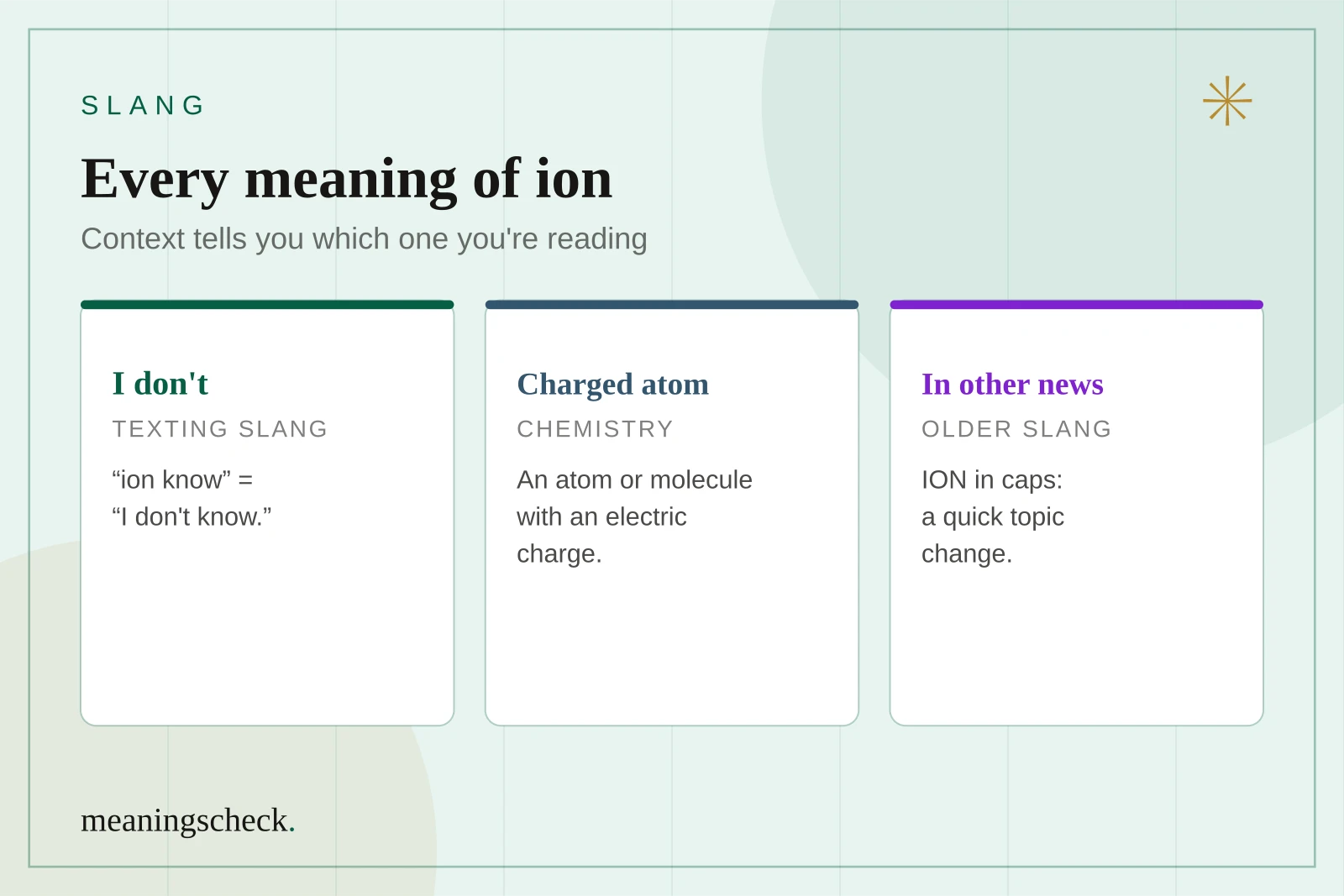
The Short Answer: Outside slang, an ion is an electrically charged atom or molecule — a chemistry term introduced by Michael Faraday in 1834. In all caps, ION can mean "in other news." Ion is also a Romanian name, and ION Television is a US TV network.
The Chemistry Meaning
In science, an ion is an atom or molecule with an electric charge. Positive ions are cations. Negative ions are anions. The word comes from the Greek for "going." Michael Faraday introduced it in 1834, with help from the scholar William Whewell.
That's why chemistry teachers sometimes do a double take when students write "ion know."
ION: "In Other News"
In early internet slang, ION (usually all caps) meant "in other news." People used it to change the subject, often with a joke: "Failed my test. ION, I found a great taco place." Dictionary.com notes it as a 2000s abbreviation.
Other Uses
- ION Television: A US broadcast TV network.
- Ion (name): The Romanian form of John.
- Ion (play): A Greek tragedy by Euripides.
| Context | Ion Means | Example |
|---|---|---|
| Texting slang | I don't | "ion know" |
| Chemistry | A charged atom or molecule | "A sodium ion has a positive charge." |
| Older internet slang | In other news (ION) | "ION, I got a new job!" |
| TV | ION Television | "It's on ION tonight." |
| Names | Romanian for John | "Ion is my cousin." |
A Mini Dictionary of Phonetic Texting Spellings
The Short Answer: "Ion" belongs to a big family of spellings that write speech the way it sounds: "finna" (fixing to), "tryna" (trying to), "bouta" (about to), "ian" (I ain't), "ight" (alright), and "lemme" (let me). Learn a few and texts get much easier to read.
If "ion" confused you, a few of its cousins might too. Here's a quick decoder:
| Spelling | Means | Example |
|---|---|---|
| ion | I don't | "ion know" |
| ian | I ain't (I'm not) | "ian going" |
| finna | Fixing to (about to) | "finna eat" |
| tryna | Trying to | "you tryna come?" |
| bouta | About to | "bouta leave" |
| ight | Alright | "ight bet" |
| lemme | Let me | "lemme see" |
| gimme | Give me | "gimme a sec" |
| gon / gonna | Going to | "it's gon be fine" |
| wanna | Want to | "wanna come?" |
| outta | Out of | "I'm outta here" |
| y'all | You all | "y'all ready?" |
Many of these — especially finna, ian, and ion — come from Black English and Southern speech. Others, like gonna and wanna, are common across almost every English dialect.
How to Decode Any Phonetic Spelling
When you hit a new one, try this:
- Say it out loud. Most phonetic spellings make sense when spoken.
- Speed it up. Say the full phrase quickly and listen for the match.
- Check the position. Before a verb? It's often "I don't," "about to," or "trying to."
- Use context. The rest of the sentence usually confirms it.
Real-World Examples: Ion in Everyday Conversations
The Short Answer: "Ion" shows up when people make plans, ask for help, vent, refuse politely, or share opinions. These everyday examples show what it means each time — and how to answer.
These are typical patterns, not quotes from real people.
Making Plans
Message: "ion know if I can make it Friday, lemme check"
What it means: "I don't know yet. I'll check my schedule."
Good reply: "No stress, just lmk by Thursday!"
Homework Help
Message: "ion get question 4 at all"
What it means: "I don't understand question 4."
Good reply: "Same lol. Want to FaceTime and figure it out?"
Venting
Message: "ion even know anymore. everything's a lot rn"
What it means: "I'm overwhelmed. I don't know what to do."
Good reply: "I'm here. Want to talk about it?"
This is the one to take seriously. "Ion even know anymore" can be a sign someone needs support.
A Polite No
Message: "ion think I'm gonna go tonight, too tired"
What it means: "I don't think I'll go. I'm tired."
Good reply: "Totally get it. Rest up!"
A Hot Take
Message: "ion care what anyone says, the original was better"
What it means: "I don't care about other opinions. I like the original more."
Good reply: "Facts" — or "nah, the remake clears."
| Situation | What "Ion" Signals | Best Reply Style |
|---|---|---|
| Making plans | Uncertainty | Give them time |
| Homework | Confusion | Offer help |
| Venting | Overwhelm | Check in kindly |
| Polite no | Low energy | Accept it gracefully |
| Hot take | Confidence | Agree or debate |
Ion Across Generations and Communities
The Short Answer: "Ion" started in Black English and Southern speech, spread through Twitter and hip-hop, and became everyday slang for Gen Z and Gen Alpha. Older texters are more likely to write "idk" or "I don't."
| Group | Typical Way to Say "I Don't Know" | Example |
|---|---|---|
| Gen X and older | Spelled out | "I don't know." |
| Millennials | Acronym | "idk" |
| Gen Z | Acronym or phonetic | "idk" / "ion know" |
| Gen Alpha | Phonetic, often with emojis | "ion know 😭" |
The shift says something about how texting has changed. Early texters used acronyms to save keypresses. Today's texters, with fast keyboards and autocorrect, often choose phonetic spellings to sound more like themselves.
Expert Insights: Why Spellings Like "Ion" Catch On
The Short Answer: Texting works like written speech. Spellings like "ion" capture how people really talk, which makes messages feel warmer and more natural. They also signal community and identity — and they show how much modern slang owes to Black English.
Texting Is "Fingered Speech"
Linguist John McWhorter has described texting as "fingered speech" — writing that behaves like conversation. In speech, nobody says "I do not know" carefully. They say "I dunno" or "I'on know." Texting lets that natural sound show up on screen.
Eye Dialect and Identity
Spelling words the way they sound is sometimes called eye dialect. "Gonna," "wanna," "finna," and "ion" all do it. These spellings carry identity. They tell the reader how to hear your voice.
Credit Where It's Due
A huge share of today's internet slang comes from Black English: "ion," "finna," "no cap," "on God," "you feel me." As these words spread, their origins often fade. Knowing where "ion" comes from is part of using it respectfully.
Why Chemistry Teachers Get Confused
Dictionary.com notes that "ion" baffles many teachers. That's understandable. The same three letters mean "I don't" in a text and "charged particle" in a lab report. It's a perfect example of how context, not spelling, decides meaning.
Real-World Patterns of Ion
- Quick answers: "ion know" is the most common use by far.
- Soft refusals: "ion think I can make it."
- Relatable captions: "ion know who needs to hear this, but…"
- Hot takes: "ion care what anyone says, pineapple belongs on pizza."
Ion in Group Chats
The Short Answer: In group chats, "ion" keeps replies short: "ion know," "ion mind," "ion care where we go." It's especially common when people are making plans and don't have strong opinions.
Group chats are full of decisions — where to eat, what to watch, when to meet. "Ion" shows up constantly:
- "ion mind, y'all pick"
- "ion know if I can make it, lemme check"
- "ion care as long as there's food"
If everyone says "ion care," though, nothing gets decided. Someone eventually has to pick. That's the group-chat version of a hedge — similar to the quiet "lowkey" in our LWK meaning guide.
How to Explain Ion to Someone Who Doesn't Get It
The Short Answer: Tell them to say "I don't" really fast. It comes out sounding like "ion." That's all it is — a spelling of how the words sound.
If a parent, coworker, or friend is puzzled by "ion," this quick script works:
- "Say 'I don't know' fast." They'll hear "eye-on know."
- "That's it. Ion means 'I don't.'"
- "It's not chemistry." Unless you're in a lab, that is.
- "It comes from Black English," and spread through social media.
Then let them try a few: "ion care," "ion think so," "ion wanna." Most people get it instantly once they hear it. If they still look puzzled, show them the phrase table at the top of this guide. Seeing "ion know" next to "I don't know" usually does the trick.
Ion for Parents and Teachers
The Short Answer: If a kid writes "ion," they mean "I don't." It's normal texting slang, not a typo or a code. Teachers may want to remind students that it belongs in texts, not essays.
Parents sometimes see "ion" and assume it's a typo — or something secret. It isn't. "ion wanna go to school" just means "I don't want to go to school."
For teachers, "ion" is a chance to talk about register — the idea that we use different language for different situations. Texting style is fine with friends. Formal writing needs "I don't."
Common Mistakes People Make With Ion
The Short Answer: The biggest mistakes are reading it as the chemistry word, confusing it with "ian," using it for "I'm not," and using it in formal writing.
- Reading it as chemistry. In texts, it's "I don't."
- Confusing ion and ian. Ion = I don't. Ian = I ain't.
- Using it for "I'm not." "ion hungry" doesn't quite work.
- Using it at work or school. Write "I don't."
- Overusing a bare "ion." It can come off as dry.
Frustrated by a dry "ion" reply? A head-shake "smh" might be tempting — our SMH meaning guide explains when that lands as playful versus rude.
Frequently Asked Questions (FAQs)
What does ion mean in text?
In texting, "ion" means "I don't." For example, "ion know" means "I don't know."
What does "ion know" mean?
"Ion know" means "I don't know." It's the same as IDK, written the way it sounds.
What does "ion care" mean?
"Ion care" means "I don't care." It can sound easygoing or dismissive depending on context.
Is ion an acronym?
No. Slang "ion" is a phonetic spelling of "I don't." In all caps, ION can be an acronym for "in other news."
Where does ion come from?
It comes from the casual pronunciation of "I don't," especially in Black English, according to Dictionary.com.
What's the difference between ion and ian?
"Ion" means "I don't." "Ian" means "I ain't" — "I'm not."
What does ion mean on Snapchat?
On Snapchat, "ion" means "I don't." A bare "ion" reply usually means "I don't want to."
What does "ion even know" mean?
"Ion even know" means "I don't even know." It usually signals confusion or feeling overwhelmed.
What does "ion fw" mean?
"Ion fw" means "I don't f*** with it" — "I don't like or support it." It's crude, casual slang.
Is ion Gen Z slang?
It's popular with Gen Z and Gen Alpha. Its roots are older, though — in Black English and Southern speech.
How do you pronounce ion?
Slang "ion" is pronounced "EYE-on," like saying "I don't" quickly.
Is ion rude?
No. It's casual. Phrases like "ion care" can sound dismissive, though.
Final Thoughts
"Ion" is a tiny word with a big job. It turns "I don't" into something that sounds like a real voice — relaxed, quick, and personal. And it carries the sound of Black English into millions of texts every day.
Just remember the context. In a chat, "ion know" means "I don't know." In chemistry class, an ion is a charged particle. And in an old blog post, ION might just mean "in other news."
Once you hear it, you can't unhear it. For more slang decoded the same way, explore our internet slang guides.
Related terms
Share: · Post on X
Written by MeaningsCheck Team · Published
The MeaningsCheck team researches and writes plain-language explanations of slang, abbreviations, and everyday words — checked for accuracy, updated as language changes.