
Citrine Meaning: Spiritual Properties, Science, and How to Spot Real Citrine (2026)
Citrine is a yellow to orange variety of quartz. In crystal lore, it stands for abundance, success, and positivity, earning nicknames like the "merchant's stone." It's a November birthstone. Most citrine sold today is heat-treated amethyst.
Citrine is a yellow to orange variety of quartz. Its name comes from the French word for lemon, and its sunny color shapes almost everything people believe about it. In crystal and spiritual circles, the citrine meaning centers on abundance, success, confidence, and positivity.
That's why fans call it the "merchant's stone" or the "success stone." Some keep a piece by the cash register or in a wallet.
But there's another side to the story. According to the Gemological Institute of America (GIA), natural citrine is rare. Most citrine on the market is heat-treated amethyst.
This guide covers both sides: the spiritual meaning of citrine, its role as a November birthstone, the real science behind its color, how to tell natural vs. heat-treated citrine, and how it compares to topaz and other yellow gems.
Key takeaway: Citrine is a yellow quartz. Spiritually, it symbolizes abundance and positivity. Scientifically, most citrine sold today is heated amethyst.
Note: Crystal meanings come from spiritual and cultural traditions. They aren't scientifically proven and aren't a substitute for medical, mental health, or financial advice.
Executive Summary: Citrine at a Glance
Here's the quick version:
- What it is: A yellow to brownish-orange variety of quartz (silicon dioxide, SiO₂).
- Name origin: From French and Latin words for citron or lemon.
- Spiritual meaning: Abundance, prosperity, confidence, joy, and creativity.
- Nicknames: Merchant's stone, success stone, money stone.
- Chakra (belief): Most often linked to the solar plexus chakra.
- Birthstone: November, shared with topaz.
- Anniversary: The gem for the 13th wedding anniversary, per GIA.
- Hardness: 7 on the Mohs scale — good for everyday jewelry.
- Color cause: A trace of iron, according to GIA.
- Reality check: Natural citrine is rare. Most is heat-treated amethyst.
What Does Citrine Mean? The Core Definition
The Short Answer: Citrine is a gemstone: a transparent, pale yellow to brownish-orange variety of quartz. As an adjective, "citrine" also describes a lemon-yellow color. In spiritual traditions, citrine symbolizes abundance, optimism, and personal power.
Citrine the Gemstone
GIA defines citrine as "the transparent, pale yellow to brownish orange variety of quartz." It belongs to the same mineral family as amethyst (purple quartz), rose quartz, and smoky quartz.
Citrine the Color
As an adjective, citrine describes a lemon-like yellow. Merriam-Webster defines it as "resembling a citron or lemon especially in color." You'll see it in fashion, paint names, and design.
Citrine the Symbol
In crystal culture, citrine "means" what its color suggests: sunshine, warmth, energy, and plenty.
| Sense | Meaning | Example |
|---|---|---|
| Gemstone | Yellow-orange quartz | "a citrine ring" |
| Color | Lemon yellow | "a citrine silk scarf" |
| Spiritual symbol | Abundance, positivity | "citrine for good luck" |
| Birthstone | November | "a November citrine pendant" |
| Anniversary gem | 13th anniversary | "citrine earrings for our 13th" |
How Do You Pronounce Citrine?
The Short Answer: For the gemstone, Merriam-Webster lists "sih-TREEN." Many people also say "SIT-reen." Both are widely understood. The color adjective is sometimes pronounced "SIH-trin."
| Pronunciation | Where You'll Hear It |
|---|---|
| sih-TREEN | Dictionary pronunciation for the gem |
| SIT-reen | Very common in jewelry stores and online |
| SIH-trin | Older pronunciation of the color word |
The word rhymes roughly with "machine" when stressed on the second syllable.
Where Does the Name Citrine Come From?
The Short Answer: Citrine comes from Old French and Medieval Latin words related to the citron, a lemon-like fruit. The color adjective dates to the 14th century in English. Merriam-Webster dates the gemstone noun to 1571.
From Lemon to Gem
The word traces back to Latin roots for the citron tree. Through Anglo-French and Medieval Latin, it became "citrine," meaning lemon-colored.
Timeline
| Period | Milestone |
|---|---|
| 14th century | "Citrine" used in English for a lemon or amber color (Merriam-Webster) |
| 1571 | First known use of "citrine" for the gemstone (Merriam-Webster) |
| Before modern gemology | Often confused with yellow topaz, per GIA |
| Victorian era | Citrine brooches and pendants become fashionable, per GIA |
| Today | Top-selling yellow-to-orange gem, according to GIA |
Key takeaway: Citrine literally means "lemon-colored." Its name describes its look.
Citrine Spiritual Meaning: What People Believe
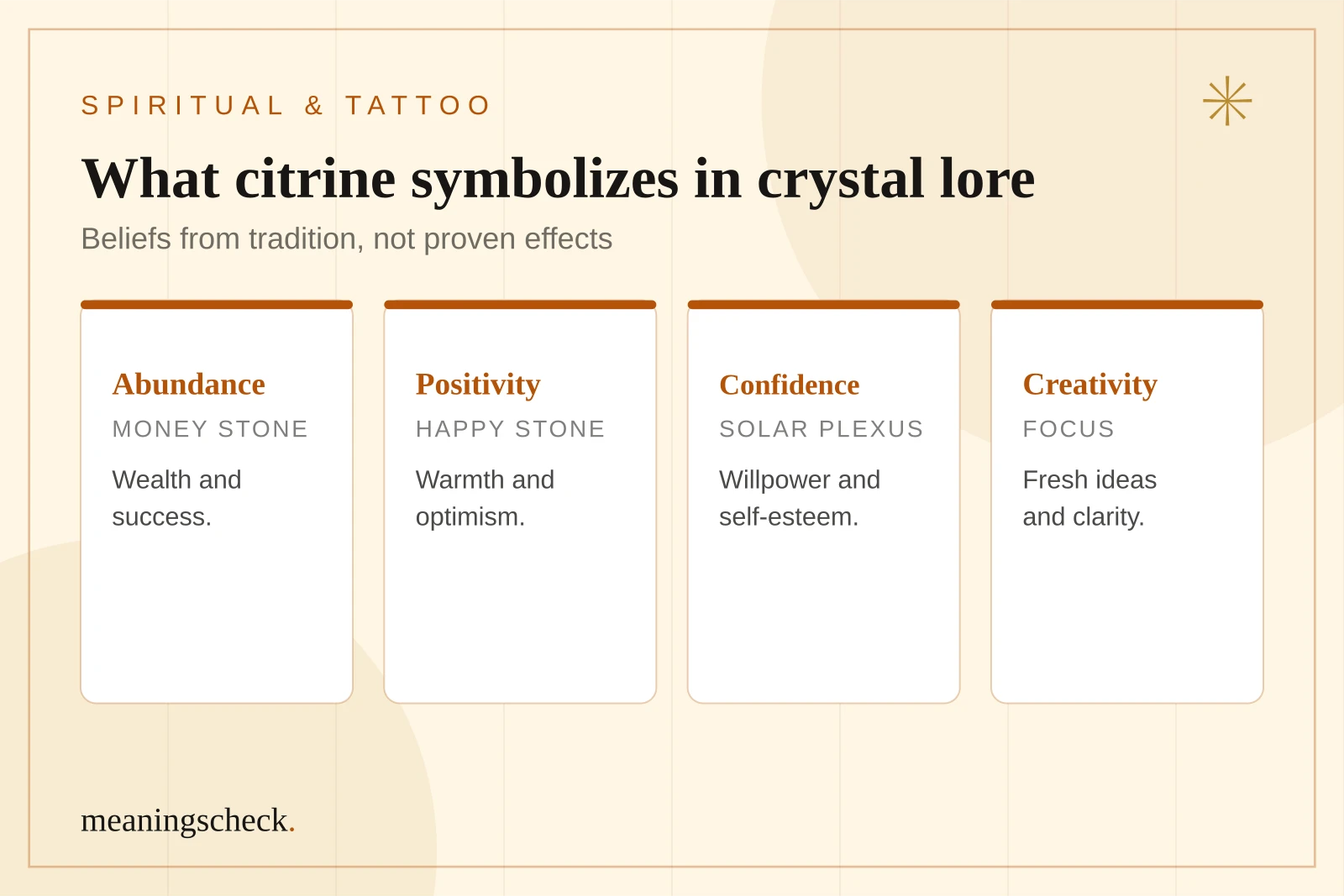
The Short Answer: In crystal lore, citrine is believed to attract abundance and success, lift mood, boost confidence, and spark creativity. These ideas come from spiritual and folk traditions and the stone's sunny color. They aren't scientifically proven.
Here's what crystal enthusiasts commonly associate with citrine:
Abundance and Prosperity
Citrine's most famous meaning is wealth. Its golden color links it to gold and money in many people's minds.
Positivity and Joy
Fans describe citrine as a "happy stone." Its warm color is said to brighten moods and push away negativity.
Confidence and Willpower
Citrine is often linked with self-esteem, motivation, and personal power — the drive to go after goals.
Creativity and Clarity
Some people keep citrine on their desks to encourage fresh ideas and mental focus.
| Belief | What People Say | Evidence |
|---|---|---|
| Abundance | "Attracts money and success" | Tradition, not science |
| Positivity | "Lifts mood, clears negativity" | Tradition, not science |
| Confidence | "Boosts willpower and self-esteem" | Tradition, not science |
| Creativity | "Sparks ideas and focus" | Tradition, not science |
| Protection (folklore) | "Guards against evil thoughts" | Historical lore |
A Fair Way to Think About It
Many people find value in crystals as reminders or rituals. Holding a sunny stone while setting an intention can be a meaningful habit. Still, it's best to treat crystal meanings as symbols, not guarantees. Science and spirituality don't have to be a strict either-or, a point our Dichotomy meaning guide explores.
Why Is Citrine Called the Merchant's Stone?
The Short Answer: Citrine's gold color connected it with wealth and trade. Crystal lore calls it the "merchant's stone" or "success stone." Some shop owners place a piece in the cash register or near the entrance as a good-luck charm for business.
The nickname reflects old associations between gold, sunlight, and prosperity. Popular customs include:
- Keeping a small citrine in the cash register or till.
- Carrying a tumbled stone in a wallet or purse.
- Placing citrine near a business entrance or desk.
In feng shui circles, some people place citrine in the "wealth corner" of a room or home.
| Custom | Intended Meaning |
|---|---|
| Citrine in the cash register | Good luck for sales |
| Citrine in a wallet | Attracting money |
| Citrine on a work desk | Focus and success |
| Citrine in a "wealth corner" | Prosperity at home |
These are cultural practices and personal rituals. They're not financial strategies, of course.
Citrine and the Solar Plexus Chakra
The Short Answer: In chakra traditions, citrine is most often linked to the solar plexus chakra, associated with confidence and willpower. Some sources also link it to the sacral chakra. Chakra systems come from Indian spiritual traditions and are matters of belief.
What Are Chakras?
Chakras are energy centers described in Indian spiritual traditions and later popularized in Western yoga and wellness. Modern Western systems usually describe seven main chakras, each linked with a color.
Citrine's Chakra
Citrine's yellow color matches the solar plexus chakra (Manipura), located above the navel. In chakra teaching, this center relates to confidence, identity, and willpower.
| Chakra | Color (Western system) | Theme | Citrine Link |
|---|---|---|---|
| Solar plexus (Manipura) | Yellow | Confidence, willpower | Most common |
| Sacral (Svadhisthana) | Orange | Creativity, emotion | Sometimes |
| Crown (Sahasrara) | Violet or white | Clarity, spirit | Occasionally |
Key takeaway: Citrine = solar plexus chakra in most crystal guides. It's a belief-based association tied to the stone's yellow color.
Citrine and the Zodiac
The Short Answer: Crystal guides often link citrine to Gemini, Aries, Leo, and Libra. There's no single standard, though. As a November birthstone, it's also associated with people born in November (Scorpio and Sagittarius dates).
Zodiac stone lists vary a lot from source to source. Commonly mentioned pairings:
| Zodiac Sign | Why Some Guides Link Citrine |
|---|---|
| Gemini | Communication and energy |
| Aries | Drive and confidence |
| Leo | Sunny, bold personality |
| Libra | Balance and optimism |
| Scorpio / Sagittarius | November birthdays |
Because these lists aren't standardized, treat them as personal preference rather than rules.
Citrine as a November Birthstone and Anniversary Gem
The Short Answer: Citrine is one of two November birthstones, along with topaz. GIA also names it the gem for the 13th wedding anniversary. Its warm color fits autumn and makes it a popular gift.
November Birthstone
GIA lists citrine and topaz as November's birthstones. Citrine is often the more affordable choice.
13th Anniversary
GIA notes that citrine is "the gem that commemorates the thirteenth anniversary."
Gift Ideas
- Citrine stud earrings for a November birthday.
- A pendant for a 13th anniversary.
- A tumbled stone for a friend starting a business.
A citrine gift for your partner works especially well in November. If you're shopping for your sweetheart, our Boo meaning guide explains the sweet nickname you might write on the card.
The Science of Citrine
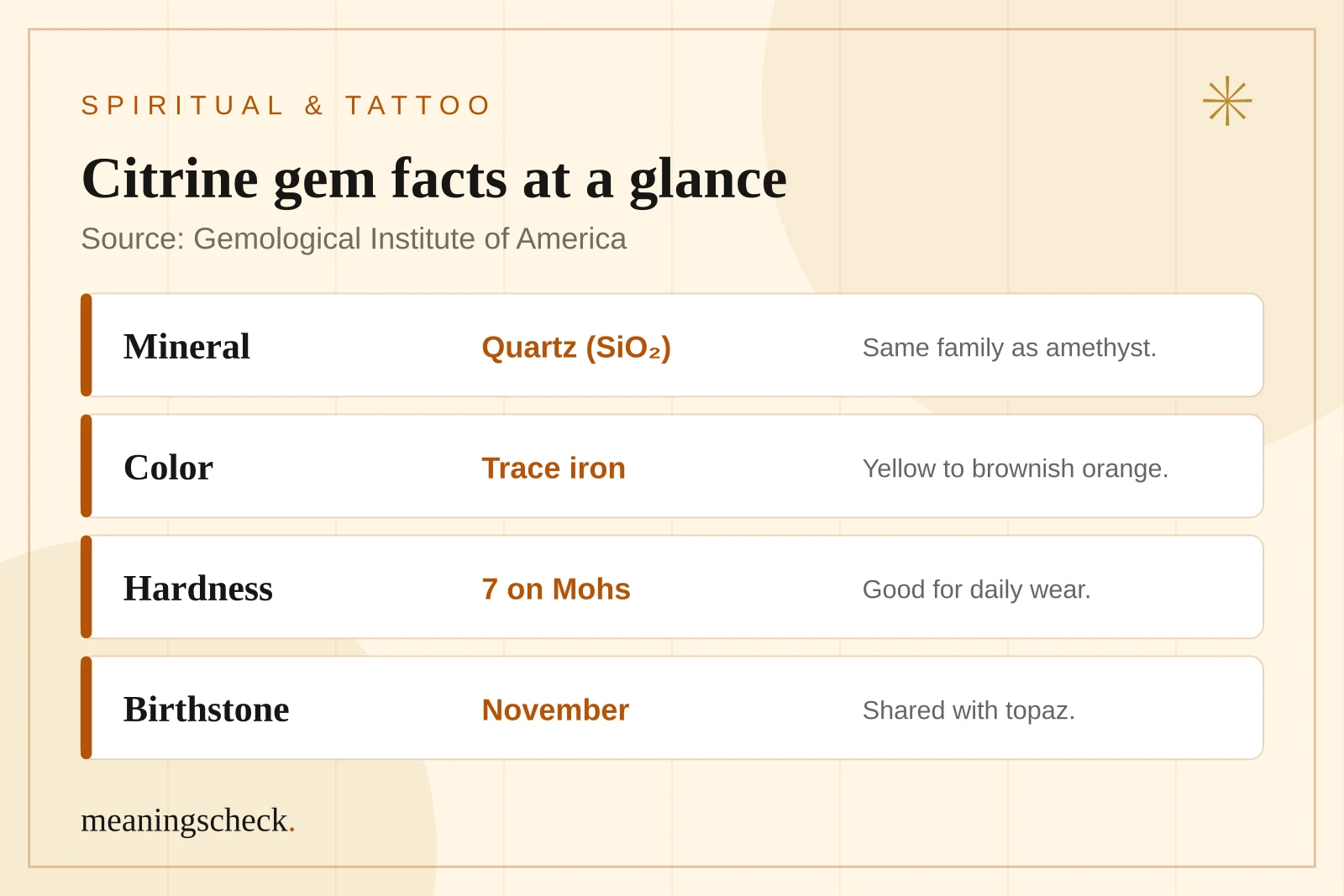
The Short Answer: Citrine is quartz (silicon dioxide) colored by a trace of iron. It rates 7 on the Mohs hardness scale. That makes it durable enough for daily wear. GIA says natural citrine is rare. Most citrine sold today is heat-treated amethyst.
Key Gem Facts
| Property | Citrine |
|---|---|
| Mineral | Quartz |
| Chemical formula | SiO₂ |
| Color | Pale yellow to brownish orange |
| Cause of color | Trace iron (per GIA) |
| Mohs hardness | 7 |
| Refractive index | 1.544–1.553 (per GIA) |
| Specific gravity | About 2.66 (per GIA) |
| Birthstone | November |
Where It Comes From
Brazil is a major source of amethyst, much of which is heated to make citrine. In Bolivia, amethyst and citrine colors can occur together in one crystal, a gem called ametrine, according to GIA.
Durability
At 7 on the Mohs scale, citrine resists everyday scratches better than many popular gems like opal or pearl. It's a good choice for rings and bracelets.
Natural vs. Heat-Treated Citrine
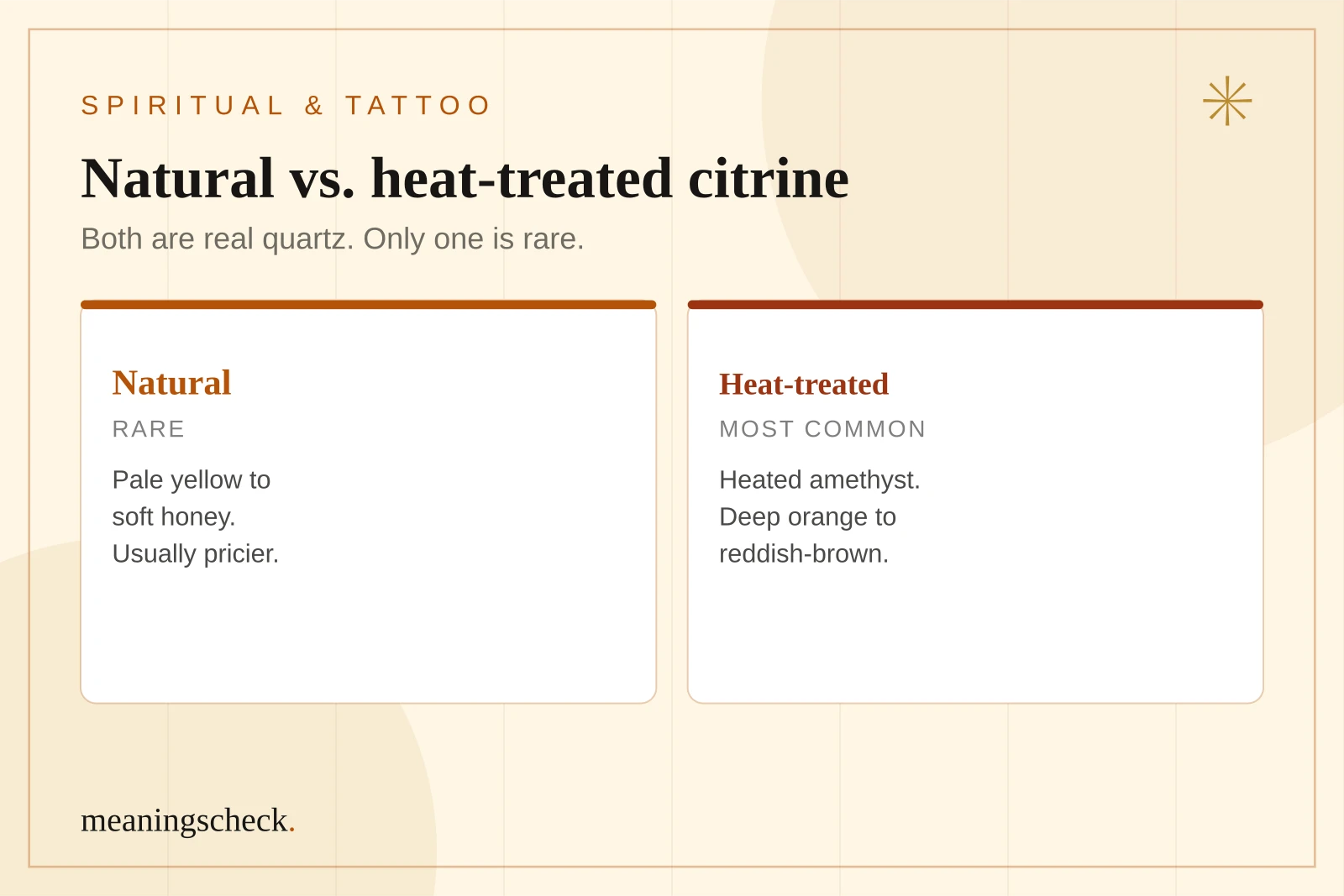
The Short Answer: Natural citrine is usually pale yellow to soft honey. Heat-treated citrine, made from amethyst, is often deeper orange or reddish-brown. Treated clusters may show dark orange tips with whitish bases. Only a gem lab can confirm a stone's history for certain.
Why Heat Treatment Is So Common
Heating changes quartz's color but not the mineral itself. Because natural citrine is rare and amethyst is plentiful, jewelers heat amethyst to produce the yellow-orange stones most buyers want. GIA notes this is the source of most citrine on the market.
Common Differences
| Feature | Natural Citrine | Heat-Treated Citrine |
|---|---|---|
| Typical color | Pale yellow, light honey | Deep orange, reddish-brown |
| Color evenness | Often even and soft | Can be intense or uneven |
| Clusters | Rare | Often orange tips with white bases |
| Price | Higher for fine natural stones | Usually more affordable |
| Origin | Natural conditions | Heated amethyst or smoky quartz |
Is Heated Citrine "Fake"?
Not exactly. Heat-treated citrine is still real quartz. The treatment is common and stable. The important thing is honest disclosure: sellers should tell you if a stone was treated.
Tips for Buyers
- Ask whether the stone is natural or heat-treated.
- Be wary of very cheap "natural citrine" clusters with bright orange tips.
- Buy from reputable sellers who disclose treatments.
- Get a lab report for expensive stones.
Citrine vs. Topaz, Yellow Sapphire, Amber, and Smoky Quartz
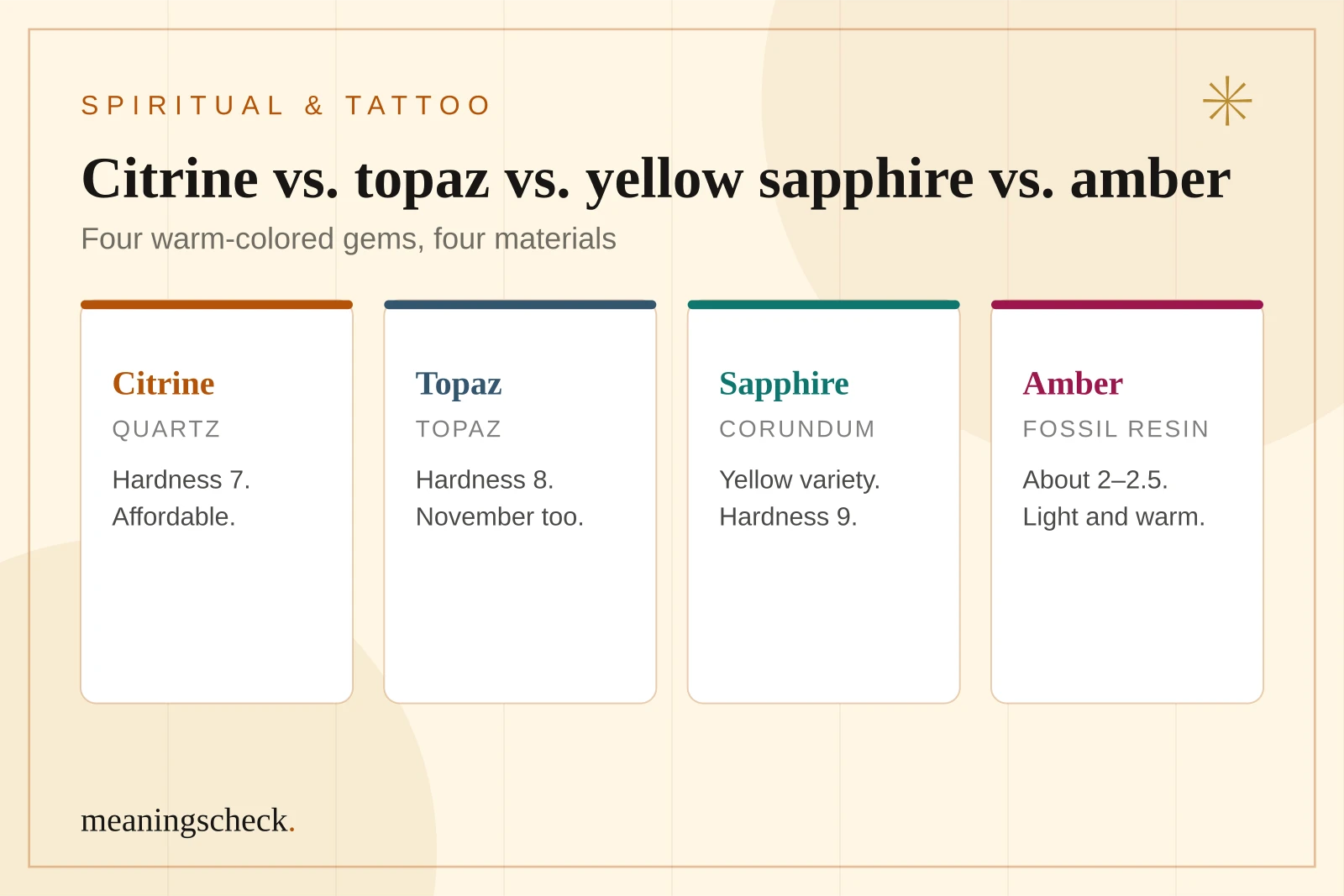
The Short Answer: Citrine is yellow quartz. Topaz is a different, harder mineral that shares the November birthstone. Yellow sapphire is even harder corundum. Amber isn't a mineral at all but fossilized tree resin. Smoky quartz is citrine's brown cousin.
Before modern gemology, citrine was often confused with topaz, according to GIA. Here's how they compare:
| Gem | What It Is | Mohs Hardness | Notes |
|---|---|---|---|
| Citrine | Quartz | 7 | Affordable, yellow-orange |
| Topaz | Topaz (silicate mineral) | 8 | Also a November birthstone |
| Yellow sapphire | Corundum | 9 | Very durable, pricier |
| Amber | Fossilized tree resin | About 2–2.5 | Soft, warm, lightweight |
| Smoky quartz | Quartz | 7 | Brown to gray quartz |
| Ametrine | Quartz | 7 | Purple and yellow in one stone |
Citrine vs. Topaz
The most common mix-up. Both are November birthstones and can look similar. Topaz is harder (8 vs. 7) and comes in many colors. A gemologist can tell them apart with simple tests.
Citrine vs. Amber
Amber feels warm and light. It's organic (fossilized resin), not a crystal. Citrine feels cool, heavier, and glassy.
Citrine Colors and Value
The Short Answer: Citrine's value depends mostly on color. GIA notes that deep, earthy reddish-orange shades are especially popular today. The trade name "Madeira citrine" describes rich reddish-orange stones. Pale yellow citrine is usually less valuable, though natural stones can command a premium.
Like most colored gems, citrine is judged first by color, then clarity, cut, and size.
Popular Shades
| Shade | Description | Typical Appeal |
|---|---|---|
| Pale yellow | Light, lemony | Soft and subtle |
| Golden yellow | Bright, sunny | Classic citrine look |
| Orange | Warm and vivid | Very popular |
| Reddish-orange ("Madeira") | Deep, wine-like | Often the most prized |
| Brownish | Earthy, muted | Less in demand |
Clarity
Citrine is usually eye-clean, meaning you can't see inclusions without magnification. Visible flaws lower value.
Size
Because quartz forms large crystals, big citrine stones are relatively affordable compared with many other gems of the same size.
How to Choose a Citrine
The Short Answer: Pick a color you love, look for an eye-clean stone, ask whether it's heat-treated, check the cut for sparkle, and choose a protective setting for rings. For pricey stones, ask for a lab report.
A simple checklist:
- Color: Choose the shade that suits you — lemon, gold, orange, or deep reddish.
- Clarity: Look for a clean stone with no obvious cracks.
- Cut: A good cut reflects light evenly. Dull or glassy "windows" in the center mean a weaker cut.
- Treatment: Ask, "Is this natural or heat-treated?"
- Setting: For everyday rings, a bezel or protective setting helps prevent chips.
- Seller: Buy from a store that clearly discloses treatments and offers returns.
| Question to Ask | Why It Matters |
|---|---|
| "Natural or heated?" | Affects price and honesty |
| "Any fractures?" | Affects durability |
| "What's the return policy?" | Protects your purchase |
| "Is there a lab report?" | Confirms identity for expensive stones |
Citrine vs. Other "Abundance" Crystals
The Short Answer: Crystal fans often pair citrine with pyrite, green aventurine, tiger's eye, and jade as "abundance" or "luck" stones. Each has its own look and mineral makeup. As with citrine, their meanings are beliefs, not proven effects.
| Crystal | What It Is | Common Belief |
|---|---|---|
| Citrine | Yellow quartz | Abundance, positivity |
| Pyrite | Iron sulfide ("fool's gold") | Wealth, protection |
| Green aventurine | Quartz with green mineral flecks | Luck, opportunity |
| Tiger's eye | Banded, silky quartz-based stone | Courage, focus |
| Jade | Jadeite or nephrite | Prosperity, harmony |
Why So Many "Money Stones" Are Gold or Green
In many cultures, gold suggests wealth and green suggests growth and money. Crystal meanings often follow those color associations.
Citrine-Inspired Tattoo and Design Ideas
The Short Answer: Citrine tattoos are usually designed as crystal shapes, suns, or golden gems to symbolize optimism, abundance, or a November birthday. Because color tattoos fade over time, many people choose yellow-orange accents rather than a fully colored crystal.
Since citrine is a November birthstone, some people get birthstone-inspired tattoos. Popular ideas include:
- A crystal point outline with yellow-orange shading.
- A sun with a small gem at its center for positivity.
- A birthstone ring design honoring a November loved one.
- Geometric crystal clusters mixed with flowers.
| Design | Common Meaning |
|---|---|
| Crystal point | Clarity and intention |
| Sun with gem | Optimism and warmth |
| Birthstone ring | Honoring someone born in November |
| Crystal cluster | Abundance and growth |
Talk with a licensed tattoo artist about how yellow and orange inks age on your skin tone.
How People Use Citrine
The Short Answer: People wear citrine as jewelry, display it as décor, hold it during meditation or intention-setting, keep it on desks or in wallets for "abundance," and give it as November birthday gifts.
Jewelry
Citrine's hardness and price make it popular for rings, earrings, pendants, and bracelets.
Décor and Workspaces
Geodes and clusters brighten shelves and desks. Many are heat-treated amethyst.
Meditation and Intentions
Some people hold citrine while setting goals or practicing gratitude. The stone acts as a physical reminder of an intention.
Gifts
Citrine makes a thoughtful gift for November birthdays, 13th anniversaries, new jobs, and new businesses.
| Use | Why People Choose Citrine |
|---|---|
| Engagement or fashion rings | Durable and affordable |
| Desk stone | Symbol of focus and success |
| Wallet stone | Symbol of abundance |
| Meditation | A cheerful focal point |
| Gift | Birthstone and anniversary meaning |
Family jewelry often carries meaning beyond the stone itself. A citrine ring passed from a grandparent becomes part of a family's legacy — a word our Legacy meaning guide unpacks.
How to Care for Citrine
The Short Answer: Clean citrine with warm, soapy water and a soft brush. Avoid sudden temperature changes and harsh chemicals. Some citrine can fade with long exposure to strong heat or light. Store it away from direct sunlight.
Cleaning
- Use warm water and mild soap.
- Scrub gently with a soft brush.
- Rinse and dry with a soft cloth.
Avoid
- Sudden temperature changes, which can stress quartz.
- Harsh chemicals, like bleach.
- Long periods in strong sunlight or heat, which may fade some stones.
Storage
Store citrine separately from harder gems like sapphires and diamonds, which can scratch it.
| Do | Don't |
|---|---|
| Warm soapy water | Bleach or harsh cleaners |
| Soft brush | Abrasive pads |
| Store in a pouch | Toss with harder gems |
| Keep out of strong sun | Leave on a sunny windowsill for weeks |
Cleansing and Charging Citrine (Crystal Practice)
The Short Answer: In crystal practice, "cleansing" and "charging" are rituals meant to refresh a stone's energy. Popular methods include moonlight, sound, and smoke. Some guides say citrine rarely needs cleansing. These are spiritual practices, not physical cleaning.
Crystal enthusiasts often describe these rituals:
- Moonlight: Leaving the stone out overnight, often during a full moon.
- Sound: Using a singing bowl or bell near the stone.
- Smoke: Passing the stone through incense or herb smoke.
- Intention: Holding the stone and setting a personal goal.
Some guides say sunlight "charges" citrine. If you try it, keep sessions short to avoid any fading.
| Ritual | Belief | Practical Note |
|---|---|---|
| Moonlight | Refreshes energy | Harmless to the stone |
| Sound | Clears stagnant energy | Harmless to the stone |
| Smoke | Purifies | Use safely, with ventilation |
| Sunlight | "Charges" citrine | Brief exposure only |
Citrine Meaning in Love and Relationships
The Short Answer: Citrine isn't usually called a "love stone" like rose quartz. In crystal lore, it's linked to warmth, optimism, and confidence in relationships, encouraging a cheerful, generous attitude.
Crystal fans typically suggest:
- Rose quartz for love and compassion.
- Citrine for joy, confidence, and positive communication.
Some people give citrine to a partner as a symbol of shared happiness or a bright future. As a 13th-anniversary gem, it also carries a built-in romantic meaning.
Citrine in Dreams and Symbolism
The Short Answer: In dream interpretation traditions, a citrine or golden stone is often read as a symbol of hope, opportunity, or success. Dream meanings vary widely by culture and person. Treat them as personal reflections.
Common symbolic readings include:
- Finding citrine: a new opportunity.
- Wearing citrine: growing confidence.
- A broken citrine: worry about money or plans.
These interpretations are folk symbolism, not predictions.
Citrine as a Name and a Color
The Short Answer: Citrine is also used as a given name, a color name in fashion and paint, and a brand or product name. As a color, it describes a lemony yellow, sometimes with a green or golden tint.
As a Name
Citrine occasionally appears as a girl's name or nickname, inspired by the gem and its bright meaning.
As a Color
Designers use "citrine" for shades between lemon and gold. You'll find it in clothing, home décor, and paint collections.
| Context | Citrine Means |
|---|---|
| Gemstone | Yellow-orange quartz |
| Color | Lemon-gold yellow |
| Name | A bright, sunny given name |
| Product name | Branding that suggests warmth |
Expert Insights: Why Citrine Resonates With So Many People
The Short Answer: Citrine's meaning grows from color psychology, history, and ritual. Yellow is widely associated with sunlight and optimism. Its affordability makes it accessible. Meanwhile, its market reality — mostly heated amethyst — is a lesson in informed buying.
Color Shapes Meaning
Across many cultures, yellow suggests sunlight, warmth, and energy. Citrine's spiritual meanings closely mirror these color associations.
Rituals Can Be Meaningful
A crystal can work as a cue. Seeing a stone on your desk can remind you of a goal you set. That effect comes from habit and attention, not from the stone itself.
Honest Labeling Matters
Because most citrine is heat-treated, disclosure is the key ethical issue. A treated stone isn't bad. Misleading labels are.
Affordable Beauty
As GIA notes, citrine shares quartz's durability and affordability. That makes it one of the easiest ways to wear a warm-colored gem every day.
Real-World Patterns
- Jewelry shoppers: "a November birthstone that's affordable."
- Crystal fans: "my abundance stone."
- Small businesses: "a citrine in the register for luck."
- Collectors: "is this natural or heated?"
Real-World Examples: How People Talk About Citrine
The Short Answer: You'll hear citrine in jewelry stores, crystal shops, birthday gift searches, and online wellness communities. These examples show what people usually mean.
These are typical patterns, not quotes from real people.
At a Jewelry Store
Customer: "Is this citrine or topaz?"
What it means: They want to know the stone type, hardness, and value.
In a Crystal Shop
Shopper: "I need a citrine for my new business."
What it means: They want a symbolic good-luck stone.
Online
Post: "Got my first citrine cluster! 💛"
Comment: "Looks heat-treated — still pretty though."
What it means: A friendly heads-up about treatment.
| Setting | What "Citrine" Usually Signals |
|---|---|
| Jewelry store | A yellow-orange quartz gem |
| Crystal shop | Abundance and positivity |
| Gift shopping | November birthday or 13th anniversary |
| Collector forums | Natural vs. heated debate |
A Simple Citrine Intention Practice
The Short Answer: Many crystal fans use citrine as a focus object while setting goals. Hold the stone, name one clear intention, take a few slow breaths, and place it where you'll see it daily. The value comes from the reminder and the habit.
Here's a beginner-friendly routine people often describe:
- Choose a goal. Make it specific: "Finish my portfolio this month."
- Hold the citrine. Notice its weight and color.
- Breathe slowly for a minute.
- Say or write your intention.
- Place the stone somewhere visible, like your desk.
- Check in weekly on your progress.
The stone works as a visual cue. The real progress comes from the actions you take.
Quick Quiz: Citrine Facts or Crystal Lore?
The Short Answer: Some citrine claims are gem facts you can measure. Others are spiritual beliefs. Test yourself on which is which.
| Statement | Fact or Lore? |
|---|---|
| "Citrine is a variety of quartz." | Fact |
| "Citrine attracts money." | Lore |
| "Citrine rates 7 on the Mohs scale." | Fact |
| "Citrine is linked to the solar plexus chakra." | Lore |
| "Most citrine is heat-treated amethyst." | Fact (per GIA) |
| "Citrine never needs cleansing." | Lore |
If you sorted them all correctly, you can enjoy citrine with clear eyes.
Citrine Glossary: Words You'll See in Shops
The Short Answer: Crystal and jewelry shops use terms like tumbled stone, point, cluster, geode, cabochon, and faceted. Knowing them helps you understand exactly what you're buying.
| Term | Meaning |
|---|---|
| Tumbled stone | A small, smooth, polished piece |
| Point | A single crystal with a pointed tip |
| Cluster | Many crystal points growing together |
| Geode | A hollow rock lined with crystals |
| Cabochon | A smooth, domed, unfaceted cut |
| Faceted | Cut with flat, shiny faces for sparkle |
| Heat-treated | Color changed by heating, often from amethyst |
| Ametrine | Purple and yellow quartz in one stone |
| Mohs scale | A 1–10 scale of scratch resistance |
How to Explain Citrine to a Kid
The Short Answer: Say: "Citrine is a yellow crystal made of quartz, the same stuff as lots of sand. Some people think it brings happiness and good luck. It's also the birthstone for November."
A simple script:
- "It's a yellow-orange crystal called quartz."
- "Its name comes from an old word for lemon."
- "People born in November can call it their birthstone."
- "Some people believe it brings good luck — that's a belief, like a lucky charm."
Kids often love that most citrine starts as purple amethyst and turns yellow when heated. It's a fun bit of real science.
Common Mistakes People Make With Citrine
The Short Answer: The biggest mistakes are assuming all citrine is natural, confusing it with topaz, leaving it in strong sunlight for long periods, and treating crystal beliefs as guaranteed results.
- Assuming it's natural. Most citrine is heat-treated amethyst.
- Confusing it with topaz. Different minerals, different hardness.
- Overexposing it to sunlight. Some stones may fade.
- Expecting guaranteed results. Crystal meanings are symbolic.
- Skipping disclosure questions. Always ask about treatments.
Frequently Asked Questions (FAQs)
What does citrine mean spiritually?
In crystal lore, citrine symbolizes abundance, success, positivity, and confidence. These are beliefs, not proven effects.
What is citrine made of?
Citrine is quartz (silicon dioxide). A trace of iron gives it its yellow-to-orange color, according to GIA.
Is citrine a November birthstone?
Yes. Citrine shares November with topaz.
Is most citrine fake?
Most citrine is heat-treated amethyst. It's still real quartz. Natural citrine, however, is rare.
Why is citrine called the merchant's stone?
Its gold color links it with wealth. Crystal lore says it brings luck to business. That's why some people keep it in cash registers.
What chakra is citrine?
Citrine is most often linked to the solar plexus chakra in crystal traditions.
How hard is citrine?
Citrine rates 7 on the Mohs scale, making it durable for everyday jewelry.
What's the difference between citrine and topaz?
Citrine is quartz with a hardness of 7. Topaz is a different mineral with a hardness of 8. Both are November birthstones.
Can citrine go in the sun?
Brief sunlight is fine. Long exposure to strong sun or heat may fade some citrine.
Final Thoughts
Citrine's meaning starts with its color: a bright, lemony gold that people have linked to sunshine, success, and good fortune for centuries. That's why it's called the merchant's stone — and why it shows up on so many desks and November birthday wish lists.
Whether you value it for its spiritual symbolism or simply its beauty, the best citrine is one you understand. Ask about treatment, care for it gently, and enjoy the warmth it brings.
For more symbols, crystals, and tattoo meanings, explore our spiritual and tattoo meanings guides. And if a rough day has you sighing "ugh," our Ugh meaning guide has you covered.
Related terms
Share: · Post on X
Written by MeaningsCheck Team · Published
The MeaningsCheck team researches and writes plain-language explanations of slang, abbreviations, and everyday words — checked for accuracy, updated as language changes.