
What Does Ugh Mean? Ugh Meaning in Text, Every Tone of Ugh, and How to Reply (2026)
"Ugh" is an interjection that expresses annoyance, disgust, frustration, or exhaustion — like a groan in text form. Merriam-Webster dates it to 1678. Online, it can also express overwhelming affection, as in "ugh, I love this song." Extra letters ("ughhh") make the feeling stronger.
"Ugh" is a groan in text form. It expresses annoyance, disgust, frustration, or exhaustion. When a friend texts "ugh, Monday again," you can practically hear the sigh.
That's the classic meaning. But online, "ugh" has picked up a surprising twist.
Sometimes "ugh" means love. "Ugh, I love her." "Ugh, this song." Here the groan says "this is so good it's almost too much." So if you're wondering what does ugh mean, the answer depends on what comes after it — and on how many h's there are.
Merriam-Webster defines "ugh" as a word used to indicate the sound of a cough or grunt, or to express disgust or horror. It dates the word to 1678, making it one of the older interjections still in heavy daily use.
This guide covers the ugh meaning in text, every tone of "ugh," how it compares to ew, yuck, argh, meh, smh, and bruh, how to reply, what linguists say about interjections, and the "ugh boots" you might hear about in Australia.
Key takeaway: "Ugh" usually means "this is annoying or gross." But "ugh, I love this" means "this is overwhelmingly good."
Executive Summary: Ugh at a Glance
Here's the quick version:
- What it is: An interjection — a word that expresses feeling.
- Main meanings: Annoyance, disgust, frustration, exhaustion.
- Online twist: Overwhelming affection — "ugh so cute."
- History: Merriam-Webster gives a first known use of 1678, first for a cough or grunt sound.
- Pronunciation: Something like "uh," "ug," or a throaty "ugh."
- Intensity: More h's = more feeling. "ughhhh" > "ugh."
- Also: Ugh boots — Australian sheepskin boots, often spelled "ugg" or "ug."
What Does Ugh Mean? The Core Definition
The Short Answer: "Ugh" is a sound that shows displeasure — annoyance, disgust, frustration, or tiredness. It's like a written groan. Online, it can also show overwhelming happiness or affection, depending on what follows it.
The Dictionary Definition
Merriam-Webster defines "ugh" as an interjection "used to indicate the sound of a cough or grunt or to express disgust or horror." Its example: "ugh, this oven desperately needs to be cleaned."
That covers the classic uses. In everyday texting, "ugh" stretches even further.
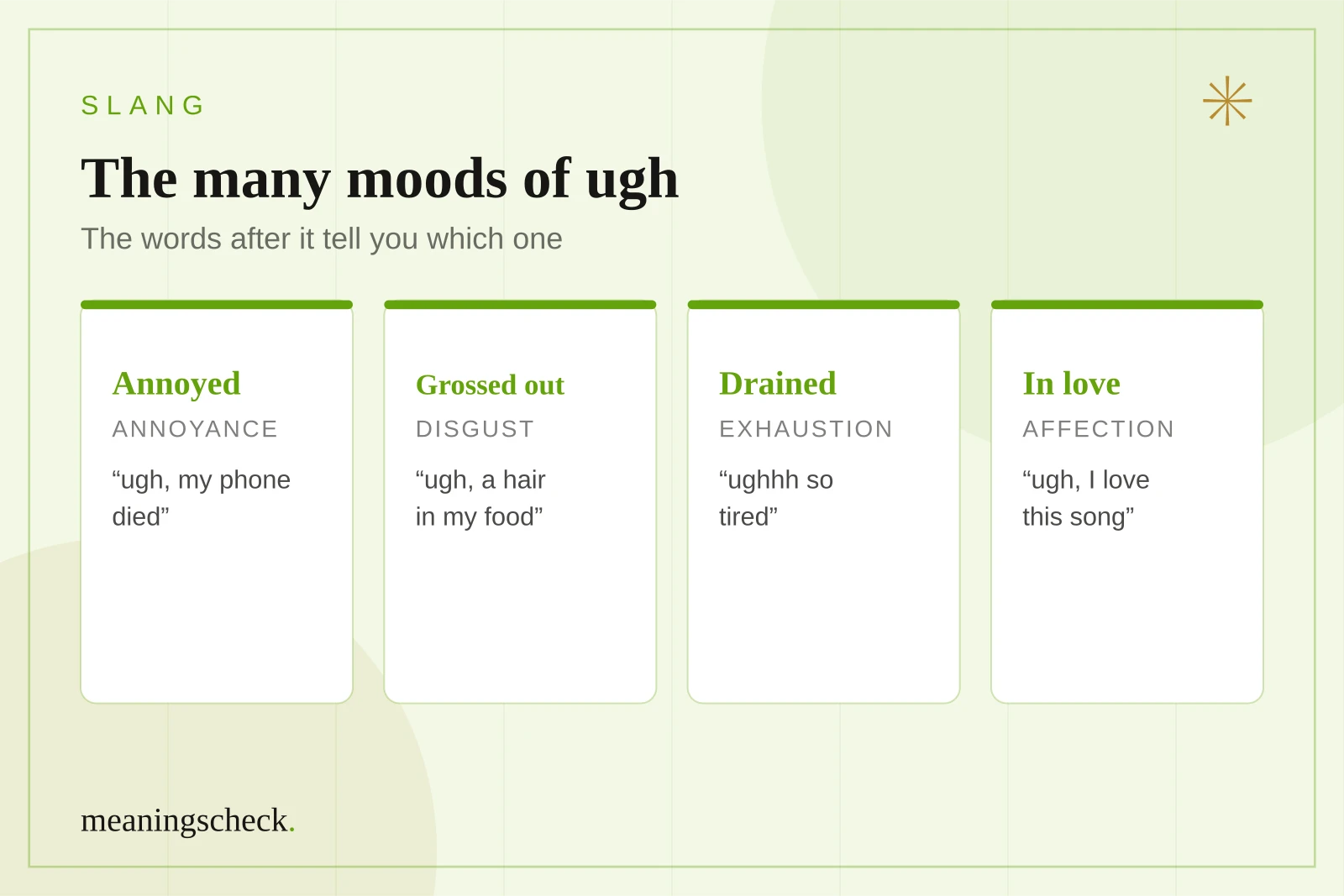
The Many Moods of "Ugh"
| Mood | Example | What It Means |
|---|---|---|
| Annoyance | "ugh, my phone died" | "This is irritating." |
| Disgust | "ugh, there's a hair in my food" | "Gross." |
| Frustration | "ugh, I can't get this right" | "I'm stuck and fed up." |
| Exhaustion | "ugh so tired" | "I'm drained." |
| Dread | "ugh, Monday tomorrow" | "I'm not looking forward to this." |
| Jealousy (playful) | "ugh, you're in Hawaii??" | "I'm so jealous." |
| Affection | "ugh, I love this song" | "This is so good." |
| Resignation | "ugh, fine" | "Okay, I'll do it." |
How to Say It
Merriam-Webster lists a few pronunciations, roughly "ug," "uh," and a throaty sound like the end of "Bach." In real life, most people make a short groan. The spelling just tries to capture that sound.
Where Does "Ugh" Come From?
The Short Answer: "Ugh" is an imitative word — it spells out a natural sound. Merriam-Webster dates it to 1678, when it described a cough or grunt. Over time, it became a standard way to express disgust, then annoyance, and now even affection online.
An Imitative Word
"Ugh" is onomatopoeic — it imitates a sound. Like "ow," "hmm," and "brr," it started as a way to write down a noise people make naturally.
From Cough to Disgust
According to Merriam-Webster, "ugh" was in use by 1678, describing the sound of a cough or grunt. Over time, it became strongly linked to disgust and horror — the sound you make when something is gross.
From Disgust to Daily Annoyance
As "ugh" settled into everyday speech, it widened. People said it about chores, weather, traffic, and Mondays. It became the all-purpose sound of mild suffering.
From Annoyance to Affection
Online, especially on social media, "ugh" took a playful turn. People began using it for things that were overwhelmingly good: "ugh, this outfit," "ugh, they're so cute." The groan stayed. The meaning flipped.
| Era | Main Use of "Ugh" | Example |
|---|---|---|
| 1600s | The sound of a cough or grunt | Describing a noise |
| Later centuries | Disgust or horror | "Ugh, how horrid!" |
| 20th century | Everyday annoyance | "Ugh, Mondays." |
| Texting era | Stretched for emphasis | "ughhhh" |
| Social media era | Affection and overwhelm | "ugh, I love this" |
Ugh vs. Ew, Yuck, Argh, Meh, SMH, and Bruh
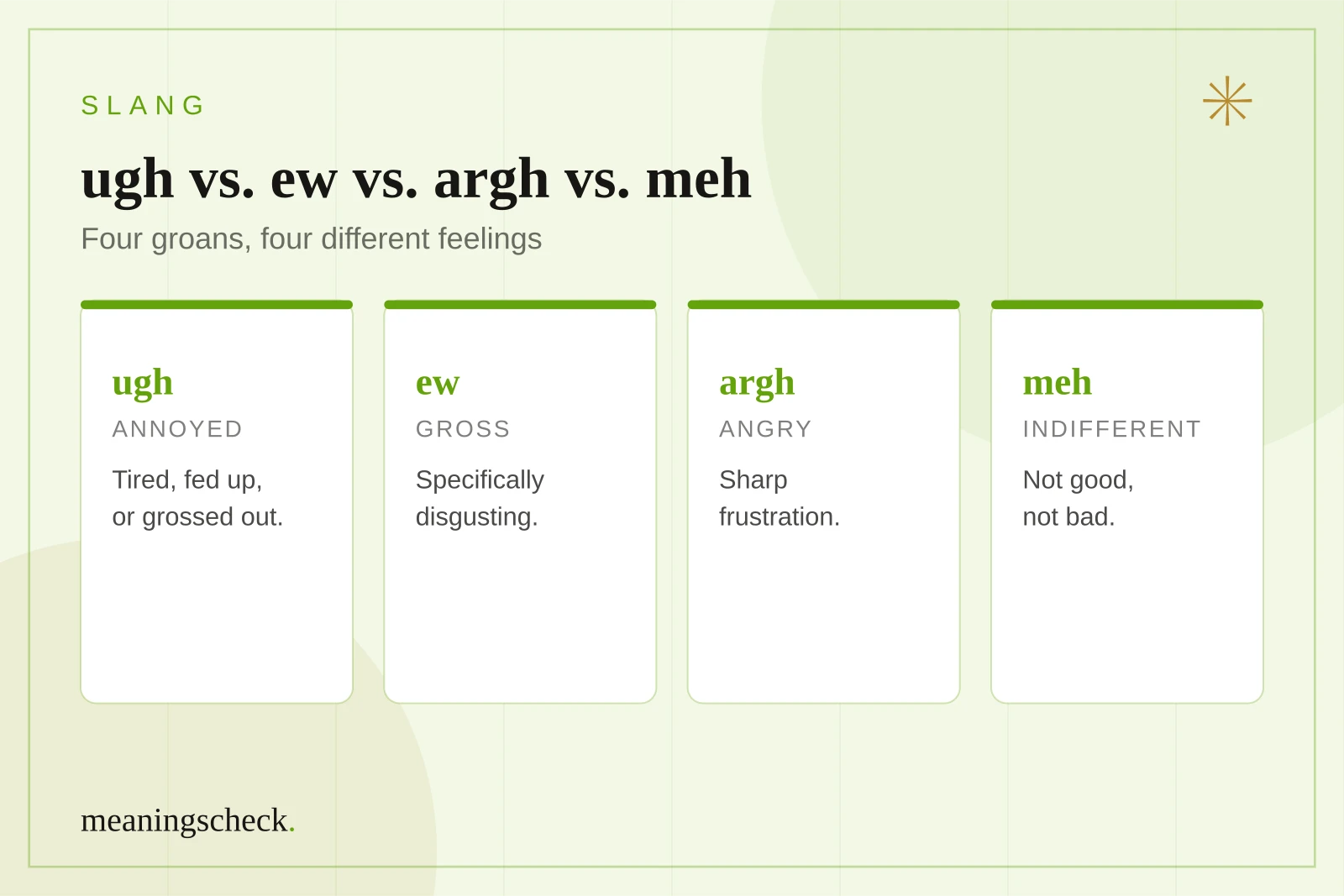
The Short Answer: "Ugh" is broad displeasure. "Ew" and "yuck" are specifically gross. "Argh" is angry frustration. "Meh" is indifference. "SMH" is disappointed head-shaking. "Bruh" is disbelief. Each expresses a slightly different feeling.
| Word | Main Feeling | Example |
|---|---|---|
| ugh | Annoyance, disgust, fatigue | "ugh, traffic" |
| ew | Gross | "ew, a bug" |
| yuck | Gross (often food) | "yuck, soggy fries" |
| argh | Angry frustration | "argh, I lost my keys" |
| meh | Indifference | "the movie was meh" |
| smh | Disappointment | "he forgot again smh" |
| bruh | Disbelief | "bruh, really?" |
| sigh | Tired resignation | "sigh back to work" |
Ugh vs. Ew
Ew is specifically about something gross. Ugh can be gross — but it can also be annoying, tiring, or frustrating. "Ew, a spider" is about the spider. "Ugh, a spider" might also mean "now I have to deal with this."
Ugh vs. Argh
Argh is sharper and angrier — the sound of real frustration. Ugh is heavier and more tired. And for total, theatrical defeat, some people skip words entirely and type OTL — a little figure collapsed on its knees, explained in our OTL meaning guide.
Ugh vs. SMH
SMH ("shaking my head") shows disappointment, often at someone else. Our SMH meaning guide covers it in detail. Ugh is more about how you feel.
Ugh Meaning in Text: Reading the Tone
The Short Answer: In texts, the number of h's, capital letters, and emojis change what "ugh" means. "ugh" is mild. "ughhhh" is intense. "UGH" is loud. "ugh 😍" is affection. "ugh 🤢" is disgust.
Stretching for Intensity
- "ugh" — mild annoyance.
- "ughh" — a bit more.
- "ughhhhh" — deep suffering (often dramatic).
Capitals for Volume
- "UGH" — a loud, exasperated groan.
- "UGHHHH" — maximum frustration.
Emojis for Direction
- "ugh 😩" — tired or overwhelmed.
- "ugh 🙄" — annoyed at someone.
- "ugh 🤢" — grossed out.
- "ugh 😍" — loving it.
- "ugh 🥹" — touched or emotional.
| Message | Tone |
|---|---|
| "ugh" | Mild annoyance |
| "ughhhh" | Dramatic suffering |
| "UGH" | Loud frustration |
| "ugh 🙄" | Annoyed at someone |
| "ugh 😍" | Affection |
| "ugh fine" | Reluctant agreement |
| "ugh same" | Shared misery |
Key takeaway: Look at what comes after "ugh." That tells you whether it's suffering or swooning.
The Affectionate "Ugh": When Ugh Means Love
The Short Answer: Online, "ugh" often introduces something wonderful: "ugh, I love her," "ugh, this view." It signals that the feeling is so strong it's almost uncomfortable — a playful, overwhelmed kind of joy.
This is the "ugh" that confuses people most. Why would anyone groan about something they love?
Because big feelings can feel like too much. A puppy so cute it hurts. A song so good you can't stand it. A friend so kind you're overwhelmed. The groan captures that overload.
Examples of Affectionate "Ugh"
- "ugh, I love you guys"
- "ugh, this dress is perfect"
- "ugh, my dog is so cute"
- "ugh, they're adorable together"
How to Tell It Apart
Affectionate "ugh" usually comes with:
- Positive words: love, cute, perfect, obsessed.
- Warm emojis: 😍 🥹 ❤️.
- Context: a photo, a compliment, a happy moment.
| Message | Affection or Annoyance? |
|---|---|
| "ugh, traffic" | Annoyance |
| "ugh, she's so pretty" | Affection |
| "ugh, homework" | Annoyance |
| "ugh, this song 😭❤️" | Affection |
| "ugh, why" | Annoyance |
Ugh on TikTok, Instagram, Snapchat, and X
The Short Answer: On TikTok and Instagram, "ugh" shows up in captions and comments — often affectionate ("ugh, obsessed"). On Snapchat and in texts, it's usually everyday complaining. On X, it caps relatable gripes.
Ugh on TikTok
On TikTok, comments like "ugh, this is so cute" and "ugh, the way I relate" are everywhere. The affectionate "ugh" thrives here.
Ugh on Instagram
On Instagram, "ugh" appears in captions ("ugh, missing summer") and comments ("ugh, stunning 😍").
Ugh on Snapchat
On Snapchat, "ugh" is everyday venting: "ugh, school," "ugh so tired."
Ugh on X (Twitter)
On X, "ugh" starts relatable complaints: "ugh, why is it Monday already."
| Platform | Typical Use | Example |
|---|---|---|
| TikTok | Affectionate comments | "ugh, obsessed" |
| Captions and compliments | "ugh, stunning 😍" | |
| Snapchat | Everyday venting | "ugh so tired" |
| X (Twitter) | Relatable gripes | "ugh, Mondays" |
| Texts | All of the above | "ugh, fine" |
Ugh Meaning From a Girl or a Guy
The Short Answer: "Ugh" means the same thing from anyone. From a crush, "ugh, you're so funny" is a good sign. "Ugh" about you in a frustrated way, though, might mean they're annoyed. Context and emojis tell the story.
When It's Affectionate
- "ugh, you're so sweet 🥹"
- "ugh, I like you"
These are warm. The "ugh" adds playful overwhelm.
When It's Teasing
- "ugh, you're so annoying 😂"
With a laughing emoji, it's usually playful. Friends and crushes tease like this all the time.
When It's Real Annoyance
- "ugh, you always do this."
This one has weight. It's worth taking seriously and maybe talking about.
How to Reply to Ugh (With Examples)
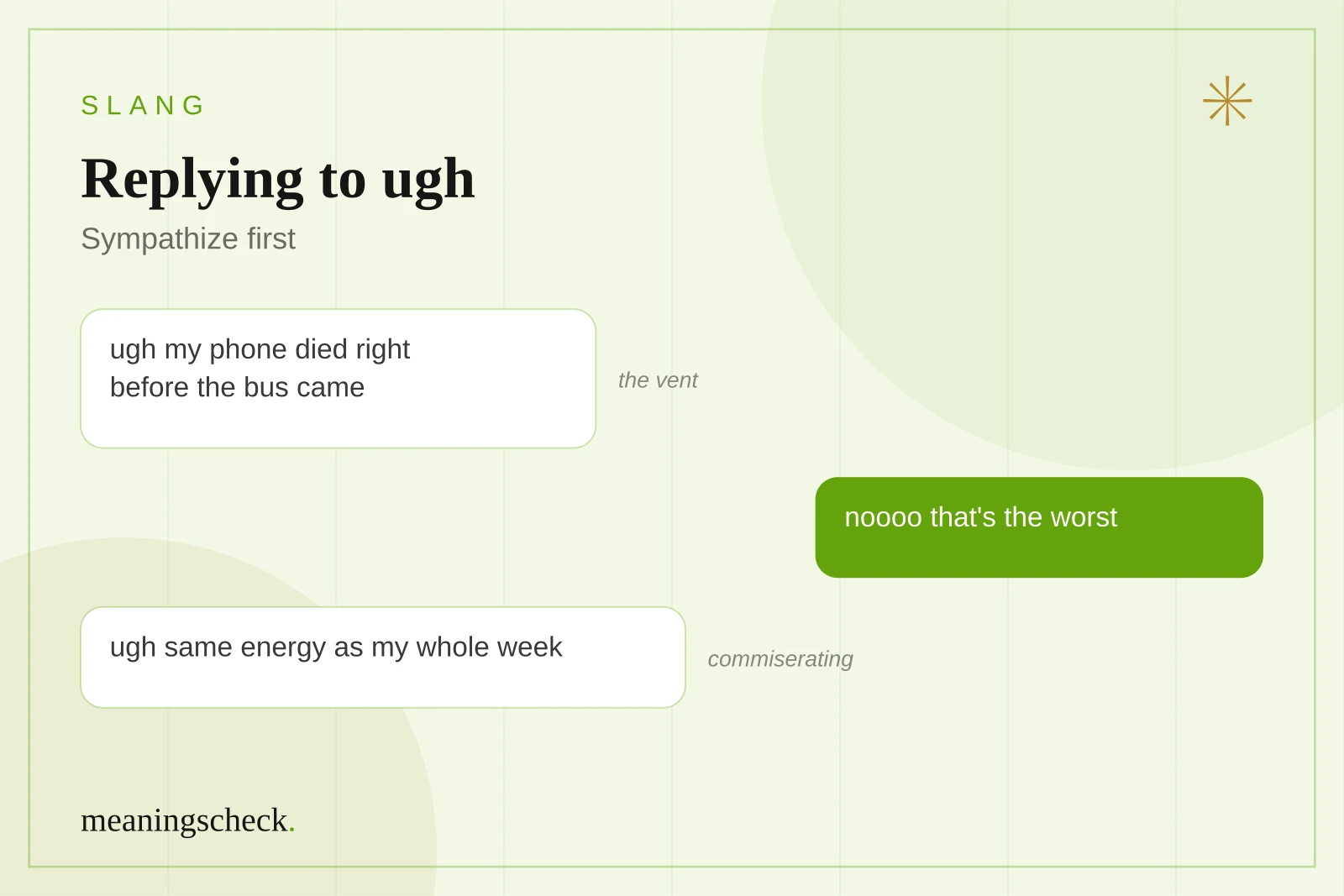
The Short Answer: Match the mood. If they're annoyed, sympathize ("that's the worst"). If they're grossed out, react ("EW"). If it's affectionate, share the joy ("right?? so cute"). If it's about you, ask what's up.
When They're Annoyed
- "That's the worst."
- "Ugh, same."
- "Want to vent?"
When They're Grossed Out
- "EWWW"
- "Nope, nope, nope."
When They're Exhausted
- "Get some rest!"
- "You've got this, almost the weekend."
When It's Affectionate
- "RIGHT?? So cute."
- "I'm obsessed too."
When It's About You
- "Uh oh, what did I do? 😅"
- "You okay?"
Real-World Examples: Ugh in Everyday Conversations
The Short Answer: "Ugh" shows up in morning complaints, food disasters, chores, cute-animal moments, and reluctant agreements. These examples show which "ugh" is which — and how to answer.
These are typical patterns, not quotes from real people.
Morning Dread
Message: "ugh, alarm went off and it's raining"
What it means: "Today is starting badly."
Good reply: "Ugh, same. Coffee time ☕"
A Food Disaster
Message: "ugh, I burned the pasta"
What it means: "I'm annoyed at myself."
Good reply: "Noooo. Takeout night?"
A Chore
Message: "ugh, laundry"
What it means: "I really don't want to do this."
Good reply: "Put on a podcast and get it over with!"
Cute Overload
Message: "ugh, look at this kitten 😭"
What it means: "This is unbearably cute."
Good reply: "I'm DEAD. So cute." (For food, the same overwhelmed energy often comes out as "feening" — see our feening meaning guide.)
A Reluctant Yes
Message: "ugh, fine, I'll come to the party"
What it means: "I'll go, even though I'm not excited."
Good reply: "Yay! It'll be fun, I promise."
A Friend's Big News
Message: "I got the internship!!" — "ugh, I'm so proud of you 🥹"
What it means: The "ugh" here is pure affection.
Good reply: "Thank you!! 😭"
| Situation | Which "Ugh" | Best Reply Style |
|---|---|---|
| Morning dread | Annoyance | Commiserate |
| Food disaster | Frustration | Offer a fix |
| Chore | Reluctance | Encourage |
| Cute overload | Affection | Share the joy |
| Reluctant yes | Resignation | Reassure |
| Big news | Affection | Celebrate |
How to Vent Without Sounding Negative
The Short Answer: A little "ugh" is healthy. Too much can wear people down. Vent briefly, add humor, ask about the other person, and balance complaints with good news. That keeps conversations warm.
Everyone needs to complain sometimes. "Ugh" is a quick, harmless way to do it. But a stream of "ugh" messages can make you seem constantly unhappy. A few habits help:
- Keep it short. "ugh, Mondays 😩" is enough.
- Add humor. "ugh, my plant died again. I'm a plant villain" is funnier than a plain complaint.
- Ask back. "ugh, long day. How was yours?"
- Share good news too. Balance helps friendships.
- Notice patterns. If every message starts with "ugh," it might be worth a deeper look at what's bothering you.
| Draining | Balanced |
|---|---|
| "ugh" (every message) | "ugh, long day — but I got the job done!" |
| "ugh, everything sucks" | "ugh, rough week. Want to get food Friday?" |
| "ugh, my boss" (daily) | Talking it through with someone once |
When "Ugh" Might Mean Someone Needs Support
The Short Answer: Usually "ugh" is everyday venting. But if someone's "ugh" messages turn darker — "ugh, I can't do this anymore" — or pile up with signs of stress, a sincere check-in can matter.
"Ugh" is mostly about small annoyances. Still, pay attention to:
- Heavier language: "ugh, I hate everything," "ugh, what's the point."
- Frequency: Constant "ugh" with no lighter moments.
- Changes: Pulling away, sleeping more, or losing interest in things they love.
If you notice that, set the jokes aside: "Hey, you've seemed really down lately. Want to talk?" Simple questions open doors.
Ugh Across Generations
The Short Answer: Older generations mostly use "ugh" for annoyance or disgust. Younger people also use it affectionately — "ugh so cute" — and stretch it for drama: "ughhhhh." The core sound is the same.
| Group | Typical "Ugh" | Example |
|---|---|---|
| Gen X and older | Annoyance, disgust | "Ugh. Traffic." |
| Millennials | Annoyance, drama | "ughhh Mondays" |
| Gen Z | Annoyance and affection | "ugh, obsessed 😍" |
| Gen Alpha | Dramatic and playful | "UGHHH 😭" |
These are tendencies, not rules. Anyone might use any version.
Is "Ugh" Rude?
The Short Answer: "Ugh" about a situation is fine. "Ugh" at a person — especially to their face — can feel rude or dismissive. Groaning when someone speaks or asks for help sends a clear, unkind message.
| Situation | How "Ugh" Lands |
|---|---|
| About the weather | Fine |
| About a chore | Fine |
| After someone asks you a question | Rude |
| When someone walks in | Very rude |
| About a friend's success (playfully jealous) | Usually fine among friends |
| Over text, about a plan change | Can sting — add context |
The Eye-Roll Effect
A spoken "ugh" often comes with an eye roll or a sigh. In person, that combination reads as contempt. Over text, "ugh 🙄" can carry the same weight. Use it carefully with people you don't know well.
Ugh Boots: The Australian Meaning
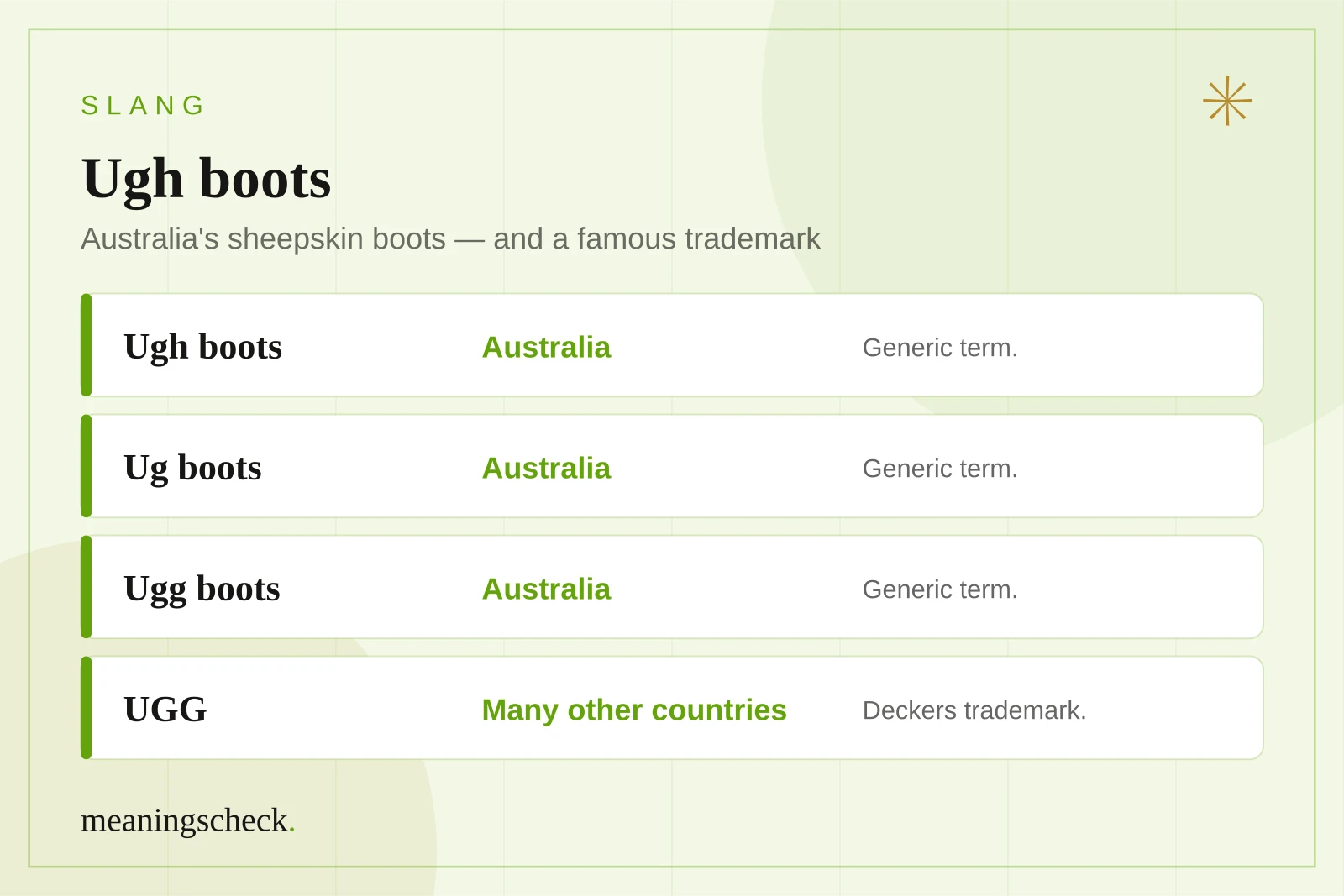
The Short Answer: In Australia, "ugh boots" (also "ugg" or "ug" boots) are sheepskin boots. Australia treats the terms as generic. The American company Deckers owns the "UGG" trademark in many other countries. The origin of the name is unclear.
If you hear "ugh boots" in Australia, nobody's groaning. They're talking about sheepskin boots — the soft, fleece-lined footwear Australians have worn for decades.
Generic in Australia
In Australia, "ugh boots," "ug boots," and "ugg boots" are considered generic terms for sheepskin boots. A 2006 decision by Australia's trademarks office found the evidence "overwhelming" that the terms were generic. The word "ug" even appeared in Australia's Macquarie Dictionary decades earlier.
A Trademark Elsewhere
Outside Australia, it's a different story. The American company Deckers Outdoor Corporation owns the "UGG" trademark in many countries. That's led to long-running legal disputes with Australian bootmakers who want to sell "ugg boots" abroad.
Where the Name Came From
Nobody is completely sure. A popular story says the boots were called "ugly," shortened to "ug." Others credit specific Australian makers. The origin remains debated.
| Spelling | Where You'll See It | Status |
|---|---|---|
| Ugh boots | Australia | Generic term |
| Ug boots | Australia | Generic term |
| Ugg boots | Australia | Generic term |
| UGG | Most other countries | Deckers trademark |
Expert Insights: Why We Groan — The Science of Interjections
The Short Answer: Interjections like "ugh," "huh," and "um" are real words with real jobs. Research shows they help manage conversations and express emotion quickly. Stretching them in text ("ughhhh") is a way to add tone of voice that writing usually loses.
Interjections Are Real Words
It's easy to dismiss "ugh" as just a noise. Linguists disagree. Interjections are a legitimate word class. They pack a whole emotional reaction into one short sound.
"Huh?" Might Be Universal
In a 2013 study, linguists Mark Dingemanse, Francisco Torreira, and Nick Enfield found that a word like "huh?" — used to ask someone to repeat themselves — exists in very similar forms across many languages. They argued it may be a universal word, shaped by how conversation works.
"Um" and "Uh" Have Jobs
Psychologists Herbert Clark and Jean Fox Tree published research in 2002 arguing that "uh" and "um" aren't random noise. Speakers use them to signal delays — "uh" for a short pause, "um" for a longer one. Tiny sounds can carry real meaning.
Stretching Words Shows Feeling
In a 2011 study, researchers Samuel Brody and Nicholas Diakopoulos looked at word lengthening on Twitter — spellings like "coooool." They found it was common and strongly linked to emotion. "Ughhhh" fits that pattern exactly: the extra letters stand in for a longer, louder groan.
Venting Together
Shared complaining can be social glue. When a friend texts "ugh, Mondays" and you reply "ugh, same," you're bonding over a common annoyance. It's a small moment of solidarity. Those tiny exchanges add up. Friends who can groan about the little stuff together often find it easier to talk about the big stuff too.
Real-World Patterns of Ugh
- Monday dread: "ugh, alarm" posts every week.
- Food fails: "ugh, burned the rice."
- Cute overload: "ugh, look at this puppy."
- Reluctant yeses: "ugh, fine, I'll come."
"Ugh" Out Loud: Body Language and Tone
The Short Answer: Spoken "ugh" usually comes with body language — an eye roll, a slump, a sigh, or a head tilt. Those signals change its meaning. A playful "ugh" with a smile is very different from an "ugh" with crossed arms.
In person, "ugh" rarely travels alone:
- Eye roll + "ugh" — annoyance, sometimes at a person.
- Slumped shoulders + "ugh" — exhaustion.
- Wrinkled nose + "ugh" — disgust.
- Hand on heart + "ugh" — affection ("ugh, that's so sweet").
- Smile + "ugh" — playful teasing.
Texting removes all of that. That's why emojis, capital letters, and extra h's matter so much. They do the job your face and voice would do in person.
| In Person | Text Equivalent |
|---|---|
| Eye roll | "ugh 🙄" |
| Long, tired groan | "ughhhhh" |
| Disgusted face | "ugh 🤢" |
| Hand on heart | "ugh 🥹" |
| Laughing groan | "ugh 😂" |
Ugh on Dating Apps
The Short Answer: On dating apps, "ugh" is usually playful: "ugh, you're funny" or "ugh, same, I hate mornings." Shared "ugh" moments can build connection. A frustrated "ugh" aimed at your match is a different story.
Light complaining can actually help two people connect:
- "ugh, Mondays" — "ugh, SAME" → instant common ground.
- "ugh, you have a dog? I'm jealous" → playful compliment.
- "ugh, that's so cute" → warm reaction to a photo.
Just avoid using "ugh" about your match's interests or questions. It can come off as dismissive, even if you meant it as a joke.
How to Explain the Affectionate "Ugh" to Someone Confused
The Short Answer: Say: "It's like when something is so cute or amazing that it's almost overwhelming. The groan means 'I can't handle how good this is.'"
Some people find the affectionate "ugh" confusing. Here's a quick way to explain it:
- "You know how people say 'I'm dead' when something is hilarious?"
- "'Ugh, I love this' works the same way."
- "The feeling is so strong it comes out as a groan."
- "Look for words like love, cute, or obsessed after it."
Once people see the pattern, they spot it everywhere — especially in comment sections.
Ugh in Other Languages
The Short Answer: Every language has its own sounds for disgust and annoyance. French speakers say "beurk," Spanish speakers often say "puaj," and German speakers say "igitt" for something gross. English "ugh" covers both gross and annoying.
| Language | Word | Closest English Meaning |
|---|---|---|
| English | ugh | Annoyed, gross, tired |
| English | ew / yuck | Gross |
| French | beurk | Yuck |
| Spanish | puaj | Yuck |
| German | igitt | Yuck |
| Spanish | uf | Ugh (tired, overwhelmed) |
These words often don't translate perfectly. Each one carries its own flavor and its own situations where native speakers would naturally use it. "Ugh" is unusually flexible — it can be gross, annoying, tired, or even affectionate.
How to Spell "Ugh" (and Common Misspellings)
The Short Answer: The standard spelling is "ugh." You'll also see "ugghh," "uhg," and "ug," but those are typos or playful variants. In formal writing, stick with "ugh."
"Ugh" is short. People still spell it many ways:
| Spelling | Status | Notes |
|---|---|---|
| ugh | Standard | The dictionary spelling |
| ughhh | Playful | Extra h's for emphasis |
| uggh | Playful | Extra g's, same idea |
| uhg | Common typo | Letters swapped |
| ug | Rare | Sometimes used for "ugh," also Australian boot slang |
| ugg | Brand / boots | Usually refers to the boots, not the sound |
Why the "gh"?
The "gh" at the end tries to capture the throaty, groaning sound at the end of the word. English used "gh" to represent that kind of sound in older spellings, which is part of why "ugh" looks the way it does.
"Ugh" vs. "UGG"
If you mean the sound, write "ugh." If you mean the boots, many people write "Uggs" or "ugg boots." In Australia, "ugh boots" is also common for the footwear.
Ugh Variations and Spellings
The Short Answer: You'll see ugh, ughh, ughhhh, UGH, "ugh fine," "ugh same," and "ugh, cute." More letters mean more feeling. Add-ons tell you the direction.
| Variation | Meaning | Example |
|---|---|---|
| ugh | Mild displeasure | "ugh, rain" |
| ughhhh | Strong displeasure | "ughhhh, finals" |
| UGH | Loud frustration | "UGH, again??" |
| ugh fine | Reluctant agreement | "ugh fine, I'll go" |
| ugh same | Shared misery | "ugh same" |
| ugh cute | Affection | "ugh cute 😭" |
| ugh why | Exasperation | "ugh why is it so hot" |
Ugh in Group Chats
The Short Answer: In group chats, "ugh" is how people vent, react, and bond. One person's "ugh, Monday" often gets a chorus of "ugh, same." It's also used for affectionate reactions to photos.
Group chats run on reactions:
- "ugh, class got moved to 8 am" — "UGH" — "ugh same"
- "look at my new puppy" — "ugh, SO CUTE"
- "who's driving?" — "ugh, fine, me"
That shared "ugh" is part of what makes group chats feel like hanging out. It's a quick way to say "I feel you." It also keeps small frustrations from feeling lonely. A canceled class or a broken coffee machine is easier to laugh off when five friends groan along with you.
Ugh for Parents and Teachers
The Short Answer: If a kid says or texts "ugh," they're usually just expressing mild frustration — like a sigh. A sudden flood of "ugh" about everything, though, might mean they're overwhelmed and could use a check-in.
"Ugh" is one of the most common sounds in any household with kids:
- "ugh, homework"
- "ugh, do I have to?"
- "ugh, my sibling"
Most of the time, it's normal venting. It helps to respond calmly instead of reacting to the tone. "I know, it's a lot. Let's do the first part together" often works better than "Don't 'ugh' me."
If the "ugh" seems constant and paired with withdrawal or stress, it might be worth a deeper conversation.
Is "Ugh" Professional?
The Short Answer: Mostly no. In emails and meetings, swap "ugh" for clear, neutral language: "That's frustrating" or "Unfortunately, the deadline moved." Among close coworkers in a casual chat, a light "ugh" is usually fine.
| Casual | Professional |
|---|---|
| "ugh, the server's down" | "The server is down — investigating now." |
| "ugh, another meeting" | "I have a scheduling conflict." |
| "ughhh, deadline moved up" | "The deadline has moved up. Here's our plan." |
| "ugh, fine" | "Understood. I'll take care of it." |
Neutral language keeps the focus on solutions instead of feelings.
Common Mistakes People Make With "Ugh"
The Short Answer: The biggest mistakes are saying "ugh" at people, missing the affectionate "ugh," overusing it until you sound negative, and using it in professional writing.
- Saying "ugh" at someone. It can feel dismissive or rude.
- Missing the affectionate meaning. "Ugh, I love this" is a compliment.
- Overusing it. Constant "ugh" can make you seem negative.
- Using it at work. Choose neutral words.
- Ignoring the emoji. "ugh 😍" and "ugh 🙄" are opposites.
Sometimes a big "ugh" comes after someone overshares — the moment covered in our TMI meaning guide. And when a story is so wild you can't believe it, "bffr" might be the better reaction — see our BFFR meaning guide.
Frequently Asked Questions (FAQs)
What does ugh mean in text?
"Ugh" expresses annoyance, disgust, frustration, or exhaustion. Online, it can also express overwhelming affection, as in "ugh, I love this."
What does "ugh, I love you" mean?
It means "I love you so much it's almost too much." The "ugh" adds playful, overwhelmed affection.
Is "ugh" a real word?
Yes. Merriam-Webster lists "ugh" as an interjection and dates it to 1678.
How do you pronounce ugh?
Most people make a short groan, something like "uh" or "ug." Merriam-Webster lists a few pronunciations.
What's the difference between ugh and ew?
"Ew" is specifically about something gross. "Ugh" can be gross, annoying, or tiring.
What does "ughhhh" mean?
Extra letters make "ugh" stronger. "Ughhhh" means deep, often dramatic frustration or exhaustion.
Is saying ugh rude?
"Ugh" about a situation is fine. Saying it at a person can feel rude.
What are ugh boots?
In Australia, "ugh boots" (also "ug" or "ugg" boots) are sheepskin boots. The terms are generic there.
What does "ugh fine" mean?
"Ugh fine" means "okay, I'll do it — but I'm not thrilled." It's reluctant agreement.
Why do people say ugh when something is cute?
Because the feeling is overwhelming. The groan captures "this is so good it's almost too much."
How do you respond to ugh?
Match the mood: sympathize if they're annoyed, react if they're grossed out, or share the joy if it's affectionate.
Final Thoughts
"Ugh" is one of the oldest and most useful sounds in English. It started as a cough or grunt, became the sound of disgust, settled in as the anthem of Mondays — and then, online, flipped into a groan of love.
That flexibility is its superpower. One little word can mean "gross," "I'm tired," "I'm jealous," or "this is perfect." The words around it tell you which.
So the next time someone texts "ugh," look at what follows. It might be a complaint. It might be a compliment. Either way, a quick, warm reply — "ugh, same" or "right?? so cute" — shows you're listening. That's what most "ugh" messages are really asking for: someone who gets it. For more slang decoded the same way, explore our internet slang guides.
Related terms
Share: · Post on X
Written by MeaningsCheck Team · Published
The MeaningsCheck team researches and writes plain-language explanations of slang, abbreviations, and everyday words — checked for accuracy, updated as language changes.