
What Does OTL Mean? The OTL Emoticon, Orz, and the Pose of Despair Explained (2026)
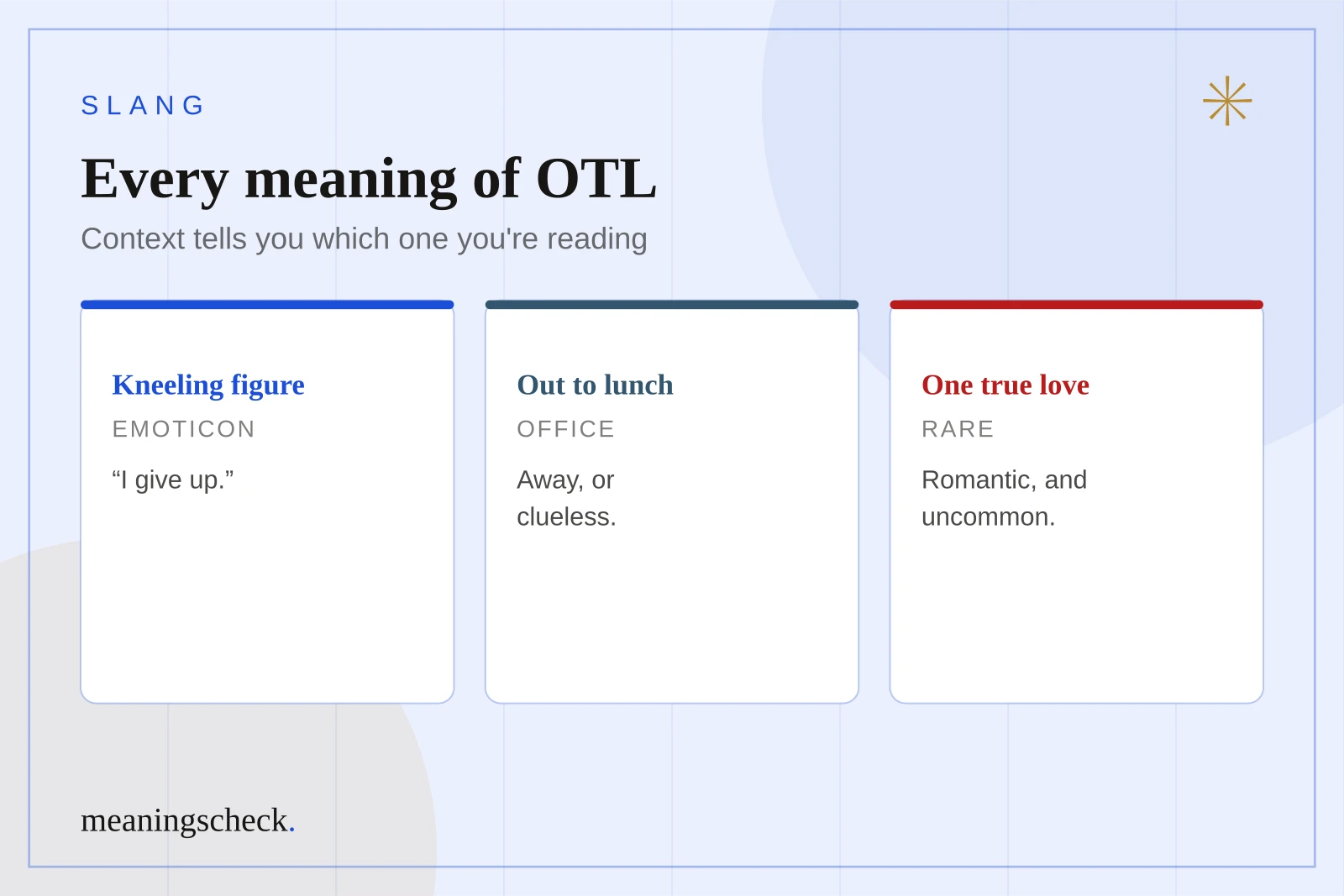
OTL is a text emoticon showing a person kneeling on hands and knees in defeat. Read sideways, the O is the head, the T is the arms and body, and the L is the legs. People type it to say "I give up" or "my life is over" — usually as a joke after a small failure.
OTL is an emoticon of a person collapsed on their hands and knees in despair. It isn't an acronym. It's a tiny picture made of letters. Tilt your head and look: the O is the head, the T is the arms and body, and the L is the bent legs.
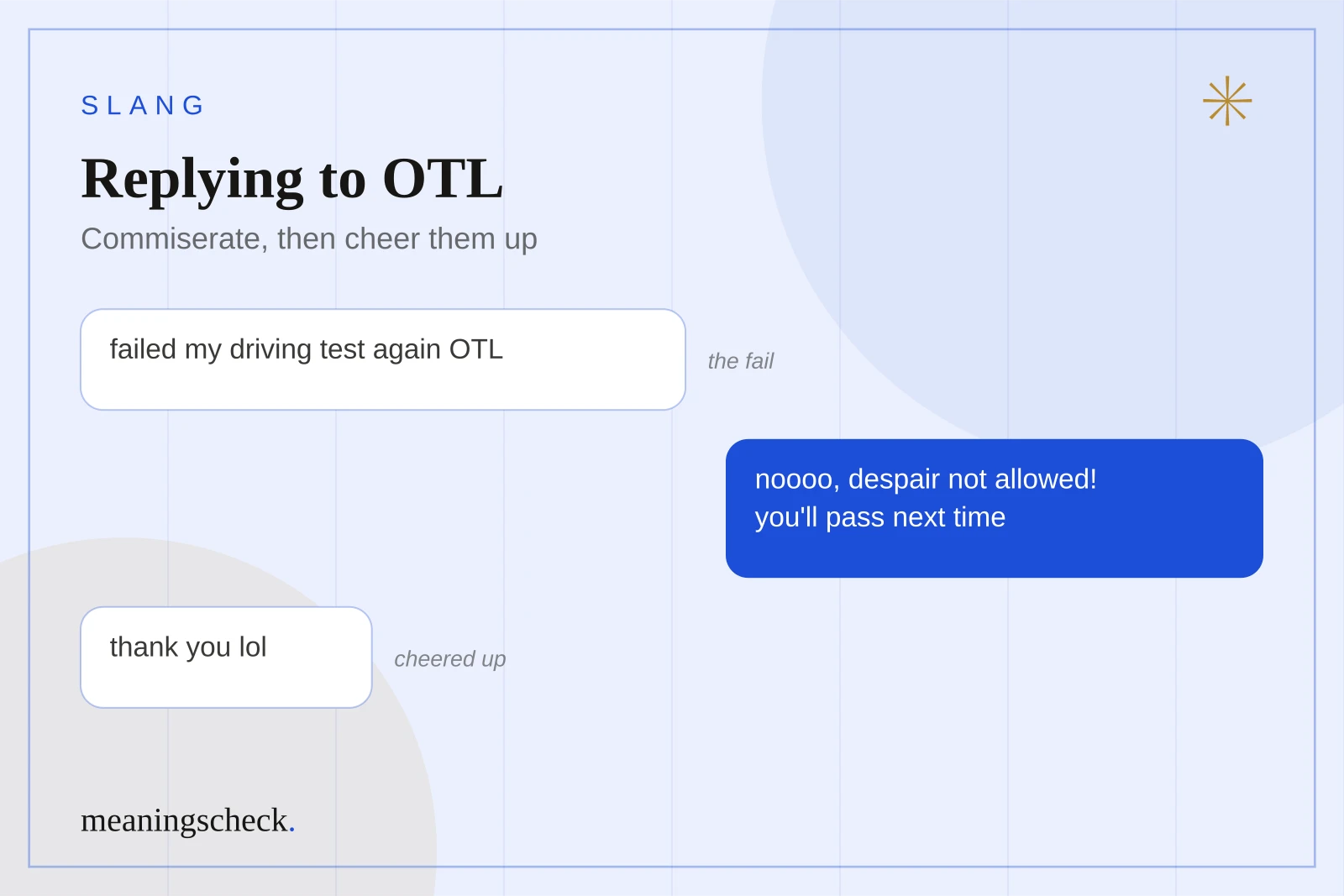
When someone texts "failed my driving test again OTL," they're showing you a little figure slumped on the floor — the internet's way of saying "I give up."
If you're wondering what does OTL mean, that's the core idea: defeat, despair, and "my life is over" — almost always said with a wink. It's especially popular in Korean and Japanese internet culture, where it grew out of an earlier emoticon, orz.
This guide covers the OTL meaning in text, how to "read" it, where it came from, how it compares to orz, OTZ, 囧, and the facepalm, how it's used in K-pop fandoms and anime, how to reply, and the few other things OTL can mean.
Key takeaway: OTL is a picture, not an acronym. It shows someone on their knees in defeat — usually as a playful exaggeration.
Executive Summary: OTL at a Glance
Here's the quick version:
- What it is: A text emoticon of a person kneeling in defeat.
- How to read it: O = head, T = arms and torso, L = legs. The figure faces left.
- What it means: "I give up," "I'm defeated," or "my life is over" — usually jokingly.
- Family: A variant of orz, which traces back to a Japanese forum in 2002.
- Korean connection: OTL spread widely on the Korean imageboard DCInside starting in 2003.
- Similar to: A facepalm, a dramatic sigh, or the 😩 emoji.
- Tone: Mostly playful self-pity. Rarely serious.
What Does OTL Mean? The Core Definition
The Short Answer: OTL is an emoticon that shows a person on their hands and knees, head down in despair. It means "I'm defeated" or "I give up." People use it after small failures, embarrassing moments, or bad luck — usually to laugh at themselves.
How to "Read" OTL
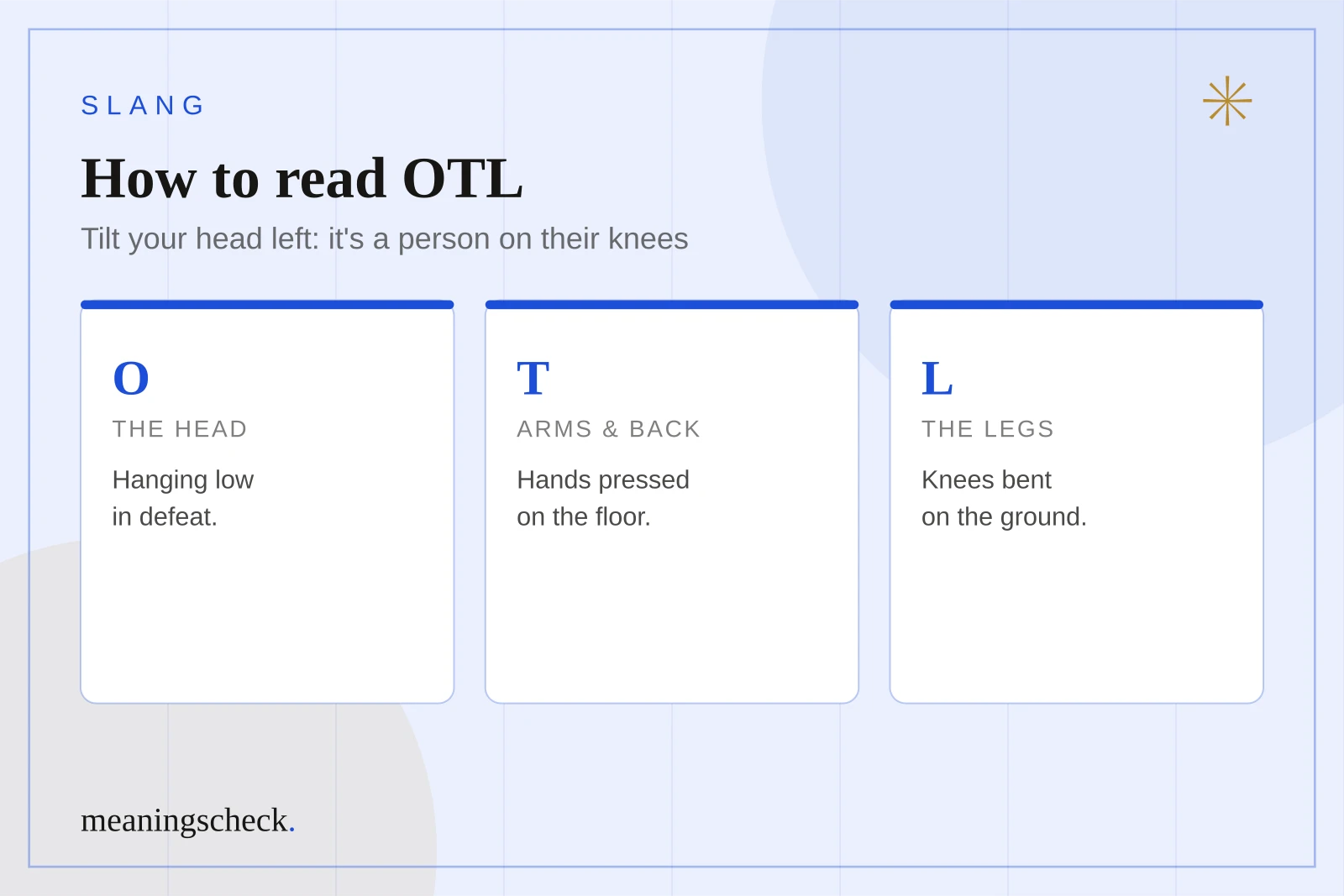
Most emoticons, like :) or ;), are faces turned sideways. OTL is a whole body. Picture someone who has just collapsed on the floor, seen from the side:
- O — the head, hanging low.
- T — the arms pressing on the ground, with the top bar as the back.
- L — the legs, bent at the knee.
The figure faces left, head down, as if the world just ended.
What It Expresses
| Feeling | Example | What It Means |
|---|---|---|
| Defeat | "lost again OTL" | "I give up." |
| Embarrassment | "called my teacher 'mom' OTL" | "I want to disappear." |
| Bad luck | "missed the bus by 5 seconds OTL" | "Why me?" |
| Exhaustion | "3 exams tomorrow OTL" | "I can't do this." |
| Disappointment | "concert sold out OTL" | "Heartbroken." |
| Mock despair | "they ran out of my favorite snack OTL" | "Tragic (not really)." |
Is OTL an Acronym?
Not usually. Some people assume OTL stands for something. In this sense, it's purely visual. Think of it as an emoji made of letters, long before emojis were everywhere.
Where Did OTL Come From? Orz and Its Origins
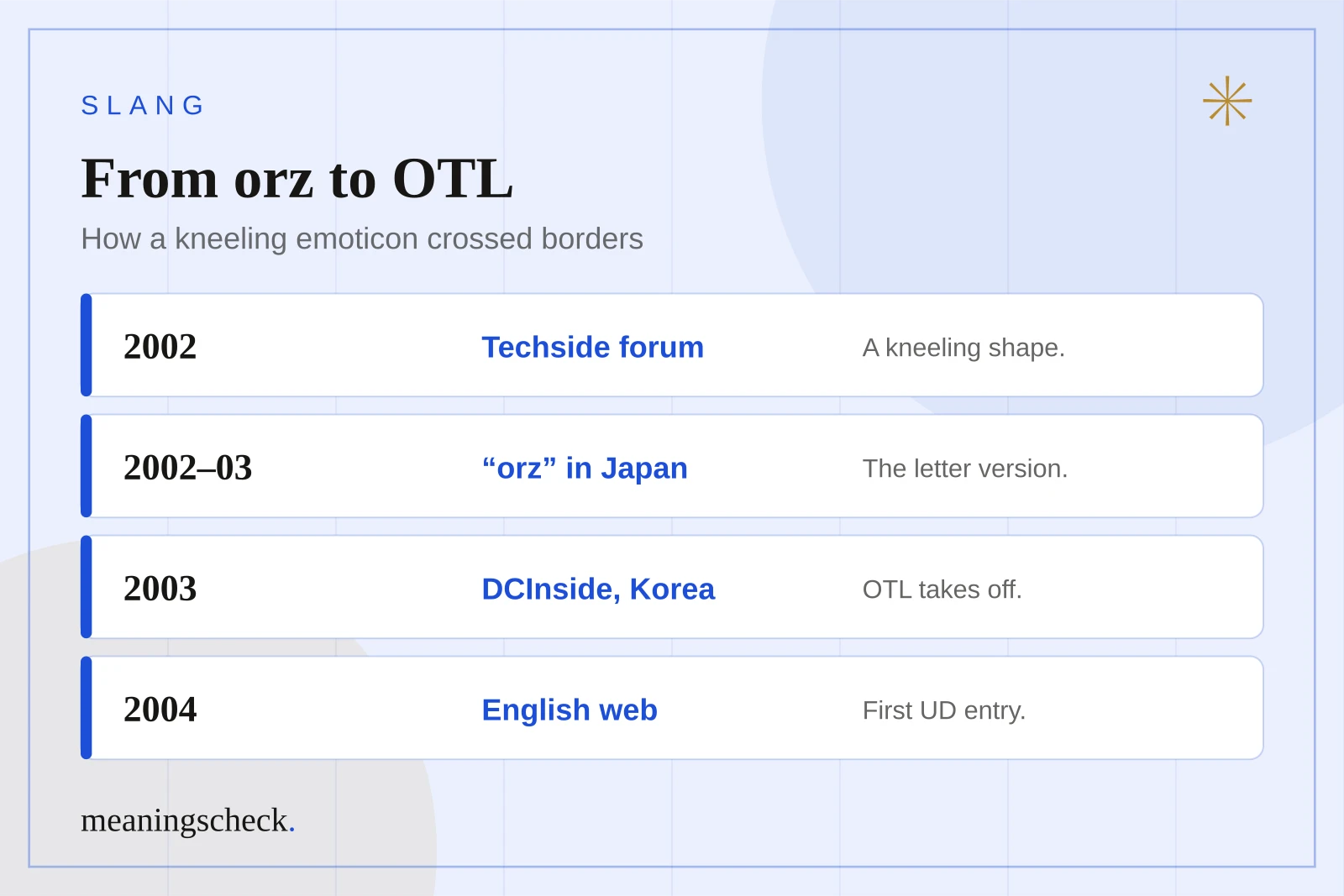
The Short Answer: OTL comes from "orz," a kneeling-figure emoticon that appeared on the Japanese forum Techside in late 2002. It spread across Japanese forums, then to Korea's DCInside in 2003 — where OTL became especially popular — and to Chinese and English-speaking sites by 2004.
Japan, 2002: The First Kneeling Figure
According to Know Your Meme, the story starts on Techside, a Japanese tech forum, in late 2002. A user asking about a cable cover typed a shape like _| ̄|○. Other users said it looked like a person kneeling in defeat. The symbol caught on.
Japanese internet users compressed that shape into letters. The most famous result was orz — o for the head, r for the arms, z for the legs.
The Japanese Name for the Pose
In Japanese, the pose is sometimes called 失意体前屈 (shitsui-tai-zenkutsu), roughly "bending the body forward in despair." It's a playful twist on a phrase for a standing forward stretch. The pose also resembles dogeza, a deep kneeling bow used in formal Japanese apologies.
Korea, 2003: OTL Takes Off
Starting in 2003, the kneeling figure spread through DCInside, a huge South Korean imageboard. Users made image macros of characters kneeling in remorse, often captioned 좌절금지 — "despair not allowed." In Korea, the OTL form became especially common. It's still widely recognized there today.
China and the English-Speaking Web
The emoticon also spread to the Chinese internet around the same time. In English, it likely arrived through 4chan, which borrowed many memes from Japanese imageboards. Know Your Meme notes that the earliest English reference is an Urban Dictionary entry from May 2004.
| Year | Event | Why It Matters |
|---|---|---|
| Late 2002 | A kneeling shape appears on Japan's Techside forum | The pose is born |
| 2002–2003 | "orz" spreads on Japanese forums | The letter version catches on |
| 2003 | DCInside users in Korea adopt the kneeling figure | OTL becomes popular in Korea |
| Mid-2000s | Chinese sites adopt orz and OTL | It goes pan–East Asian |
| May 2004 | First English Urban Dictionary entry | It reaches English speakers |
| Today | OTL used in K-pop fandoms, gaming, and texts | A classic emoticon |
OTL vs. Orz, OTZ, 囧, and the Facepalm
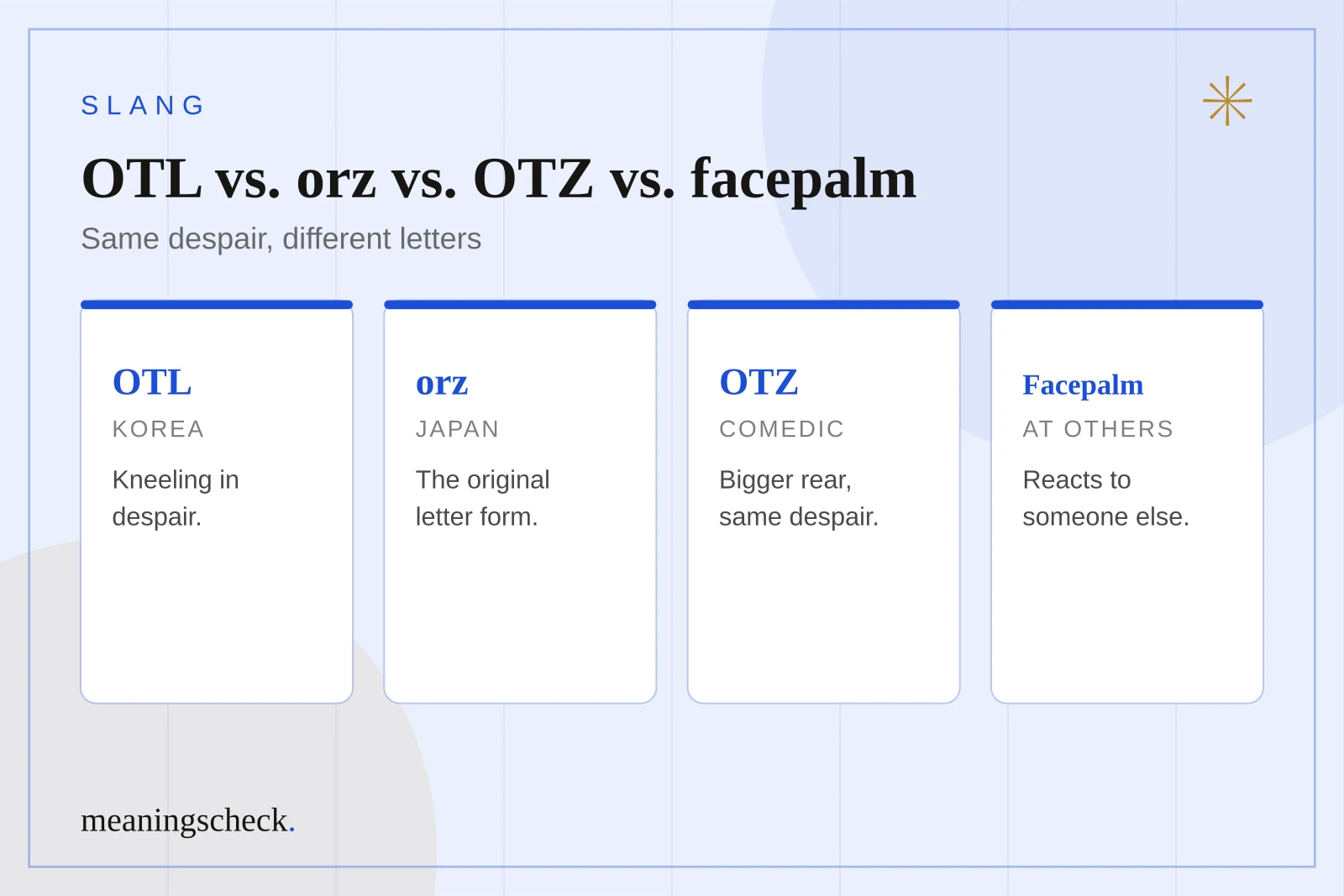
The Short Answer: OTL and orz are the same kneeling figure in different letters. OTZ is a variant with a bigger rear end. 囧 is a Chinese character used as a dismayed face. A facepalm expresses frustration at someone else, while OTL usually expresses defeat about yourself.
| Emoticon | How It's Built | Meaning | Common In |
|---|---|---|---|
| OTL | O head, T arms, L legs | Defeat, despair | Korea, international |
| orz | o head, r arms, z legs | Defeat, despair | Japan, China, international |
| OTZ | Z for legs and a bigger rear | Same, often comedic | Japan |
| Orz | Capital O — a bigger head | Same, with emphasis | Various |
| 囧 | A Chinese character that looks like a sad face | Dismay, awkwardness | China, Taiwan |
| 🤦 | Facepalm emoji | Frustration, disbelief | Everywhere |
| 😩 | Weary face emoji | Exhaustion, despair | Everywhere |
| 🧎 | Person kneeling emoji | Kneeling (sometimes used like OTL) | Everywhere |
OTL vs. Orz
They're the same idea. orz is more common in Japan and China. OTL is especially popular in Korea. Some people say OTL looks more dramatic because the capital letters make the figure bigger.
OTL vs. the Facepalm
A facepalm usually reacts to someone else's mistake: "you did WHAT? 🤦." OTL usually reacts to your own bad luck or failure: "I did it again OTL." Know Your Meme notes OTL can sometimes express frustration with others too. Self-directed despair is still its classic use.
OTL vs. 😩
The weary face emoji covers similar feelings. OTL adds a full-body, theatrical flair — like collapsing dramatically on the floor rather than just sighing.
Key takeaway: OTL = orz = a person on the floor in defeat. Different letters, same drama.
OTL Meaning in Text: How People Use It
The Short Answer: In texts, OTL usually comes at the end of a sentence about a small disaster: "forgot my lunch OTL." It's self-deprecating and funny. Repeating it ("OTL OTL") or stretching it ("OTLLL") makes the despair extra dramatic.
After a Small Failure
- "burned the toast again OTL"
- "fell asleep and missed the livestream OTL"
These are tiny tragedies. OTL makes them funny.
After an Embarrassing Moment
- "waved back at someone who was waving at the person behind me OTL"
- "sent the text to the wrong group chat OTL"
Here OTL means "I want to sink into the floor."
When Plans Fall Apart
- "rain canceled the picnic OTL"
- "tickets sold out in 2 minutes OTL"
For Extra Drama
- "OTL OTL OTL" — total collapse.
- "OTLLL" — stretched-out despair.
- "orz" in the same message — doubling up on kneeling figures.
| Message | Mood |
|---|---|
| "missed the bus OTL" | Mildly annoyed, laughing |
| "failed the quiz OTL" | Disappointed |
| "OTL OTL OTL" | Totally defeated (dramatically) |
| "it's fine OTL" | Not fine — and joking about it |
| "OTL… why" | Exasperated |
OTL in K-pop Fandoms and Korean Internet Culture
The Short Answer: OTL is common in K-pop fan spaces and Korean online communities. Fans use it when ticketing fails, when a comeback is delayed, or when a favorite idol does something unbearably cute. It's a quick, recognizable way to show dramatic despair.
Because OTL took off in Korea, it remains familiar in Korean online communities and in K-pop fandoms around the world.
Common Fandom Uses
- Ticketing fails: "server crashed and I didn't get tickets OTL"
- Long waits: "no comeback news yet OTL"
- Overwhelming cuteness: "he did the heart pose again OTL I can't"
That last use is interesting. Sometimes OTL means "this is too much" in a happy way — like falling to your knees because something is so good.
"Despair Not Allowed"
The DCInside image macros captioned 좌절금지 ("despair not allowed") became a meme of their own. They often showed a kneeling figure with a big "no" symbol — a joking way to tell someone to cheer up.
OTL in Anime and Japanese Media
The Short Answer: In anime and manga, characters often collapse into the orz pose when they're defeated or embarrassed — sometimes with gloomy vertical lines, a spotlight, or a sad bell sound. The emoticon captures that classic comedic moment.
The kneeling-in-despair pose is a staple of anime and manga comedy. A character fails, freezes, and drops to hands and knees. Artists often add:
- Gloomy vertical lines over the character.
- A dramatic spotlight, like a stage tragedy.
- A "chiin" bell sound, suggesting the character is "dead inside."
Japanese With Anime notes these visual conventions often accompany the pose. When fans type orz or OTL, they're borrowing that exact comedic beat.
OTL on TikTok, X, Discord, and in Games
The Short Answer: On X and TikTok, OTL appears in captions and replies about small fails. On Discord and in gaming chats, it follows a lost match or a bad drop. Everywhere, it means "I'm defeated."
OTL on X (Twitter)
On X, OTL caps short posts about bad luck: "dropped my phone in the sink OTL."
OTL on TikTok
On TikTok, OTL shows up in captions and comments — especially in anime, K-pop, and gaming communities.
OTL on Discord and in Games
In gaming chats, OTL is a quick reaction to defeat: "lost the final round OTL," "worst drop rates ever OTL."
| Platform | Typical Use | Example |
|---|---|---|
| X (Twitter) | Bad-luck posts | "missed the train OTL" |
| TikTok | Captions and comments | "my cooking skills OTL" |
| Discord | Reactions | "lost again OTL" |
| Games | Defeat | "gg… OTL" |
| Texts | Small disasters | "forgot my keys OTL" |
| K-pop fan spaces | Ticketing and comebacks | "sold out OTL" |
How to Reply to OTL (With Examples)
The Short Answer: Match the playful tone. Commiserate ("noooo 😭"), cheer them up ("you'll get it next time!"), or join the joke with your own "OTL." If it seems like real distress, check in sincerely.
Commiserate
- "Noooo 😭"
- "That's so painful, I'm sorry"
- "Same honestly OTL"
Cheer Them Up
- "Despair not allowed! You'll get it next time 💪"
- "It's okay, there's always next round"
Join the Joke
- "OTL OTL"
- "orz"
When It Might Be Real
If someone seems genuinely hopeless — not just joking about toast — set the joke aside: "Hey, are you actually okay?"
Real-World Examples: OTL in Everyday Conversations
The Short Answer: OTL shows up after exam stress, cooking disasters, gaming losses, embarrassing moments, and fandom heartbreak. These examples show what it means each time — and how to respond.
These are typical patterns, not quotes from real people.
Exam Stress
Message: "studied the wrong chapter for the quiz OTL"
What it means: "I'm defeated — and a little embarrassed."
Good reply: "Nooo 😭 there's always the next one!"
A Cooking Disaster
Message: "the cake sank in the middle OTL"
What it means: "My baking dreams are crushed (jokingly)."
Good reply: "Still tastes good though, right?"
A Gaming Loss
Message: "lost on the final boss AGAIN OTL"
What it means: "I'm done… for now."
Good reply: "Take a break and try again tomorrow!"
An Embarrassing Moment
Message: "said 'you too' when the waiter said enjoy your meal OTL"
What it means: "I want to sink into the floor."
Good reply: "Classic. Everyone's done that 😂"
Fandom Heartbreak
Message: "icl I cried when the tour sold out OTL"
What it means: "I'm honestly heartbroken." The "icl" adds an honest confession — explained in our ICL meaning guide.
Good reply: "I'm so sorry 😭 maybe they'll add dates!"
| Situation | What OTL Signals | Best Reply Style |
|---|---|---|
| Exam stress | Defeat | Encourage |
| Cooking fail | Mock tragedy | Laugh along kindly |
| Gaming loss | Frustration | Suggest a break |
| Embarrassment | Wanting to disappear | Reassure — everyone does it |
| Fandom heartbreak | Real disappointment | Sympathize |
OTL Across Communities
The Short Answer: OTL is especially familiar in Korean online spaces and K-pop fandoms, orz is more common among Japanese and anime fans, and both show up in international gaming and meme communities. Younger English speakers may know the 😩 emoji better.
| Community | Most Common Form | Typical Use |
|---|---|---|
| Korean internet users | OTL | Everyday defeat |
| K-pop fandoms | OTL | Ticketing fails, delays |
| Japanese internet users | orz | Self-deprecating jokes |
| Anime and manga fans | orz / OTL | Comedic despair |
| Gamers | OTL / orz | Losses and bad luck |
| General English texting | 😩 / 😭 | Similar feelings, emoji style |
How to Explain OTL to Someone Who Doesn't Get It
The Short Answer: Say: "It's a little person on their hands and knees, giving up. The O is the head, T is the arms, L is the legs." Then tilt your head. They'll see it.
If someone is puzzled by OTL, try this:
- "It's not letters — it's a picture."
- "Tilt your head to the left."
- "O is the head. T is the arms. L is the legs."
- "It's someone collapsed on the floor going 'why me.'"
Most people suddenly see it — and then can't unsee it. Some even start typing it themselves the next time something goes wrong. That's how a tiny emoticon from a 2002 Japanese forum keeps finding new fans more than twenty years later.
Is OTL Sad or Serious?
The Short Answer: Usually not. OTL is mostly playful exaggeration — mock despair over small things. But because it expresses hopelessness, pay attention if someone uses it a lot about serious problems.
OTL is built for comedy. It turns "I burned the toast" into a dramatic tragedy. That exaggeration is the joke.
Still, the feeling it depicts — hopelessness — is real. A few signs that OTL might mean more than a joke:
- It's about serious topics, like health, family, or feeling worthless.
- It appears constantly, every day, with no humor around it.
- The person withdraws or seems different in other ways.
If you notice those signs, a gentle, sincere check-in matters more than any emoticon.
Other Meanings of OTL
The Short Answer: Outside the emoticon, OTL can mean "out to lunch" — either literally away from your desk or figuratively clueless. A few sites list "one true love," but that's rare.
Out to Lunch
OTL can stand for "out to lunch." In offices, it's a literal status: "OTL, back at 1." As an idiom, "out to lunch" also means clueless or not paying attention: "He's totally OTL in meetings."
One True Love
Some websites list OTL as "one true love." It's uncommon. If you see it in a romantic context, that might be the meaning.
| Context | OTL Means | Example |
|---|---|---|
| Texting and social media | Kneeling-in-despair emoticon | "failed again OTL" |
| Office status | Out to lunch | "OTL, back at 1" |
| Idiom | Clueless ("out to lunch") | "He's OTL today" |
| Romantic (rare) | One true love | "You're my OTL" |
Expert Insights: Why a Kneeling Emoticon Took Over the Internet
The Short Answer: Emoticons give text the body language it lacks. Most Western emoticons are sideways faces. Japanese kaomoji are upright faces. OTL shows a whole body — making it unusually expressive. Its theatrical self-pity turns small frustrations into shared jokes.
Emoticons Add Body Language
Text strips away tone of voice, facial expressions, and posture. Emoticons put some of that back. Computer scientist Scott Fahlman is widely credited with proposing :-) and :-( on a Carnegie Mellon University message board in 1982, to signal jokes and seriousness in text.
Western Faces vs. Japanese Kaomoji
Western emoticons are usually sideways faces: :) ;) :P. Japanese kaomoji are usually upright faces: (^_^) (T_T) (╯°□°)╯. OTL is different from both. It's a full-body pose — rare in emoticon history.
The Power of Theatrical Self-Pity
OTL works because it's over the top. Collapsing to the floor over a burned piece of toast is absurd. That absurdity invites friends to laugh with you, not at you. It's self-deprecating humor in visual form.
Shared Culture Across Borders
OTL started in Japan, boomed in Korea, spread to China, and reached English speakers — all within a couple of years. It's an early example of how internet culture crosses languages. You don't need to read Korean or Japanese to understand a kneeling figure.
Real-World Patterns of OTL
- Exam season: "3 tests tomorrow OTL."
- Ticketing chaos: "sold out instantly OTL."
- Cooking fails: "smoke alarm went off again OTL."
- Gaming losses: "lost on the last round OTL."
OTL and Other Text Pictures You Should Know
The Short Answer: OTL belongs to a family of "text pictures" built from characters: the shrug, the table flip, the look of disapproval, crying eyes, and more. Each one shows a body or face doing something specific.
Long before emoji keyboards, people built pictures out of characters. Here are some classics alongside OTL:
| Text Picture | Name | Meaning |
|---|---|---|
OTL / orz | Kneeling in despair | "I give up." |
¯\_(ツ)_/¯ | The shrug | "I don't know" or "oh well." |
(╯°□°)╯︵ ┻━┻ | The table flip | "I'm furious!" |
┬─┬ノ( º _ ºノ) | Putting the table back | "Let's calm down." |
ಠ_ಠ | Look of disapproval | "Really?" |
T_T | Crying eyes | "So sad." |
^_^ | Happy eyes | "Yay!" |
<3 | Heart | Love or appreciation |
Faces vs. Bodies
Most text pictures are faces. A few, like OTL, the shrug, and the table flip, show bodies doing something. That's why they feel so expressive. You can almost see the person.
When to Use Which
- Defeated by your own luck? OTL.
- Not sure and don't care? The shrug.
- Absolutely furious (in a funny way)? The table flip.
- Judging someone silently? The look of disapproval.
When OTL Means "This Is Too Good"
The Short Answer: Sometimes OTL means the opposite of sad: you're so overwhelmed by something wonderful that you "collapse." Fans use it for unbearably cute moments, amazing performances, or perfect food.
The internet loves exaggerated reactions. "I'm dead," "I can't," and 💀 all mean something is too funny or too good. OTL can work the same way:
- "he smiled at the camera OTL I can't"
- "this ramen is so good OTL"
- "the encore was perfect OTL"
In these cases, the kneeling figure isn't defeated by bad luck. It's defeated by joy. Context — and a happy emoji or "I can't" — tells you which kind of collapse it is.
| Message | Kind of OTL |
|---|---|
| "missed the bus OTL" | Defeated (bad luck) |
| "failed the test OTL" | Defeated (disappointment) |
| "this puppy OTL 🥹" | Overwhelmed (too cute) |
| "best concert ever OTL" | Overwhelmed (too good) |
A Short History of Emoticons and Emoji
The Short Answer: Scott Fahlman proposed :-) in 1982. Japanese kaomoji like (^_^) and orz built a richer, upright style. Shigetaka Kurita designed an influential set of emoji for a Japanese mobile service in 1999, and Unicode began standardizing emoji in 2010.
OTL sits in a bigger story about how people add emotion to text:
| Year | Milestone | Why It Matters |
|---|---|---|
| 1982 | Scott Fahlman proposes :-) and :-( | Sideways faces signal tone |
| 1980s–1990s | Japanese kaomoji spread | Upright faces like (^_^) and (T_T) |
| 1999 | Shigetaka Kurita designs emoji for NTT DoCoMo | Tiny pictures arrive on phones |
| 2002–2003 | orz and OTL appear | Full-body text pictures |
| 2010 | Unicode begins standardizing emoji | Emoji go global |
| Today | Text pictures and emoji coexist | OTL is still a favorite |
Even with thousands of emoji available, text pictures like OTL survive. They're quick to type, work on any keyboard, and carry a retro charm that emoji can't quite match.
OTL Variations and Spellings
The Short Answer: You'll see OTL, otl, orz, OTZ, Orz, OTL OTL, and OTLLL. They're all the same kneeling figure. Repeating or stretching it adds drama.
| Variation | Notes | Example |
|---|---|---|
| OTL | Classic, popular in Korea | "lost again OTL" |
| otl | Lowercase, smaller figure | "missed it otl" |
| orz | Japanese original form | "orz" |
| Orz | Big-headed version | "Orz" |
| OTZ | Bigger rear, comedic | "OTZ" |
| OTL OTL | Double despair | "OTL OTL" |
| OTLLL | Stretched for drama | "OTLLL" |
OTL in Group Chats
The Short Answer: In group chats, OTL is a quick way to share a small disaster and get sympathy. Friends often reply with their own OTL, a crying emoji, or "despair not allowed!" It keeps bad news light.
Group chats are perfect for OTL moments:
- "spilled coffee on my notes OTL"
- "the group project is due tomorrow?? OTL"
- "OTL" (replying to someone else's bad news)
When everyone drops an "OTL," it becomes a little chorus of shared suffering — which can actually make the bad news feel lighter. Misery loves company, especially when the misery is a burned pizza.
OTL for Parents and Teachers
The Short Answer: If a kid types OTL, they're showing a little figure kneeling in defeat — usually as a joke about something small. It's harmless. If it appears often alongside serious worries, a gentle check-in can help.
Parents and teachers may see OTL in messages, chats, or even handwritten notes. In almost every case, it means "ugh, I failed" in a dramatic, funny way.
If you're curious, ask: "What does OTL mean?" Kids often enjoy explaining that it's a person on the floor — and might even demonstrate the pose.
How to Type OTL and Its Variants
The Short Answer: OTL is easy: just type the three capital letters. For orz, type lowercase o, r, z. Some people add underscores or spaces for longer figures. The simple versions are still the most recognizable.
One reason OTL survives is that it's effortless to type on any keyboard — no emoji menu needed.
- OTL — Shift + O, T, L.
- orz — lowercase o, r, z.
- OTZ — Shift + O, T, Z.
- OTL OTL — repeat for extra drama.
- OTL… — add an ellipsis for a long, tragic pause.
Tips for Clarity
- Put it at the end of a sentence. "missed the train OTL" reads best.
- Add context. Not everyone knows OTL. A clear sentence before it helps.
- Pair with an emoji if you're unsure the reader knows it: "OTL 😭."
Will People Understand It?
People familiar with Korean, Japanese, gaming, or anime communities will usually recognize OTL instantly. Others might think it's a typo. If you're texting someone new to it, a quick "(that's a person on their knees lol)" can make the joke land.
Is OTL Professional?
The Short Answer: Not really. In work emails, skip emoticons like OTL. In casual team chats with friendly coworkers, a light "OTL" after a small mistake can be fine.
| Casual | Professional |
|---|---|
| "broke the build OTL" | "I introduced a bug — fixing it now." |
| "missed the deadline OTL" | "I missed the deadline. Here's my plan to catch up." |
| "OTL" | "Unfortunately, that didn't work." |
If you mean "out to lunch," spelling it out — "At lunch, back at 1" — avoids confusion.
Common Mistakes People Make With OTL
The Short Answer: The biggest mistakes are reading OTL as an acronym, not seeing the kneeling figure, confusing it with "out to lunch," and missing when someone's despair is real.
- Reading it as an acronym. It's a picture.
- Not seeing the figure. Tilt your head: head, arms, legs.
- Confusing it with "out to lunch." Context tells you.
- Using it at work. Keep it to casual chats.
- Missing real distress. Check in if it seems serious.
If someone's OTL is about a friend's terrible decision, a dramatic "jfc" might fit better — see our JFC meaning guide. And for everyday exasperation, the head-shake in our SMH meaning guide works too.
Frequently Asked Questions (FAQs)
What does OTL mean in text?
OTL is an emoticon of a person kneeling on hands and knees in defeat. It means "I give up" or "I'm defeated," usually jokingly.
How do you read OTL?
Tilt your head left. The O is the head, the T is the arms and back, and the L is the legs.
Is OTL the same as orz?
Yes. Both show the same kneeling figure. orz is more common in Japan, while OTL is especially popular in Korea.
Where did OTL come from?
It grew out of orz, which appeared on the Japanese forum Techside in 2002. OTL spread widely in Korea through DCInside starting in 2003.
Is OTL sad?
It expresses despair. Usually, though, it's a joke about small problems.
What does OTL mean in K-pop?
In K-pop fandoms, OTL shows dramatic despair — over ticketing fails, delays, or even overwhelming cuteness.
What does OTZ mean?
OTZ is a variant of orz and OTL. The Z suggests a bigger rear end, making it more comedic.
Can OTL mean "out to lunch"?
Yes. In an office context, OTL can mean "out to lunch." As an idiom, it can also mean clueless.
What does "despair not allowed" mean?
It comes from Korean image macros captioned 좌절금지 ("despair not allowed"), often showing a kneeling figure with a "no" symbol. It's a joking way to say "cheer up."
Is there an emoji for OTL?
The person kneeling emoji 🧎 is close, and 😩 captures the feeling. Many people still prefer the letters OTL for the full dramatic effect.
How do you respond to OTL?
Commiserate ("noooo"), cheer them up ("despair not allowed!"), or reply with your own OTL.
Final Thoughts
OTL is one of the internet's most expressive little pictures. Three letters become a whole person collapsed on the floor — the universal pose of "I give up."
It started on a Japanese tech forum, took off in Korea, and traveled the world. Today, it's still a perfect way to turn small disasters into shared jokes. And because it's just three letters, it works on any phone, any keyboard, and any app. No emoji update required — just a little imagination and a tilt of the head.
So the next time you miss the bus by five seconds, you know what to type. For more slang decoded the same way, explore our internet slang guides. And when something is so funny you can't breathe, the LMAO meaning guide has you covered.
Related terms
Share: · Post on X
Written by MeaningsCheck Team · Published
The MeaningsCheck team researches and writes plain-language explanations of slang, abbreviations, and everyday words — checked for accuracy, updated as language changes.