
What Does LMR Mean? LMR Meaning on Instagram, Snapchat, and TikTok (2026)
LMR stands for "like my recent" — a request asking you to like someone's most recent post on Instagram, TikTok, or another app. You'll often see "LMR" on Snapchat stories with a screenshot of the new post. It has a harmful second meaning, "last minute resistance," from pickup-artist culture.
LMR means "like my recent." It's a request asking you to like someone's most recent post — usually on Instagram or TikTok. When a friend posts "LMR 💕" on their Snapchat story with a screenshot of a new photo, they're asking you to go show it some love.
That's the meaning you'll see almost every time.
But if you're asking what does LMR mean, there's one more thing you should know. In some corners of the internet, LMR stands for "last minute resistance" — a harmful term from pickup-artist culture about pushing past someone's hesitation before sex. We'll explain why that meaning is a red flag, and how to tell the two apart.
This guide covers the LMR meaning on Instagram, Snapchat, and TikTok, where it came from, how it compares to L4L, F4F, and LMS, the etiquette of asking for likes, how to reply, what research says about likes and self-esteem, and every other meaning of LMR.
Key takeaway: On social media, LMR = "like my recent." It's a casual request for a like on someone's newest post.
Executive Summary: LMR at a Glance
Here's the quick version:
- Main meaning: "Like my recent" — please like my newest post.
- Where you'll see it: Snapchat stories, Instagram comments and DMs, TikTok, and group chats.
- How it's used: Often with a screenshot of the new post and an emoji.
- Close cousins: L4L (like for like), F4F (follow for follow), LMS (like my status).
- Tone: Casual and friendly with friends. Can feel spammy from strangers.
- Harmful meaning: "Last minute resistance" — a pickup-artist term that treats hesitation about sex as an obstacle. Hesitation means stop.
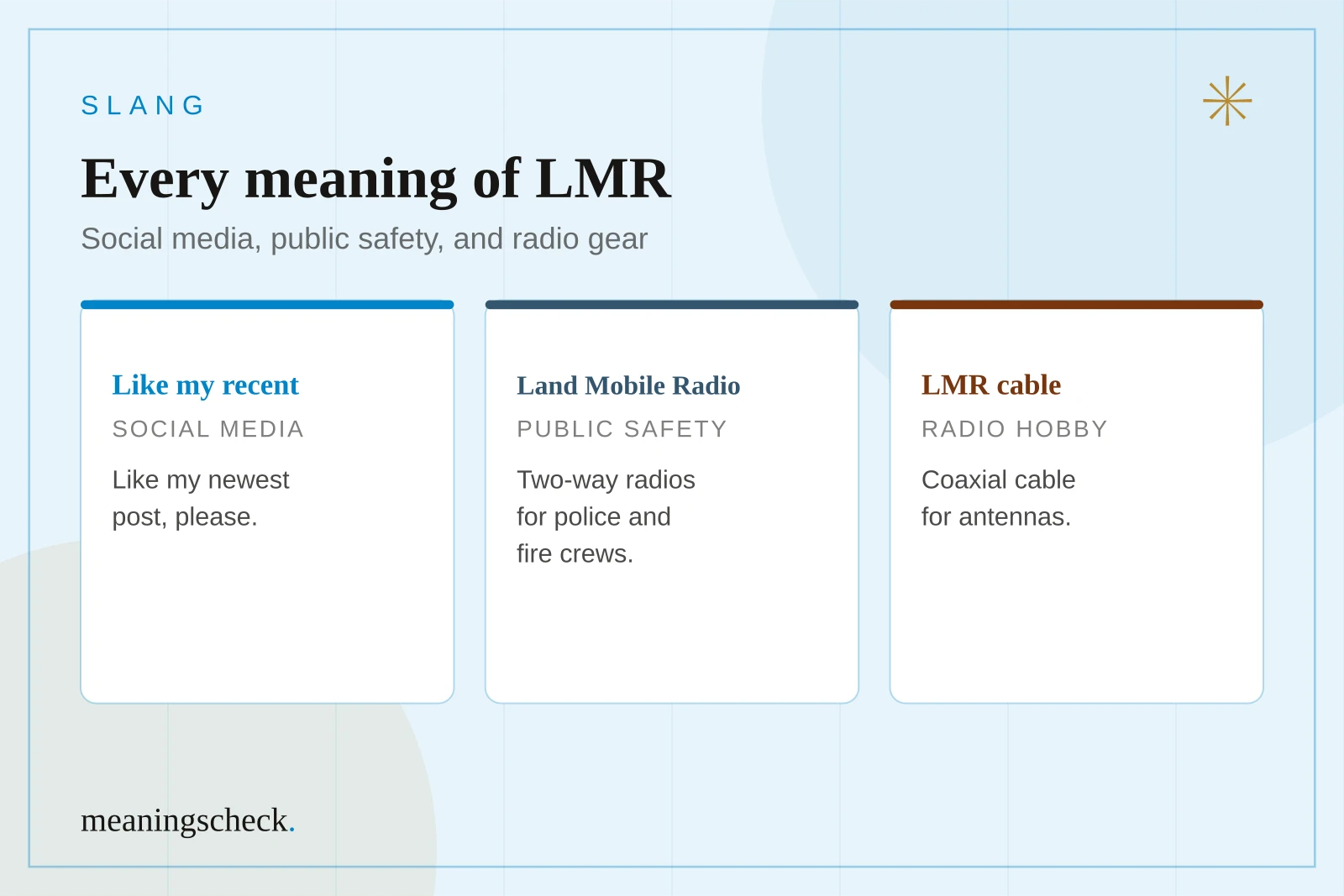
- Technical meanings: Land Mobile Radio (two-way radio systems) and LMR coaxial cable.
What Does LMR Mean? The Core Definition
The Short Answer: LMR stands for "like my recent." It asks people to like the newest photo or video someone posted. It's common on Snapchat stories, Instagram, and TikTok, especially among teens and young adults.
The Literal Translation
The LMR meaning comes straight from its letters:
- L — Like
- M — My
- R — Recent
A "recent" is your most recent post — usually the latest photo or video on Instagram, though it can also be a TikTok or another platform's post.
How People Use It
You'll see LMR in a few common forms:
| Where | How LMR Appears | What It Means |
|---|---|---|
| Snapchat story | "LMR 💕" + screenshot | "Go like my new post!" |
| Instagram comment | "lmr 🥺" | "Like my newest post, please." |
| DM | "lmr pls" | A personal request |
| Group chat | "everyone lmr!!" | Asking the whole group |
| TikTok | "lmr on IG" | Cross-promoting a post |
Why People Ask
People ask for likes for lots of reasons:
- They're proud of a photo and want friends to see it.
- They want support — especially for something personal, like a graduation or new job.
- They hope for reach. Many people believe early engagement helps a post get seen by more people.
- It's fun. Among friends, "LMR" can be a playful habit.
Where Did LMR Come From?
The Short Answer: LMR grew out of Instagram's like-driven culture in the 2010s. Urban Dictionary entries from as early as 2016 define it as "like my recent," often shared on Snapchat stories. It follows older requests like "LMS" (like my status) from the Facebook era.
The Facebook Era: LMS
Before LMR, there was LMS — "like my status" — from the Facebook era. People posted "LMS" to get likes on their status updates, sometimes as part of games: "LMS and I'll rate you."
Instagram and the Rise of the Like
As Instagram grew in the 2010s, likes became a big deal. Posts lived and died by engagement. Hashtags like #L4L (like for like) and #F4F (follow for follow) spread as people traded likes and follows.
Snapchat Stories Join In
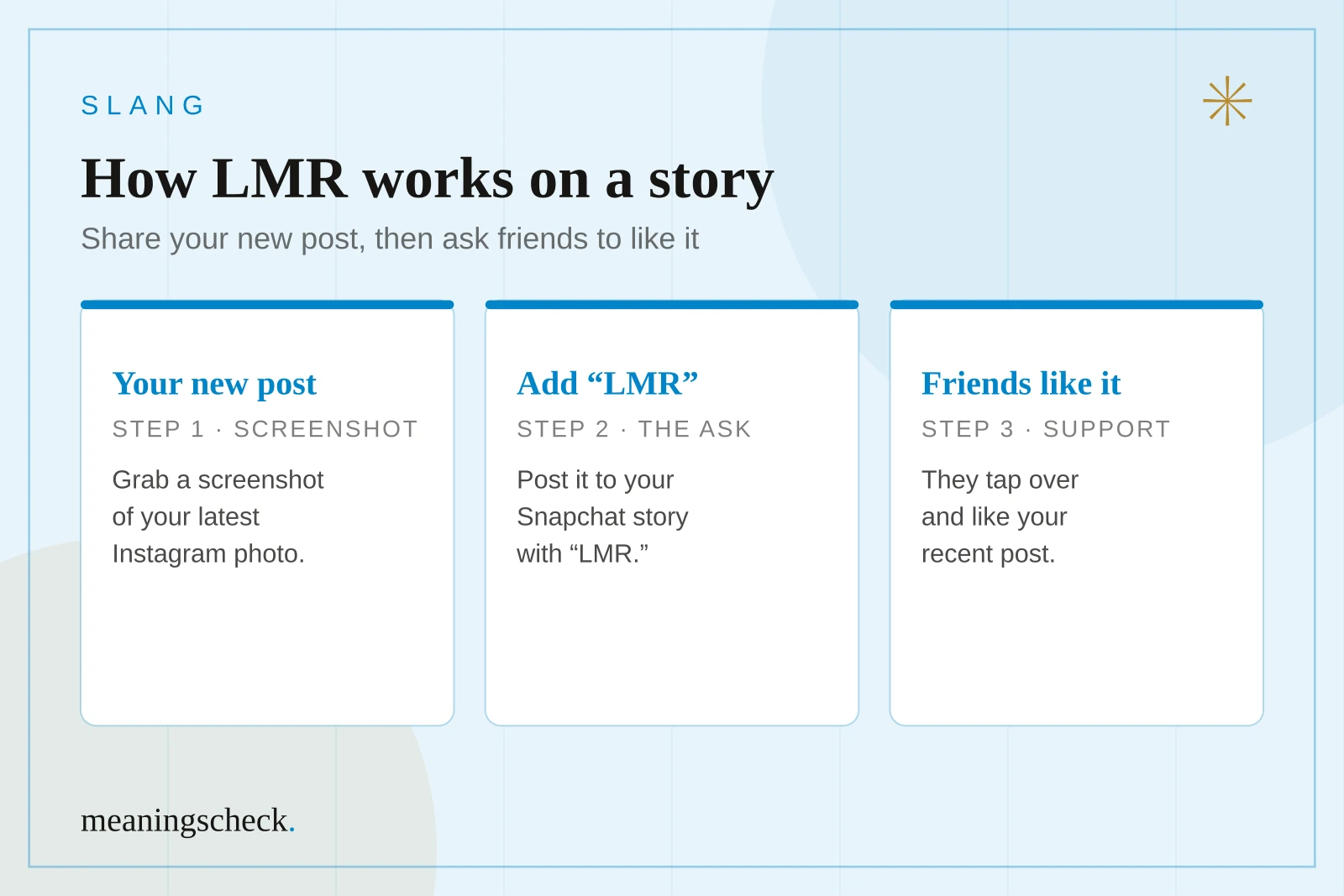
Snapchat stories became a popular place to promote Instagram posts. Post a screenshot, add "LMR," and your friends see it within hours. Urban Dictionary entries from December 2016 and throughout 2017 describe exactly this: LMR on Snapchat stories asking friends to like a new Instagram photo.
TikTok and Beyond
By the 2020s, "LMR" had spread to TikTok and group chats. A 2020 Urban Dictionary entry notes its use on TikTok and Instagram.
| Era | Request | Platform |
|---|---|---|
| Late 2000s–2010s | LMS (like my status) | |
| 2010s | #L4L, #F4F | |
| 2016–2017 | LMR on Snapchat stories | Snapchat → Instagram |
| 2020s | LMR | Instagram, TikTok, group chats |
LMR on Instagram, Snapchat, and TikTok
The Short Answer: On Snapchat, LMR usually appears on stories with a screenshot of a new Instagram post. On Instagram, it shows up in comments and DMs. On TikTok, people use it to cross-promote posts. Everywhere, it means "like my recent."
LMR on Snapchat
Snapchat is LMR's natural home. The classic format: a screenshot of your new Instagram post, the letters "LMR," and an emoji or two. Your friends tap over to Instagram and like it.
LMR on Instagram
On Instagram, you'll see "lmr" in:
- Comments on other people's posts (often seen as spammy from strangers).
- DMs to close friends.
- Stories sharing your new post.
LMR on TikTok
On TikTok, LMR may refer to a recent TikTok — or point people to an Instagram post. "LMR on IG 🙏" is a typical caption.
LMR in Group Chats
Friend groups often support each other: "just posted, lmr!!" in the group chat gets a wave of likes.
| Platform | Typical LMR Use | Example |
|---|---|---|
| Snapchat | Story with a screenshot | "LMR 💕" |
| DMs and stories | "lmr pls 🥺" | |
| TikTok | Cross-promotion | "lmr on IG" |
| Group chats | Friends supporting friends | "everyone lmr!!" |
| Rare today | "LMR" on a share |
Key takeaway: LMR is a small favor among friends. From strangers, it can feel like spam.
LMR Variations and Spellings
The Short Answer: You'll see "LMR," "lmr," "lmr pls," "LMR 🥺," "lmr x," and "CMR" (check my recent). They all ask for attention on a new post. Emojis and "pls" make the request softer or cuter.
| Variation | Tone | Example |
|---|---|---|
| LMR | Direct | "LMR" on a story |
| lmr | Casual | "just posted lmr" |
| lmr pls | Polite | "lmr pls 🥺" |
| LMR 💕 | Friendly | Story with a screenshot |
| lmr x | Warm (UK style) | "lmr x" |
| CMR | Softer | "cmr 👀" |
| LMR + tag | Targeted | "LMR @sam" |
Story Games: "Like for a TBH" and "Like for a Rate"
LMR has relatives in old Instagram and Snapchat story games. "Like for a TBH" meant "like my post and I'll tell you honestly what I think of you." "Like for a rate" meant "like and I'll rate you." These games boosted likes the same way LMR does — with a little extra social reward attached.
LMR vs. L4L, F4F, LMS, and "Check My Recent"
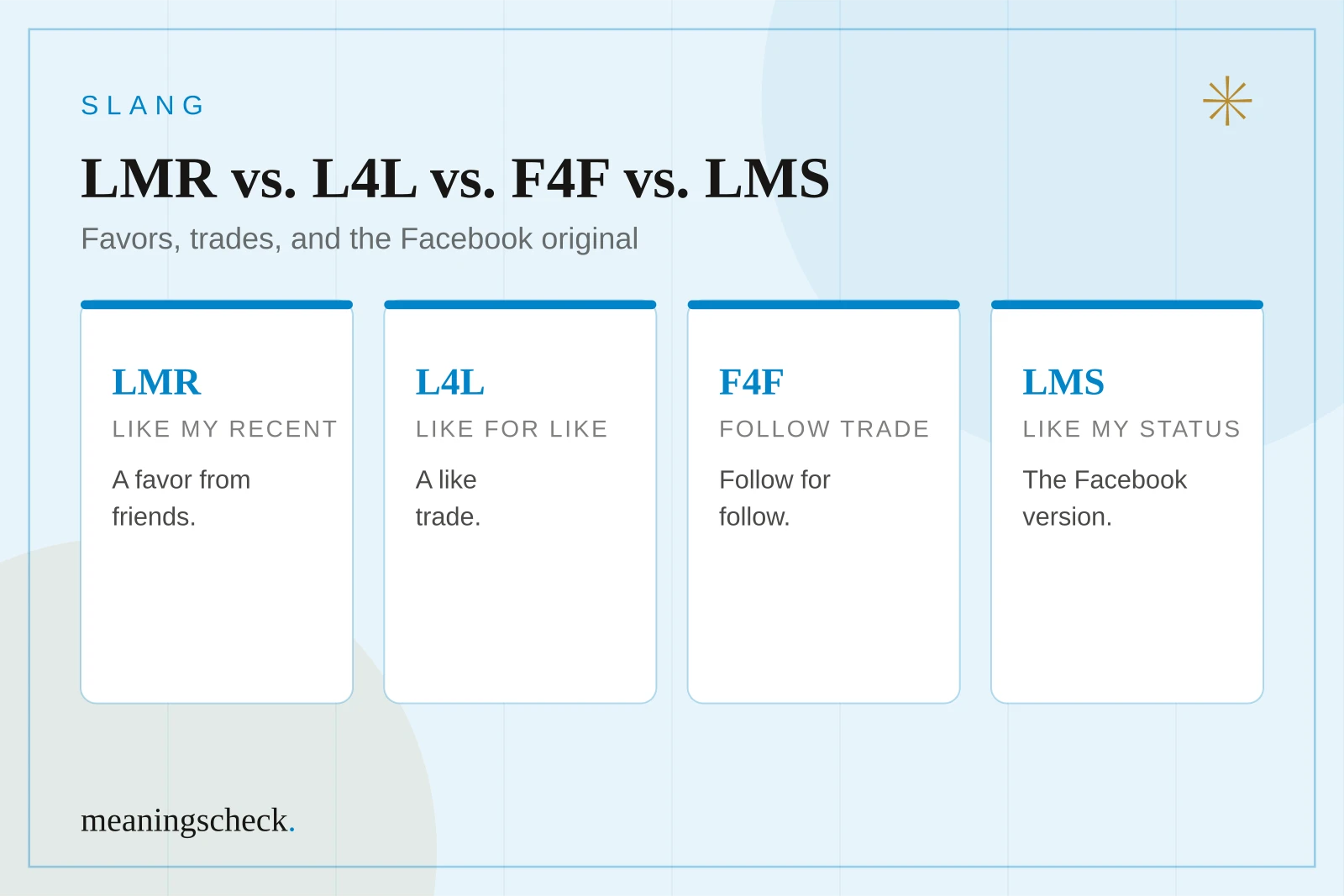
The Short Answer: LMR asks for a like on your newest post. L4L means "like for like" — a trade. F4F means "follow for follow." LMS means "like my status" from the Facebook era. "Check my recent" is a softer version of LMR.
| Term | Means | What It Asks For | Example |
|---|---|---|---|
| LMR | Like my recent | A like on your newest post | "lmr 💕" |
| L4L | Like for like | A like trade | "#l4l" |
| F4F | Follow for follow | A follow trade | "f4f?" |
| LMS | Like my status | A like on a Facebook status | "LMS for a rate" |
| CMR | Check my recent | A look at your newest post | "cmr 👀" |
| SFS | Shoutout for shoutout | A promotion swap | "sfs?" |
LMR vs. L4L
The big difference is reciprocity. LMR is a favor. L4L is a trade: "I'll like yours if you like mine." L4L is more common among strangers trying to grow accounts.
LMR vs. LMS
LMS ("like my status") was the Facebook-era version. It often came with games — "LMS and I'll tell you what I think of you." LMR is the Instagram-era descendant.
Is It Rude to Say LMR? Etiquette for Asking for Likes
The Short Answer: With friends, LMR is normal and friendly. With acquaintances or strangers, it can feel pushy or spammy. Commenting "lmr" on a stranger's post is widely seen as annoying. Ask sparingly and return the favor.
When LMR Is Fine
- Close friends who support each other's posts.
- Group chats where everyone does it.
- Big moments — a graduation, a new job, a creative project.
When LMR Feels Pushy
- Commenting "lmr" on strangers' posts. It reads as spam.
- Asking after every single post. It can wear people out.
- DMing people you barely know. It feels transactional.
Good LMR Etiquette
- Ask friends, not strangers.
- Save it for posts you care about.
- Return the favor. Like their posts too.
- Don't guilt anyone. A like is a gift, not an obligation.
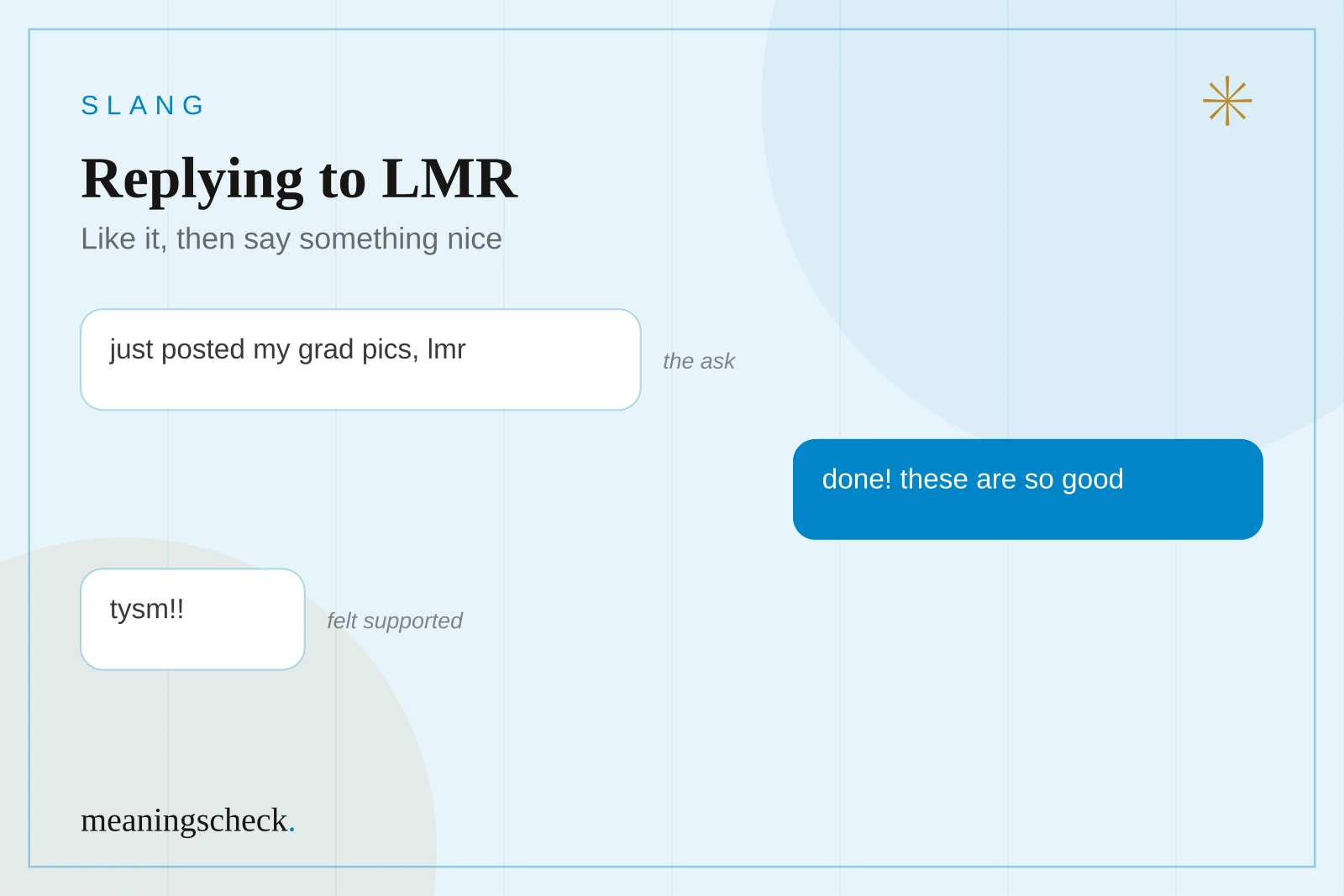
- Say thanks. A quick "tysm!!" goes a long way — as our TYSM meaning guide explains.
| Do | Don't |
|---|---|
| "Just posted my grad pics, lmr? 🥹" | Comment "lmr" on a celebrity's post |
| Like your friends' posts too | Ask for likes on every post |
| Thank people who liked it | Get upset when someone doesn't |
| Share it in a group chat | Spam DMs to strangers |
How to Reply to LMR (With Examples)
The Short Answer: If you want to support them, like the post and reply "done ✅" or "liked! 😍." If you can't right now, "will do later!" works. You're never obligated — ignoring a mass LMR request is perfectly fine.
When You Want to Support Them
- "Done ✅"
- "Liked! These are so good 😍"
- "Obsessed with this one"
When You'll Get to It Later
- "Will do when I'm off work!"
- "On it later 🫡"
When It's From a Stranger
You can ignore it. Strangers asking for likes don't need a reply.
When You Want to Go Further
Comments mean more than likes to many people. "This photo is stunning" is a bigger compliment than a tap.
Real-World Examples: LMR in Everyday Conversations
The Short Answer: LMR shows up around milestones, creative posts, group-chat support, and the occasional spam comment. These examples show what's happening each time — and how to respond.
These are typical patterns, not quotes from real people.
A Milestone Post
Story: Screenshot of graduation photos + "LMR 🎓"
What it means: "I'm proud of this. Please go like it."
Good response: Like it, then DM "congrats!! these are so good."
A Creative Project
Message: "posted my first painting on IG, lmr? 🥹"
What it means: "I'm a little nervous about sharing this. Support would mean a lot."
Good response: Like and comment something specific: "The colors are amazing."
Group-Chat Support
Message: "just posted, everyone lmr!!"
What it means: "Friends, help me out."
Good response: "Done ✅"
A Crush
Message: "lmr 🙈"
What it means: "I want you to see this — and maybe notice me."
Good response: Like it, and maybe reply "cute pic 👀"
Comment Spam
Comment on a stranger's post: "lmr!!"
What it means: Someone fishing for likes from strangers.
Good response: Usually none. Many people react with an eye-roll — or a silent "smh," the head-shake explained in our SMH meaning guide.
| Situation | What LMR Signals | Best Response |
|---|---|---|
| Milestone | Pride | Like + congrats |
| Creative post | Nervous sharing | Like + specific compliment |
| Group chat | Asking for support | Like + "done ✅" |
| Crush | A bit of attention-seeking | Like + light comment |
| Spam | Fishing for likes | Ignore |
LMR From a Girl or a Guy
The Short Answer: LMR means "like my recent" from anyone. From a crush, it can be a small sign they want your attention — or just that they want likes. Liking it and adding a comment shows extra interest.
When a Crush Asks
If someone you like sends "lmr 🙈," they want you to see their post. That's at least a little bit of attention. Liking it — and maybe commenting something kind — keeps the door open.
When a Friend Asks
From friends, LMR is just mutual support. Nothing to overthink.
When It's a Mass Request
If it's on a story everyone can see, it's not personal. It's a general call for likes.
Likes, Self-Esteem, and Why "LMR" Matters to Teens
The Short Answer: Research suggests likes can feel genuinely rewarding, especially to teens. A 2016 UCLA study found teens' brain reward areas responded strongly when they saw their photos with many likes. That's part of why "LMR" exists — and why it's worth keeping likes in perspective.
What the Research Shows
In a 2016 study published in Psychological Science, researchers led by Lauren Sherman at UCLA scanned teens' brains while they used a simulated photo-sharing app. When teens saw their own photos with many likes, a brain region linked to reward became more active. Teens were also more likely to like photos that already had many likes.
In other words, likes can feel good in a very real way. That helps explain why people ask for them.
Instagram's Hidden Likes
Instagram began testing hidden like counts in 2019, partly in response to concerns about pressure and comparison. In 2021, it gave users the option to hide like counts on their own posts and on others' posts.
Keeping Likes in Perspective
- Likes aren't a measure of worth. Algorithms, timing, and luck affect them.
- Real support matters more. A friend's comment beats a hundred strangers' taps.
- Breaks help. Many people feel better after time away from like counts.
If a teen seems stressed about likes, a calm conversation about how algorithms work can take some pressure off.
The Harmful Meaning: LMR as "Last Minute Resistance"
The Short Answer: In pickup-artist communities, LMR stands for "last minute resistance" — a term that frames someone's hesitation or "no" before sex as an obstacle to overcome. That idea is harmful. Hesitation or "no" means stop. Consent can be withdrawn at any time.
You may come across a very different meaning of LMR in some online forums, especially communities built around so-called "pickup artist" advice. There, LMR means "last minute resistance."
What It Refers To
The term describes a person's hesitation or refusal right before sexual activity — and frames it as something to be pushed past. That framing is the problem.
Why It's Harmful
- Hesitation is a signal. It means someone isn't sure, or doesn't want to.
- "No" means no. It isn't an obstacle or a game.
- Consent can change. Anyone can stop at any point, even after saying yes earlier.
- Pressure isn't consent. Wearing someone down doesn't make it okay.
Even Urban Dictionary includes a definition that criticizes this meaning as a way people excuse sexual assault.
If You See It
If someone uses LMR this way, treat it as a red flag about their attitude toward consent. If you or someone you know has been pressured or harmed, support is available. In the US, the RAINN National Sexual Assault Hotline can be reached at 800-656-4673.
Key takeaway: On social media, LMR is harmless. In a "dating advice" context about hesitation, it's a warning sign.
Other Meanings of LMR
The Short Answer: In technical fields, LMR means Land Mobile Radio — the two-way radio systems police, fire, and utilities use. LMR is also a family of coaxial cables used for antennas. A few sites list "last message received," but that's uncommon.
Land Mobile Radio
In public safety and utilities, LMR means Land Mobile Radio — the two-way radio systems used by police, fire departments, EMS, and utility crews. Many US public-safety agencies use radio standards like P25 for these systems.
LMR Coaxial Cable
Radio hobbyists and installers know LMR as a line of coaxial cables (like LMR-400) used to connect antennas and radios.
"Last Message Received/Read"
A few websites list LMR as "last message received" or "last message read." It's uncommon in everyday texting.
| Context | LMR Means | Example |
|---|---|---|
| Social media | Like my recent | "LMR 💕" |
| Pickup-artist forums (harmful) | Last minute resistance | A red flag about consent |
| Public safety | Land Mobile Radio | "Upgrading our LMR system" |
| Radio hobby | Coaxial cable | "Run LMR-400 to the antenna" |
| Rare | Last message received | "Check the LMR timestamp" |
Expert Insights: The Economy of Likes
The Short Answer: Likes work like a social currency. People trade them (L4L), request them (LMR), and feel rewarded by them. Research on teen brains and platform changes like hidden like counts shows how powerful — and pressuring — that currency can be.
Likes as Social Currency
On social platforms, a like is a tiny signal: "I saw this, and I approve." Collect enough, and posts get more visibility. That turns likes into a kind of currency — something people request, trade, and track.
Reciprocity
Many social behaviors run on reciprocity: you help me, I help you. L4L makes that explicit. LMR among friends is softer — an unspoken promise to return the favor.
Early Engagement and Reach
Many creators believe that likes soon after posting help a post reach more people. Platforms don't publish exact formulas. They also change them often. Still, that belief is a big reason "LMR" requests show up right after a new post goes live.
When Requests Become Pressure
Asking for likes is normal. But when likes start to feel like a scorecard, the pressure can hurt. Instagram's option to hide like counts was a response to exactly that concern.
Real-World Patterns of LMR
- Milestone posts: Graduations, birthdays, and new jobs often come with "LMR."
- Story screenshots: The classic Snapchat format.
- Group-chat support: "everyone lmr!!" among close friends.
- Comment spam: "lmr" on strangers' posts — usually ignored.
Should You Ask for Likes? Pros and Cons
The Short Answer: Asking close friends for likes on a post you care about is normal and can feel supportive. Asking constantly, or asking strangers, can backfire. Think about why you're asking and who you're asking.
| Pros | Cons |
|---|---|
| Friends see posts they might have missed | Constant asks can feel needy |
| Support feels good on big milestones | Likes can start to feel like a scorecard |
| Group chats can build each other up | Strangers often see it as spam |
| It can help a new post get noticed | It can make low likes feel worse |
A Simple Gut Check
Before you post "LMR," ask yourself:
- Is this a post I'm genuinely proud of?
- Am I asking people who care about me?
- Will I feel okay if it doesn't get many likes?
If the answer to all three is yes, go for it.
A Quick Glossary of Social Media Requests
The Short Answer: LMR is one of many social media requests. Others include "link in bio," "tag me," "repost," "SFS" (shoutout for shoutout), and "F4F" (follow for follow). Each asks for a different kind of support.
| Request | Means | What They Want |
|---|---|---|
| LMR | Like my recent | A like on the newest post |
| CMR | Check my recent | A view of the newest post |
| Link in bio | The link is on my profile | A click |
| Tag me | Mention me in a post or comment | Credit or a notification |
| Repost / share | Share my post to your story | More reach |
| SFS | Shoutout for shoutout | A promotion swap |
| F4F / L4L | Follow for follow / like for like | A trade |
| PFP | Profile picture | Usually "new pfp!" — notice it |
How to Explain LMR to Someone Who Doesn't Get It
The Short Answer: "It means 'like my recent' — they want you to like their newest post." That's all there is to it for social media.
If a parent or friend is confused, try:
- "LMR means 'like my recent.'"
- "A 'recent' is their newest post."
- "They're asking you to tap like."
- "It's usually from friends, often on Snapchat stories."
That's the whole explanation for the social media meaning. The only extra note: in dating "advice" circles, LMR has a harmful meaning about ignoring hesitation — and that's a conversation worth having separately.
How to Get Likes Without Saying "LMR"
The Short Answer: Post things you're proud of, write a caption that invites conversation, share to your story, support your friends' posts, and post when your friends are online. Asking directly is fine — but you don't always have to.
If you'd rather not ask outright, try these:
- Share to your story. Friends see it without a request.
- Write a better caption. A question invites comments: "Which pic should I frame?"
- Support others. People often return likes and comments.
- Post when friends are active. Evenings and weekends are often busy.
- Use a softer ask. "New post 👀" feels less demanding than "LMR."
| Instead of… | Try… |
|---|---|
| "LMR" | "New post up 👀" |
| "lmr pls" | "Which one's your favorite?" |
| Commenting "lmr" on strangers' posts | Engaging genuinely with their content |
LMR in Group Chats
The Short Answer: In group chats, "lmr" is a quick call for support: "just posted, lmr!!" Friends usually reply "done" or drop a heart. It works best in groups where everyone supports each other's posts.
Friend group chats are where LMR feels most natural:
- "new post!! lmr 🥹"
- "everyone lmr pls, it's my bday post"
- "done ✅" — "done!" — "liked 😍"
Some groups even have an unspoken rule: if someone posts, everyone likes. That's sweet — as long as nobody feels guilty for missing one. If your group starts keeping score, it might be time to relax the rule.
When someone thanks the group afterward, it closes the loop nicely. A warm "y'all are the best" makes the next request feel easy.
LMR for Parents and Teachers
The Short Answer: If a kid posts "LMR," they're asking friends to like their newest photo. It's normal social media behavior. The only meaning worth worrying about is "last minute resistance," which appears in very different, adult contexts.
Parents may see "LMR" on a teen's Snapchat story or Instagram. In that context, it almost always means "like my recent." Nothing to worry about.
What's worth talking about:
- Pressure. Is your teen stressed about how many likes they get?
- Strangers. Are they asking strangers for likes or follows?
- Perspective. Do they know likes depend on algorithms and timing?
If you ever see LMR in a context about dating or sex, that's the harmful "last minute resistance" meaning — and a good opening for a conversation about consent.
LMR and Online Safety
The Short Answer: Most LMR requests come from friends and are harmless. Be cautious when strangers or brand-new accounts ask for likes or follows, especially with links or DMs. Fake "like for like" accounts are sometimes used for spam or scams.
A few smart habits keep LMR fun and safe:
- Know the sender. Friends' LMR requests are normal. Strangers' requests are often spam.
- Don't click unknown links. Some fake accounts pair "lmr" or "l4l" with suspicious links.
- Watch for "growth" pitches. "Like my recent and I'll get you 1,000 followers" is usually a scam.
- Keep accounts private if you're young. Fewer strangers, fewer spammy requests.
- Report pushy accounts. Platforms let you report spam and harassment.
| Request | Likely Safe? | Why |
|---|---|---|
| "lmr!!" from your best friend | Yes | Normal friend support |
| "lmr" from a classmate | Usually | Casual social request |
| "l4l?" from a stranger | Be cautious | Often growth-hacking or bots |
| "lmr and click my link" | No | Common spam pattern |
| "lmr for free followers" | No | Common scam pattern |
LMR Across Generations
The Short Answer: Millennials grew up with "LMS" on Facebook. Gen Z made "LMR" a Snapchat-story staple. Gen Alpha uses it on TikTok and Instagram — often alongside newer habits like reposting and story mentions.
| Group | Typical Request | Platform |
|---|---|---|
| Millennials | "LMS" (like my status) | |
| Older Gen Z | "LMR" + screenshot | Snapchat → Instagram |
| Younger Gen Z | "lmr pls 🥺" | Instagram, TikTok |
| Gen Alpha | "lmr" in group chats | TikTok, Instagram |
The words change. The wish to have friends see what you made stays exactly the same.
Is LMR Professional?
The Short Answer: Not really. On a brand or professional account, "Check out our latest post" or "New post is live" sounds better than "LMR." Among coworkers who are friends, it's fine in a casual chat.
| Casual | Professional |
|---|---|
| "LMR" | "Our latest post is live — take a look!" |
| "everyone lmr" | "We'd love your support on our new post." |
| "lmr pls" | "If you enjoy it, a like or share helps." |
Common Mistakes People Make With LMR
The Short Answer: The biggest mistakes are commenting "lmr" on strangers' posts, asking too often, getting upset when people don't like a post, and not knowing about the harmful "last minute resistance" meaning.
- Spamming strangers. It rarely works and often annoys.
- Asking after every post. Save it for posts you care about.
- Guilt-tripping. Likes are a favor, not a duty.
- Ignoring the reply. Thank people who supported you.
- Missing the harmful meaning. In dating "advice," LMR is a red flag.
Frequently Asked Questions (FAQs)
What does LMR mean?
LMR means "like my recent" — a request for someone to like your most recent post.
What does LMR mean on Snapchat?
On Snapchat, LMR usually appears on a story with a screenshot of a new Instagram post. It means "go like my recent post."
What does LMR mean on Instagram?
On Instagram, LMR means "like my recent." You'll see it in comments, DMs, and stories.
What does LMR mean on TikTok?
On TikTok, LMR means "like my recent" — either a recent TikTok or a post on another app.
Is LMR rude?
With friends, no. From strangers, it can feel spammy or pushy.
What's the difference between LMR and L4L?
LMR asks for a like as a favor. L4L ("like for like") is a trade — you like mine, I like yours.
What does LMR mean in dating?
In pickup-artist forums, LMR means "last minute resistance" — a harmful term about pushing past someone's hesitation before sex. Hesitation means stop.
What does LMR mean in radio?
In radio and public safety, LMR means Land Mobile Radio. LMR is also a type of coaxial cable.
What does CMR mean?
CMR means "check my recent" — a softer version of LMR asking people to look at your newest post.
What does "like for a TBH" mean?
It's an old story game: like the post, and the person tells you honestly ("to be honest") what they think of you.
How do you respond to LMR?
Like the post and reply "done ✅" or say something nice about it. You're never obligated to.
Final Thoughts
LMR is a tiny request with a big story behind it — the story of likes as social currency. Most of the time, it's simple: a friend is proud of a post and wants you to see it. A quick like and a kind word make their day.
Just remember the other meaning. If LMR shows up in a conversation about dating and hesitation, it's not harmless slang. It's a red flag.
For more social media slang decoded the same way, explore our internet slang guides. And if someone's waiting on a reply rather than a like, the TMB meaning guide has you covered — or check how open invites work in our HMU meaning.
Related terms
Share: · Post on X
Written by MeaningsCheck Team · Published
The MeaningsCheck team researches and writes plain-language explanations of slang, abbreviations, and everyday words — checked for accuracy, updated as language changes.