
What Does XOXO Mean? XOXO Meaning, Origin, and How to Use It in Texts (2026)
XOXO means "hugs and kisses." The X stands for a kiss and the O for a hug, so "XOXO" is a warm, affectionate sign-off in texts, cards, and letters. It's friendly or loving depending on who sends it.
XOXO means "hugs and kisses." The X stands for a kiss and the O stands for a hug. Together, "XOXO" is a warm sign-off, like "love," "take care," or "sending you a hug."
You'll see it at the end of texts, cards, social media captions, and handwritten notes. A grandmother might sign a birthday card with it. A best friend might text it after a fun night. A partner might send it with a heart.
So what does XOXO mean from different people, where did it come from, and how should you answer it? This guide covers the XOXO meaning in text, the history of X for a kiss and O for a hug, how XO differs from XOXO, who uses it (and what it means from each person), and how to reply. We also cover whether XOXO is flirty, whether it's okay at work, and similar sign-offs like SWAK, love ya, and hugs.
Key takeaway: XOXO = "hugs and kisses." It's affectionate. How romantic it is depends on who sends it and the other signals around it.
Executive Summary: XOXO at a Glance
Here's the quick version:
- Meaning: "Hugs and kisses."
- X = a kiss. O = a hug.
- Pronunciation: Read it as "ex-oh-ex-oh" or just say "hugs and kisses."
- XO vs. XOXO: XO is one hug and kiss. XOXO is more. It feels a little warmer.
- Tone: Affectionate. It can be loving, friendly, playful, or flirty.
- Common senders: Partners, friends, family, and sometimes brands and TV characters.
- Origin: Documented in 1878, and X for a kiss may be older. The exact roots are uncertain.
- Pop culture: Famous from the sign-off of the TV show Gossip Girl.
- At work: Usually too casual for formal emails.
What Does XOXO Mean? The Core Definition
The Short Answer: XOXO means "hugs and kisses." The X represents a kiss and the O represents a hug. People use it to close messages with warmth, from romantic notes to friendly texts.
The Literal Breakdown
- X — a kiss.
- O — a hug.
- XOXO — kiss, hug, kiss, hug.
Each pair adds a little more affection. XO is a quick "hug and kiss." XOXO is a double dose.
How People Use It
- Sign-off: "See you Saturday! XOXO"
- Reply: "Miss you! XOXO"
- Caption: "Best night with my girls. XOXO"
- Card: "Happy birthday, sweetheart. XOXO, Grandma"
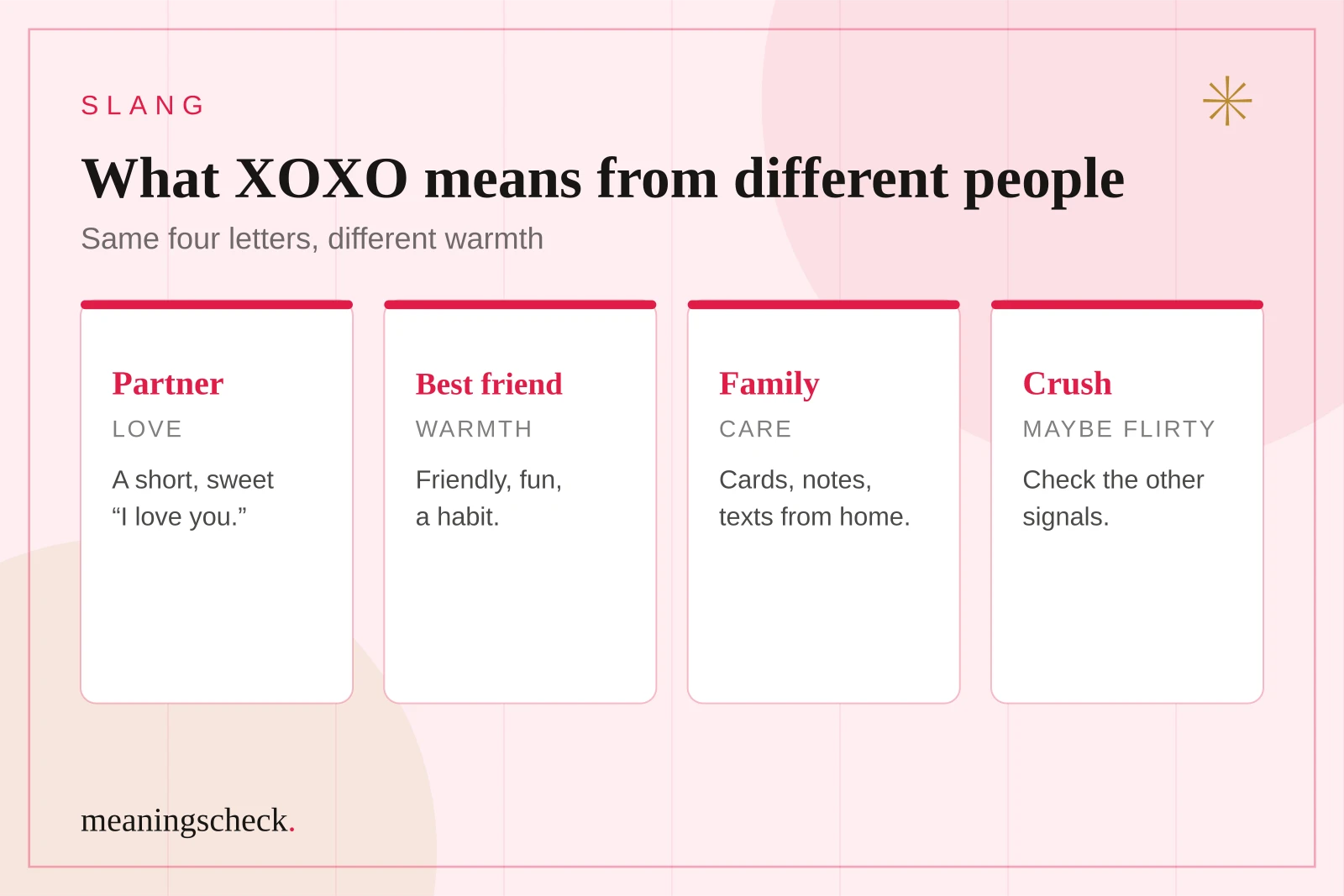
Different Meanings From Different People
| Sender | What XOXO Usually Means |
|---|---|
| Romantic partner | "I love you" in a short, sweet way |
| Best friend | Warm friendship and fun |
| Family member | Love and care |
| Crush | Possibly flirty; check other signals |
| Brand or influencer | Friendly, branded sign-off |
| Coworker | Casual warmth (can feel too familiar) |
What Does XOXO Stand For? X Is a Kiss and O Is a Hug
The Short Answer: In XOXO, X stands for a kiss and O stands for a hug. The pattern repeats for extra affection. People sometimes mix them up. The common meaning is X = kiss, O = hug.
X = Kiss
The X shows up at the bottom of cards and letters as a "kiss." Many people sign "X" or "XXX" at the end of notes to friends and family.
O = Hug
The O looks like arms wrapped in a circle. That visual helps explain why it means a hug. In tic-tac-toe, the X and the O also work as a pair.
Why Repeat Them?
Repeating the symbols adds more affection. The more you type, the more love you send.
| Sign-Off | Reads As |
|---|---|
| X | One kiss |
| XX | Two kisses |
| XXX | Lots of kisses |
| O | A hug |
| XO | A kiss and a hug |
| XOXO | Kisses and hugs, repeated |
| XOXOXO | Extra hugs and kisses |
Where Did XOXO Come From? The Origin of X and O
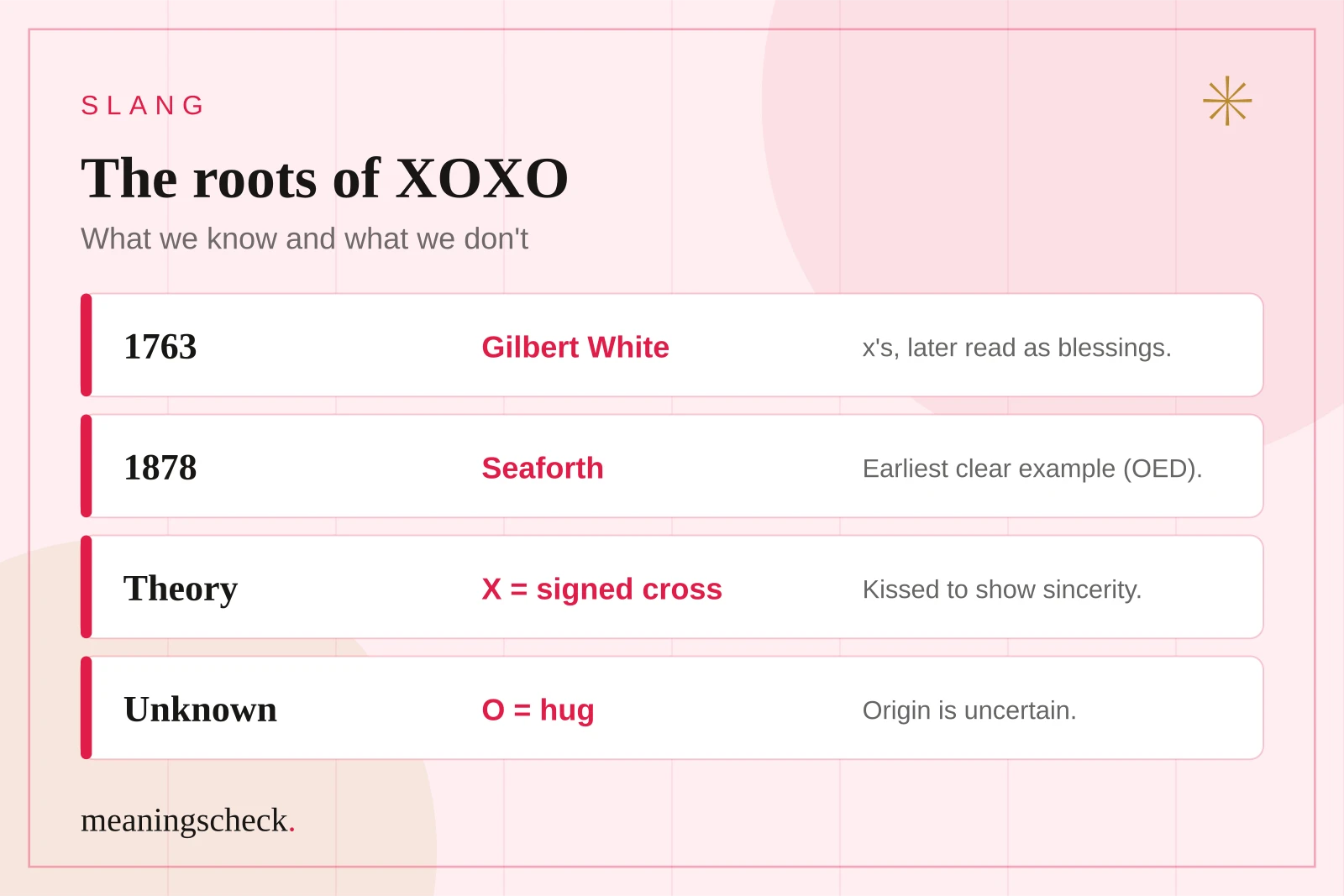
The Short Answer: The exact origin is uncertain. The Oxford English Dictionary's earliest clear example of X and O for kisses is from Florence Montgomery's 1878 novel Seaforth. Theories link X to Christian signatures and kissing the mark. How O came to mean a hug is even less clear.
The Earliest Written Evidence
According to Wikipedia, citing the Oxford English Dictionary, the earliest clear example of this kind of symbol is from Florence Montgomery's 1878 novel Seaforth. It mentions kisses "sometimes expressed by × × × × ×, and sometimes by o o o o o o." In that example, both symbols meant kisses, not hugs.
An Older, Disputed Example
The OED also records a 1763 letter by Gilbert White that ends with a string of x's. Wikipedia notes that this has since been reinterpreted as an indication of blessings rather than kisses.
Theories About X
Several theories try to explain X for a kiss:
- Signing with a cross. In the past, people who couldn't write often signed with an X, a reference to the Christian cross. Some stories say they kissed the mark to show sincerity. Mental Floss presents this as a more likely explanation than the idea that X looks like two mouths meeting.
- Kissing the Bible. Christians traditionally kissed the Bible when swearing an oath, and the X may have echoed that.
- A drawing of two mouths. Some people say an X looks like two lips pressing together. Mental Floss treats this as less likely.
Wikipedia labels the kissing parts of these stories as speculation. In other words, the explanations are interesting. They aren't proven.
Theories About O
How O became a hug is even less documented. Wikipedia says that "nothing more is known about the origins of x and o meaning 'hugs' or 'kisses,'" and notes that less is known about the O.
One popular theory, cited by Mental Floss and Wikipedia, is that Jewish immigrants to the US who spoke Yiddish signed documents with an O instead of an X, because X invoked Christ. The O may then have been adopted as a symbol of affection. Wikipedia presents this as an internet speculation. Treat it as a hypothesis, not established fact.
Timeline
| Period | Milestone |
|---|---|
| 1763 | Gilbert White letter with x's (later reinterpreted as blessings) |
| 1878 | Florence Montgomery's Seaforth uses × and o for kisses (OED's earliest clear example) |
| 20th century | X and O pairing spreads in letters and cards |
| 2000s | "XOXO" becomes a famous TV sign-off in Gossip Girl |
| Today | A standard warm sign-off in texts and DMs |
Key takeaway: Nobody knows for sure how X became a kiss or O a hug. The earliest clear written example is from 1878.
XOXO Meaning in Text
The Short Answer: In text, XOXO means "hugs and kisses." It's a warm closing that shows affection. The meaning shifts slightly depending on who sends it, their usual style, and the emojis or words around it.
How It Looks in Texts
- "Can't wait to see you! XOXO"
- "Thanks for dinner 🥰 xoxo"
- "Good night!! xoxo"
- "Proud of you. XO"
Uppercase vs. Lowercase
| Style | Feel |
|---|---|
| XOXO | Bold, excited |
| xoxo | Soft, casual |
| xo | Quick, light |
| X O X O | Playful or dramatic |
With Emojis
Emojis can change the mood:
| Combo | Mood |
|---|---|
| xoxo ❤️ | Romantic or loving |
| xoxo 😘 | Flirty |
| xoxo 🫶 | Warm friendship |
| xoxo 😂 | Playful |
| xoxo 💕 | Sweet and affectionate |
Is It Always Romantic?
No. People send XOXO to best friends, sisters, mothers, and kids. Close friends often sign texts with it without any romantic meaning.
XO vs. XOXO: What's the Difference?
The Short Answer: XO is a single hug and kiss. XOXO is a longer, warmer version. Neither has a strict rule. The difference is mostly about how much affection the sender wants to show.
| Sign-Off | Feel |
|---|---|
| XO | Quick, light, casual |
| XOXO | Warmer, more emphatic |
| XOXOXO | Very affectionate |
| xx | Light, friendly kisses (very common among friends) |
| xxx | Lots of kisses |
Which Should You Use?
- XO works for casual, quick notes.
- XOXO feels more heartfelt.
- xx is common in friendly messages.
There's no wrong choice. People tend to stick with one style.
XOXO From a Girl or a Guy
The Short Answer: From anyone, XOXO is affectionate. From a close friend or family member, it's warm. From a crush, it can be flirty. One XOXO doesn't mean romance, though. Look at tone, emojis, and how often they message you.
From a Friend
Most XOXOs are friendly. Many friends sign off every text with "xoxo" as a habit.
From a Family Member
Parents, grandparents, aunts, and uncles often sign cards and texts with XOXO as simple love.
From a Partner
In relationships, XOXO is an easy way to say "I love you" without writing it. Partners also use pet names like "boo," which our Boo meaning guide explains.
From a Crush
A crush may use XOXO to flirt. Signs include:
- Texting you often, especially at night.
- Using hearts or 😘.
- Making plans with you.
- Compliments.
If it's just one casual "xoxo" in a group chat, it probably isn't a signal.
| Who | Usual Meaning |
|---|---|
| Partner | Love |
| Close friend | Warm friendship |
| Family | Love and care |
| Crush | Possibly flirty (check the context) |
| Acquaintance | Friendly habit |
Is XOXO Flirty?
The Short Answer: It can be. It isn't automatically flirty, though. Flirtatious XOXOs usually come with other clues, like emojis, compliments, and frequent messages. Without those, treat it as friendly.
Clues It's Flirty
- Heart or kiss emojis (❤️, 😘).
- Compliments in the same message.
- Late-night texts.
- They've never signed off that way with others.
Clues It's Just Friendly
- They send it to everyone.
- It's part of their usual sign-off.
- The message is about plans or thanks, not feelings.
If You're Unsure
Ask in a relaxed way: "You always sign off with xoxo, huh? 😄" Their reply will tell you a lot.
Similarly, a message that begins "miss your face" is warm and playful, as our MYF meaning guide explains.
How to Reply to XOXO
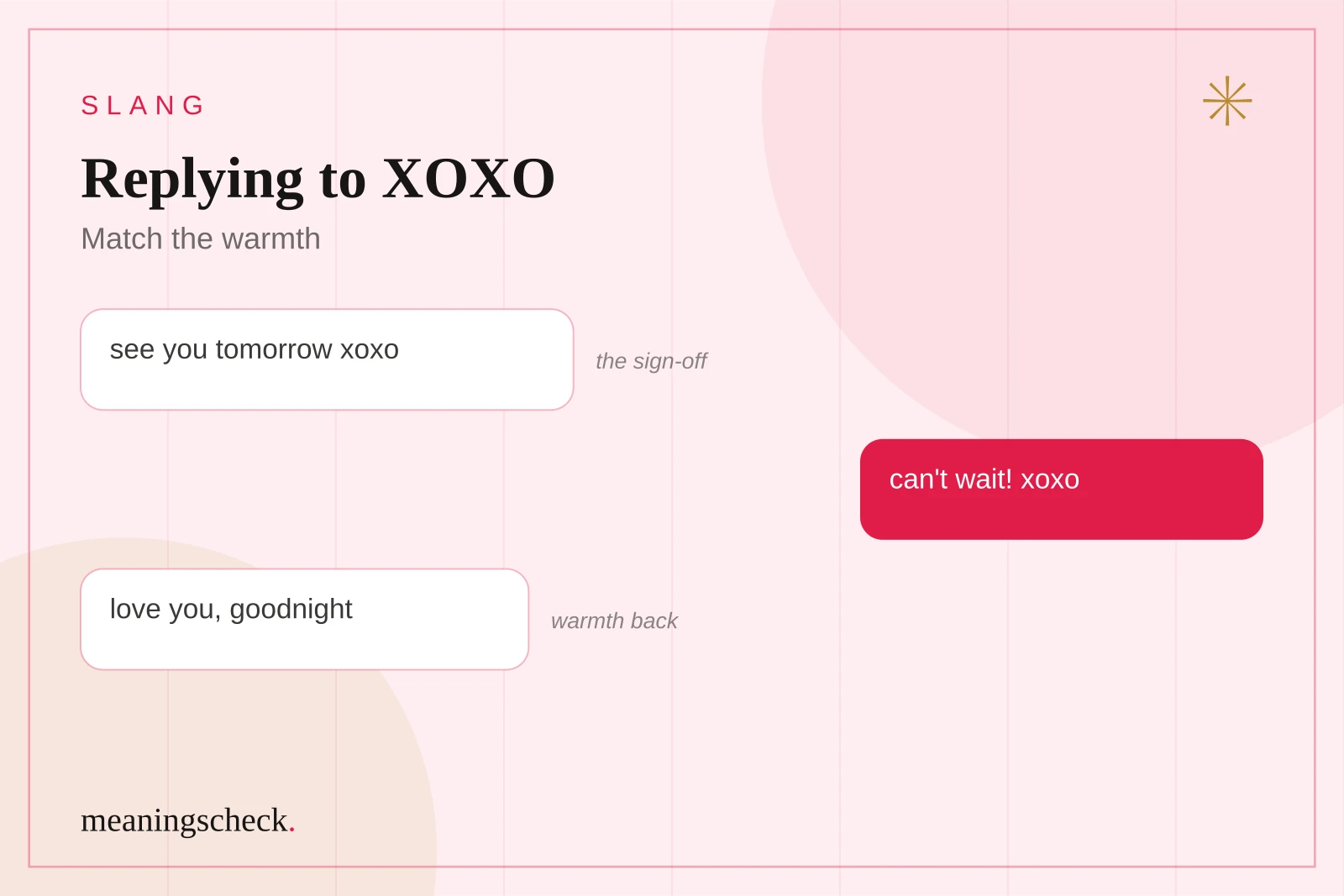
The Short Answer: Reply with something warm and matching: "xoxo back," a heart, or a friendly message. If you aren't feeling romantic, a simple "Thanks, you too!" works. Match the sender's tone.
Warm Replies
- "xoxo 🫶"
- "Love you too!"
- "Miss you! xo"
- "Can't wait to see you ❤️"
Friendly Replies
- "Thanks, you too!"
- "Aww 🥰"
- "Same! Talk soon."
Playful Replies
- "Hugs and kisses right back 😂"
- "XOXO to you too, my friend"
If You Don't Want to Send XOXO Back
You don't have to. A simple warm reply works: "Thanks! Talk soon." If you want to be clear that it's friendly, add something like "Great seeing you!"
How to Sign Off by Relationship
The Short Answer: Match your sign-off to your closeness. Use XOXO with partners, close friends, and family. Use "Take care" or "Warmly" with friendly acquaintances. Use "Best" or "Sincerely" with colleagues, managers, and strangers.
| Who You're Writing To | Good Sign-Offs |
|---|---|
| Partner | XOXO, love you, xx |
| Best friend | xoxo, love ya, hugs |
| Parent or grandparent | Love, XOXO, hugs |
| Close colleague (casual) | Thanks!, Cheers, xo (sometimes) |
| Manager or client | Best regards, Thank you |
| Someone new | Take care, Best |
A Simple Rule
If you'd hug the person in real life, XOXO probably fits. If a handshake feels right, choose "Best."
XOXO vs. SWAK, Love Ya, Hugs, and Other Sign-Offs
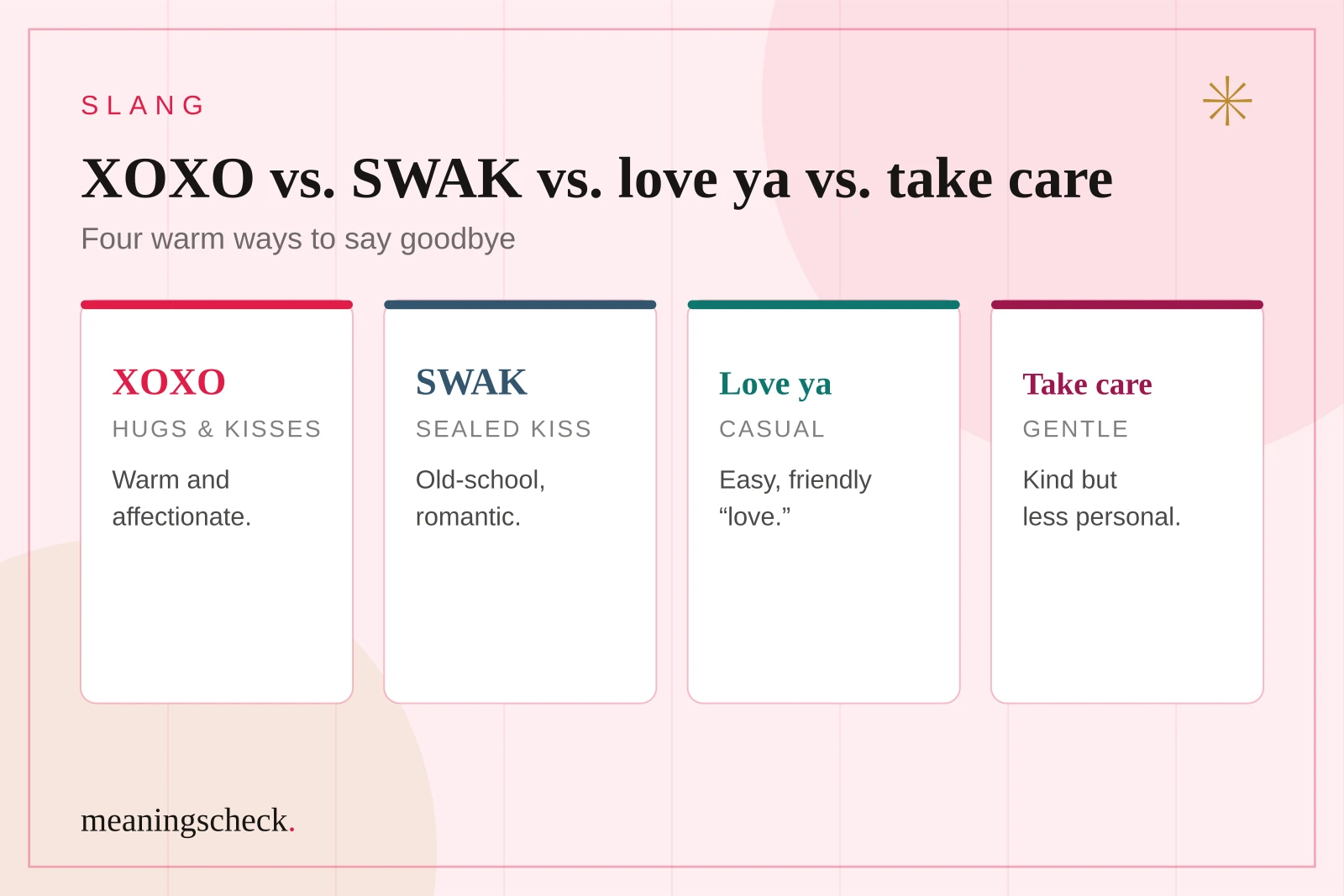
The Short Answer: XOXO, SWAK, love ya, hugs, and take care all show warmth. XOXO is playful and affectionate. SWAK means "sealed with a kiss." Love ya is a casual "love." Take care is gentler. "Best" and "regards" are more formal.
| Sign-Off | Meaning | Feel |
|---|---|---|
| XOXO | Hugs and kisses | Warm, affectionate |
| XO | A hug and a kiss | Light and sweet |
| xx | Kisses | Friendly (very common) |
| SWAK | Sealed with a kiss | Old-school, romantic |
| SWALK | Sealed with a loving kiss | Old-school, romantic |
| Love ya | Love you (casual) | Casual, warm |
| Hugs | A hug | Friendly, comforting |
| Take care | Look after yourself | Gentle, caring |
| Cheers | Friendly goodbye | Casual (very British) |
| Best | Short for "best wishes" | Polite, professional |
| Sincerely | Formal closing | Professional |
XOXO vs. SWAK
SWAK ("sealed with a kiss") is an old-fashioned sign-off from the days of letters. It feels old-school and romantic.
XOXO vs. Hugs
Hugs is a gentle, comforting sign-off. XOXO adds the kiss. It feels a bit more affectionate.
XOXO vs. Take Care
Take care is kind but less personal. XOXO shows closeness.
XOXO in Pop Culture: Gossip Girl and Beyond
The Short Answer: XOXO became a pop-culture catchphrase through the TV drama Gossip Girl, whose episodes ended with the sign-off "XOXO, Gossip Girl." Mental Floss notes that many people recognize the phrase from the end of each episode.
Gossip Girl
The TV series Gossip Girl closed each episode with an "XOXO" sign-off. Mental Floss notes that "you recognize it from the end of each Gossip Girl episode."
Songs, Cards, and Brands
You'll also find XOXO in:
- Greeting cards, often with a heart.
- Song titles and lyrics.
- Brand slogans and social posts.
- Valentine's Day messages.
Tic-Tac-Toe
Tic-tac-toe uses X and O as game symbols. In the UK, the game is called noughts and crosses.
| Context | How XOXO Shows Up |
|---|---|
| TV | Sign-off in Gossip Girl |
| Cards | "Love, XOXO" |
| Social media | Captions and comments |
| Valentine's Day | Notes and gifts |
| Merchandise | Hearts and "XOXO" prints |
X Marks the Spot: Other Jobs of the Letter X
The Short Answer: The letter X does many jobs: a signature mark, a wrong answer, a ballot choice, "X marks the spot," and a kiss. Context tells you which one you're reading. At the end of a message, X means a kiss.
| Where You See X | Meaning |
|---|---|
| End of a card or text | A kiss |
| On a form or ballot | A choice or selection |
| On a map or treasure hunt | "X marks the spot" |
| On a test | Often "incorrect" |
| Next to a signature line | Where to sign |
| On a door or sign | "No" or "closed" |
| In a closing like "XOXO" | Kisses and hugs |
Why a Kiss Feels Right
The kiss meaning probably grew from X's old job as a mark of sincerity. People who couldn't write signed with an X, and Mental Floss notes the story that they kissed it. A mark of promise became a mark of affection.
Hugs and Kisses in Other Languages
The Short Answer: Many languages have their own "hugs and kisses." Spanish people write "besos y abrazos," and French speakers write "bisous." English speakers often use XOXO because it's quick, visual, and works on any keyboard.
| Language | Common Way to Say "Kisses" or "Hugs and Kisses" |
|---|---|
| Spanish | besos y abrazos |
| French | bisous |
| Italian | baci e abbracci |
| Portuguese | beijos e abraços |
| English | hugs and kisses, XOXO |
Because X and O are letters in the Latin alphabet, XOXO is easy for many people around the world to recognize, even if they speak another language.
XOXO on Snapchat, Instagram, and TikTok
The Short Answer: On social platforms, XOXO is a friendly sign-off for comments, captions, and DMs. On Instagram and TikTok, it often appears in couple posts and friend shoutouts. On Snapchat, it's a casual, affectionate close to a chat.
XOXO on Instagram
Captions like "Girls' night out! XOXO" and comments like "Love this! xoxo" are everywhere.
XOXO on TikTok
Creators sign off videos with "xoxo" and fans leave it in comments to show support.
XOXO on Snapchat
Friends often end chats with "xoxo" or "xo."
| Platform | Typical Use | Example |
|---|---|---|
| Captions, comments | "Best day ever xoxo" | |
| TikTok | Comments | "love you guys xoxo" |
| Snapchat | Chats | "night!! xo" |
| Texts | Sign-offs | "see you soon xoxo" |
| X (Twitter) | Replies | "congrats!! xoxo" |
Is XOXO Okay at Work?
The Short Answer: Usually not in formal emails or with clients. It's too affectionate. With close coworkers in casual chat, it may be fine. When in doubt, use "Best," "Thanks," or "Take care."
Why It Can Be Risky
XOXO signals affection. At work, that can feel unprofessional or too familiar, especially with managers, clients, or people you don't know well.
Better Professional Sign-Offs
| Casual | Professional |
|---|---|
| XOXO | Best regards |
| xoxo | Thank you |
| Love ya | Take care |
| xx | Warm regards |
When It May Be Fine
Among long-time colleagues who are also close friends, a casual "xo" might fit. Follow your workplace culture.
XOXO and Valentine's Day, Birthdays, and Holidays
The Short Answer: XOXO is a favorite on Valentine's Day cards, birthday notes, and holiday messages. It adds warmth to short greetings. Pair it with a personal line so the message feels sincere rather than generic.
Ideas for Cards and Notes
- Valentine's Day: "You make every day brighter. XOXO"
- Birthdays: "Hope your day is amazing. XOXO"
- Thank-you notes: "Your help meant so much. xo"
- Get-well messages: "Thinking of you. Sending hugs. XOXO"
- Long-distance messages: "Miss you more each day. XOXO"
Make It Personal
A line of real feeling works better than a sign-off alone:
| Plain | More Personal |
|---|---|
| "XOXO" | "Thinking of our trip today. XOXO" |
| "Happy birthday XOXO" | "Happy birthday! I'm so glad you're in my life. XOXO" |
| "Thanks xo" | "Thanks for listening yesterday. It meant a lot. xo" |
A message from someone far away works even better with a personal detail. If you'd like to say it more playfully, a line like "miss your face" fits too, as our MYF meaning guide explains.
Real-World Examples: XOXO in Everyday Messages
The Short Answer: XOXO shows up in goodnight texts, thank-you notes, birthday cards, and friendly captions. These examples show what it means each time and how to respond.
These are typical patterns, not quotes from real people.
Goodnight Text
Message: "Sleep tight. XOXO"
What it means: Warm affection.
Good reply: "You too! xoxo"
Thank-You Note
Message: "Thanks for the lovely dinner! xo"
What it means: Friendly gratitude.
Good reply: "Anytime! 🥰"
Birthday Card
Card: "Happy birthday, sweetheart! XOXO, Grandma"
What it means: Family love.
Good reply: "Thank you, Grandma! I love you!"
From a Crush
Message: "Had so much fun tonight 😘 xoxo"
What it means: Possibly flirty.
Good reply: "Me too! Let's do it again soon 😊"
| Situation | XOXO Signals | Good Reply |
|---|---|---|
| Goodnight | Warm closing | "You too!" |
| Thank-you | Friendly gratitude | "Anytime!" |
| Birthday card | Family love | "Love you too" |
| Crush | Possible flirting | Match your comfort level |
XOXO Variations and Spellings
The Short Answer: You'll see XOXO, xoxo, XO, xo, xx, xxx, XOXOXO, and "x o x o." They all mean affection. Using more letters usually shows more warmth.
| Variation | Meaning |
|---|---|
| XOXO / xoxo | Hugs and kisses |
| XO / xo | A hug and a kiss |
| xx | Kisses |
| xxx | Lots of kisses |
| XOXOXO | Extra hugs and kisses |
| OXOX | Same idea, different order |
| x o x o | Spaced out for emphasis |
Some people write OXOX instead of XOXO. It means the same thing.
Expert Insights: Why We Sign Off With Symbols
The Short Answer: Text can sound flat. Symbols like XOXO add emotion in just a few characters. They stand in for the warmth of a hug or kiss when you can't be there. Over time, repeated symbols become familiar rituals of connection.
Replacing Body Language
In person, a hug or a smile shows affection. In text, those cues vanish. A sign-off like XOXO recreates warmth with just four letters.
Habits Build Bonds
Many people sign off the same way every time. That ritual becomes a small bonding habit between friends and families.
Symbols Travel Easily
X and O are simple keys on any keyboard. They work in every language and every app, which helps explain why they've lasted for so long.
Uncertain Roots Are Part of the Charm
We don't fully know how X became a kiss or O a hug. Even without a clean origin story, the symbols stuck because they're easy to understand and feel affectionate.
Real-World Patterns of XOXO
- Couples: "Goodnight xoxo."
- Friends: "Can't wait for Friday xo."
- Family: "Love you! XOXO, Mom."
- Fans: "Love you guys xoxo."
XOXO in Group Chats
The Short Answer: In group chats, XOXO is a friendly goodbye or reaction. A string of "xoxo" replies often means everyone is sending love. It's usually playful, not romantic.
Common uses:
- "Night, everyone! xoxo"
- "Congrats!!! xoxo"
- "Miss you all 🥺 xoxo"
It's a quick way to show appreciation for the whole group. If you want to say something sincere with it, a short "for real" works too, like the "fr" shortcut our FRL meaning guide explains.
XOXO for Parents and Teachers
The Short Answer: If a kid or teen sends XOXO, it's almost always friendly or playful. It's a common sign-off among friends. Parents shouldn't worry unless other messages show something concerning.
Parents might see:
- "Night mom! xoxo" — sweet.
- "Best friends forever xoxo" — friendly.
- "xoxo 😘" to a crush — a first sign of a young crush, usually harmless.
Teachers might see XOXO on cards or notes. It's fine at home. "Best wishes" or "Thank you" works better in formal school writing.
XOXO Across Generations
The Short Answer: Older generations sign cards with "love" or "XOXO." Millennials grew up with "xoxo" in texts and on TV. Gen Z uses xo and xx, often with emojis. The meaning stays the same across ages.
| Group | Typical Sign-Off |
|---|---|
| Baby boomers | "Love," "XOXO" on cards |
| Gen X | "XOXO" in notes |
| Millennials | "xoxo" in texts and emails |
| Gen Z | "xo," "xx," emojis |
| Gen Alpha | Hearts, emojis, "xo" |
These are tendencies, not rules.
How to Explain XOXO to Someone Who Doesn't Know
The Short Answer: Say: "XOXO means hugs and kisses. X is a kiss and O is a hug. People write it at the end of messages to show they care."
- "XOXO means hugs and kisses."
- "X is a kiss. O is a hug."
- "People use it as a friendly or loving sign-off."
- "It's not always romantic."
When to Hold Back on XOXO
The Short Answer: Skip XOXO with people you barely know, in tense conversations, in formal or professional writing, or when you want to keep a message clearly platonic. A warmer word or a plain "thanks" often fits better.
Think twice about XOXO when:
- You've just met someone. It can feel too familiar or send the wrong signal.
- You're in an argument. An "xoxo" after a sharp message can sound sarcastic.
- It's a work message. Use "Best" or "Thanks."
- You want to stay clearly friendly. Say "Thanks, take care!"
- The other person has asked for boundaries. Respect them.
| Situation | Better Choice |
|---|---|
| First message to a new match | Use their name, keep it light |
| After a disagreement | "Talk soon" or no sign-off |
| Email to a client | "Best regards" |
| Message to a teacher | "Thank you" |
If you're texting someone new and want to suggest plans, a casual "hit me up" is clearer than a sign-off, a phrase our HMU meaning guide covers.
15 Example Messages Using XOXO
The Short Answer: XOXO fits at the end of almost any warm message: goodnights, thank-yous, congratulations, and missing-you notes. These 15 examples show it in everyday use.
Goodnights and Good Mornings
- "Good morning, sunshine! XOXO"
- "Sleep well. xoxo"
- "Night, love. xo"
Thank-Yous and Congratulations
- "Thank you for everything today. xoxo"
- "So proud of you!! XOXO"
- "Congrats on the new job! xo"
Missing Someone
- "Miss you already. XOXO"
- "Counting down to Saturday. xoxo"
- "Can't wait to see you! xx"
Friends and Family
- "Love you, Mom. XOXO"
- "Best girls' night ever. xoxo"
- "Hugs to the kids! xo"
Playful
- "Okay, I'm off to bed. Hugs and kisses, XOXO 😂"
- "Plot twist: I love you. XOXO"
- "You know you love me. XOXO"
When XOXO Sounds Sarcastic
The Short Answer: A cold or pointed message followed by "xoxo" can read as sarcasm, like "Thanks a lot. xoxo." Without tone of voice, a sweet sign-off on a sharp message can feel passive-aggressive. Keep sign-offs sincere.
Because XOXO is so sweet, it can be used with a wink. For example:
- "Can't believe you forgot. xoxo 🙄"
- "Sure, I'll do it myself. XOXO"
Friends who know each other well can read that as teasing. With someone you don't know well, it can come across as sharp. If you aren't sure, drop the sign-off or add a friendly emoji.
| Message | How It Reads |
|---|---|
| "Thanks for dinner! xoxo" | Warm |
| "Sure, whatever. xoxo" | Sarcastic |
| "Love you! xoxo 🥰" | Loving |
| "Noted. xoxo 🙄" | Teasing or passive-aggressive |
Quick Quiz: What Does This Sign-Off Mean?
The Short Answer: Match each sign-off to its meaning: XO is a hug and a kiss, xx is kisses, SWAK is "sealed with a kiss," and "Best" is a polite professional closing.
| Sign-Off | Meaning |
|---|---|
| XOXO | Hugs and kisses (warm, repeated) |
| xx | Kisses (friendly) |
| SWAK | Sealed with a kiss (old-school) |
| Hugs | A comforting hug |
| Best | Polite, professional |
| Cheers | Casual, friendly goodbye |
If you got every one right, you can read any sign-off.
Common Mistakes People Make With XOXO
The Short Answer: The biggest mistakes are assuming it's always romantic, using it in formal emails, mixing up which letter is the hug, and overusing it so it loses meaning.
- Assuming it's always romantic. Friends and family use it too.
- Using it in formal emails. Say "Best" or "Thanks."
- Overusing it with someone new. It can feel too familiar.
- Over-reading a single XOXO. Check the whole conversation.
- Forgetting tone. A flat "xoxo." after bad news can feel odd.
Frequently Asked Questions (FAQs)
What does XOXO mean?
XOXO means "hugs and kisses." X stands for a kiss and O stands for a hug.
Which is the hug and which is the kiss in XOXO?
X is a kiss and O is a hug.
Where does XOXO come from?
The exact origin is unknown. The Oxford English Dictionary's earliest clear example of x and o for kisses is from an 1878 novel, Seaforth. Theories link X to signing with a cross and kissing it.
What is the difference between XO and XOXO?
XO is one hug and kiss. XOXO is a longer, warmer version.
Is XOXO flirty?
It can be, though not always. Look at emojis, compliments, and how often the person messages you.
How do you reply to XOXO?
Match the warmth: "xoxo back," a heart, or "Thanks, you too!"
Can I use XOXO with a friend?
Yes. Many friends sign off with XOXO as a habit.
Is XOXO okay at work?
Usually not in formal emails. Use "Best" or "Thank you" instead.
What does SWAK mean?
SWAK means "sealed with a kiss," an old-fashioned sign-off from letters.
Final Thoughts
XOXO is a tiny sign-off with a big heart: a kiss, a hug, and a little warmth in four letters. We don't know exactly how X and O got their meanings. We do know exactly what they feel like.
Use it with the people you love. Skip it in formal emails. And when you get one, answer in kind.
For more slang explained clearly, explore our internet slang guides.
Related terms
Share: · Post on X
Written by MeaningsCheck Team · Published
The MeaningsCheck team researches and writes plain-language explanations of slang, abbreviations, and everyday words — checked for accuracy, updated as language changes.