
What Does Toady Mean? Toady Definition, Toadeater Origin, Examples, and Synonyms (2026)
A toady is a person who flatters and fawns over someone powerful in hopes of gaining favors — a sycophant. As a verb, "to toady" means to behave that way. The word comes from "toadeater," a quack's assistant who ate (or pretended to eat) toads.
In this guide26 sections
A toady is someone who flatters and fawns over a powerful person to gain favors. Think of the colleague who laughs a little too hard at the boss's jokes, agrees with every idea, and never says a word of honest criticism. That's a toady. The more formal word is sycophant.
The word also works as a verb. People toady to their bosses, toady to celebrities, and toady to anyone who can help their career. Either way, it's an insult. Nobody wants to be called a toady.
So what does toady mean exactly, and where did such a strange word come from? The answer involves toads, quack doctors, and seventeenth-century street shows. This guide covers the toady definition, how to pronounce it, the colorful toadeater origin story, toady examples, synonyms and antonyms, how toady compares to sycophant, yes-man, lackey, and brownnoser, and how to tell flattery from genuine kindness.
Key takeaway: Toady = a servile flatterer who sucks up to people in power. As a verb, to toady means to fawn and flatter for personal gain.
Executive Summary: Toady at a Glance
Here's the quick version:
- Meaning (noun): A person who flatters in the hope of gaining favors — a sycophant (Merriam-Webster).
- Meaning (verb): To behave as a toady; to fawn and flatter.
- Pronunciation: TOH-dee.
- Plural: Toadies. Verb forms: toadied, toadying.
- Related noun: Toadyism — the practice of fawning.
- Origin: A shortening of "toadeater," a showman's assistant who ate or pretended to eat a toad.
- Tone: Insulting. It suggests servility and self-interest.
- Close synonyms: Sycophant, lickspittle, bootlicker, brownnoser, suck-up, flunky.
- Opposites: Critic, independent thinker, straight shooter.
- Date note: Dictionaries disagree on the exact first-use date. We explain the range below.
What Does Toady Mean? The Core Definition
The Short Answer: Toady is a noun for a person who flatters others in the hope of gaining favors, or a verb meaning to behave like that. Merriam-Webster defines the noun as "one who flatters in the hope of gaining favors : sycophant." Dictionary.com calls a toady "an obsequious flatterer."
The Noun
Merriam-Webster defines toady as "one who flatters in the hope of gaining favors : sycophant." Dictionary.com gives a similar meaning: "an obsequious flatterer; sycophant." The British dictionary Collins adds the idea of "servile" behavior: someone who "flatters and ingratiates himself or herself in a servile way."
The Verb
As a verb, to toady means "to behave as a toady : engage in sycophancy" (Merriam-Webster). Collins says it means "to fawn on and flatter (someone)." In sentences:
- "He's always toadying to the boss."
- "She toadied to every senior partner in the firm."
What Makes Someone a Toady?
A toady usually has three traits:
- Flattery. They praise powerful people excessively.
- Servility. They act subservient, agreeing and obeying without question.
- Self-interest. They do it to gain advantage, not out of real respect.
Merriam-Webster notes that the word "emphasizes the servility and snobbery of the self-seeker." In plain English: a toady grovels upward and often looks down on everyone else.
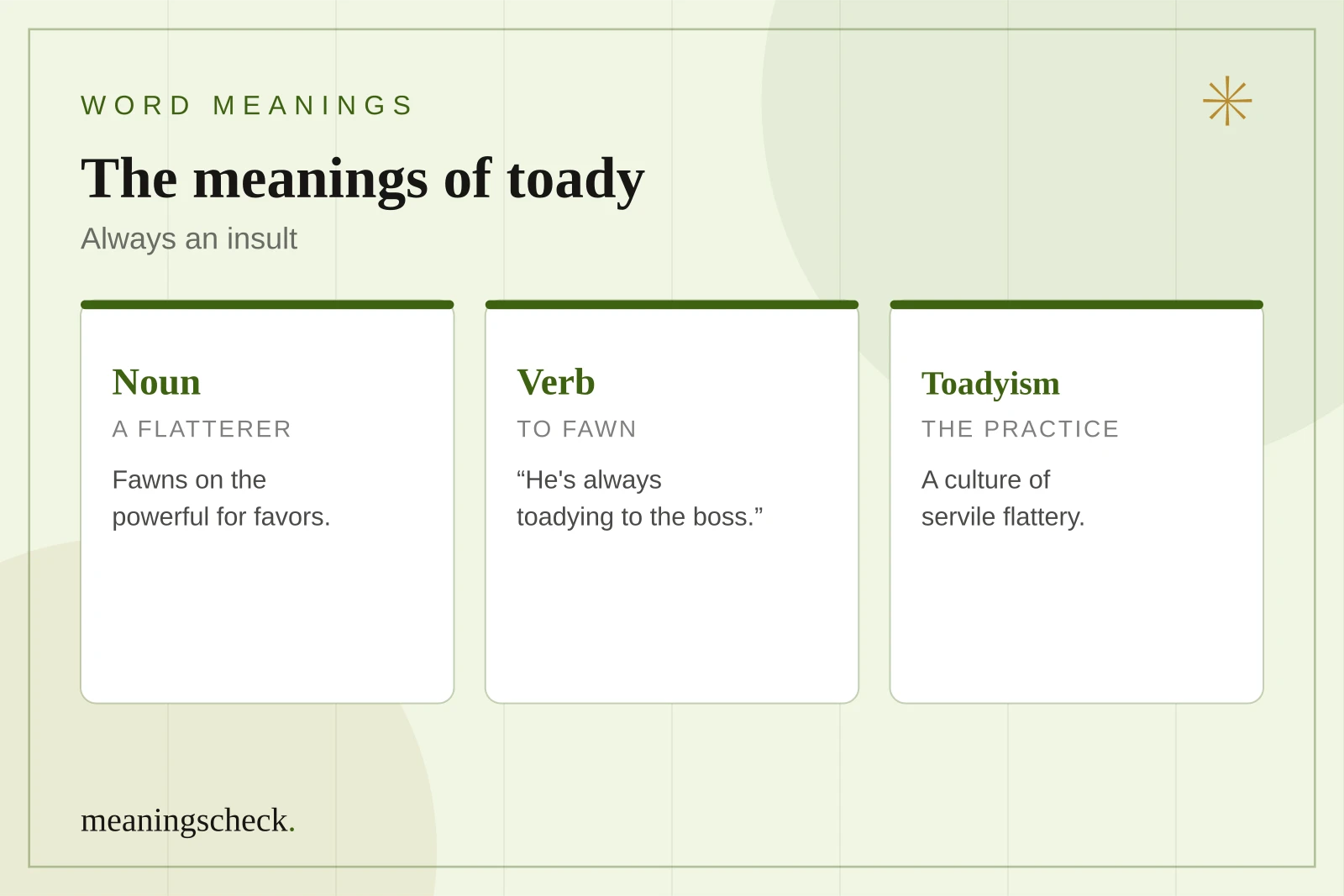
| Part of Speech | Meaning | Example |
|---|---|---|
| Noun | A servile flatterer | "She's a real toady to the boss." |
| Verb | To flatter and fawn | "He's always toadying to the boss." |
| Noun (related) | Toadyism: the practice | "The office was full of toadyism." |
How Do You Pronounce Toady?
The Short Answer: Toady is pronounced "TOH-dee," with the stress on the first syllable. It rhymes with "roadie" and "Cody." The first syllable sounds like "toe," not "tod."
| Syllable | Sounds Like |
|---|---|
| toa | "TOH" (like "toe") |
| dy | "dee" |
Plural and Verb Forms
| Form | Spelling | Example |
|---|---|---|
| Plural noun | toadies | "The senator was surrounded by toadies." |
| Verb, past | toadied | "She toadied to the director." |
| Verb, -ing | toadying | "Stop toadying to him." |
| Related noun | toadyism | "Toadyism spreads in rigid workplaces." |
Common Mistakes
- "TOD-ee" — the "oa" makes the long "o" sound, as in "toad."
- "toadys" — the plural is toadies, not "toadys."
Where Does the Word Toady Come From? The Toadeater Story
The Short Answer: Toady is short for "toadeater." In 16th and 17th-century Europe, a toadeater was a traveling quack doctor's assistant who ate, or pretended to eat, a toad believed to be poisonous. The quack then "cured" the assistant to show off his remedies. The assistant came to symbolize someone who'd do anything to please a boss.
The Quack and the Toad
Merriam-Webster explains that a toadeater "was originally the attendant of a mountebank peddling quack cures and antidotes." A mountebank was a traveling seller of fake medicines who put on shows to draw a crowd. The attendant "would eat or pretend to eat a toad, deemed poisonous, to allow the mountebank to show off skill in expelling the poison."
Toads were widely believed to be dangerous. The act made the quack look like a miracle worker. The assistant made the boss look good by suffering humiliation on command.
From Showman's Assistant to Flatterer
Over time, "toadeater" stopped meaning the assistant. It started meaning anyone who'd swallow insults or do degrading things to please a powerful person. Merriam-Webster's "Did you know?" note says: "By the early 1800s, it had been shortened and altered to toady," and "by the mid-1800s, toady was also being used as a verb."
The Date Puzzle
Dictionaries give slightly different dates:
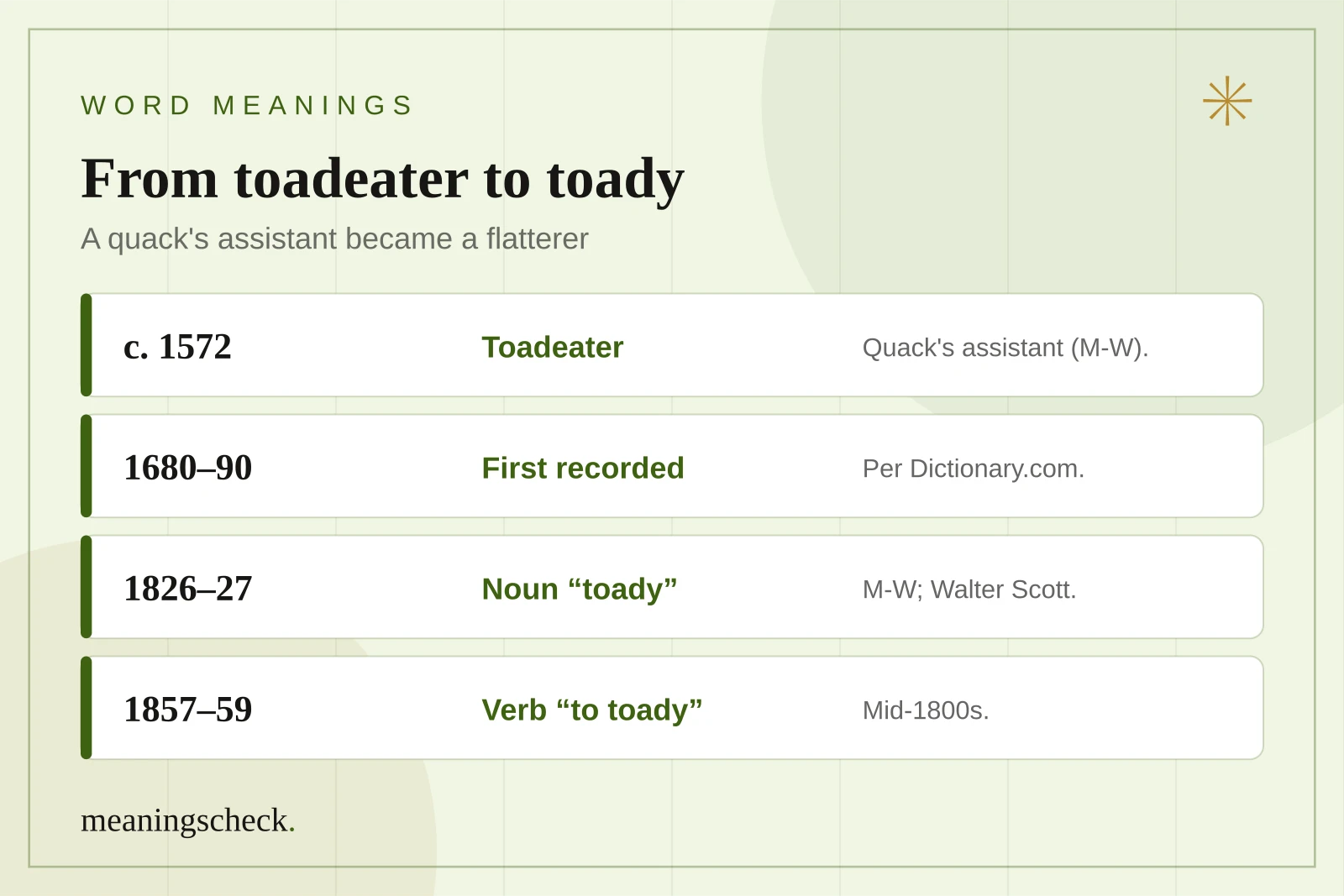
| Source | What It Says |
|---|---|
| Merriam-Webster | "Toadeater" first known use around 1572; noun "toady" in 1826; verb around 1859 |
| Wiktionary | Earliest quotation for the noun: 1827 (Walter Scott); verb: 1857 (Thomas Hughes) |
| Dictionary.com | "First recorded in 1680–90" |
That's why you'll see slightly different timelines online. The toadeater story is the best-known explanation. What's certain is that "toady" was in common English use by the early 19th century.
Timeline
| Period | Milestone |
|---|---|
| Around 1572 | "Toadeater" first used in English (Merriam-Webster) |
| 1680–1690 | Dictionary.com's "first recorded" date |
| 1826–1827 | Noun "toady" in use (Merriam-Webster; Walter Scott quotation) |
| 1857–1859 | Verb "to toady" appears |
| Today | Standard insult for a servile flatterer |
Key takeaway: A toady is a "toadeater" shortened — someone who'll swallow anything to please the boss.
Toady Examples in Sentences
The Short Answer: Toady usually describes flattery aimed upward: "She's a real toady to the boss," "He's always toadying to the director," or "The king was surrounded by toadies." It's almost always negative.
Workplace Examples
- "She's a real toady to the boss."
- "He's always toadying to the boss."
- "Nobody trusted the manager's toadies."
- "I won't toady to anyone for a promotion."
Politics and Public Life
- "The politician was surrounded by toadies who never disagreed."
- "Critics called the aide a toady for echoing every speech."
- "A free press shouldn't toady to power."
School and Social Life
- "The class hated the toady who agreed with every teacher."
- "Don't toady to the popular crowd just to fit in."
Literature and Style
- "The novel's villain keeps a circle of toadies."
- "The article described the star's entourage as toadies and yes-men."
- "His toadying was obvious to everyone but the boss."
| Pattern | Example |
|---|---|
| a toady to + person | "a toady to the CEO" |
| toady to + person | "toady to the manager" |
| surrounded by toadies | "a leader surrounded by toadies" |
| political toady | "a political toady" |
| act like a toady | "Don't act like a toady." |
| stop toadying | "Stop toadying already." |
Toady vs. Sycophant, Yes-Man, Lackey, and Brownnoser
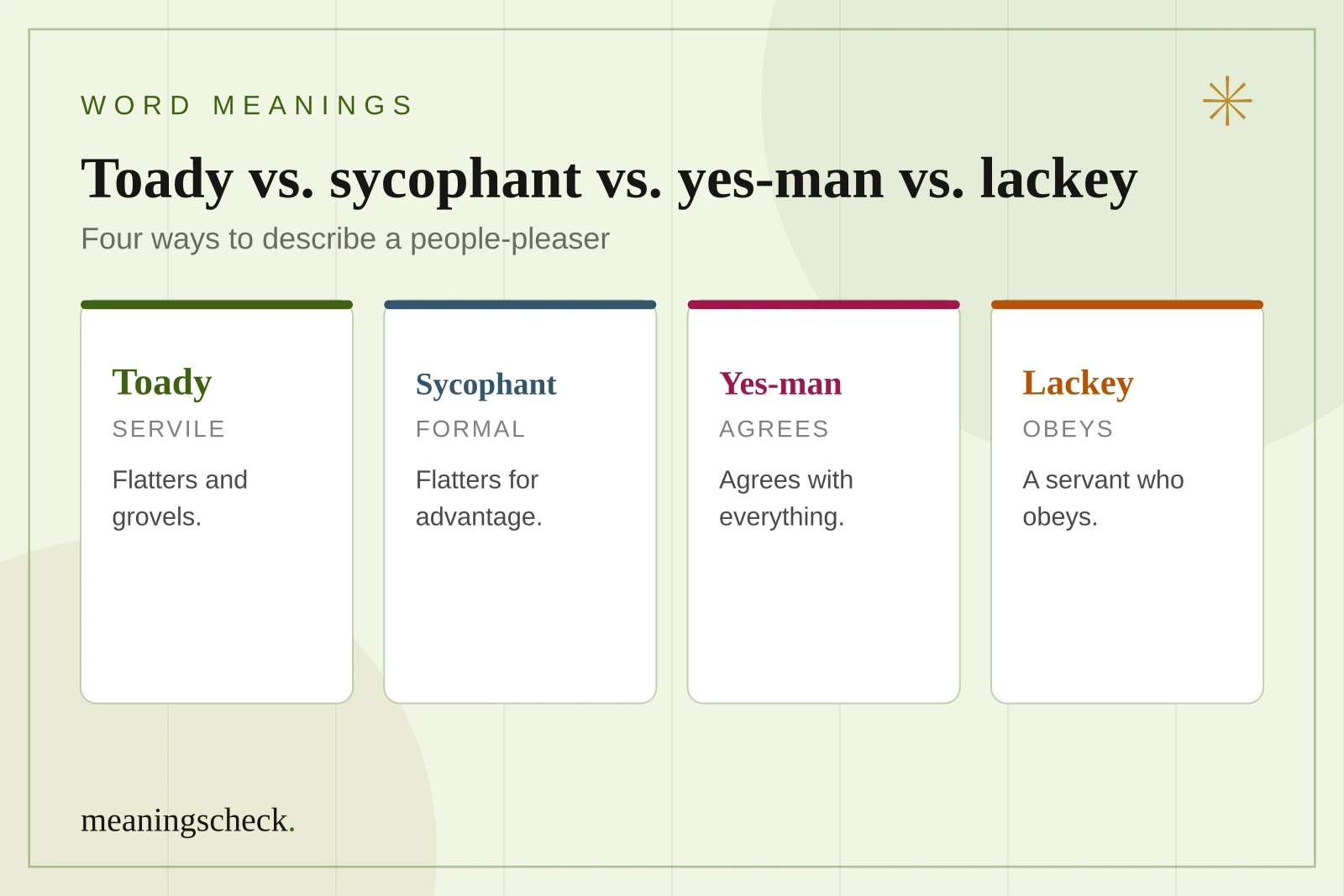
The Short Answer: All of these describe people who please the powerful for gain. Sycophant is the formal word. Yes-man stresses constant agreement. Lackey and flunky stress servile obedience. Brownnoser and suck-up are blunt slang. Toady stresses servility and snobbery together.
| Word | Core Idea | Tone | Example |
|---|---|---|---|
| Toady | Servile flatterer | Insulting | "The director's toady" |
| Sycophant | Flatterer for advantage | Formal insult | "A court full of sycophants" |
| Yes-man | Agrees with everything | Mildly insulting | "He's a yes-man" |
| Lackey | Servant who obeys | Insulting | "The mayor's lackey" |
| Flunky | Low-level follower | Insulting | "A corporate flunky" |
| Lickspittle | Extreme groveler | Harsh, old-fashioned | "A lickspittle to power" |
| Bootlicker | Fawning flatterer | Blunt | "Don't be a bootlicker" |
| Brownnoser | Sucks up for favors | Slang | "The office brownnoser" |
| Suck-up | Flatters for gain | Casual slang | "She's such a suck-up" |
| Minion | Subordinate follower | Mild to insulting | "The villain's minions" |
Merriam-Webster lists sycophant, lickspittle, bootlicker, minion, brownnoser, henchman, suck-up, and flunky as synonyms for the noun.
Toady vs. Sycophant
They're near-twins. Sycophant is more formal and common in writing. Toady feels a bit more colorful and a bit more contemptuous.
Toady vs. Yes-Man
A yes-man agrees with everything. A toady agrees and flatters and acts servile. Every toady is a yes-man. Not every yes-man is a toady.
Toady vs. Brownnoser
Brownnoser is slangier and more vulgar. Toady sounds more literary.
Toady Synonyms and Antonyms
The Short Answer: Noun synonyms include sycophant, lickspittle, bootlicker, minion, brownnoser, flunky, and suck-up. Verb synonyms include fawn, kowtow, curry favor, bootlick, and truckle. Antonyms include critic, independent thinker, maverick, and straight shooter.
Noun Synonyms
| Synonym | Best Used When |
|---|---|
| Sycophant | Formal writing |
| Lickspittle | Dramatic, old-fashioned insults |
| Bootlicker | Blunt, modern criticism |
| Brownnoser | Casual, rude slang |
| Suck-up | Casual speech |
| Flunky | A low-level underling |
| Minion | A follower of a powerful person |
| Henchman | A loyal enforcer, often villainous |
Verb Synonyms
Merriam-Webster lists these for the verb:
| Verb | Meaning |
|---|---|
| Fawn | Flatter in a servile way |
| Kowtow | Bow or act subserviently |
| Curry favor | Seek approval through flattery |
| Bootlick | Flatter servilely |
| Truckle | Submit in a servile way |
Antonyms
| Antonym | Meaning |
|---|---|
| Critic | Someone who judges honestly |
| Independent thinker | Forms their own views |
| Maverick | Unconventional, independent |
| Straight shooter | Honest and direct |
| Dissenter | Openly disagrees |
| Whistleblower | Exposes wrongdoing |
Toadyism: The Word Family
The Short Answer: The word family includes toady (noun and verb), toadies (plural and third-person verb), toadied, toadying, toadyism (the practice), and toadyish (resembling a toady). Dictionary.com also lists "untoadying."
| Word | Part of Speech | Example |
|---|---|---|
| Toady | Noun | "He's a toady." |
| Toadies | Plural noun / verb | "The boss's toadies cheered." |
| Toady | Verb | "Don't toady to him." |
| Toadied | Past tense | "She toadied to the CEO." |
| Toadying | Present participle / noun | "Toadying won't help." |
| Toadyism | Noun | "Toadyism ruins teams." |
| Toadyish | Adjective | "A toadyish smile" |
| Untoadying | Adjective | "An untoadying reply" |
Toadyism in Use
Toadyism describes the practice or culture of fawning: "Toadyism flourished at the court." It sounds formal and is common in essays and commentary.
Signs Someone Is Being a Toady
The Short Answer: Common signs include excessive praise, agreeing with everything, changing opinions to match the boss, criticizing peers to look good, and being very different around powerful people versus equals. One of these alone doesn't make a toady. A pattern does.
Behavior Patterns
- Over-the-top flattery. Praise that's far larger than the achievement.
- Constant agreement. They never push back.
- Opinion switching. Their view changes when the boss's changes.
- Two faces. Sweet to bosses, dismissive to juniors.
- Credit-seeking. They tie themselves to powerful people's wins.
- Running down rivals. They criticize peers to look better.
| Behavior | Toady or Healthy? |
|---|---|
| Praising a colleague's real achievement | Healthy |
| Praising the boss constantly to win favors | Toady |
| Agreeing because you actually agree | Healthy |
| Agreeing with everything to stay safe | Toady |
| Being polite to everyone | Healthy |
| Being polite only to people who can help you | Toady |
Not Everyone Who's Nice to the Boss Is a Toady
Respect, loyalty, and good manners aren't toadying. The difference is motive and honesty. A healthy colleague will disagree respectfully when needed. A toady won't.
Toadying at Work: How It Affects Teams
The Short Answer: Toadying can hurt teams by rewarding flattery over honest feedback. Leaders surrounded by toadies may miss problems and make worse decisions. Healthy teams reward candor and make it safe to disagree.
Problems Toadying Can Cause
- Hidden problems. People hide bad news from leaders.
- Weak decisions. Nobody challenges bad ideas.
- Resentment. Peers feel it's unfair when flatterers get ahead.
- Low trust. Teams stop believing praise.
- Fewer ideas. Honest thinkers stop speaking up.
What Leaders Can Do
- Ask for dissent. "What could go wrong here?"
- Reward honest feedback. Thank people who disagree respectfully.
- Watch for echo chambers. If everyone agrees, ask why.
- Judge results, not charm. Promote on performance.
- Invite quiet voices. Ask people directly for their view.
What Employees Can Do
- Give real praise, specific and earned.
- Disagree respectfully. Offer alternatives.
- Build relationships honestly. Be helpful without grovelling.
- Say what you mean. Honest talk is a sign of respect, a spirit our ICL meaning guide captures with "I can't lie."
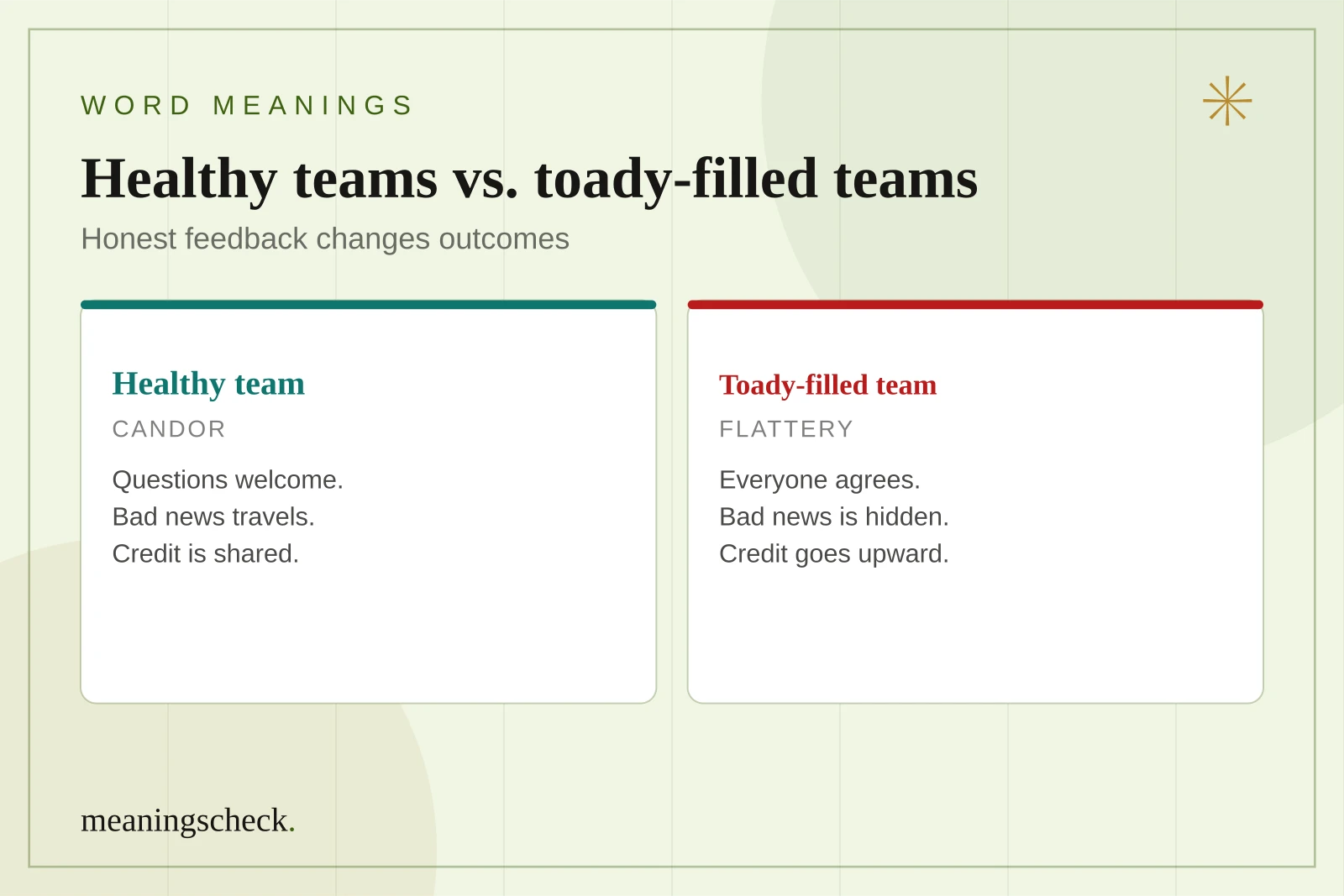
| Healthy Team | Toady-Filled Team |
|---|---|
| Questions are welcome | Questions are risky |
| Bad news travels fast | Bad news is hidden |
| Credit is shared | Credit goes upward |
| Feedback flows both ways | Feedback flows one way |
Flattery vs. Respect vs. Networking: Where Is the Line?
The Short Answer: Respect is honest appreciation. Networking is building real relationships. Toadying is flattery used as a tool for personal gain. The line is crossed when praise is insincere and tied to expecting favors in return.
| Behavior | Motive | Honest? | Example |
|---|---|---|---|
| Respect | Real admiration | Yes | "Your plan was well thought out." |
| Networking | Mutual benefit and connection | Yes | "I'd love to learn from your experience." |
| Politeness | Good manners | Yes | "Thanks for your time." |
| Toadying | Gain favor through flattery | No | "You're the smartest person alive." |
Questions to Ask Yourself
- Would I say this if the person had no power over me?
- Is the praise specific and true?
- Am I hoping for something in return?
- Would I disagree if I disagreed?
If your answers point toward honesty, you're on the right side of the line.
It isn't a strict either-or. Behavior sits on a spectrum, a point our Dichotomy meaning guide makes about many two-sided labels.
The Psychology of Ingratiation: Why Flattery Is Tempting
The Short Answer: Psychologists call using flattery to win favor "ingratiation." It works because people like being praised and tend to like those who agree with them. The risk is that overuse looks fake and damages trust.
What Researchers Call It
Social psychologists use the term ingratiation for tactics people use to make others like them. Edward E. Jones studied it in the 1960s. Typical tactics include:
- Flattery: praising someone's qualities.
- Opinion conformity: agreeing with their views.
- Favors: doing things for them to create goodwill.
- Self-presentation: showing yourself in the best light.
Why It Works (Sometimes)
People tend to like those who like them. Agreement feels comfortable. That's why mild flattery can open doors. But there's a limit: when praise looks obviously insincere or tied to a request, it backfires. People notice.
Where It Crosses Into Toadying
| Ingratiation Move | Fine in Moderation | Toadying When |
|---|---|---|
| Compliments | A sincere, specific compliment | Constant, exaggerated praise |
| Agreement | Agreeing because you do | Agreeing with everything |
| Favors | Helping a colleague | Doing favors only for powerful people |
| Presentation | Dressing well for an interview | Changing personality to please the boss |
How to Give Honest Praise Without Toadying
The Short Answer: Honest praise is specific, true, and not tied to a request. Name the exact thing you appreciated and why. Skip exaggeration. If you disagree on something else, say so respectfully.
The Recipe
- Be specific. "The way you structured the slides made it easy to follow."
- Be true. Praise only what you actually appreciate.
- Keep it proportionate. A good job isn't "the best work in history."
- Don't pair it with a request in the same breath.
- Praise everyone fairly, not only people with power.
Before and After
| Toady-Style | Honest Praise |
|---|---|
| "You're a genius! Everything you say is perfect." | "Your point about timelines changed how I see the plan." |
| "I'd follow you anywhere, boss." | "Thanks for backing me on that. It helped." |
| "That joke was the funniest thing I've ever heard." | "That one made me laugh." |
| "I agree with you 100%, always." | "I agree with the first part. I'd tweak the second." |
Honest praise is more credible because it comes from someone who also tells the truth when it's uncomfortable.
Idioms for Toadying: Curry Favor, Butter Up, and Kiss Up
The Short Answer: English has many idioms for the same behavior: "curry favor," "butter up," "kiss up to," "apple-polish," "kowtow," and "bow and scrape." They all describe flattering someone to gain advantage.
| Idiom | Meaning | Example |
|---|---|---|
| Curry favor | Seek approval through flattery | "He tried to curry favor with the board." |
| Butter up | Flatter someone before asking for something | "She buttered up her boss before asking for a raise." |
| Kiss up to | Flatter servilely | "Don't kiss up to the manager." |
| Apple-polish | Flatter a teacher or boss | "He apple-polished his way to the front." |
| Kowtow | Act with excessive deference | "They kowtowed to the investors." |
| Bow and scrape | Act in a servile way | "He bowed and scraped before the duke." |
| Fawn over | Show excessive affection or praise | "They fawned over the celebrity." |
Merriam-Webster lists curry favor and kowtow among its verb synonyms. Dictionary.com lists apple polisher as a noun synonym for toady.
A Fun Fact About "Curry Favor"
"Curry" in this phrase has nothing to do with food. The phrase traces back to an old expression about grooming a horse — a different kind of attentive fussing. It has a long history in English as a way to describe seeking approval.
Toady in History, Politics, and Literature
The Short Answer: Writers have used toady for centuries to criticize flatterers who surround powerful people. Wiktionary's earliest noun quotation is from Walter Scott in 1827. Today, commentators use it for aides and advisers accused of echoing a leader.
Courts and Kings
Power attracts flatterers. Royal courts, councils, and governments have always had people who gain by pleasing the powerful. The toady is a stock character in stories for that reason.
Early Literary Use
Wiktionary records an early noun quotation from Walter Scott (1827) and an early verb quotation from Thomas Hughes (1857). Writers found the word useful for mocking servility.
Modern Commentary
In politics and public life, commentators use "toady" for people accused of echoing a leader without independent judgment. It's a strong insult. Reporters usually attribute it to a critic instead of stating it as fact.
| Setting | How "Toady" Is Used |
|---|---|
| Fiction | A stock character beside a powerful figure |
| History writing | Court flatterers |
| Politics | Criticism of uncritical aides |
| Business | Employees who flatter for advancement |
Other Meanings of Toady
The Short Answer: Toady also has rarer meanings. Wiktionary lists an archaic sense for "a coarse, rustic woman," an adjective sense meaning "toadlike," and a childish use as a diminutive of "toad." These are uncommon today.
Rare and Old Senses
| Sense | Meaning | Status |
|---|---|---|
| Servile flatterer | Main modern meaning | Common |
| To flatter servilely | Verb meaning | Common |
| "Toadlike" | Adjective (from toad + -y) | Rare |
| A small toad | Childish diminutive | Rare |
| A coarse, rustic woman | Archaic sense | Archaic, offensive |
Don't Confuse It With "Toad" or "Tody"
- Toad is the animal.
- Tody (with no "a") is a small tropical bird in the Caribbean.
- Toady is the flatterer.
How to Use Toady Correctly
The Short Answer: Use toady as a noun or verb to criticize servile flattery. Because it's insulting, use it carefully in formal writing and never about a specific person without a reason you can stand behind. For milder situations, "flatter" or "agree too eagerly" works.
Do
- "He was known as the senator's toady."
- "She refused to toady to the board."
Don't
- Use it as a compliment. It's always negative.
- Confuse it with "toad."
- Write "toadys." The plural is toadies.
Tone Tips
| Situation | Better Choice |
|---|---|
| Formal report | "Sycophantic behavior" |
| Describing a coworker | "Overly eager to please" |
| Fiction or commentary | "Toady" |
| Direct insult | Consider whether it's worth it |
Toady in Everyday Conversation
The Short Answer: You'll hear toady in office gossip, news commentary, book reviews, and family jokes. People often use it with a wry tone: "Don't be such a toady."
These are typical patterns, not quotes from real people.
Office Chat
Employee: "Did you see how Dan agreed with everything the director said?"
Coworker: "Total toady."
What it means: Dan flattered the director to gain favor.
A Book Review
Reviewer: "The hero's toadies are more entertaining than the hero."
What it means: The followers who flatter him are lively characters.
A Family Joke
Teen: "I'm not a toady. I just like the teacher."
Parent: "Sure, sure."
What it means: A playful tease about a student who gets along with a teacher.
| Setting | Toady Signals |
|---|---|
| Office | Criticism of a flatterer |
| Reviews | A stock character in a story |
| Family | Playful tease |
| News | Sharp political criticism |
Expert Insights: Why Toadying Exists
The Short Answer: Flattery works because people like being praised, and powerful people control resources. That makes flattering them tempting. The cost is honesty. Understanding why toadying happens helps leaders and employees avoid it.
Power Attracts Flattery
When someone controls promotions, pay, or access, people feel pressure to please them. Flattery feels like a safe shortcut.
Praise Feels Good
Humans enjoy approval. A leader who rewards flatterers, even by accident, teaches everyone to flatter.
Fear Plays a Role
Sometimes toadying comes from fear, not ambition. People who worry about punishment learn to agree first and think later.
Honest Cultures Beat Flattering Ones
Teams that reward candor tend to catch problems earlier. Leaders who ask for disagreement, and mean it, make flattery less useful.
The Language of Flattery Is Everywhere
Flattery shows up as a constant background hum in many workplaces and feeds — nearly ubiquitous, a word our Ubiquitous meaning guide explains. Online, people spot it fast and call it out, often with a blunt "be for real," as our BFFR meaning guide explains.
Real-World Patterns
- Offices: "She never disagrees with the VP."
- Politics: "He echoes every talking point."
- School: "The teacher's pet."
- Online: "Glazing" is newer slang for excessive praise.
Modern Slang Cousins of Toady
The Short Answer: Modern slang for toady behavior includes brownnoser, suck-up, bootlicker, and "glazing" (excessive praise). Online, people also say "peak cringe" for over-the-top fawning. They're casual cousins of an old word.
| Slang | Meaning |
|---|---|
| Brownnoser | Sucks up to the boss |
| Suck-up | Flatters for favors |
| Bootlicker | Servile, fawning person |
| Glazing | Over-the-top praise (modern slang) |
| Teacher's pet | A student who favors the teacher |
| Yes-man | Agrees with everything |
Fawning can also look embarrassing in public. When a person gushes over a famous figure, commenters might call it "peak cringe," a phrase our Peak meaning guide explains.
How to Handle a Toady
The Short Answer: Stay polite, don't take the bait, reward honesty, and judge people by their work. If you're a leader, encourage disagreement. If you work with a toady, stay focused on facts and keep your own credibility.
If You're the Boss
- Ask for opinions before you share yours.
- Notice who always agrees. Ask for the opposite view.
- Reward truth-telling, even when it's uncomfortable.
If You're a Coworker
- Don't compete in flattery. Do good work.
- Keep records of your contributions.
- Stay respectful. Avoid gossip.
If You Catch Yourself Toadying
- Pause and ask why. Are you afraid?
- Replace flattery with specific, honest praise.
- Practice respectful disagreement.
| Role | Best Response |
|---|---|
| Leader | Invite dissent |
| Peer | Focus on your own results |
| Self | Be honest and specific |
How to Explain Toady to a Kid
The Short Answer: Say: "A toady is someone who says nice things they don't mean, just to get something from a powerful person. Like a kid who flatters the teacher only to get a better grade."
- "A toady is someone who flatters just to get favors."
- "They agree with everything the boss says."
- "It's not kind — it's sneaky."
- "The word comes from toad eaters, long ago."
Quick Quiz: Toady or Not?
The Short Answer: Decide whether each behavior fits a toady (insincere, self-serving flattery) or healthy respect.
| Behavior | Toady or Not? |
|---|---|
| Praises the boss's every idea, even bad ones | Toady |
| Gives specific, honest praise and sometimes disagrees | Not a toady |
| Laughs at all the boss's jokes to get promoted | Toady |
| Thanks a mentor sincerely | Not a toady |
| Criticizes coworkers to look better to the boss | Toady |
| Respectfully disagrees in a meeting | Not a toady |
If you got every one right, you can spot a toady and avoid becoming one.
Common Mistakes With Toady
The Short Answer: The biggest mistakes are using it as a compliment, mispronouncing it, spelling the plural "toadys," confusing it with "toad," and applying it to anyone who's simply polite.
- Using it as praise. It's always an insult.
- Saying "TOD-ee." It's "TOH-dee."
- Writing "toadys." It's "toadies."
- Calling polite people toadies. Toadying needs insincere flattery.
- Overusing it. It's a strong word.
Frequently Asked Questions (FAQs)
What does toady mean?
A toady is a person who flatters and fawns over someone powerful in hopes of gaining favors. As a verb, it means to behave that way.
Is toady an insult?
Yes. It suggests servility and insincerity.
Where does the word toady come from?
It's short for "toadeater," a quack's assistant who ate or pretended to eat a toad. Merriam-Webster says it was shortened to "toady" by the early 1800s.
What is the difference between a toady and a sycophant?
They're nearly the same. Sycophant is more formal. Toady is more colorful and contemptuous.
How do you pronounce toady?
It's pronounced "TOH-dee."
What is the plural of toady?
The plural is toadies.
Can toady be a verb?
Yes. "To toady" means to flatter servilely, as in "He's always toadying to the boss."
What is toadyism?
It's the practice of fawning and flattering for personal gain.
What is the opposite of a toady?
A critic, an independent thinker, or a straight shooter.
Final Thoughts
Toady is a wonderfully odd word with a wonderfully odd history: a quack's assistant swallowing toads on a street corner to make his boss look good. That image still fits. A toady will swallow almost anything to please someone with power.
Next time you're tempted to offer a compliment you don't mean, remember the toad. Honest praise and honest disagreement are worth far more.
For more words explained in plain language, explore our word meanings guides. And if you enjoy words with colorful origins, our Bespoke meaning guide has a good one too.
Related terms
Share: · Post on X
Written by MeaningsCheck Team · Published
The MeaningsCheck team researches and writes plain-language explanations of slang, abbreviations, and everyday words — checked for accuracy, updated as language changes.